Vinyl Cleaner vs Leather Cleaner: Which One to Use
Use vinyl cleaner on true vinyl and most leatherette or coated faux-leather trim, but avoid it on real leather unless the label says leather-safe; for real leather, pick a dedicated leather cleaner. Wrong chemistry dries leather, dulls vinyl, and can strip trim coatings. I’ve seen that in shop interiors and in my own cleanup work. This guide tells you which surfaces can take each cleaner, where the swap is safe, and where it is a mistake.
Vinyl cleaner vs leather cleaner: the short answer


The surface decides, not the seat name. Vinyl cleaner is generally suited to PVC, vinyl, leatherette, dashboards, door panels, and similar synthetic trim; leather cleaner is generally better suited to finished automotive leather, where the material still benefits from gentle care. A bad match often shows up as haze, tackiness, streaks, or a finish that no longer matches the rest of the cabin.
| Decision factor | Vinyl Cleaner | Leather Cleaner | Winner |
|---|---|---|---|
| Best material match | PVC, vinyl, leatherette, faux leather, dashboards, door panels | Finished automotive leather and leather-coated seats | tie |
| Finish control | Can leave gloss or residue if overapplied or not fully wiped | Usually milder; less likely to alter a leather finish when used correctly | Leather Cleaner |
| Risk on the wrong surface | Can dry or haze coated leather and create color transfer on old dye | Can leave slick residue or shine mismatch on vinyl and soft-touch plastics | Leather Cleaner |
| Aftercare need | No conditioner needed on vinyl or leatherette | Often paired with conditioner after cleaning finished leather | Vinyl Cleaner |
| General forgiveness | More forgiving on synthetic trim when the label matches the material | Better for hides, but still needs a hidden spot test | tie |
Best material match
Vinyl cleaner is made for synthetic surfaces that show up in cars every day: PVC seats, faux leather, seat trim, dash tops, and door inserts. Leather cleaner is made for finished hide, where the topcoat and the leather underneath should stay intact. That split matters because many modern interiors mix both materials in one seat.
Finish control
Vinyl products are often aimed at heavier surface grime and transfer, which helps on steering wheels and bolsters. The trade-off is visible residue if the formula is too glossy or if the surface is not wiped dry. Leather cleaner is usually milder, so it is less likely to leave the seat looking patchy or over-shined when used on actual leather.
Risk on the wrong surface
A leather cleaner on vinyl can be fine on some pieces and a bad idea on others, especially if it leaves a slick film on a steering wheel or glossy rings on a matte dash. A vinyl cleaner on finished leather can create the opposite problem: dulling, drying, or light haze where the finish used to look even. Older dye and worn topcoats raise the risk of transfer.
Aftercare need
Leather cleaner and conditioner usually serve separate jobs. Cleaner removes soil; conditioner goes on afterward when the leather needs replenishment or a softer hand. Vinyl usually does not need conditioner, and adding one to synthetic trim can leave the surface feeling greasy or slippery.
What each cleaner is designed to do
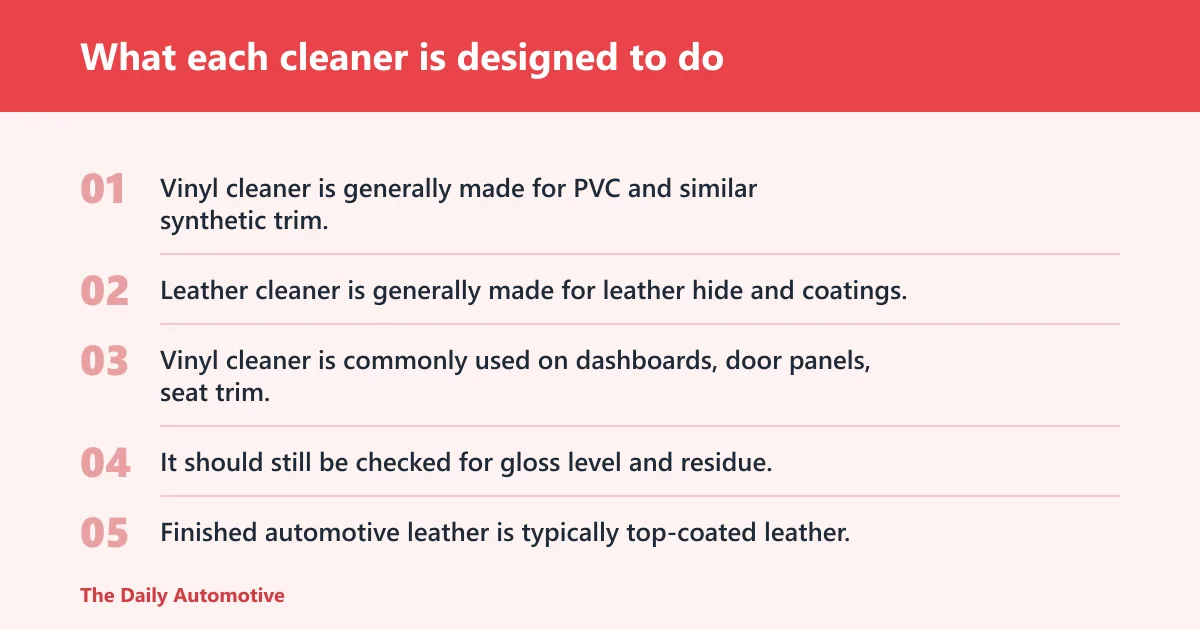
Vinyl cleaner is generally made for PVC and similar synthetic trim, so it usually focuses on soil, body oils, and transfer on surfaces that clean more easily. Leather cleaner is generally made for leather hide and coatings, and it is usually kept mild so it is less likely to strip conditioners or finishes from finished automotive leather.
Vinyl cleaner on PVC, vinyl, and leatherette
Vinyl cleaner is commonly used on dashboards, door panels, seat trim, and other synthetic surfaces that can take a stronger wipe-down than leather. It should still be checked for gloss level and residue, because a product that leaves a shiny film may look wrong on a matte cabin. I still test a hidden spot first.
Leather cleaner on finished automotive leather
Finished automotive leather is typically top-coated leather, and it can sometimes be mistaken for vinyl or leatherette. It usually takes a dedicated leather cleaner better than harsh all-purpose products because the cleaner is meant to respect the coating. In many cases, conditioner follows only if the leather needs it.
How pH and residue differ between the two
pH level matters because a mild or balanced formula is less likely to dry the surface or leave it blotchy. Vinyl cleaner can be more aggressive on grime, but that does not make it better for leather. Residue is the other big check: shine, tackiness, and streaking are warning signs that the product does not match the surface.
Can I use vinyl cleaner on leather car seats?
Sometimes, but only on surfaces that are actually vinyl, leatherette, or coated faux leather, and only after a hidden spot test. On real finished leather, vinyl cleaner is a risk unless the product label specifically says it is leather-safe; otherwise it can dull the finish, dry the hide, or leave a haze.
Finished leather versus leather-look surfaces
Modern seats can often be misread at a glance. Finished leather feels different from vinyl or leatherette, but both may have a top layer that looks similar from the driver’s seat. If the material is real leather, use a leather cleaner first; if it is synthetic, vinyl cleaner is usually the better fit.
When vinyl cleaner is acceptable
Vinyl cleaner can be acceptable on coated leather-look surfaces when the label matches the material and the test patch stays even. That means no color lift, no sticky feel, and no matte-to-gloss change after dry-down. It is a material match question, not a brand or seat-name question.
When to stop
Stop if the cleaned area looks hazy, feels tacky, or turns shinier than the surrounding trim. Those are signs the chemistry is too strong, too slick, or not wiped clean enough. On leather, those warning signs can come with drying or color transfer, which usually means switching to a dedicated leather cleaner.
Will leather cleaner damage vinyl interiors?
Usually it will not destroy vinyl, but it may leave the wrong finish on dashboards, door panels, and seat trim if the formula is aimed at hide rather than synthetic trim. The common failure is residue: a slick feel, streaking, or a slight sheen change that stands out in daylight.
Dashboards, door panels, and seat trim
These parts are often vinyl, soft-touch plastic, or leatherette rather than leather. A leather cleaner may clean them gently, but it is not always the best match because the product can leave the wrong sheen or a film that collects dust. Vinyl cleaner is usually the better fit for those pieces.
What happens with shine and streaking
If a product leaves the dash glossier than the rest of the cabin, the mismatch is obvious. Streaking is common when too much liquid sits on textured grain or around buttons and stitching. That is why wipe-off quality matters as much as cleaning strength.
When leather cleaner is a poor match
Leather cleaner is a poor match when the surface is a touch point that should stay grippy, such as a steering wheel rim or a bolstered vinyl seat. A slick residue there is more than cosmetic; it changes how the part feels in use. If the part is synthetic, a vinyl-safe interior cleaner is usually the cleaner choice.
Which cleaner is safe for faux leather or vinyl seats?

For faux leather or vinyl seats, vinyl cleaner is usually the safer default because those materials are synthetic and often easier to clean than real leather. Leather cleaner can still work on some coated surfaces, but the cleaner should be chosen by the material, not by the seat description on the window sticker or sales sheet.
Why leatherette is not the same as hide
Leatherette, faux leather, and vinyl can look close to genuine leather, but they react differently to cleaners and conditioners. A product made for hide may not sink in or wipe off the same way on a synthetic topcoat. That difference is why finish changes happen after what looked like a harmless cleaning step.
How to read texture and label clues
Uniform grain, seam patterns, and a plasticky backing feel often point toward vinyl or leatherette. If the label says leatherette, synthetic leather, or vinyl, treat it as a synthetic surface and choose a surface-safe cleaner. If the label says leather, assume real hide until the manufacturer says otherwise.
Choosing a cleaner for mixed synthetic seating
Mixed synthetic seating often includes a leather-look center panel and harder vinyl on the sides or rear. In that case, a vinyl cleaner is often the better single-product choice, provided the test patch stays even and the finish does not turn glossy. The steering wheel and touch points deserve the same caution.
Material-to-cleaner decision table for five real cases
This table is built for the situations that cause the most confusion in daily use. Match the material first, then check the finish and the hidden spot test before moving across the whole seat or panel.
| Real-world scenario | Safe product choice | Risk level | Hidden spot-test notes |
|---|---|---|---|
| Finished leather | Leather cleaner; conditioner afterward if needed | Medium if wrong cleaner is used | Test on the back edge or underside for haze, drying, and dye transfer |
| Coated leather | Leather cleaner first; vinyl cleaner only if the maker says it is safe | Medium | Check for finish change, shine mismatch, and residue on a low-visibility section |
| Vinyl or leatherette | Vinyl cleaner | Low if wiped properly | Test for gloss shift and tackiness, especially on matte trim |
| Perforated seats | Leather cleaner for leather; mild surface-safe cleaner for synthetic perforated trim | Medium to high if soaked | Use very little liquid and check holes, stitching, and seams for residue |
| Mixed-trim cabins | Use the material-specific cleaner for each surface; one product only if every surface accepts it | Medium | Test each material separately, since dash, seat, and bolster may react differently |
Choose vinyl cleaner if… / Choose leather cleaner if…
Choose vinyl cleaner when the surface is true vinyl, leatherette, faux leather, or another synthetic trim that needs a stronger wipe for transfer and daily grime. Choose leather cleaner when the seat is finished automotive leather, especially if you want a mild formula that will not strip the topcoat or leave the hide dry.
Choose vinyl cleaner if…
- The seat, dash, or panel is vinyl, PVC, leatherette, or faux leather.
- You are cleaning door panels, dashboards, or seat trim that need a synthetic-safe product.
- The surface is easy to clean but shows body oils, transfer, or steering-wheel grime.
- You have checked the finish and the product wipes off without shine, tack, or streaks.
Choose leather cleaner if…
- The seat is finished automotive leather, not synthetic leather-look trim.
- You want a mild or pH-balanced formula that is less likely to dry the hide.
- You plan to clean the surface and then use conditioner if the leather needs it.
- You are working on seats, bolsters, or touch points where finish control matters.
When neither is ideal
If the label and the surface do not line up, a milder interior cleaner made for the exact material is the better answer. That is especially true for mixed cabins, old cracked vinyl, or leather with a worn topcoat. Wrong chemistry often leaves the damage visible long after the cleaning towel is put away.
How do I test a cleaner on car upholstery before using it?
Test the cleaner on a hidden area first, then wait for the surface to dry before judging the result. The goal is to catch haze, finish change, color transfer, or tackiness before the product touches the whole seat or panel. That one step prevents most avoidable damage.
Hidden spot test steps
- Pick a low-visibility area, such as the underside of a seat, a rear edge, or a lower panel.
- Apply a small amount of cleaner to a microfiber towel, not directly into seams.
- Wipe a small patch once, then dry it with a clean towel.
- Check for shine change, dulling, streaks, softness, tackiness, or dye on the towel.
- If the patch looks normal after drying, proceed slowly on the rest of the surface.
What failure looks like
Failure is not always immediate. Haze can appear after the area dries, tackiness can show up when your hand touches the seat, and dye transfer can show up on the cloth instead of the upholstery. On older materials, those signs mean the product is too aggressive or the finish is already worn.
What should I use for perforated leather seats?
Use the cleaner that matches the actual material, then use very little liquid. For perforated leather, that usually means a dedicated leather cleaner and careful wipe-off, because excess fluid can settle in the holes and seams. For perforated synthetic trim, use a material-safe vinyl cleaner only if the finish accepts it.
Why perforations need extra care
Perforations can trap liquid and residue. That can lead to spotting, uneven sheen, or a sticky feel around the holes. A light application on the towel is safer than spraying the seat directly.
What to avoid
Avoid soaking the seat, scrubbing hard, or flooding stitching. Those habits can push cleaner where it does not belong and make the finish look blotchy once it dries. If the seat is perforated leather, the safer path is usually a mild leather cleaner with quick wipe-off.
Is an all-purpose interior cleaner safe on leather or vinyl?
Only when the label and the material both call for it. Some all-purpose interior cleaners are fine on vinyl, leatherette, and certain finished leather surfaces, but they are not a default choice. A product that is too strong can leave residue, gloss mismatch, or drying on the wrong material.
Where an all-purpose cleaner can fit
It can fit in mixed-trim cabins when the manufacturer lists both surfaces as approved. That makes it useful for quick work on dashboards, door panels, and synthetic seat trim. Even then, the hidden spot test still comes first.
Where it does not belong
It does not belong on leather just because it is convenient, and it does not belong on vinyl if it leaves a slippery film. Convenience is not a material spec. The cleaner should match the surface, the finish, and the amount of residue you are willing to leave behind.
Frequently asked questions
Can I use vinyl cleaner on leather car seats?
Only if the seat is actually vinyl, leatherette, or another coated synthetic surface, or if the product label explicitly says leather-safe. On finished leather, vinyl cleaner can cause dulling, haze, or drying. A hidden spot test is the first step before any full-seat cleaning.
What is the difference between vinyl cleaner and leather cleaner?
Vinyl cleaner is made for PVC and other synthetic trim, where it often handles grime and transfer more aggressively. Leather cleaner is made for leather hide and coatings, usually with a milder or pH-balanced formula. The main difference is material match and finish control, not just cleaning power.
Which cleaner is safe for faux leather or vinyl seats?
Vinyl cleaner is usually the better choice for faux leather and vinyl seats because those surfaces are synthetic. Leather cleaner may work on some coated surfaces, but it is not the default. Check the label, test a hidden area, and look for finish change before cleaning the whole seat.
Will a leather cleaner damage vinyl interiors?
It usually will not ruin vinyl, but it can leave the wrong feel or sheen on dashboards, door panels, and seat trim. The common problems are streaking, slick residue, and a finish that no longer matches nearby surfaces. That is why vinyl cleaner is usually the better fit for synthetic trim.
Do I need different products for dashboards and seats?
Often yes, because dashboards and seat surfaces are frequently made from different materials. A dash may be vinyl or soft-touch plastic, while the seats may be finished leather or leatherette. Matching the cleaner to each material is safer than using one bottle everywhere.
How do I test a cleaner on car upholstery before using it?
Use a hidden spot, a small amount on a microfiber towel, and a full dry-down before judging the result. Look for haze, tackiness, color transfer, and any gloss shift. If the patch looks different from the surrounding material, stop and switch products.
Products related to this article
Sponsored / affiliate links. As an Amazon Associate I earn from qualifying purchases. I may earn additional commission from eligible campaigns.