Tow Notice vs Boot Notice
A tow notice means your vehicle is scheduled for removal; a boot notice means it is or soon will be immobilized, so the key difference is whether the car is being hauled away or locked in place. Ignoring either can add storage fees, towing charges, and delays that grow fast. This guide explains how to tell the two apart, what stage each notice signals, what to photograph, and what to do next.
| Trigger | Who issues it | Likely next step | Urgency | Documents to request | Common invalidation points |
|---|---|---|---|---|---|
| Tow Notice | Property manager, HOA board member, towing company, or law enforcement contact tied to the vehicle | Removal and storage, or a pending tow after a notice window | High if the vehicle is already marked for removal | Tow authorization, citation, signage photos, invoice, any mailed or windshield notice, law-enforcement contact record if used | No valid authority, missing or unclear signs, wrong plate or vehicle, missing timestamp, no photo record, no citation where required |
| Boot Notice | Property manager, HOA board member, or immobilization contractor where local law allows it | Wheel clamp or other immobilization, then release steps before any tow | Immediate if the vehicle is creating a hazard or blocking access | Boot notice, immobilization authorization, signage photos, release fee sheet, any photo of the device placement | No authority for immobilization, bad sign placement, mistaken vehicle ID, no proof of who ordered the boot, unsafe or unlawful location |
Tow notice vs boot notice
The operational difference is simple: a tow notice points toward removal, while a boot notice points toward immobilization. That difference matters because the first warning usually leads to a tow truck, storage bill, and possible police notification; the second usually means the vehicle stays put until release steps are completed.
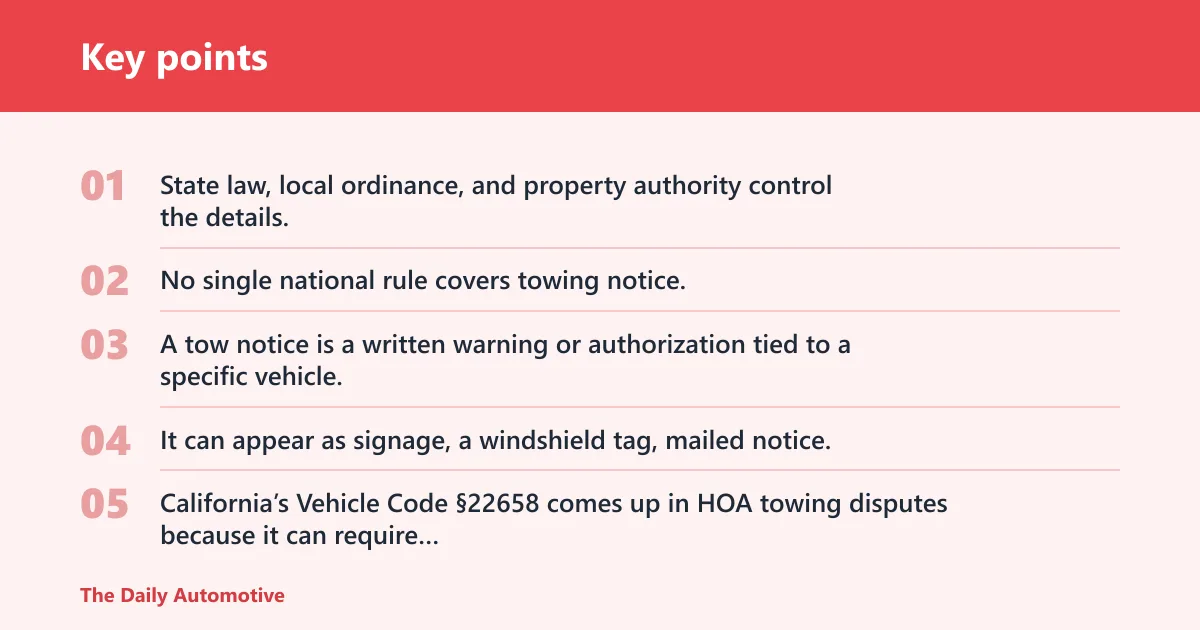
State law, local ordinance, and property authority control the details. No single national rule covers towing notice, and an HOA cannot rely on a generic rule if it lacks authority in recorded CC&Rs, adopted rules, or control of the lot or common area.
Tow notice
A tow notice is a written warning or authorization tied to a specific vehicle. It can appear as signage, a windshield tag, mailed notice, or contact involving law enforcement, and it usually points to removal rather than immobilization.
California’s Vehicle Code §22658 comes up in HOA towing disputes because it can require several days before towing for certain violations. Florida is different: Florida Statute 715.07 relies on specific posted signage and ongoing notice instead of a fixed notice period.
Boot notice
A boot notice is a warning tied to immobilization enforcement. It usually appears before or alongside a wheel clamp or similar device, and in some urgent cases the immobilization can be immediate.
Immediate action can happen for a vehicle blocking a fire lane, blocking a driveway, or creating an abandoned-vehicle safety hazard. Private booting is more restricted in many places than towing, so the sign, the property type, and the local rule matter a great deal.
Tow notice decision table
Use this table to sort the paper or tag in front of you into the right enforcement stage. It separates warning, immobilization, and removal so you can decide whether you are dealing with a pre-tow notice, a boot situation, or an active removal process.
| Notice type | Trigger | Who issues it | Likely next step | Urgency | Documents to request | Common invalidation points |
|---|---|---|---|---|---|---|
| Tow Notice | Parking violation that is being treated as towable under state law, local ordinance, or property rules | HOA, property manager, towing company, or law-enforcement contact tied to the vehicle | Vehicle removal or storage | Act at once if the notice says tow is pending | Written tow authorization, citation, timestamps, photos, signage, invoice, law-enforcement notification record | No statutory or property authority, missing sign, wrong vehicle, no timestamped photos, unclear ground for removal |
| Boot Notice | Immobilization enforcement for an access, payment, or parking-rule issue | HOA, property manager, or immobilization contractor where allowed | Wheel clamp or similar device, then release steps | Act at once if the car is already immobilized | Boot authorization, photos of the boot and placement, sign photos, release instructions, fee sheet | No authority for booting, weak sign placement, wrong plate or space, no record of who ordered it |
| Immediate Tow Exception | Fire lane obstruction, driveway obstruction, assigned or numbered space blocking, or abandoned-vehicle safety hazard | Usually property authority acting under local law and towing procedures | Immediate tow or rapid removal | Highest | Tow authorization, photos showing the obstruction, any citation, police contact record if required | Bad identification of the space or hazard, no proof of obstruction, no lawful authority, missing police notice where required |
Why the table separates stages
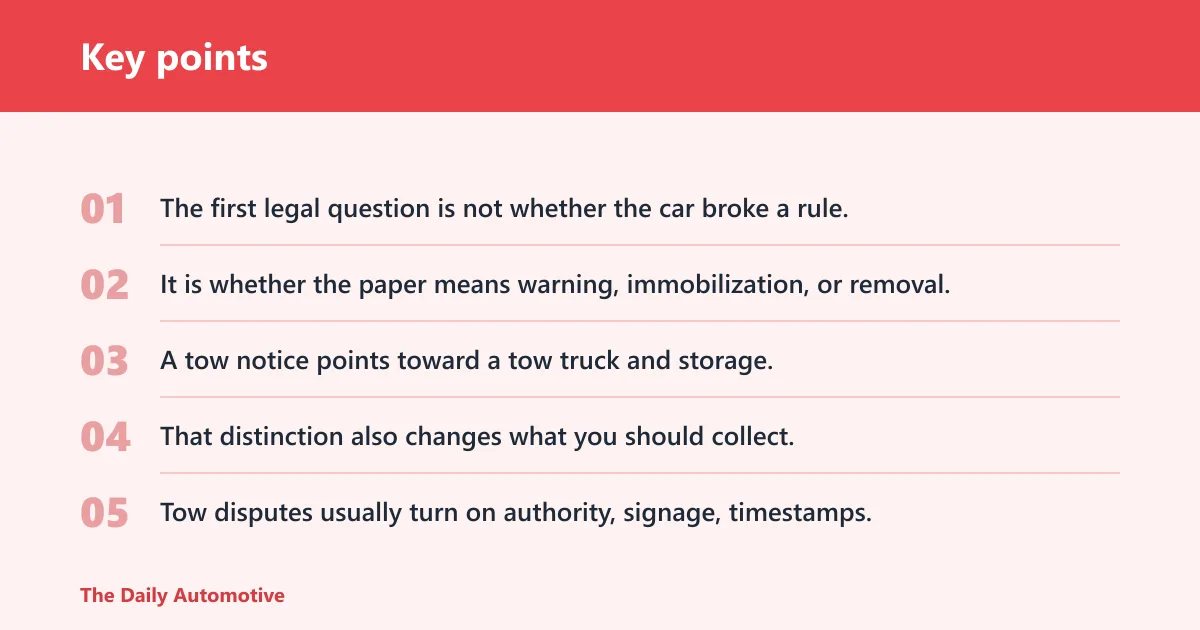
The first legal question is not whether the car broke a rule. It is whether the paper means warning, immobilization, or removal. A tow notice points toward a tow truck and storage, while a boot notice points toward a clamp and release fees.
That distinction also changes what you should collect. Tow disputes usually turn on authority, signage, timestamps, and a citation or police contact record. Boot disputes usually turn on who ordered the immobilization, whether the signs covered that remedy, and whether the vehicle was correctly identified.
Where authority comes
HOA towing authority generally depends on recorded CC&Rs, adopted rules, and control of the area at issue. That usually means common areas the HOA owns or controls. It is limited in driveways and absent on public streets unless local ordinance allows it.
A tow authorization document matters more than a generic warning. It should be signed by a named manager or board member, state the statutory or CC&R ground for removal, and include a timestamp and photo record. If the towing company had to notify law enforcement, that record can become decisive in a dispute.
What does a tow notice mean?
A tow notice means the vehicle is being flagged for removal, not merely warned about a parking rule. It can appear as a sign, windshield tag, mailed notice, or contact from law enforcement, and it often points to a specific violation tied to a specific car.
Common first-timer mistake: reading a generic parking warning as if it were a full tow order. If the paper names storage, removal, or towing company contact information, treat it as urgent and start documenting the scene right away.
What to capture right away
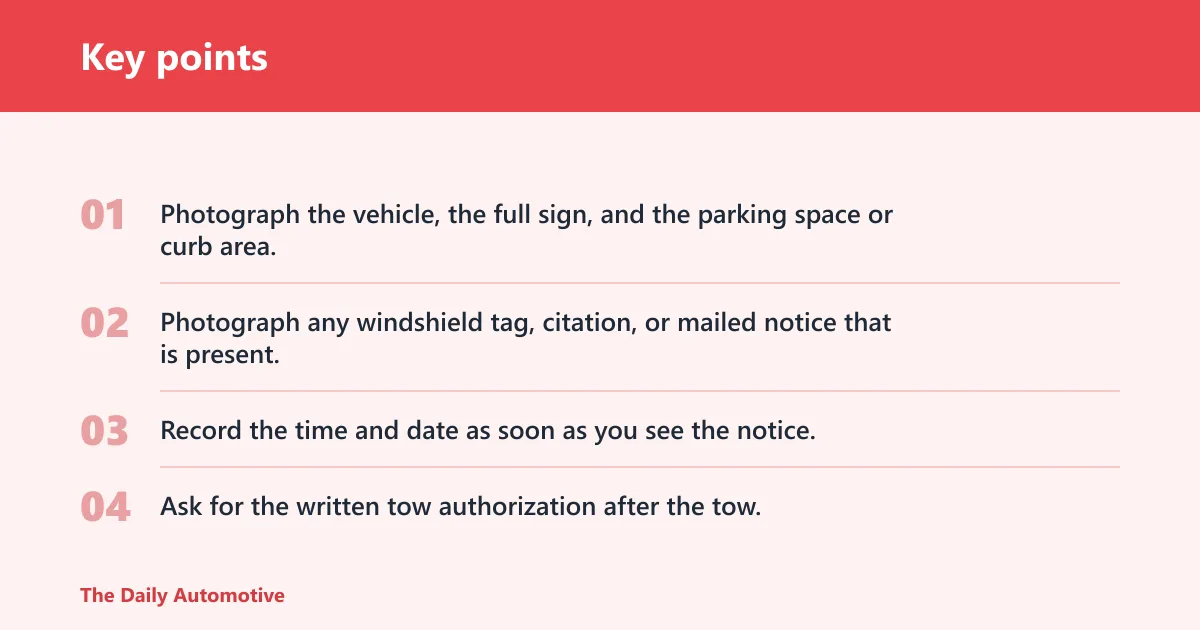
- Photograph the vehicle, the full sign, and the parking space or curb area.
- Photograph any windshield tag, citation, or mailed notice that is present.
- Record the time and date as soon as you see the notice.
- Ask for the written tow authorization after the tow, along with the invoice and any release paperwork.
For a tow dispute, the strongest evidence is usually the sign, the authority document, the timestamp, and any citation or law-enforcement contact record. If the notice exists but the sign is missing, unclear, or out of place, that gap can matter.
What does a boot notice mean?
A boot notice means the vehicle is being moved into immobilization enforcement, or is about to be. In many places that step comes before towing, because the operator wants to restrict movement before deciding whether removal is next.
Booting is often tied to signs and property-rule requirements, but it can be immediate in hazard cases. If a car is blocking a fire lane, blocking a driveway, or creating a safety hazard, the immobilization or tow may happen without advance warning.
When a boot can be immediate
Immediate booting or quick immobilization is most likely where the vehicle creates a hazard or blocks access. The same logic applies to urgent enforcement cases where the property owner or manager needs the car stopped before it can move.
That said, booting and towing are not parallel remedies with the same notice standard. A boot notice may be tied to a different rule set, and private booting may be restricted or banned in many jurisdictions even when towing is allowed.
Who can issue each notice?
Authority comes from the property owner or controller, the governing documents, and the local law that allows the enforcement action. An HOA can only tow when it has authority in recorded CC&Rs or adopted rules and when the property falls within its control or statutory reach.
That is why a written tow authorization matters. A sign alone is not enough if the person who ordered the tow lacked authority, used the wrong ground, or omitted the required record trail. The same logic applies to booting, especially where private immobilization is limited.
Why law-enforcement notification matters
A towing company may need to notify law enforcement where required. That step can help confirm the tow was processed under the right channel, and in a dispute it can show whether the company followed the required notice path.
If the tow company says police were contacted, ask for the record or reference information that shows when and how that happened. If no such notification was required, that fact should match the local rule and the tow paperwork.
What evidence matters most?
For tow disputes, the key evidence is the sign, the tow authorization, timestamps, photos, and any citation or police contact record. For boot disputes, the key evidence is the boot notice, the sign placement, the vehicle identification, and proof of who ordered the immobilization.
Photograph the scene. Save every notice, receipt, and release document. That includes the towing invoice, any posted or mailed notice, the boot release instructions, and anything handed over at pickup or release.
Tow dispute evidence
Start with the exact sign that was posted where the car was parked. Then gather the written tow authorization, the photo record, and any citation number. If the plate, vehicle color, or space number is wrong, that mismatch can matter as much as a missing signature.
Boot dispute evidence
For a boot, the device itself and its placement matter. So does the notice that came with it, the rule or sign that supposedly allowed immobilization, and the identity of the person who ordered it.
Suppose a sedan is clamped in a numbered space under a posted lot sign, but the sign is mounted at the entrance and not near the space. The sign may still be argued either way, but the placement and wording become the first things to check.
What should I do if I got a notice to have my vehicle towed?
Move fast, but document first. Photograph the car, the sign, the notice, and the exact parking spot before anything changes. Then ask for the written tow authorization, the citation if one was issued, and the towing invoice or release instructions.
If the vehicle is still there and the notice points to removal, the safest move is usually to stop the risk from getting worse. If the car has already been towed, ask whether law enforcement notification was required and whether the storage yard has the vehicle release process.
First 15 minutes after finding a notice
- Do not move the notice or the vehicle before taking photos.
- Check whether the paper says tow, storage, boot, immobilization, or release.
- Photograph the nearest sign and the whole parking area.
- Save every receipt, tag, and written instruction.
- Ask for the authorization document if the car has already been removed.
What notice is required before an HOA can tow a car?
There is no single national standard for towing notice. An HOA usually cannot tow without meeting some notice requirement, but the exact form depends on state law, local ordinance, the property status, and whether the area is controlled by the HOA.
California’s Vehicle Code §22658 is one state-specific example of a notice window in certain private-property towing disputes. Florida’s Statute 715.07 is different: it relies on posted signage with specific requirements instead of a fixed waiting period.
Signage versus written warning
Some places treat posted signs as the ongoing notice. Others require a windshield tag, mailed notice, or a period of advance warning for certain violations. The paperwork and the sign need to match the local rule, or the tow can become easier to challenge.
Missing or unclear signage can create a dispute, but the stronger argument is often the mismatch between the sign, the authority document, and the actual vehicle situation. If the rule said one thing and the property did another, that gap matters.
Can a boot notice be left on my windshield before a tow?
A boot notice can be left on the windshield before towing, but it often signals immobilization first rather than immediate removal. In some cases the notice and the boot appear together, especially where the operator wants to force release steps before a tow happens.
If the notice mentions release fees, a clamp, or immobilization, treat it as a boot matter even if a tow is mentioned later. That means you should focus on the device, the sign, and the authority for the immobilization, not only the threat of removal.
How much time do I have after a boot notice before towing?
There is generally no universal countdown after a boot notice before towing. The time between a boot notice and a tow usually depends on the local rule, the property’s authority, and whether the situation is an ordinary parking violation or an immediate hazard. In some cases, the tow can follow quickly.
If the car is already clamped, do not assume the operator must wait a set period before towing. Check the notice language, the sign, and the release instructions, then ask for the immobilization authorization and any towing rule that applies in that location.
Choose Tow Notice if… / Choose Boot Notice if…
Choose Tow Notice if the paper, tag, or sign points to removal, storage, or a pending tow truck. Choose Boot Notice if it points to immobilization, release fees, or a wheel clamp. The correct label follows the enforcement stage, not the frustration level.
Choose Tow Notice if…
- The document names towing, storage, or a removal deadline.
- You are being asked for a tow release, not a boot release.
- The key dispute is whether the car could be removed under the posted rule.
- You need to verify signage, authority, and police notification for a pending tow.
Choose boot notice if…
- The document refers to immobilization, a clamp, or release fees.
- The vehicle is already blocked from moving.
- The main dispute is who ordered the boot and whether the sign covered that remedy.
- You need to verify the placement of the device and the authority behind it.
Frequently asked questions
What is the difference between a tow notice and a boot notice?
A tow notice points toward removal and storage, while a boot notice points toward immobilization. The practical difference is whether the vehicle is headed to a tow yard or being locked in place on-site. That difference changes which records matter most and how fast you need to act.
Does a tow notice mean my car can be towed immediately?
Not always. Some violations require a notice window, while others can allow faster removal if the vehicle blocks a fire lane, blocks a driveway, or creates another urgent hazard. The notice, the sign, and the local rule need to line up before you assume the tow is lawful.
Who is allowed to issue a towing notice for an HOA?
The HOA, property manager, or towing contractor may be involved, but authority has to come from the right source. That usually means recorded CC&Rs, adopted rules, control of the area, and any state or local towing law that allows the action. A signature from a named manager or board member matters.
Is a towing notice valid without proper signage or posted rules?
Sometimes it is not, but the answer depends on state law, local ordinance, and property authority. Florida relies heavily on posted signage under Florida Statute 715.07, while other places use different notice rules. If the sign is missing, unclear, or badly placed, that can create a dispute.
Products related to this article
Sponsored / affiliate links. As an Amazon Associate I earn from qualifying purchases. I may earn additional commission from eligible campaigns.