Viper 350 Plus Vehicle Security System Review: Worth It?
The Viper 350 Plus is worth buying today mainly as a legacy keyless-entry and basic alarm add-on, not a modern security upgrade; choose it only if you need a cheap 2-door central-locking kit and accept dated features. Install it badly, and you can get false alarms, dead batteries, or door-lock faults that cost far more than the unit. This guide explains what the 350 Plus includes, how its wiring and lock outputs work, and whether it makes sense on cars with or without factory power locks.
This guide is part of our Car key, lock, and door access guide series.
Verdict
That is the right way to judge it. Viper brands itself around remote start and vehicle security systems, and it separates Security Systems from Keyless Entry Systems on its site, which is the clue here: the 350 Plus sits closer to a convenience upgrade with alarm hardware attached than to a modern, all-in-one deterrent package.
Pros and cons
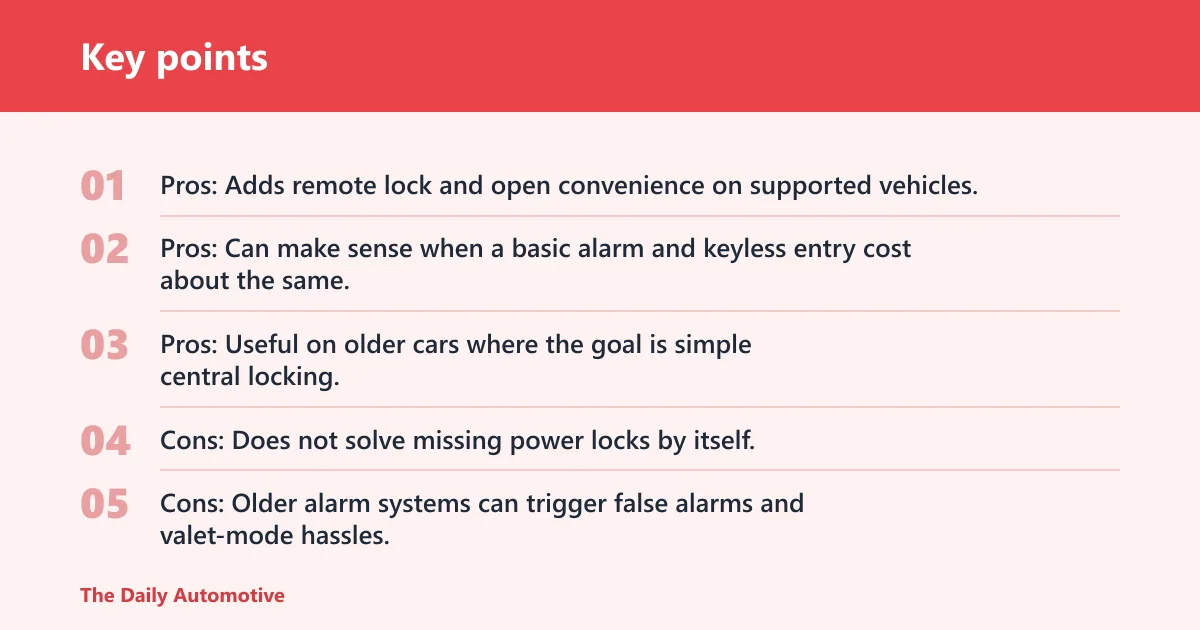
- Pros: Adds remote lock and open convenience on supported vehicles.
- Pros: Can make sense when a basic alarm and keyless entry cost about the same.
- Pros: Useful on older cars where the goal is simple central locking, not app control or remote start.
- Cons: Does not solve missing power locks by itself.
- Cons: Older alarm systems can trigger false alarms and valet-mode hassles.
- Cons: Used units and older remotes raise compatibility risk.
Who it’s for
This suits DIY installers who already have power locks, owners of older cars who want basic remote lock and open, and shoppers who are comfortable working from a manual and wiring diagram. It does not suit buyers who want current support, modern telemetry, or a cleaner install path on a vehicle with no factory central locking.
📊 A DIY writer installed a Viper 350 Plus to add power door locks and keyless entry. Source: Smbaker.
Specs at a glance
| Item | What to know about the Viper 350 Plus |
|---|---|
| Primary role | Legacy aftermarket alarm and keyless-entry unit |
| Alarm function | Basic vehicle security warning and deterrence |
| Keyless-entry function | Remote lock and open for compatible door-lock systems |
| Power door-lock support | Requires a vehicle with power locks or added lock hardware |
| Install complexity | Moderate to high for DIY; higher without existing power locks |
| Programming | User-serviceable in many cases, but remote model matching matters |
| Documentation | Look for the Viper 350HV manual PDF for wiring and setup references |
| Current lineage | Older model, positioned behind newer Viper security systems |
Who is the Viper 350 Plus for?
The Viper 350 Plus is for a buyer who wants an older, straightforward remote lock and open setup and can live with dated alarm behavior. It makes the most sense on a vehicle that already has power locks, because the central-locking side of the install stays simpler and the payoff is easier to see.
It is a weaker fit for drivers who want a current security platform, modern remote features, or a plug-in path with less wiring. A common first-timer mistake is buying an alarm because it sounds more secure, then discovering the car still needs lock actuators, relays, or more wiring before keyless entry works at all.
What the original writeup implies
A DIY writer installed a Viper 350 Plus to add power door locks and keyless entry on a Jeep TJ, and that writer said they did not care much about the alarm function. That matters because it frames the model as a convenience project first. It also supports the idea that a full alarm can cost little more than a keyless-entry-only system, which is a useful value check for older vehicles.
What does the Viper 350 Plus include out of the box?
The 350 Plus is best understood as a basic alarm-plus-keyless-entry package, not as a remote-start system and not as a universal fix for missing vehicle equipment. You should expect door-lock control functions, alarm hardware, and remotes, but you still need to confirm the exact remote count and key fob type before buying used or open-box stock.
Because older Viper kits often change hands incomplete, the box contents matter more than the model name. If the remotes are missing, wrong, or mismatched, programming can fail even when the control unit is healthy. That is why the manual and part numbers matter as much as the module itself.
Alarm vs keyless-entry feature set
As an alarm, the 350 Plus is intended to warn and deter. As keyless entry, it is meant to lock and open the doors from a distance. Those are not the same use case. Security-only buyers care about triggering and deterrence. Convenience-only buyers care about everyday open access and whether the locks cycle cleanly.
What to confirm before buying used
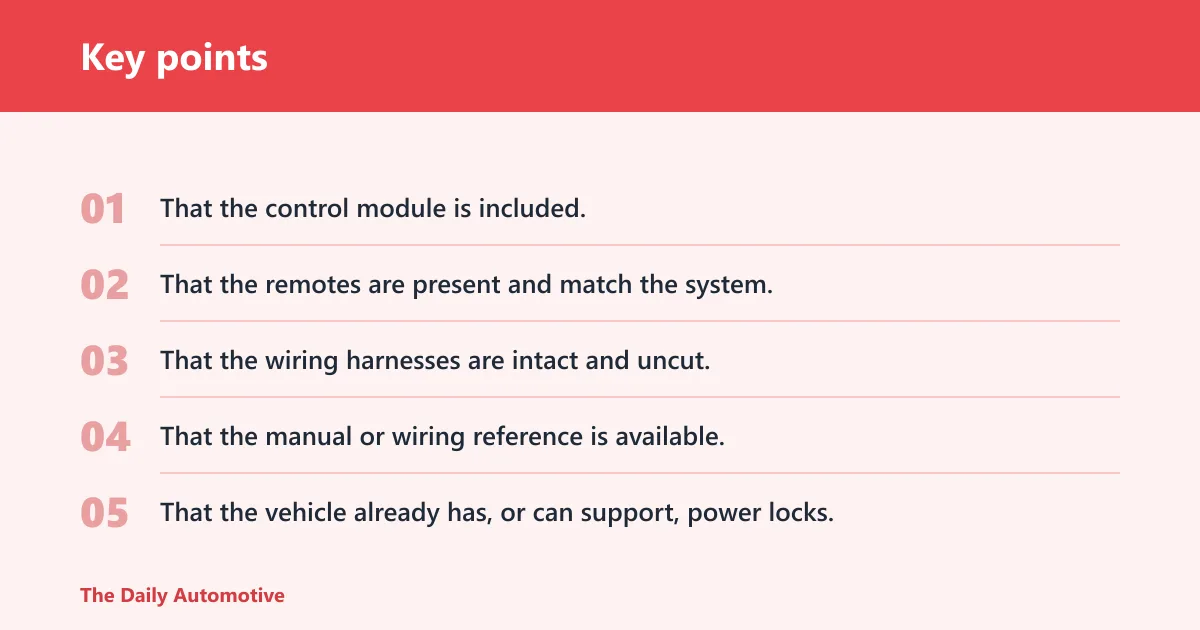
- That the control module is included.
- That the remotes are present and match the system.
- That the wiring harnesses are intact and uncut.
- That the manual or wiring reference is available.
- That the vehicle already has, or can support, power locks.
Can the Viper 350 Plus add power door locks and keyless entry?
It can control power locks only if the vehicle already has central locking or if you add the right hardware. The Viper 350 Plus does not magically create door motors in a car that lacks them. On vehicles without factory power locks, the install becomes a combined alarm-and-lock project with more parts, more wiring, and more labor.
That extra labor is the real cost center. The lock output itself is only part of the job; the installer still has to route wires, identify the correct lock circuits, and verify that the outputs are compatible with the vehicle’s locking architecture or any aftermarket actuators being added.
How the lock outputs work
Keyless entry depends on the module sending the right lock and open signals to the vehicle’s central locking system. If the car lacks power door locks, those signals have nothing to drive. In that case, aftermarket lock actuators or a lock kit are usually required, and the install stops being simple very quickly.
Why aftermarket power locks may be required
Aftermarket power locks are needed when the car does not already have actuators in the doors. That adds parts, mounting work, and vehicle-specific wiring. It can also change whether the system is worth it, because the convenience gain may be modest compared with the added time and failure points.
Install labor implications
Say your older coupe has manual locks on both doors and no central locking. The alarm box may still fit, but the keyless-entry benefit will not appear until actuators, linkage, and wiring are added. In that situation, the 350 Plus is no longer a small weekend upgrade; it is a door hardware project.
How hard is Viper 350 Plus remote programming?
Remote programming is usually user-serviceable on systems like this, but it is only straightforward when the remote model matches the unit and the system is not stuck in valet mode or another disabled state. If the wrong remote is ordered, or the pairing sequence is interrupted, the system may accept nothing at all.
That means programming is not the hardest part. Matching the exact remote and reading the manual correctly is. Older systems also create more confusion because a dead battery, an open door, or a mistaken valet setting can look like a bad remote when the module is the real issue.
Setup steps in plain terms
- Confirm the remote model matches the Viper 350 Plus system family.
- Check that the vehicle battery and remote battery are both healthy.
- Follow the manual’s programming sequence exactly.
- Verify lock, open, and alarm responses after pairing.
- Recheck valet mode if the system refuses to arm or respond.
Common pairing failures
- Wrong remote model.
- Incomplete pairing sequence.
- Unit left in valet mode.
- Weak or dead remote battery.
- Wiring faults that make the control unit seem unresponsive.
Where can I find the Viper 350HV manual PDF?
The Viper 350HV manual PDF is the first document to look for when you need wiring diagrams, programming steps, and compatibility confirmation. For an older system like the 350 Plus, a model-specific PDF is more useful than generic forum advice because it shows connector pinouts, programming flow, and which functions the unit actually supports.
Use the manual as a fit check before buying remotes, lock actuators, or installation parts. If the document cannot confirm the setup, treat the sale as incomplete until you have the right paperwork. That is especially important when the unit is used, because older kits often ship without the original guide.
What the manual should answer
- Which remotes are compatible.
- Which wires handle lock and open output.
- How to enter programming mode.
- How valet mode works.
- Whether the unit needs added relays or lock hardware.
What problems do Viper alarm systems commonly have?
Older Viper alarm systems commonly run into false alarms, lock-output confusion, valet-mode issues, and wiring faults that show up as intermittent behavior. Those are not unique to Viper, but they matter more on an older model because age, prior installs, and missing documentation make diagnosis slower and more annoying.
When the system is being used mainly for keyless entry, a lock-output problem can be more frustrating than a missed alarm trigger. If the doors do not cycle cleanly, the convenience benefit disappears. If the system falls into valet mode, the owner may think the remote is dead when the module is simply disabled.
Common failure points to check first
- Valet mode accidentally enabled.
- Remote battery weak or dead.
- Door trigger or shock-sense wiring misrouted.
- Lock/open wires connected to the wrong vehicle circuit.
- Corroded grounds or loose power connections.
Security-only versus convenience-only in real use
Security-only use asks whether the alarm will deter tampering and alert the owner. Convenience-only use asks whether the doors open reliably every day. On a legacy system, the second question is often the more practical one, because a flaky alarm can create more annoyance than protection.
What does not
The biggest drawback is that the Viper 350 Plus is an older model with older expectations. It does not buy you modern support, and it does not erase the labor burden of vehicles without existing power locks. If you want current features or an easier troubleshooting path, newer Viper systems make more sense.
It also does not make a weak alarm strategy suddenly strong. Older aftermarket alarms can still false-trigger, and a car with poor wiring, tired door switches, or missing lock hardware can turn the install into a chase for faults. That is a bad trade if your real goal is low-effort daily convenience.
Model-era decision table: where the 350 Plus still fits
| Use case | What it solves | What it cannot solve | Verdict |
|---|---|---|---|
| Older car with power locks and a simple convenience-upgrade goal | Remote lock and open, basic alarm deterrence | Modern app features, remote start, current support depth | Good fit |
| Older car without power locks and a tight DIY budget | Possible keyless entry after added lock hardware | Low-complexity install, low parts count, fast troubleshooting | Poor fit |
| Buyer comparing it with a newer Viper system for daily use | Legacy basic lock control | Modern features, easier support, cleaner documentation path | Usually skip it |
Simple install-risk checklist for vehicles without existing power locks
- Confirm the doors already have or can accept lock actuators.
- Check whether the vehicle needs a 2-door or 4-door lock strategy.
- Verify access to the correct wiring diagram before starting.
- Budget for extra labor if the door panels must come off.
- Expect more fault tracing if the car has prior electrical repairs.
Alternatives and newer Viper systems
Newer Viper security systems are a better choice when you want current support, clearer documentation, or a cleaner path to modern convenience features. The 350 Plus belongs to an older product line, so even if it still functions, it is not the model to choose when you care most about future-proofing or easier replacement parts.
 As an Amazon Associate we earn from qualifying purchases. Prices and availability are accurate as of the date shown and are subject to change.

Viper Responder 350 2-Way Security System 3305V
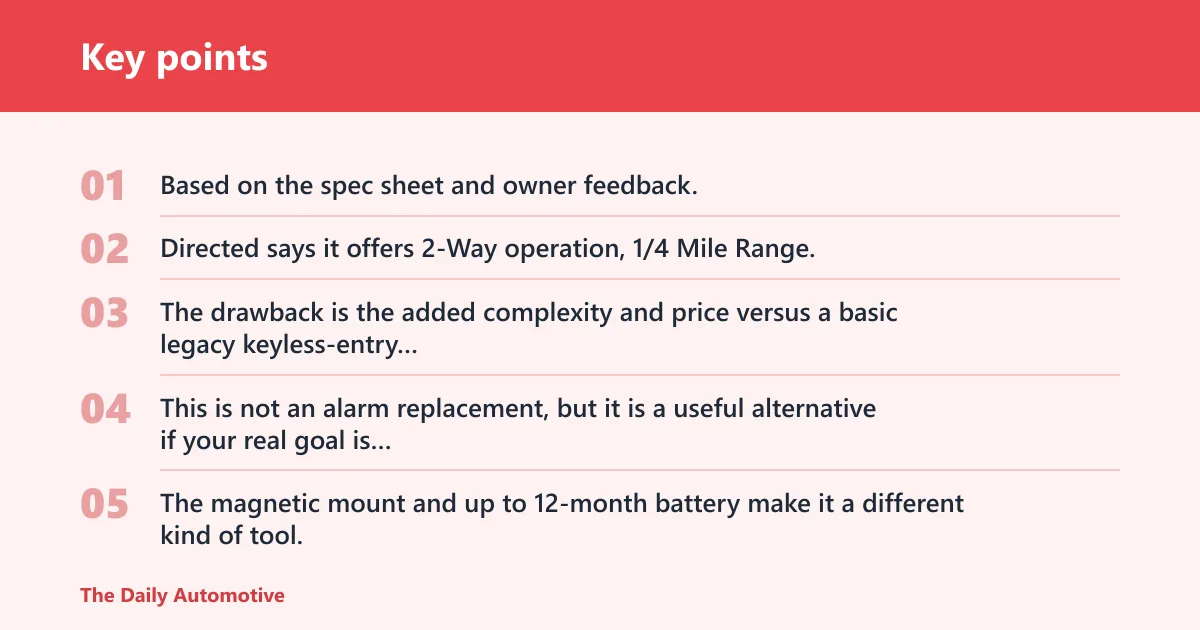
Based on the spec sheet and owner feedback, this is the more security-forward option of the two Viper products listed here. Directed says it offers 2-Way operation, 1/4 Mile Range, Clone-Safe Code-Hopping technology, and two auxiliary outputs, so it fits buyers who care more about alarm feedback and broader control than simple lock and open convenience. The drawback is the added complexity and price versus a basic legacy keyless-entry install.
As an Amazon Associate we earn from qualifying purchases. Prices and availability are accurate as of the date shown and are subject to change.

Spy Tec GPS Tracker for Vehicles, Magnetic Mount, 12-Month Battery
This is not an alarm replacement, but it is a useful alternative if your real goal is vehicle location awareness rather than horn-trigger deterrence. The magnetic mount and up to 12-month battery make it a different kind of tool, and the drawback is obvious: it tracks, but it does not lock doors, sound a siren, or add keyless entry.
Should you buy it?
Buy the Viper 350 Plus only if your project is centered on adding basic remote lock and open to an older vehicle and you are comfortable with legacy wiring work. If you need a modern security upgrade, skip it. If the car has no power locks, budget for actuators and extra labor before the purchase looks cheap.
For many daily drivers, a newer Viper system or a different convenience solution is the smarter buy because current documentation, compatibility, and support matter more than squeezing value out of an older box. The 350 Plus still has a place, but that place is narrow.
Frequently asked questions
Is the Viper 350 Plus still worth buying today?
It is worth buying only for a narrow use case: older vehicles, existing power locks, and a buyer who wants basic keyless entry more than modern security features. If you need current support, easier troubleshooting, or stronger daily-driver convenience, a newer system is usually the better buy.
Is the Viper 350 Plus mainly an alarm or a keyless entry system?
In daily use, it makes more sense to treat the 350 Plus as a keyless-entry convenience upgrade with basic alarm hardware attached. That is especially true on older vehicles where the owner cares most about remote locking and opening, not about building a modern theft-prevention system.
How does the Viper 350 Plus compare with newer Viper security systems?
Newer Viper systems generally make more sense if you want current support, clearer feature separation, and a more modern install experience. The 350 Plus is a legacy model, so it can still work, but it sits behind newer Viper security systems in convenience, documentation, and long-term fit.
Products related to this article
Sponsored / affiliate links. As an Amazon Associate I earn from qualifying purchases. I may earn additional commission from eligible campaigns.