Do Dealers Give a Better Price If You Pay Cash?
Usually, no: a dealer does not cut the price simply because you pay cash. The real numbers sit in the sale price, fees, trade-in allowance, and finance terms. Focus on the full deal, or you can miss a rebate, a padded fee, or a loan offer that changes the total.
This guide is part of our Car Dealer Money Guide: Negotiating, Financing, Leasing, Trading In and Selling series.
Why a check does not guarantee a lower out-the-door price
Usually not by default. Cash can make closing faster, but many dealers care more about total profit than payment method because they can earn on the vehicle, financing, and trade-in. Some stores may quote a lower margin for cash buyers, while others may bargain harder if financing still looks possible.
Why cash is not a pricing magic trick
Cash removes the lender from the middle, but it does not force a lower sale price. A dealer can still hold the vehicle price firm, add doc fees, or stack add-ons that wipe out any cash advantage. The target should be the out-the-door price, not the payment method.
What dealers can earn from financing
Dealer financing can produce profit through lender partnerships and a rate markup. Dealers can add a markup to the bank’s approved APR, then keep part of that spread as compensation. That is why some stores prefer a financed deal and may be more willing to discount the car if financing stays on the table.
What is the out-the-door price?
The out-the-door price is the full amount you pay to leave with the car. It should include the sale price, taxes, mandatory fees, and any add-ons the dealer insists on including. If that breakdown is not written down, you do not really know what you are paying for.
Sale price versus taxes and fees
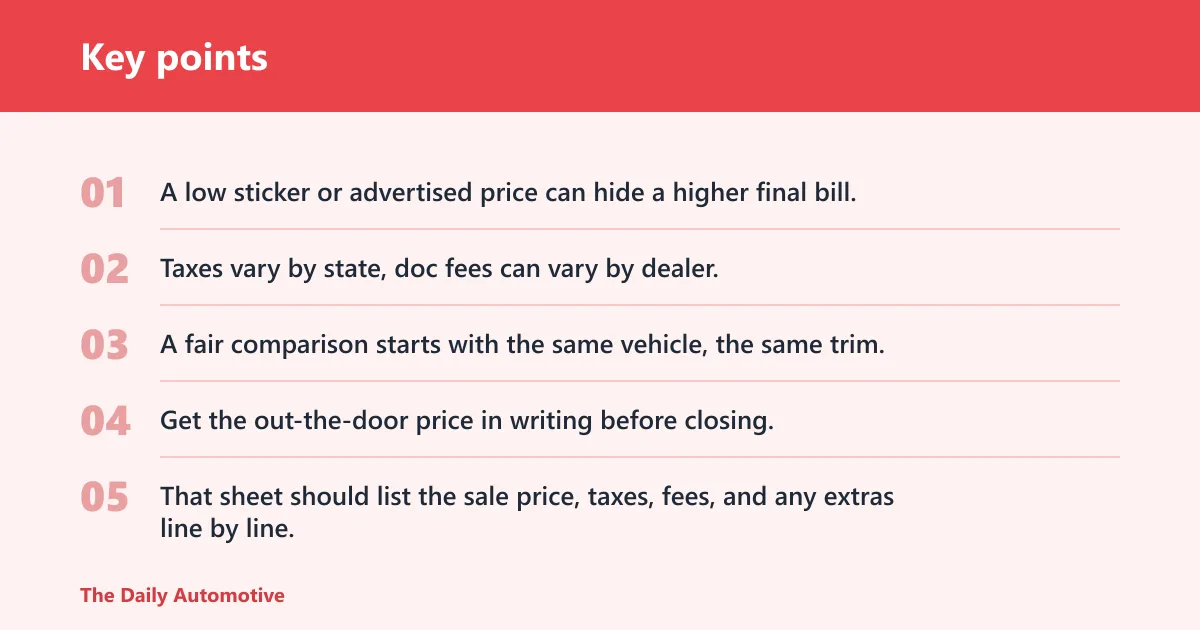
A low sticker or advertised price can hide a higher final bill. Taxes vary by state, doc fees can vary by dealer, and add-ons such as paint protection or VIN etching can change the math fast. A fair comparison starts with the same vehicle, the same trim, and the same written fee breakdown.
Why you need a written breakdown
Get the out-the-door price in writing before closing. That sheet should list the sale price, taxes, fees, and any extras line by line. Without it, you cannot compare a cash offer against a finance offer on equal terms, and you cannot tell whether the discount is real or padded elsewhere.
Where add-ons can change the math
Some deals look cheaper only because the payment method changes how the store presents the numbers. A cash quote can come with a higher fee stack, while a finance quote can include a rebate or lower price. The only useful comparison is the final total after all required charges.
| Scenario | Price target | Likely dealer incentive | Interest cost window | Payoff risk | Who wins if the dealer discounts only with financing? |
|---|---|---|---|---|---|
| Pure cash | $30,000 sale price, plus $700 fees and applicable tax | No finance rebate; possible higher quote if the store prefers financed deals | $0 | None from a loan, but no lender-backed discount | Often loses if the dealer only reduces price for financed buyers |
| Dealer financing with immediate payoff | $29,000 sale price, plus $700 fees and tax | $1,000 finance-only discount or rebate | About 30 to 90 days of interest on the loan balance | Need to confirm no prepayment penalty or waiting period | Often wins if the discount exceeds short-term interest and any payoff cost |
| Outside financing | $29,500 sale price, plus $700 fees and tax | Possible middle-ground price if dealer knows financing is still possible | Interest paid to your outside lender over the full loan term | Low if the loan is fully yours, but the dealer may not match the finance-only discount | Can win if the outside APR and total loan cost are better than the dealer offer |
In that example, dealer financing with a quick payoff beats pure cash only if the finance-only discount is larger than the short interest window and any payoff restriction. If the discount is smaller, cash or outside financing may cost less overall.
Should you tell the dealer you are paying cash?
Not too early. Negotiate the vehicle price first, then discuss payment method. If the dealer hears “cash” at the start, some stores may tighten the quote or steer the conversation away from the discount. A pre-approved loan keeps your options open and gives you a comparison number to use at the desk.
How a pre-approved loan changes your leverage
Jalopnik recommends getting pre-approvals from other lenders first. That gives you a known APR and a backup if the dealer’s financing is worse. It also stops the store from treating cash as the only alternative. A buyer with outside financing can still act like a ready buyer, without naming the final payment method too soon.
When to reveal payment method
Tell the dealer after you have a written out-the-door price, or after the numbers are already close. If the dealer asks early, a simple answer is enough: you are deciding among cash, outside financing, and dealer financing. That keeps the negotiation on price rather than on how the store gets paid.
Scenario examples
Say your dealer offers an out-the-door price of about $28,900 if you finance, while the cash quote is about $30,100. If the loan costs about $120 in interest for the first two months and there is no payoff penalty, the finance deal can still win by a wide margin.
Suppose a shopper is bringing about $12,000 in cash and financing the rest through a credit union. That is still an outside-financing deal, not a pure cash deal, and it gives the buyer a comparison rate while keeping pressure on the car price.
Can financing still save you money?
Yes, sometimes. Finance-only rebates, special APRs, and manufacturer incentives can lower the total cost even if you pay interest for a short period. Cash avoids interest, but it does not guarantee the lowest out-of-pocket total when the dealer discounts only with financing.
Finance-only rebates and incentive limits
Some dealer offers and manufacturer incentives may require financing and may exclude cash buyers. That is market practice, not a universal rule, and it varies by store, lender, and model. If the rebate is tied to financing, ask for the full price difference in writing so you can compare it against the interest you would pay.
When paying interest briefly may still win
If the dealer knocks enough off the price, a short loan can be cheaper than cash. The math is simple: finance cost plus any fees versus the cash price you would otherwise pay. A small APR on a short payoff window can be far less expensive than giving up a larger finance-only discount.
Refinancing or paying off the loan early
If the dealer requires financing for a lower price, you may be able to pay it off early or refinance after closing. Early payoff can reduce future interest, and refinancing can replace dealer financing with a lower-rate loan, sometimes at low or no cost. Check the paperwork first so you do not trade a discount for a hidden restriction.
Early payoff, restrictions, and rate shopping
Do not assume every loan can be cleared immediately without cost. Check for a prepayment penalty, a minimum finance period, or a lender restriction on early payoff. State law can matter here, and the contract controls the timing. If the dealer says the lower price requires financing, make sure you know the exit cost before signing.
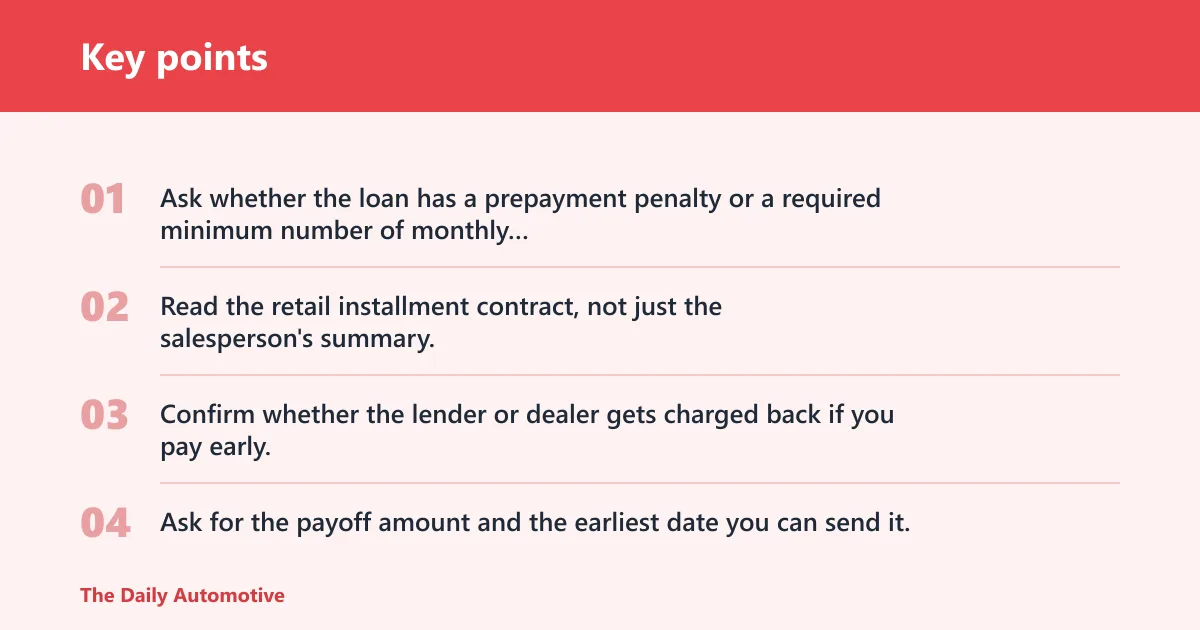
How to check for a prepayment penalty
- Ask whether the loan has a prepayment penalty or a required minimum number of monthly payments.
- Read the retail installment contract, not just the salesperson’s summary.
- Confirm whether the lender or dealer gets charged back if you pay early.
- Ask for the payoff amount and the earliest date you can send it.
Why outside lender pre-approval matters
Outside pre-approval lets you compare rates before you visit and gives you a clear ceiling for the dealer offer. It also shows whether the dealer’s APR is higher than the bank’s approved rate. That spread matters because dealers can add a markup to the bank’s approved APR, and that markup changes the true cost of financing.
When refinancing is the cleaner exit
If the dealer offer is good only because of a lower financed price, refinancing can be a clean way out after closing. Use it when the numbers still work after a short holding period and when the new loan beats the dealer rate. If you can pay the balance off without penalty, that may be even simpler.
Frequently asked questions
Do dealerships give you a better deal if you pay cash?
Usually no. Cash may help the deal close faster, but it does not automatically lower the sale price. Dealers often care more about total profit than payment method, and some may even quote a higher cash price or refuse the sale if they believe financing would have been more profitable.
Will car dealers give a better deal if you pay cash?
Sometimes they might, but not as a rule. A dealer may be more flexible if financing is still possible, and some stores use finance-only incentives. That is why you should compare the out-the-door price, not assume cash will beat every finance offer.
Does paying cash for a car lower the price?
Not necessarily. Paying cash avoids interest, which can reduce your total cost, but it does not force the dealer to cut the sale price. The best comparison is cash versus finance over the same out-the-door number, including taxes, fees, and any rebate tied to financing.
Should I tell the dealer I’m paying cash?
Not at the start. Negotiate the car price first, then reveal how you plan to pay once you have a written out-the-door quote. If you disclose cash too early, you may lose leverage. A pre-approved loan can help you compare offers without locking yourself in.
Can a dealer refuse cash and push financing?
Some dealers may do that, and Jalopnik notes that some quote higher prices for cash sales or refuse the sale. A dealer can set business terms for its own offer, but you should be wary if the lower price only appears when financing is used. Always ask for the full written breakdown.
If the dealer requires financing for a lower price, can I pay it off early?
Often yes, but check the contract for a prepayment penalty or a minimum finance period. If there is no restriction, an early payoff may let you keep the lower sale price while cutting future interest. Refinancing is another exit if the dealer rate is too high after closing.
Products related to this article
Sponsored / affiliate links. As an Amazon Associate I earn from qualifying purchases. I may earn additional commission from eligible campaigns.