Manufacturer vs Third-Party Extended Warranty: Which Is Better?
Manufacturer coverage is usually the better fit for a new car if you want factory-backed repairs and a simpler claims path. Third-party extended warranties are often the better choice for used cars, higher-mileage vehicles, or longer terms with more room to compare shop access and contract rules. Picking the wrong plan can leave you paying more for repairs, facing claim denials, or buying coverage that ends long before you sell the car. This guide compares cost, coverage, claims handling, transferability, and which option fits new-car, used-car, and resale goals.
This guide is part of our Car Dealer Money Guide: Negotiating, Financing, Leasing, Trading In and Selling series.
| Decision factor | Manufacturer | Third-Party Extended Warranty | Winner |
|---|---|---|---|
| New-car convenience | Fits factory timing and dealer paperwork | May require separate approval and provider rules | Manufacturer |
| Used-car flexibility | Often harder to buy after age or mileage rises | May accept older or higher-mileage vehicles | Third-Party Extended Warranty |
| High mileage | Eligibility can narrow as mileage climbs | Some providers accept very high-mileage cars | Third-Party Extended Warranty |
| Transferability | Often limited, sometimes absent | More likely to allow transfer, but contract rules vary | Third-Party Extended Warranty |
| Cancellation flexibility | Often non-refundable or tightly limited | Can be more flexible, but timing and proration still matter | Third-Party Extended Warranty |
| Repair-shop choice | Usually tied to dealer network or brand-approved repair rules | May allow independent shops if the contract allows it | Third-Party Extended Warranty |
| Value for money | Can be expensive for the coverage received | May offer better value or customer service | Third-Party Extended Warranty |
What each plan covers?
An extended car warranty is a vehicle service contract that pays for specified repairs after the factory warranty ends. It covers mechanical or electrical breakdowns, not collision damage, and the contract language controls what parts, labor, exclusions, deductibles, and approval rules apply.
Powertrain coverage versus broader protection
Powertrain coverage generally focuses on the engine, transmission or gearbox, and drivetrain-type parts. It is often the lower-cost tier, but it is not the same as bumper-to-bumper-style coverage, which usually reaches more systems and components.
Broad coverage can include electrical systems, air conditioning, and timing belt or chain-related repairs if the contract lists them. Some policies also include replacement car hire, diagnostics, emergency transport, roadside assistance, and accommodation. Those extras can matter after a failure, but they only help if the contract actually includes them.
Deductibles and exclusions
A deductible is the amount you pay on each covered claim, so it changes what a repair really costs you. A lower deductible can soften the hit on one visit, while a higher deductible can make a cheaper premium look less attractive once repairs begin.
Exclusions matter just as much. A plan can look broad on a summary page and still exclude wear items, certain seals, pre-existing faults, or specific electronics, so the contract should be checked line by line before you buy.
Which is better for a new car?
Manufacturer coverage is usually the cleaner fit for a new car because it lines up with factory paperwork, dealer repair channels, and the original ownership period. Third-party coverage can still work, but the factory option is often simpler when the car is still close to new and you want the least friction at the dealership.
Factory convenience
New-car warranties usually last three to five years, and manufacturer extended plans are often sold near the factory-warranty end or at new-car purchase. That timing makes the process straightforward if you want one brand, one service path, and a plan that feels close to the original warranty structure.
Dealer network repair rules
Manufacturer plans can be easier to use at the selling dealer, but they may also be tied to brand-specific rules and approved repair channels. If you want the dealership to handle most of the process, that alignment is a real advantage.
Say your new SUV is still under factory coverage and the infotainment unit fails at 18,000 miles. A manufacturer plan is more likely to keep the claim process inside the brand’s own system, which can reduce friction if the repair needs preapproval before parts are ordered.
Which is better for a used or high-mileage car?
Third-party coverage is often a practical choice for a used or high-mileage car because eligibility can be broader and the contract can be easier to tailor to age, mileage, and budget. Manufacturer plans may still be available in some cases, but older cars often run into stricter rules or less favorable pricing.
Eligibility by age and mileage
Age and mileage matter more here than brand preference. Some third-party providers are built for older vehicles: Endurance has no age restriction, and CarShield approves cars with up to 300,000 miles. That kind of eligibility can matter when the factory-backed route is already out of reach.
When a manufacturer plan may be out of reach
Manufacturer extended warranties are often non-refundable and non-transferable. They may also be unavailable once a car passes certain age or mileage thresholds, or they may not make financial sense on an older vehicle where the premium eats too much of the repair savings.
Picture a 9-year-old sedan with 128,000 miles and an air conditioning fault. A third-party vehicle service contract may be the only realistic option, especially if the owner wants broader eligibility and does not need dealer-only repair handling.
Are third-party extended car warranties worth it?
Third-party extended car warranties can be worth it when the contract fits the car, the mileage, and the repair network you plan to use. They can offer better customer service or value for money, but only if the exclusions, deductible, and claims rules still fit your ownership timeline.
The median repair bill in 2026 is about $725, and more than half of repair bills cost $1,000. That does not make every contract a bargain, but it explains why buyers with aging cars often compare plans against likely repair exposure rather than against the original purchase price.
What can go wrong with value?
Common cost traps are easy to miss. Diagnostic fees may be excluded, some contracts limit payment per visit, and preauthorization can slow a repair if the provider needs more documentation before approving work. Those rules can shrink the real value of a low premium.
If a plan excludes electrical diagnosis or caps labor time, a repair that looks covered on paper may still leave you paying a large share of the bill. The only safe way to judge value is to compare the contract details, not the headline price alone.
What is the difference between a manufacturer warranty and a third-party warranty?
A manufacturer extended warranty comes from the vehicle maker, while a third-party extended warranty comes from an independent provider. Both are vehicle service contracts that pay for specified repairs after the original warranty expires, but they differ in repair access, transfer rules, cancellation terms, and price structure.
Claims handling and repair access
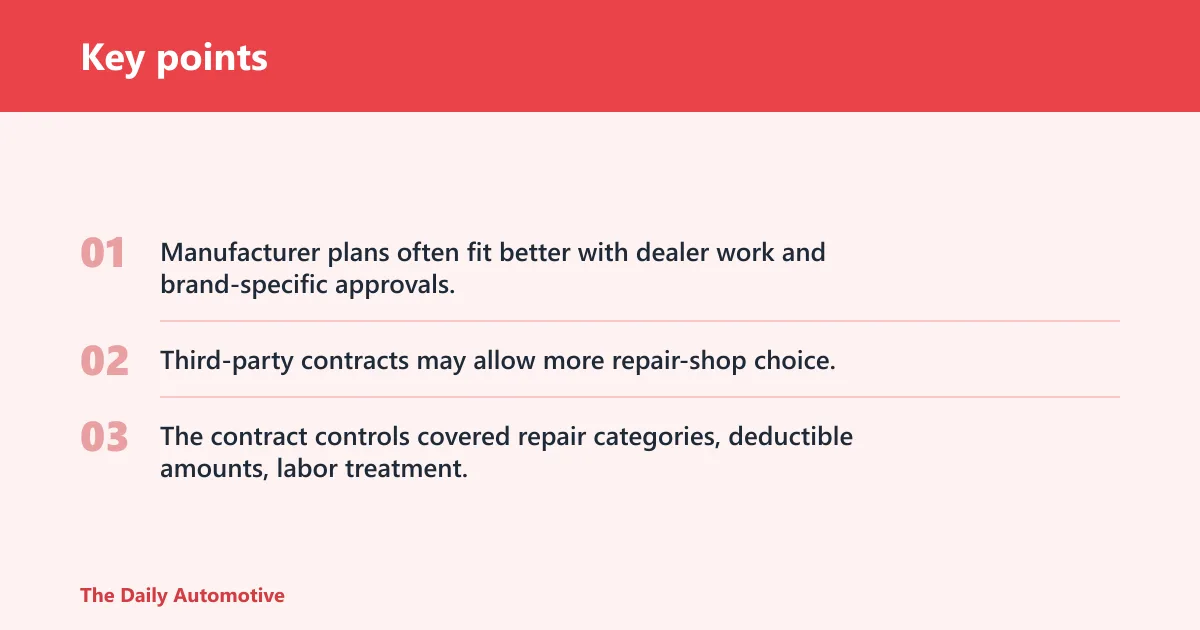
Manufacturer plans often fit better with dealer work and brand-specific approvals. Third-party contracts may allow more repair-shop choice, but the claim process can vary more from one provider to another, especially when preauthorization or documentation is required before repairs start.
Contract language controls the outcome
Neither type covers collision damage. The contract controls covered repair categories, deductible amounts, labor treatment, exclusions, and whether the provider will pay the shop directly or reimburse later.
Are manufacturer extended warranties transferable if I sell the car?
Sometimes, but not reliably. Transferability varies by brand and plan, and manufacturer extended warranties are often non-transferable or limited in a way that reduces resale value. If you expect to sell the vehicle privately, transfer terms matter as much as the repair list.
A transferable contract can make a car easier to market because the next owner gets a remaining coverage period. If the plan cannot move with the car, the value stays with the seller only if the seller can cancel and recover some money under the contract terms.
Are manufacturer extended warranties refundable?
Sometimes, but many manufacturer extended warranties are non-refundable or only partly refundable under strict timing rules. Cancellation policy details matter: some plans use proration, some charge administrative fees, and some limit refunds once a claim has been filed or too much time has passed.
Do not assume the refund rules match the brochure language. Check the cancellation window, the refund formula, and whether the contract is still cancellable after the car is sold or after a repair has already been approved.
Choose Manufacturer if… / Choose Third-Party Extended Warranty if…
Choose Manufacturer if you want dealer-aligned coverage, a simpler buying process on a new car, or the best chance of keeping repairs inside the brand’s service system. Choose Third-Party Extended Warranty if you need broader eligibility, more repair-shop choice, better transfer potential, or a lower upfront price on a used or high-mileage vehicle.
- Choose Manufacturer if: the car is new, you plan to service it at the dealer, you want one brand for repair approval, or resale transfer is not your main goal.
- Choose Third-Party Extended Warranty if: the car is used, mileage is already high, you want to compare more flexible deductibles, or you need coverage that may still be available after factory timing has passed.
How do I compare extended warranty quotes?
Compare quotes by contract terms first, price second. The best quote is the one that matches your car, your mileage, your repair-shop preferences, and your risk tolerance for deductibles, exclusions, and claims delays.
- Check whether the plan is manufacturer or third-party and whether your vehicle is eligible.
- Compare covered repair categories, including engine, transmission or gearbox, electrical systems, air conditioning, and timing belt or chain coverage.
- Look at the deductible and ask whether it applies per claim, per visit, or per component.
- Review exclusions, diagnostic fees, and any payment caps for labor or claims.
- Check transferability and cancellation rules if you may sell the car early.
- Confirm where repairs can be done and whether preauthorization is required.
That checklist also helps with common first-timer mistakes. A low premium can hide a narrow claim approval rule, while a slightly higher price can be better value if the contract gives you wider shop choice or a cleaner refund policy.
Frequently asked questions
Is a manufacturer extended warranty better than a third-party warranty?
Manufacturer coverage is usually better for a new car because it feels closer to factory warranty handling and dealer service. Third-party coverage is often better for used cars, higher-mileage vehicles, or buyers who need more flexibility on repair shops, transferability, or price.
What does a third-party extended car warranty cover?
Coverage depends on the contract, but common items include mechanical or electrical breakdowns after the original warranty expires. That can include engine, transmission, electrical systems, air conditioning, and timing belt or chain-related repairs, along with some plans that add roadside help or rental coverage.
Can I buy an extended warranty from the manufacturer after my warranty expires?
Sometimes, but not always. Manufacturer plans are often sold near the end of the factory warranty, and eligibility can narrow with age and mileage. If you wait too long, the manufacturer route may no longer be available or may cost more than a third-party alternative.
Can I get an extended warranty on a used car with high mileage?
Yes, often through third-party providers rather than the manufacturer. Eligibility varies widely, but some providers accept very high-mileage vehicles, and some have no age restriction. The key is matching the contract to the car’s current condition and likely repair needs.
Which extended warranty is better for customer service?
There is no universal winner, but third-party providers may offer better customer service or value for money in some cases. The better choice is the one with clear claim rules, reachable support, and a repair process that does not create delays when the car needs authorization.
Products related to this article
Sponsored / affiliate links. As an Amazon Associate I earn from qualifying purchases. I may earn additional commission from eligible campaigns.