
What Is a Dealer Doc Fee and Can You Negotiate It?
By Jordan Ellis, automotive buying editor — This guide is written for shoppers who want the total price, not a surprise at signing. It reflects common dealership contract patterns and the way doc-fee language appears on buyer’s orders and retail installment sales contracts. Fee rules vary by state and can change by date, dealer type, and transaction type, so verify current amounts with your state DMV, attorney general, or dealer-licensing board before you sign.
This guide is part of our Car Dealer Money Guide: Negotiating, Financing, Leasing, Trading In and Selling series.
A dealer doc fee is a dealer-added paperwork charge, usually separate from taxes and title fees. You can often fold it into the out-the-door price, even if the line item stays. Ignore it, and you may overpay by hundreds or miss a duplicate fee in the paperwork. This guide shows you how to read the fee line by line, spot double charges, and decide whether to fight the doc fee directly or offset it in the total.
What a dealer doc fee covers
A dealer doc fee is usually a paperwork handling charge tied to preparing the sale documents, submitting title work, and processing registration paperwork. It often appears on the buyer’s order or purchase order, and it sits apart from government charges such as tax, title, and registration.
Dealers charge it because paperwork takes staff time and back-office processing. Some stores build that cost into the advertised price; others show it as a separate line. That is why the number varies so much by dealer and by state.
Where it appears on the paperwork
Look for it on the buyer’s order, purchase order, or final contract. It may be labeled “doc fee,” “documentation fee,” “dealer processing fee,” or “dealer administrative fee.” The name matters less than the effect: if the amount is added to the deal, it changes your out-the-door price.
How it differs from taxes and government fees
Sales tax, title, and registration are not dealer charges. They are government charges and are not negotiable. A dealer doc fee is not the same thing, and a dealer prep fee is not the same thing either; prep can be optional, duplicative, or bundled in a way that hides what you are actually paying for.
Can you negotiate a doc fee?

Yes, sometimes, but the better question is whether you can move the total deal. Many dealers treat the doc fee as fixed, yet the final out-the-door number can still change if the store cuts the vehicle price, removes a duplicate fee, or credits the same amount elsewhere in the deal.
When the fee itself is worth challenging
Challenge the doc fee directly when it is unusually high for your state, when the dealer’s number is above a legal cap, or when the paperwork shows two charges that appear to cover the same work. Car and Driver says some dealerships charge less than $100 while others charge hundreds, and it also notes that dealers often do not negotiate doc fees. (Caranddriver)
Suppose a dealer quotes a $695 doc fee and then adds a second $295 “processing fee” on the same buyer’s order. That is not a normal pricing pattern. Ask for a line-by-line explanation before you sign anything.
When the better move is to cut the total price
If the fee is legal and single, pushing on the doc fee alone can waste time. The cleaner move is to negotiate the out-the-door price, which includes the doc fee, tax, title, and registration. That keeps the conversation on the real cost instead of one line item in isolation.
A common first-timer mistake is to fixate on the monthly payment. A dealer can move numbers around and still leave you paying the same total. Anchor the conversation to the out-the-door figure and ask the dealer to show every fee inside it.
What changes in a used-car deal
Used-car deals can give you more room to push back because pricing is often less standardized than on a new vehicle. At the same time, the paperwork stack can be messier, with dealer add-ons, reconditioning, or service packages slipped into the contract. Read every line before you compare offers.
Dealer doc fee limits by state
Some states cap the fee, and others do not. That is the first thing to verify. Instead of relying on secondary summaries, check the current rule with your state’s DMV, attorney general, or dealer-board source before you sign. State fee rules can change, and some dealers use different labels for similar charges.
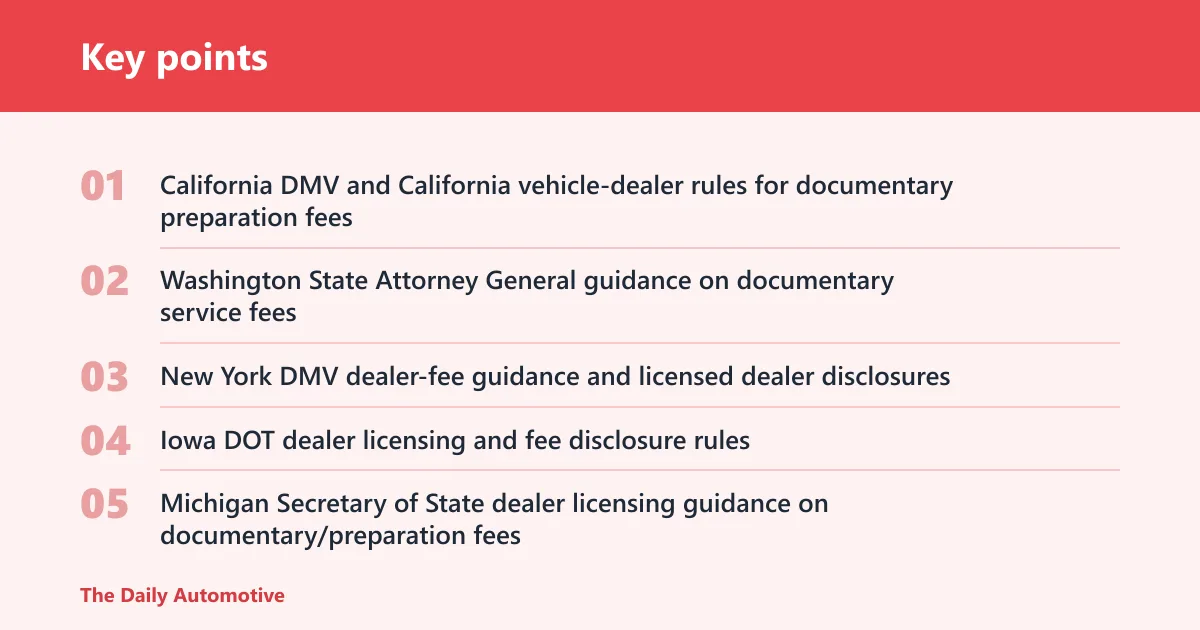
Examples commonly cited by state or dealer-licensing sources include California, Washington, New York, Iowa, Michigan, Minnesota, Texas, Maryland, Ohio, and Florida. The exact amount or structure can depend on the dealer’s license type, whether the charge is mandatory or optional, and whether the state treats a documentary service fee differently from a processing fee. Verify the current rule in your state before you use any advertised number in negotiations.
Capped states versus uncapped states
In capped states, a legal maximum gives you a clear ceiling to check against. In uncapped states, “normal” becomes a negotiation question rather than a legal one. The safest approach is to verify the cap or lack of a cap with an official state source, then compare the dealership’s number to that rule rather than to a competitor summary.
How dealers work around caps
A dealer can still try to collect more than the cap by renaming the charge or splitting it into two lines. That is where a processing fee deserves scrutiny. If one line says “doc fee” and another says “dealer processing,” ask whether both cover the same paperwork work. If the answer is yes, the second charge may be a duplicate rather than a separate service.
In capped states, watch for “prep,” “admin,” or “processing” fees that appear right beside the capped line. The label may change, but the math does not. A renamed fee can be a work-around, not a new service.
Sources for state-fee rules
- California DMV and California vehicle-dealer rules for documentary preparation fees
- Washington State Attorney General guidance on documentary service fees
- New York DMV dealer-fee guidance and licensed dealer disclosures
- Iowa DOT dealer licensing and fee disclosure rules
- Michigan Secretary of State dealer licensing guidance on documentary/preparation fees
- Minnesota Department of Public Safety dealer guidance on administration fees
- Texas DMV or Texas Department of Motor Vehicles dealer fee guidance
- Maryland Motor Vehicle Administration dealer-processing fee guidance
- Ohio Bureau of Motor Vehicles or Ohio dealer-licensing guidance on documentary service charges
- Florida Department of Highway Safety and Motor Vehicles dealer fee guidance
Which fees are fixed?
Title fee, registration fee, and sales tax are fixed in the sense that they are government charges, not dealer choices. They are not negotiable. A trade-in can reduce the taxable amount in some states, but that is a tax rule, not a dealer concession.
Title fee
The title fee pays for ownership transfer. It is a government charge. You can verify it on the contract, but you generally cannot bargain it down at the dealership.
Registration fee
The registration fee is also government-set and depends on state and vehicle details. The dealer may collect it, but the dealer does not control the amount. Ask for the exact figure and make sure it is not padded with another administrative charge.
Sales tax
Sales tax is mandatory and not negotiable. In some states, a trade-in lowers the taxable amount, which can lower the tax due. That is one of the few ways the tax line can move, and it depends on state law.
How to spot hidden duplicates
Hidden duplicates usually show up when one charge is renamed, split, or layered on top of another. The key is to compare the wording on every fee line. If a dealer lists a doc fee, a processing fee, and a prep fee, do not assume each one is separate.
Dealer processing fee versus doc fee
Dealer processing fee can be another name for a doc fee, or it can be a separate line that duplicates the same work. If the dealer claims both are required, ask for the exact service each line covers. In a capped state, that question matters even more.
Dealer prep fee versus destination charge
Dealer prep fee is not the same as manufacturer destination charge. Destination charge is usually a manufacturer shipping charge, while prep is a dealer-side line that may be optional or duplicative. If the dealer says prep is mandatory, ask why it is not already included in the vehicle price.
Add-on packages mixed into paperwork lines
Some stores slip add-on packages into paperwork with vague labels, then attach them to the same section as the doc fee. That can make the fee stack look smaller than it is. Read each line item, then ask whether the charge is required, optional, or already reflected in the advertised price.
Doc fee decision checklist
Use this checklist to pressure-test each line item before you sign. The question is not only whether the fee can move. It is also whether the charge is real, duplicated, capped, or better handled through the out-the-door price.
Mini flowchart:
Capped state? → Compare the fee to the official state maximum → If above cap, request a corrected contract; if under cap, check for duplicate labels.
Uncapped state? → Treat the fee as a negotiation point → Push the out-the-door price rather than the fee alone.
Duplicate-fee scenario? → Ask what each line covers in writing → Remove one fee or reduce the vehicle price by the same amount.
| Line item name | Usually negotiable? | Exact follow-up question to ask |
|---|---|---|
| Doc fee | Sometimes, but often fixed | “Is this fee capped in this state, and is it separate from any processing fee?” |
| Dealer processing fee | Sometimes; may be duplicative | “What service does this cover that is not already included in the doc fee?” |
| Dealer prep fee | Often negotiable or removable | “Is this optional, and is it different from the destination charge?” |
| Title fee | No | “What is the exact government title amount for this sale?” |
| Registration fee | No | “What registration amount are you collecting on my behalf?” |
| Sales tax | No | “What tax rate and taxable amount are you using here?” |
| Add-on package | Often yes | “Is this package required, and can you remove it from the deal?” |
What to do in capped and uncapped states
The right move depends on whether your state caps the fee, whether the dealer is using a duplicate label, and whether the deal has enough room to absorb the charge. If the fee is capped or duplicated, press on the paperwork. If it is legal and singular, push the total price instead.
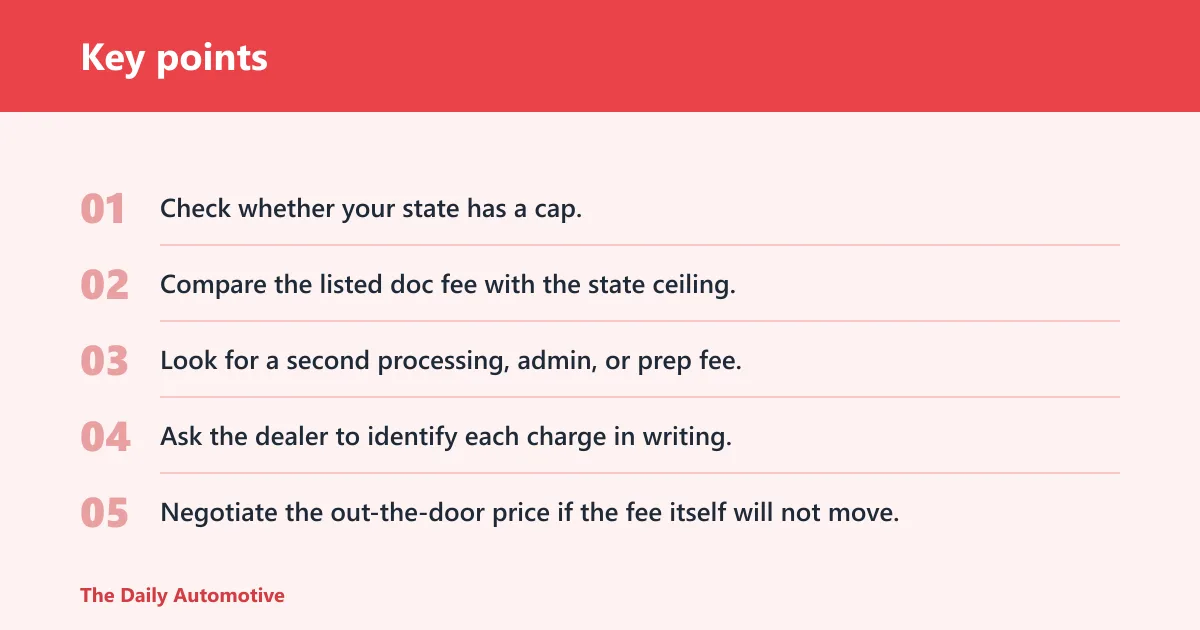
- Check whether your state has a cap.
- Compare the listed doc fee with the state ceiling.
- Look for a second processing, admin, or prep fee.
- Ask the dealer to identify each charge in writing.
- Negotiate the out-the-door price if the fee itself will not move.
Capped state decision path
If the state has a cap, compare the number on the buyer’s order to the legal maximum first. If the fee is above the cap, stop and ask for a corrected contract. If the number is under the cap, check for a renamed duplicate that pushes the total over the line. Confirm the rule with an official state source because fee rules change and dealer labels do not always match the law.
Uncapped state decision path
If your state has no cap, use market pressure. A fee in the low hundreds may be normal in some places, while a much higher charge deserves a challenge. Car and Driver notes that some dealerships charge less than $100 while others charge hundreds, so the benchmark is the local market, not the sticker alone.
Duplicate-fee decision path
If you see both a doc fee and a processing fee, treat that as a possible duplicate until the dealer explains the difference. If the dealer cannot explain it clearly, ask to remove one or lower the vehicle price by the same amount. Either result keeps the total in check.
Frequently asked questions
Can you negotiate doc fee car buying?
Sometimes, but not always on the line itself. The better tactic is to negotiate the out-the-door price, which lets the dealer absorb the doc fee through a lower vehicle price, a removed add-on, or a credit elsewhere in the deal. If the fee is duplicated or above a state cap, challenge it directly.
Are dealership doc fees negotiable?
Often they are treated as fixed, especially at high-volume stores. Even then, the total purchase price can move. Ask for the out-the-door number and compare offers across dealers. If one contract includes a lower vehicle price, that may matter more than a stubborn doc-fee line.
Are dealer document fees negotiable?
They can be, but that depends on the dealer and the state. In capped states, the real issue is legality and duplication, not just bargaining. In uncapped states, a lower total price is often the cleaner win. Either way, verify the paperwork before you agree to anything.
What is the dealer doc fee?
It is a dealer-added charge for paperwork handling and processing. It usually appears on the buyer’s order or purchase order and sits apart from government charges like title, registration, and sales tax. The fee amount varies by dealer and state, and some states cap it while others do not.
Does every dealership have a doc fee?
No. Many do, but not all use the same structure or the same label. Some stores list a doc fee, some call it a processing fee, and some roll the cost into the vehicle price. That is why the out-the-door figure matters more than any single line item.
Are dealer fees negotiable?
Some are, some are not. Sales tax, title, and registration are not negotiable government charges. Doc fees, processing fees, prep fees, and add-ons may be negotiable or removable, especially if they are duplicated or optional. Read the contract line by line and push on the total cost, not just one fee.
Products related to this article
Sponsored / affiliate links. As an Amazon Associate I earn from qualifying purchases. I may earn additional commission from eligible campaigns.
 GPS Tracker for Vehicles,1PCS GPS Tracker No Monthly Fee, Super Magnetic GPS Locator for Cars, Trucks with IP67 Waterproof Case, Precise Location Tracking, Stealth Tracking, iOS Only (White)
 GPS Tracker for Vehicles, 2PCS GPS Tracker No Monthly Fee, Super Magnetic GPS Locator for Cars, Trucks with IP67 Waterproof Magnetic Case, Precise Location Tracking, Stealth Tracking, iOS Only (Black)