Dust Cover for Car: Budge Lite vs. Disposable Plastic Covers
Choose Budge Lite for clean indoor storage and long-term dust control; use Disposable Plastic Covers only for very short, low-risk project protection. Choose wrong, and you can trap moisture, scuff paint, or replace a torn cover sooner than expected. This guide compares both by storage setting, moisture risk, fit, and cleanup so you can choose the safer option.
| Decision factor | Budge Lite | Disposable Plastic Covers | Winner |
|---|---|---|---|
| Material and paint contact | Single-layer polypropylene; soft, non-abrasive fabric for indoor dust protection | Often described as clear or transparent plastic film, typically suited to temporary or short-term use. | Budge Lite |
| Moisture management | A breathable indoor cover that allows air circulation. | Can trap condensation in enclosed spaces, especially in humid garages. | Budge Lite |
| Short-term project use | Better for repeated indoor storage, not masking overspray | Often better for overspray protection, polishing dust, and temporary garage work. | Disposable Plastic Covers |
| Fit and hold-down | Universal fit with elastic hem; better when the vehicle length is matched | Universal temporary fit; excess film can shift unless secured carefully | Budge Lite |
| Reuse and cleanup | Reinforced double-stitched seams support longer service life | Single-use or limited-use durability in PE plastic listings; more waste after short jobs | Budge Lite |
Which cover should you buy?
Budge Lite is often presented as a better pick for indoor dust control, while Disposable Plastic Covers make sense when you need temporary barrier protection for a project. Humidity, condensation, and short service life limit the plastic option to narrow jobs.
The real choice is not price alone. Storage time, garage humidity, and the car’s condition before covering all matter more.
Material and protection overview
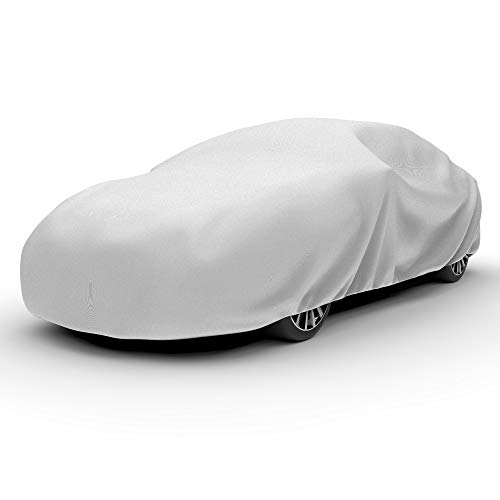
Budge Lite uses single-layer polypropylene. That matters because the listing is aimed at indoor storage, where dust control and paint safety matter more than waterproofing. The fabric is described as soft and non-abrasive, which fits long-term garage use better than a film that can shift and hold grit against paint.
Disposable Plastic Covers are clear or transparent plastic film meant for temporary or short-term protection. They can block dust accumulation and are sometimes described as protecting against rain, dirt, and dust. That is useful for masking and quick storage, but the same film can create a moisture problem when it sits over a car for days.
Why the material choice changes the risk
Polypropylene has the cleaner profile for repeated indoor storage because it is built around breathability, not sealing the car in a plastic shell. PE plastic is lighter and easier to deploy, but the tradeoff favors convenience for a short job, not durability for ongoing use.
Say your coupe sits in a dry garage and collects light dust each week. A breathable fabric cover keeps dust off without turning the car into a sealed box. Swap that same setup for plastic over several days in a humid space, and condensation becomes the issue you now have to manage.
Will a plastic car cover scratch paint?
Yes, it can, especially if dust, grit, or road film is already on the paint before the cover goes on. Plastic film does not cushion contamination the way a soft indoor fabric can. If the cover moves in the wind or shifts while you work around the car, the abrasion risk rises further.
That risk changes if the car is spotless and dry, but it does not disappear. In a humid garage, plastic can also trap condensation against the bodywork. If moisture builds under the film and sits there for days, the cover can turn a dust shield into a moisture trap.
Condensation is the part many listings skip
Clear plastic is easy to picture as a clean shield. It is less convenient when it seals in damp air from a humid garage or a car that was covered before it fully dried. That is why a disposable plastic cover is a poor match for multi-day storage in enclosed spaces.
A common first-timer mistake is to cover a freshly washed car with transparent plastic and leave it in a closed garage overnight. The finish may look protected at first, but any remaining moisture can sit under the film instead of evaporating.
How do breathability and moisture change the choice?
Breathability matters because air circulation helps reduce moisture buildup, musty odor, and the paint issues that come from trapped dampness. For indoor storage, that usually makes Budge Lite the safer default. A breathable cover can still be the wrong call, though, if the car is dirty or damp when you install it.
Disposable Plastic Covers block dust well, but they do not breathe in the same way. That is fine for brief masking or very short storage, not for sitting through changing garage humidity. If the air is already damp, a sealed film can concentrate the problem instead of solving it.
When breathable is better, and when it is not enough
Use breathable fabric when the car is clean, dry, and staying inside. That is the setup where dust control is the main task and moisture management matters most. If the vehicle is still wet, dusty, or needs bodywork, even a breathable cover may be a bad match until the surface is properly prepared.
Put another way, a breathable cover is not a substitute for cleaning the car first. It is a better long-term storage tool once the vehicle is already in good condition.
How do fit and securement affect real-world use?
Fit changes how well either cover works. Budge Lite uses an elastic hem and is sold as an indoor storage cover for broad vehicle use, including sedan and SUV applications when the length matches the car. Disposable Plastic Covers are also broadly sized, but universal fit can leave extra material to sag or shift.
Length matching matters because excess fabric or film can collect dust, rub trim, or slide out of place. A cover that is too loose is easier for air movement to disturb, especially if the vehicle is moved in and out of the garage.
Securement features are not all equal
Elastic hems help hold a cover around the lower edge of the vehicle. Hook-and-loop fasteners and buckles can add retention, especially in draftier garages or short outdoor exposure, but they are still secondary to proper sizing. If the cover is much longer than the vehicle, the extra material becomes a problem no fastener fully fixes.
For a sedan, check the manufacturer’s listing for the model length before buying. For an SUV, do the same. Universal fit is convenient, but it is not a precise fit, and slack fabric or film is more likely to move, wrinkle, and collect dust.
Car cover decision matrix
| Scenario | Choose | Why | Main failure risk |
|---|---|---|---|
| Dry climate-controlled garage | Budge Lite | Best for clean indoor dust control with low moisture risk | Loose sizing that lets dust gather under excess fabric |
| Humid garage | Budge Lite | Breathability helps reduce trapped moisture and odor buildup | Plastic film can trap condensation against the paint |
| Short-term project bay | Disposable Plastic Covers | Useful for overspray protection, polishing dust, and temporary masking | Film can abrade a dirty surface if it shifts |
| Multi-day temporary storage | Budge Lite | Better for repeated indoor use and lower moisture risk over time | Disposable film is more likely to fail from condensation or tearing |
Suppose a sedan sits in a climate-controlled garage for two weeks between weekend drives. Budge Lite fits the job because dust is the main issue and humidity is controlled. Swap in Disposable Plastic Covers, and the car may still be dust-free, but the risk profile gets worse without giving you any real storage advantage.
Choose Budge Lite if… / Choose Disposable Plastic Covers if…
Choose Budge Lite if the car is staying indoors, the surface is clean and dry, and you want a reusable cover that is soft, breathable, and better at reducing moisture buildup. It is the stronger pick for climate-controlled garages, humid garages, and storage that lasts more than a very short project window.
Choose Disposable Plastic Covers if you need temporary masking for overspray, polishing dust, or a short garage project and you accept that the cover may be single-use or limited-use. They are also the better call when you need a low-cost throwaway barrier for a one-off task and do not expect the cover to live on the car for days.
If the car will sit for multiple days, Budge Lite is usually the safer value because replacement frequency and waste can make disposable film the weaker choice even before moisture enters the picture. If the task ends the same day and cleanup matters more than reuse, Disposable Plastic Covers earn their place.

Frequently asked questions
Is a Budge Lite car cover better than a disposable plastic cover for dust protection?
Yes, for clean indoor storage. Budge Lite is the better dust-control choice when the car stays in a garage and you want breathable protection with lower moisture risk. Disposable Plastic Covers are better only when the job is temporary and you need a short-term barrier, not ongoing indoor storage.
Will a plastic car cover scratch my paint?
It can, especially if the paint is dusty, gritty, or not fully clean before covering. Plastic film can move across the surface and hold contamination in place. A clean, dry car lowers the risk, but it does not make plastic as paint-friendly as a soft indoor fabric cover.
Can I use a Budge Lite cover indoors in a garage?
Yes. That is the setting it is built for, and the construction is aimed at indoor dust protection. It is the safer choice for a garage because the cover can allow air circulation instead of trapping humidity against the bodywork.
When should I choose a breathable car cover instead of disposable plastic?
Choose breathable fabric when the vehicle will sit indoors for more than a short project, especially in a garage that is humid or only partly climate-controlled. Breathability helps reduce trapped moisture and musty odor. If the car is dirty or damp, clean and dry it first before covering.
Are disposable clear car covers reusable or single-use?
Some are sold in multi-packs and can be reused briefly, but PE plastic listings are often described as single-use or limited-use. That makes them practical for short masking or temporary storage, not for repeated long-term coverage.
What size cover do I need for my sedan or SUV?
Match the cover to the vehicle length rather than assuming a universal fit will be precise. Sedans and SUVs often need different lengths, and excess material can sag or shift. Check the manufacturer’s listing for your exact model before buying.
How do I keep dust and moisture from building up under a car cover?
Start with a clean, fully dry car, then choose a breathable cover for indoor storage. In a humid garage, avoid sealing the car under plastic for days. Secure the cover so it does not flap or shift, and remove it periodically if the storage situation changes.
Which cover is better for short-term storage or wrenching in the garage?
For short-term storage that lasts only a brief time, Budge Lite is usually safer if the car is clean and you want dust control with less moisture risk. For wrenching, polishing, or overspray protection, Disposable Plastic Covers are more practical because they are built for temporary, low-cost coverage and easy cleanup.
Products related to this article
Sponsored / affiliate links. As an Amazon Associate I earn from qualifying purchases. I may earn additional commission from eligible campaigns.