EverStart Car Battery Review: Which Tier Is Worth It?
Verdict: EverStart is a practical budget choice for daily driving, but the correct tier depends on climate and electrical load; for short trips, high heat, or many accessories, the cheapest EverStart is usually the wrong pick. Choose badly and you risk weak cold starts, shorter life, and a faster replacement cycle that wipes out the savings.
Pros and cons

EverStart can make sense when the battery fits the vehicle and duty cycle. The brand’s value comes from Walmart pricing, common fitment coverage, and tiered warranty support, but the low end is easiest to outgrow in cold weather, stop-and-go use, or vehicles with heavier electrical demand.
Pros
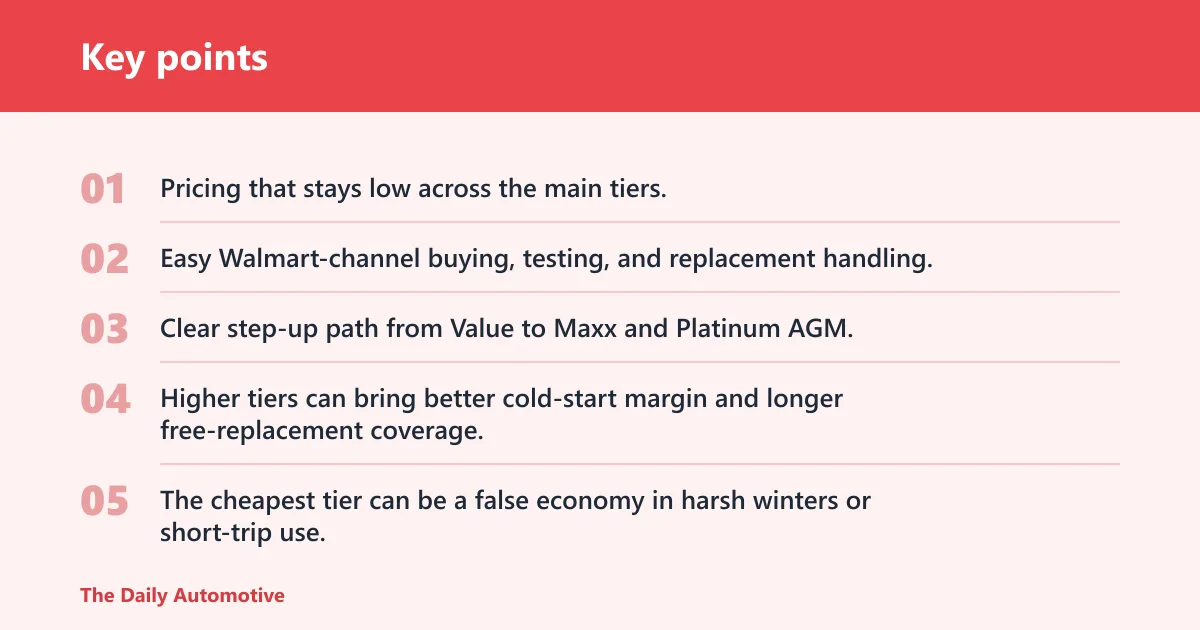
- Pricing that stays low across the main tiers.
- Easy Walmart-channel buying, testing, and replacement handling.
- Clear step-up path from Value to Maxx and Platinum AGM.
- Higher tiers can bring better cold-start margin and longer free-replacement coverage.
Cons
- The cheapest tier can be a false economy in harsh winters or short-trip use.
- Fitment mistakes are easy if you ignore group size, terminal layout, and hold-down style.
- Warranty handling can get annoying if the exact model changes or is out of stock.
- Lower tiers are a poor match for start-stop systems and high accessory loads.
Who is EverStart best for?
EverStart is best for budget-minded drivers who want a simple replacement for a conventional commuter car, truck, or SUV, especially when the vehicle’s electrical load is ordinary and the climate is mild. It is a weaker fit for frequent short trips, cold winters, start-stop systems, or vehicles with heavy accessory demand.
Daily commuters and budget shoppers
If your vehicle starts once or twice a day, runs a normal charge cycle, and uses standard electronics, the Value and Plus tiers can be enough. Match the battery to the car’s specified group size and keep the charging system healthy.
Cold-climate drivers
If winter cranking is part of the job, aim higher in the lineup and pay attention to CCA. A stronger battery in the correct group size helps more than chasing the lowest price tag. In freezing conditions, reserve margin matters.
Drivers with start-stop or high accessory load
Vehicles with start-stop, big infotainment screens, power seats, heated gear, or long idle periods are better candidates for Maxx or Platinum AGM. The cheapest tier is the easiest one to wear down with repeated partial charges and deeper discharges.
EverStart battery matrix
This is the buying table that matters on the shelf. Match the tier to use case, then confirm group size, CCA, reserve capacity, and warranty before you buy. The label can tell you more than the badge.
| Tier | Typical use case | Group-size examples | CCA / RC expectations | Warranty | Do not buy this tier if… |
|---|---|---|---|---|---|
| Value | Basic commuter replacement, mild climate, low accessory load | 24F is listed at 585 CCA | Mechanic Base cites 490 to 650 CCA; RC is usually the least forgiving on the lineup | 1-year free replacement | You have start-stop, short-trip use, cold winters, or repeated deep discharge |
| Plus | Middle-ground daily driving, moderate climate, ordinary electronics load | Common fitment ranges vary by vehicle; always verify the exact tray and terminals | Mechanic Base cites 525 to 750 CCA; RC is better than Value, but still not the top shelf choice | 2-year free replacement | You expect frequent winter cranking, heavy accessory use, or long idle periods |
| Maxx | Heavier daily use, colder weather, more accessories, better replacement margin | Often seen in sizes like 35N, H5/LN2/47, H7/LN4/94R, and 65 depending on the vehicle | Mechanic Base cites 370 to 900 CCA; one test sample was rated at 810 CCA | 3-year free replacement | You only need a bare-minimum starter battery and never see cold weather or accessory load |
| Platinum AGM | High-demand vehicles, frequent starts, vibration, and higher electrical loads | EverStart lists a Platinum AGM in H7 / LN4 / 94R with 850 CCA | AGM design is aimed at better vibration resistance, faster recharging, and extended cycle life | Verify the exact label; coverage can differ by model and store | You want the lowest price and do not need AGM features |
Group size examples, CCA, RC, and warranty at a glance
Group size decides physical fit first. CCA tells you how much starting force the battery can deliver in the cold. Reserve capacity, or RC, tells you how long it can keep accessories alive if the alternator quits. Warranty is the backup plan, not the main reason to buy.
That matters because a battery can look “strong” on CCA and still be a poor match if the case size, terminal placement, or hold-down do not fit the vehicle. The reverse is true as well: a perfect fit with too little reserve can still be the wrong battery.
Red-flag scenarios for each tier
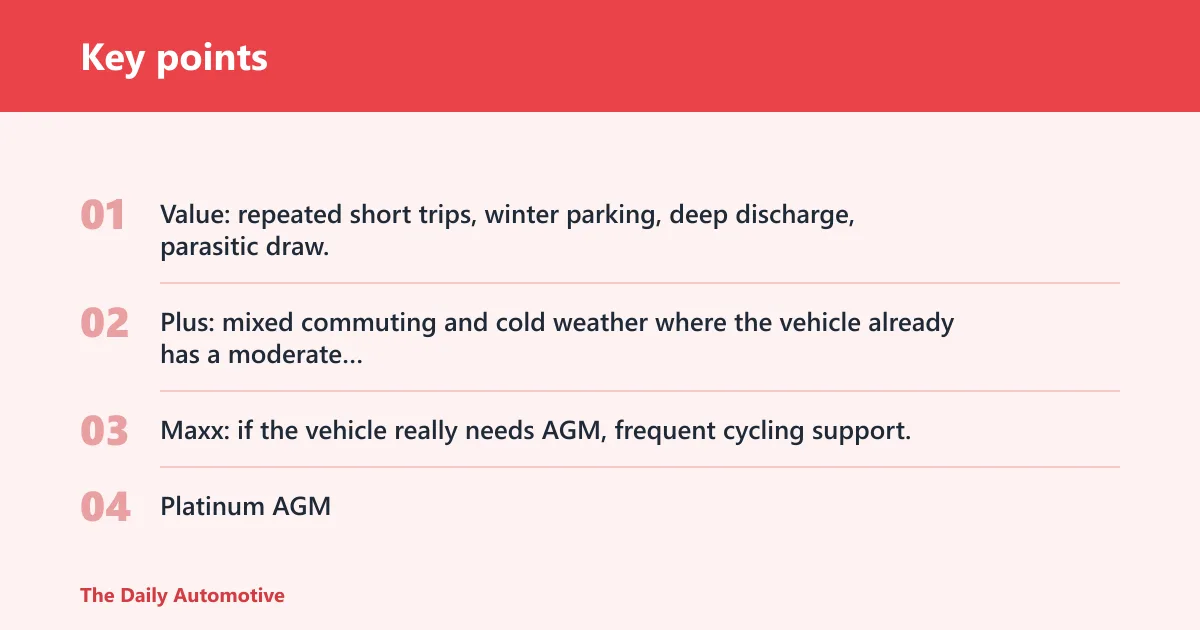
- Value: repeated short trips, winter parking, deep discharge, parasitic draw, or a vehicle with lots of electronics.
- Plus: mixed commuting and cold weather where the vehicle already has a moderate electrical load.
- Maxx: if the vehicle really needs AGM, frequent cycling support, or the highest possible reserve margin, move to Platinum AGM instead.
- Platinum AGM: if the vehicle is simple, lightly loaded, and used in mild weather, AGM may be more battery than you need.
What do CCA, RC, and group size mean?
CCA is the starting-power metric that matters most in cold weather. RC is the runtime cushion if charging stops. Group size is the fitment code that tells you whether the battery will physically work in the tray, with the correct terminals and hold-down points.
CCA for cold starts
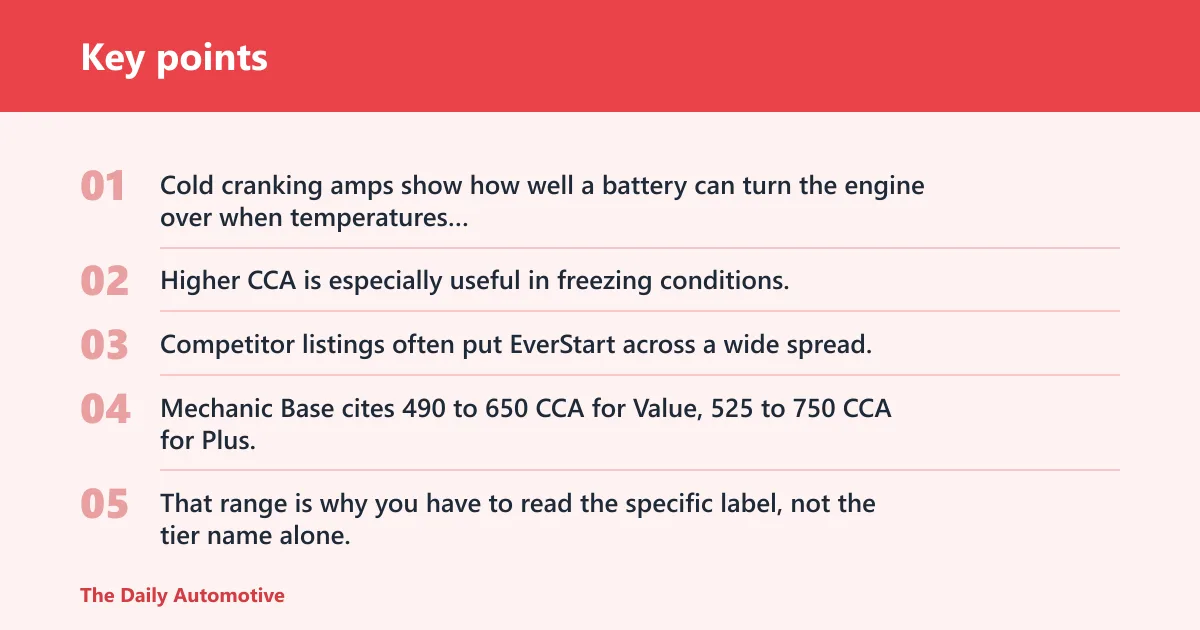
Cold cranking amps show how well a battery can turn the engine over when temperatures fall. Higher CCA is especially useful in freezing conditions, where battery output drops and the engine takes more effort to spin.
Competitor listings often put EverStart across a wide spread. Mechanic Base cites 490 to 650 CCA for Value, 525 to 750 CCA for Plus, and 370 to 900 CCA for Maxx. That range is why you have to read the specific label, not the tier name alone.
RC for backup runtime
Reserve capacity matters when the alternator is not doing its job or the vehicle sits with accessories on. A battery with better RC can tolerate a longer stall, longer idle, or more parasitic load before voltage falls off.
On the tested Maxx sample, the battery maintained 12.59 volts after a 30-minute load test drawing 42-44 amps. It also showed 3.48 milliohms of internal resistance and delivered 766 actual cold cranking amps at 0°F, which is the kind of reserve performance that makes a higher tier worth paying for in harsher use.
Why fitment starts with group size
Group size is not a technical detail to skip. A 24F battery will not necessarily work where a 65 or H7/LN4/94R belongs, and terminal layout can be just as important as the case dimensions. Check the owner’s manual, the old battery label, and the tray before you pay.
Say your sedan calls for H5/LN2/47 and you find a lower-priced battery in a different group with the same CCA. That is not a win if the posts sit wrong or the hold-down will not secure it. Fit beats price.
How EverStart compares with other brands
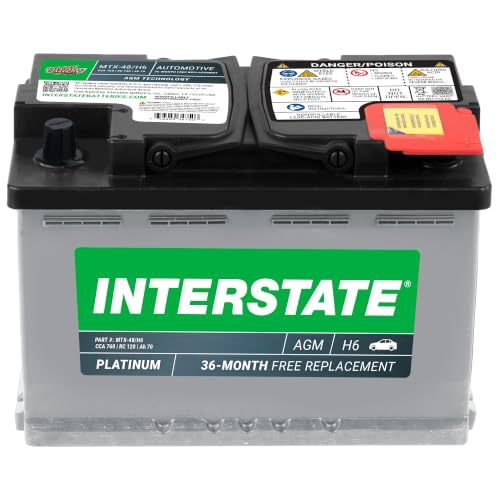
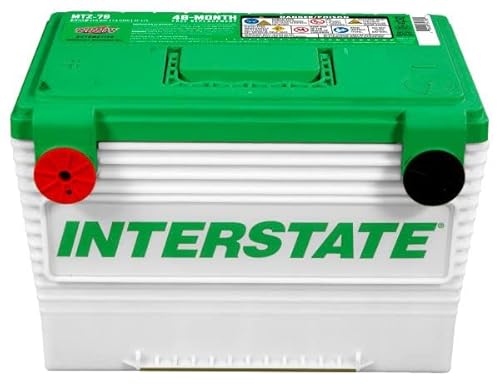
EverStart is usually judged on value, not prestige. Compared with a higher-priced nameplate like Interstate, EverStart can be the better buy when the vehicle is simple and the replacement path is easy. Interstate often makes more sense when you want broader channel support, a stronger premium lineup, or more tolerance for heavy use.
EverStart versus Interstate on value and replacement risk
The main trade-off is not badge quality alone. It is purchase friction versus service margin. EverStart’s Walmart-only channel makes the price easy to see, but it can also mean fewer exact models on hand, more substitutions, and more hassle if a specific group size is out of stock.
A cheaper battery only wins if it survives long enough to stay cheaper. If your driving pattern shortens life, or if the exact replacement is unavailable when failure hits, the price gap shrinks fast.
When paying more makes sense
Pay more when the vehicle asks for more. That includes start-stop systems, high accessory load, cold weather, or a history of short battery life. In those cases, the better match is usually Maxx or Platinum AGM, and sometimes a different brand altogether if the required fitment is hard to source.
What to check before you buy at Walmart
EverStart is sold through Walmart channels, so the buying experience is part of the value proposition. That can help with in-store testing and replacement handling, but it also means you should inspect the label closely. A store may have installation help, but exact-fit substitutions and warranty processing can still take time.
- Confirm the exact group size from the owner’s manual or the old battery label.
- Match terminal layout and hold-down style, not just the battery case size.
- Read the CCA number on the label and compare it with your climate and use pattern.
- Check RC if the vehicle idles a lot, sits for long periods, or carries many accessories.
- Verify the free-replacement term on the exact battery in front of you.
- Ask whether the store has the same model in stock before you remove the old battery.
- Keep the receipt and note the service date for warranty handling.
Suppose your SUV needs H7/LN4/94R and the shelf only has a similar-looking battery with a different group number. Waiting for the correct one is better than forcing an almost-fit battery into the tray. The wrong case or terminal layout can create a return problem before the battery ever starts the vehicle.
Walmart’s convenience cuts both ways. In-stock replacements are simple. Out-of-stock returns or warranty swaps are less simple, especially if the exact model has changed since the original purchase.
Frequently asked questions
Are EverStart batteries good?
Yes, for the right use case. EverStart is a practical budget choice for ordinary daily driving, especially in mild climates and vehicles with normal electrical loads. The answer changes if the car sees short trips, winter starts, or extra accessories; then the higher tiers are the safer buy.
Is EverStart a good battery brand?
It is a good budget brand, not a universal best-in-class pick. The lineup gives you clear steps up from Value to Maxx and Platinum AGM, but the brand’s real strength is matching price to ordinary use. It is less convincing when the vehicle asks for more reserve and cycle life.
Are EverStart Maxx batteries any good?
Yes. Maxx is the tier that most often makes sense when you want better cold-weather margin, stronger warranty coverage, and less replacement risk than the cheapest options. One tested sample was rated at 810 CCA, which is a serious number for a mainstream replacement battery.
How much is an EverStart car battery?
The main tiers sit at different price points: Value is priced around $60-70, Plus around $100-110, and Maxx around $130-150. That spread is why it pays to compare the actual label, not the badge alone. Platinum AGM pricing varies by fitment and store.
How long should an EverStart battery last?
Warranty life and service life are not the same thing. The free-replacement terms run 1 year, 2 years, or 3 years by tier, while Mechanic Base says EverStart batteries can last four to six years when properly cared for. Climate, charging health, and driving pattern can shorten or extend that.
What EverStart battery is best for cold weather?
Maxx is the safer pick for most cold-weather buyers, and Platinum AGM is better still if the vehicle has higher electrical demand or frequent starts. High CCA matters in freezing conditions, but the correct group size and a healthy charging system matter just as much.
What is the difference between everStart value, plus, maxx, and platinum AGM?
Value is the cheapest option with a 1-year free replacement warranty. Plus moves up to a 2-year term. Maxx adds a 3-year free replacement warranty and better reserve for tougher use. Platinum AGM uses absorbed glass mat construction for better vibration resistance, faster recharging, and longer cycle life.
Are Walmart car batteries reliable?
They can be, as long as you buy the right model and keep expectations tied to the tier. Walmart’s channel is convenient for testing and replacement, but reliability still depends on the exact battery, the store’s stock situation, and whether the vehicle’s electrical system is healthy.
Which battery is better, Interstate or EverStart?
Neither is automatically better. EverStart is usually the value pick, especially if price and quick Walmart replacement matter most. Interstate often makes more sense when you want a broader premium lineup or more headroom for demanding use. The better battery is the one that fits the car and the duty cycle.
Are everstart batteries good: yes, if you buy?
Yes, if you buy the right tier for the job. EverStart works well for everyday driving, but the low-cost model is not the right answer for short-trip use, cold starts, or heavy accessory loads. Match group size, CCA, and warranty to the vehicle before price becomes the deciding factor.
Is everstart a good battery brand: it is a good budget?
It is a good budget brand with clear tiering and Walmart convenience, but not a one-size-fits-all solution. The brand makes the most sense when you want a straightforward replacement and understand the trade-offs. If your vehicle is demanding, move up the lineup or compare against a premium alternative.
Products related to this article
Sponsored / affiliate links. As an Amazon Associate I earn from qualifying purchases. I may earn additional commission from eligible campaigns.