Schumacher Battery Charger Review
For most DIY drivers, the best Schumacher pick is a 6/12V automatic charger/maintainer with engine-start mode if you need dead-battery rescue; skip simple maintainers if you need recovery, not storage care. Buy the wrong unit and you can strand a sedan, overbuy for a motorcycle, or miss a battery fault that keeps coming back. This review breaks down Schumacher models by battery type, failure scenario, charging speed, boost help, and diagnostic features.
Verdict and best picks

Schumacher is a practical budget garage system when you match the model to the job. The lineup covers three needs: recovery after a dead battery, long-term maintenance, and basic diagnosis. That matters more than the logo on the case.
Best overall for dead-car emergencies
The SC1281 is the broadest pick for mixed-use owners because it combines 6-amp charging, a 30-amp boost, and a 100-amp engine start with a built-in battery and alternator test. It also handles 6V and 12V batteries, plus standard flooded, AGM, deep-cycle, and 12V lithium batteries.
Best for storage and maintenance
The SC1678 Rugged 2A is the cleanest storage and maintainer choice when speed is secondary. It is a 3-in-1 charger, maintainer, and reconditioner, outputs 2A, and supports 6V and 12V packs. That makes it better for seasonal batteries than for urgent roadside recovery.
Best for motorcycle or lithium use
The SC1678 fits smaller batteries well, while the SC1281 is the safer broader buy if you also need vehicle rescue. For 12V-only use, the SC1361 can handle emergency help with a 10-amp boost charge and 50-amp engine start, but it is not the right choice for 6V equipment or mixed-voltage garages.
Pros and cons
Schumacher chargers are usually good value when you buy the right category. Smart models use multi-stage charging, many include reverse-polarity or reverse-hookup protection, and several cover common battery types such as AGM, flooded, gel, and deep-cycle.
Pros
- Wide spread of roles: charging, maintaining, boosting, and engine-start assistance.
- Some models include battery and alternator testing.
- 6V and 12V support appears on several units.
- Select models support AGM, flooded, deep-cycle, gel, and 12V lithium batteries.
Cons
- Older manual Schumacher units are not the same as smart chargers.
- Some models are 12V only, which limits flexibility.
- Engine-start mode helps with cranking assistance, but it is not a standalone jump starter.
- Charging speed depends on amperage and battery size, so one model can feel slow on large batteries.
Who it’s for
Schumacher fits drivers who want one garage tool for battery care, recovery, and basic checks. It is a strong match for people who store a car over winter, keep a motorcycle on a tender, or want a charger that can tell them whether the battery or charging system is at fault.
It is a weaker fit for buyers who only need a tiny maintainer for a single small battery, or who want a pure jump starter and nothing else. A charger with engine-start mode still needs AC power and is not the same thing as a portable booster pack.
Suppose a sedan has sat for two weeks and now only clicks at the starter. A 6A smart charger can recover the battery more responsibly than a quick crank attempt, while a 100A engine-start mode can help once the battery has enough charge to accept it. The wrong maintainer-only unit would not solve that problem.
A common first-timer mistake is buying a 2A maintainer for a truck that routinely sits low after short trips. That unit can keep a healthy battery topped off, but it is a poor answer when the battery is already deeply discharged.
What a Schumacher charger actually does
Schumacher’s smart models use microprocessor-controlled multi-stage charging. That means the charger can change output as the battery fills, rather than pushing one fixed current the whole time. Older manual units are different: they do not manage the process in the same way and can be a poor fit for batteries that need careful charging.
Smart charging versus manual charging
Smart charging is the better category for most DIY users because it is more hands-off and better suited to common lead-acid battery types. Manual models can still have a place in a shop, but they are not the same product class, and buyers should not treat them as equivalent.
Maintenance, boost, and engine-start modes
Maintenance mode keeps a battery topped up during storage. Boost mode adds extra current to help a weak battery recover enough to accept a charge. Engine-start mode is high-current cranking assistance for a dead or deeply discharged battery. It is not a substitute for a jump starter, and it still depends on the charger being connected to AC power.
When a built-in tester matters
On select Schumacher chargers, a battery and alternator test can save money by separating battery failure from charging-system failure. That matters when a fresh charge does not fix the symptom, because the real problem may be the alternator, a parasitic draw, or a battery that can no longer hold voltage.
Schumacher battery charger buyer decision table
This table is the quickest way to sort the lineup by what it actually solves. Focus on battery support, output current, and the scenario you need to cover, not the model name alone.

| Model | Battery type support | Charge / boost / start amps | Estimated use case | Buy / skip verdict |
|---|---|---|---|---|
| SC1281 | 6V and 12V; standard flooded, AGM, deep-cycle, and 12V lithium | 6A charge, 30A boost, 100A engine start | Mixed-use garage tool for rescue, diagnosis, and storage care | Buy for dead sedan battery, winter storage, and truck starting; skip only if you need a tiny maintainer |
| SC1361 | 12V only | 2A to 6A charging, 10A boost, 50A engine start | Simple 12V household garage use | Buy for 12V-only cars and light rescue; skip for 6V batteries and mixed-voltage garages |
| SC1363 | 6V and 12V; standard battery support plus AGM | 8A to 2A charging | Maintenance, reconditioning, and desulfation work | Buy for storage and battery recovery; skip if you need engine-start help |
| SC1678 Rugged 2A | 6V and 12V packs; lithium LiFePO4 compatibility | 2A output | Motorcycle, seasonal, and low-rate maintenance charging | Buy for motorcycle maintenance and winter storage; skip for dead sedan emergencies |
| SC1667 | 6V and 12V; AGM, gel, and standard battery compatibility | 50A maximum charge, 250 cranking amps, 135-minute timer | Higher-current charging with timer-based control | Buy for bigger batteries and heavier-duty needs; skip if you want the simplest smart maintainer |
Scenario verdicts: sedan, truck, motorcycle, storage
- Dead sedan battery: SC1281 first, SC1361 second if you only need 12V support, SC1667 if higher current and timer control matter.
- Winter storage: SC1678 or SC1363, because maintain and recondition modes matter more than boost.
- Truck starting: SC1281 is the clearest fit because of the 100A engine start; SC1667 is better if you want 50A maximum charge and timer control in a heavier-duty charger.
- Motorcycle maintenance: SC1678, because 2A output and LiFePO4 compatibility suit small batteries better than a higher-output rescue unit.
How long does a Schumacher battery charger take?
Charging time depends on amperage, battery size, and how empty the battery is when you start. A 2A maintainer is slow by design. A 6A or 8A smart charger moves faster, while boost and engine-start modes are for short rescue help, not full battery recovery.
Amperage versus battery size
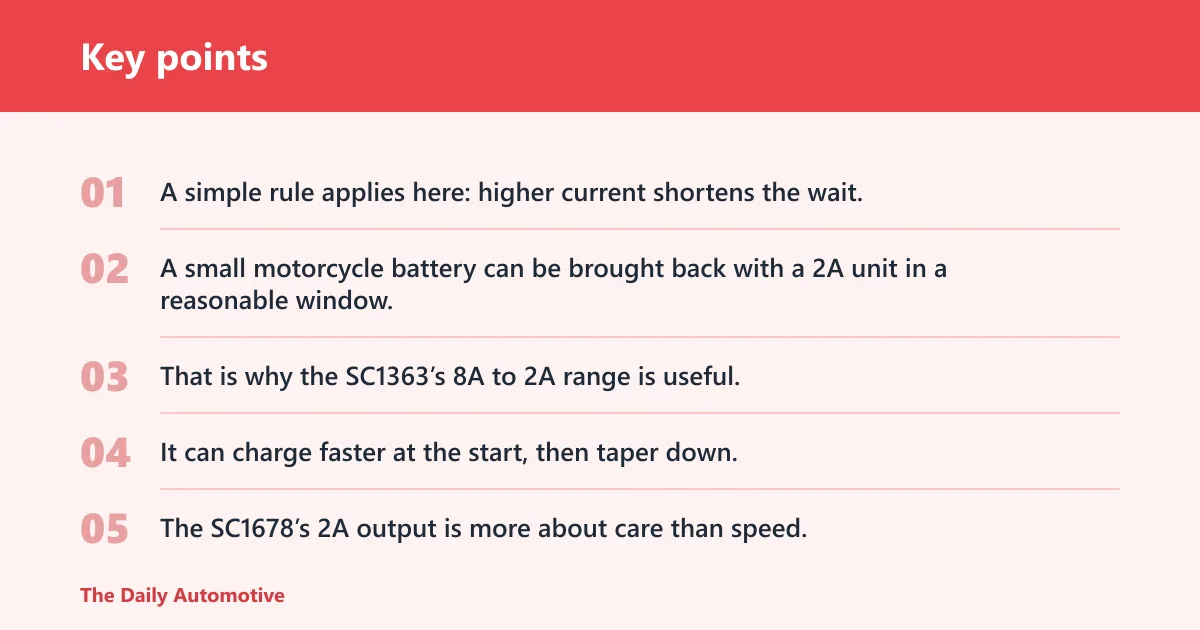
A simple rule applies here: higher current shortens the wait, but only up to the battery’s acceptance rate. A small motorcycle battery can be brought back with a 2A unit in a reasonable window, while a large truck battery may take much longer on the same charger.
That is why the SC1363’s 8A to 2A range is useful. It can charge faster at the start, then taper down.
Why a deeply discharged battery takes longer
A deeply discharged battery usually spends more time in the early part of the charge cycle, especially if the charger has to recover a weak battery before it can move into normal charging. If the battery was left flat for a long time, the charger may also need to spend time in recondition or desulfation mode.
Say a 12V SUV battery has been parked all winter and reads very low at the posts. A 6A charger may eventually recover it, but the process will not be quick, and the battery may still fail a load test after charging if it has aged out.
What the display can and cannot tell you
A charger display can show whether voltage is rising, whether the unit has moved into maintenance, and whether it thinks the battery is accepting charge. It cannot tell you, by itself, that the battery is healthy. A battery can look charged and still collapse under load.
Which Schumacher charger is best for a dead car battery?
If you only need 12V support, the SC1361 is a simpler choice. For higher-current charging, the SC1667 is worth a look.
SC1281 for mixed-use recovery and testing
This is the clearest all-rounder. The built-in battery and alternator test helps if the same battery keeps going flat, and the 6V/12V support plus lithium compatibility make it useful in a wider garage than a basic maintainer.
SC1361 for 12V-only engine-start help
The SC1361 offers 2A to 6A charging, a 10A boost charge, and 50A engine start, but it is 12V only. That makes it a practical budget pick for a car-focused garage that does not need 6V support.
SC1667 for higher-current charging and timer-based use
The SC1667 delivers 250 cranking amps, uses a 135-minute timer, and has a 50A maximum charge. It supports 6V and 12V output, with AGM, gel, and standard battery compatibility. It is the more utilitarian choice when you want heavier charging and a timer in one unit.
How do you check that it is working?
Start with the hardware, then verify the numbers. A Schumacher charger that is working should show sensible display behavior, secure clamp contact, and a battery voltage response that makes sense for the battery’s condition. If the reading looks wrong, confirm it with a multimeter.
Clamp and cable inspection
- Check that the clamps are tight and clean.
- Look for cracked insulation, bent jaws, or loose strain relief at the cable ends.
- Confirm that the charger is set for the correct battery voltage and chemistry.
- Make sure reverse-hookup protection is not being triggered by a bad connection.
Outlet and display sanity checks
Plug the charger into a known working outlet, then confirm that the display powers up normally and does not flash error behavior immediately. If the unit claims to be charging but the battery voltage never changes at the posts, suspect clamp contact, wrong settings, or a charger fault.
How to compare charger readings with a multimeter
Use a multimeter at the battery terminals and compare its reading with the charger’s display. The two do not need to match exactly, but they should be in the same neighborhood. If the charger says the battery is full while the multimeter still shows a low resting voltage after charging and a rest period, the battery may be weak or the charger may be misreading.
Frequently asked questions
Is Schumacher a good battery charger?
Yes, if you buy the right Schumacher category for the job. The brand makes budget-friendly smart chargers, maintainers, and rescue units with features such as reverse-hookup protection and, on some models, battery and alternator testing. The key is matching amperage and mode to the battery problem.
How does a Schumacher battery charger work?
On smart models, Schumacher uses microprocessor-controlled multi-stage charging. The charger can start with a stronger push, then taper into normal charging and maintenance as the battery fills. Some units also add boost or engine-start support, while older manual models do not manage charging the same way.
How do I know if my Schumacher battery charger is working?
Check that the clamps are secure, the outlet is live, and the display changes in a sensible way after connection. Then compare the charger’s voltage or charge status with a multimeter at the battery posts. If the numbers do not track reasonably, the battery or charger may be the problem.
How long does it take a Schumacher battery charger to charge?
It depends on amperage, battery size, and state of discharge. A 2A unit is slow but suited to maintenance, while a 6A or 8A model finishes much sooner on common car batteries. A deeply discharged battery always takes longer, especially if it needs recovery before normal charging.
Can a Schumacher charger test the alternator too?
Some Schumacher chargers can. The SC1281 includes a built-in battery and alternator test, which helps separate a weak battery from a charging-system issue. That feature is not universal across the lineup, so check the model before buying if diagnosis matters to you.
Products related to this article
Sponsored / affiliate links. As an Amazon Associate I earn from qualifying purchases. I may earn additional commission from eligible campaigns.