Golf Cart Seat Belts: A Genius Mod Or Dangerous Mistake?
Installing seat belts on a golf cart can be a smart safety upgrade, especially for carts driven on roads or with children. However, you should never use golf cart seat belts in a regular car like a 1971 Ford Maverick. They are not designed or tested to withstand car crash forces and would be extremely dangerous.
Hello! I’m Md Meraj, and I love helping people feel more confident with their vehicles. Today, we’re talking about something you might have wondered about: adding seat belts to a golf cart. Is it a brilliant safety move or a risky modification? You might even be thinking about using them for other projects, and we’ll cover that too.
It’s a common question, and for good reason! You want to keep your family safe, whether you’re cruising around the neighborhood or the back nine. Don’t worry, we’re going to break it all down. We’ll look at the good, the bad, and exactly how to do it right. Let’s get you the clear answers you need.
Why Even Consider Seat Belts on a Golf Cart?
Most golf carts roll off the factory line without seat belts. They are designed as low-speed vehicles (LSVs) for controlled environments like golf courses. But as more people use them for neighborhood transportation, the conversation about safety has grown. Let’s look at the main reasons people add them.
Keeping Passengers Secure
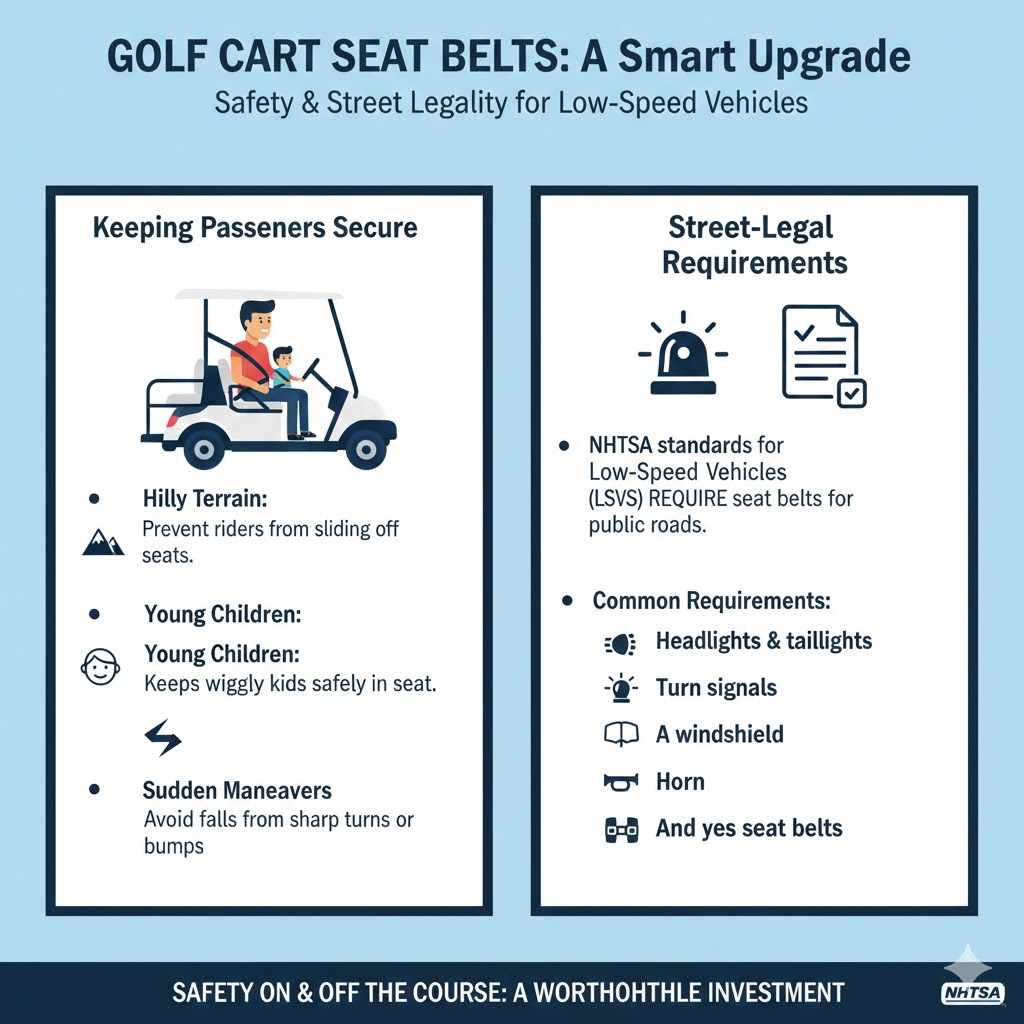
The biggest reason is simple: preventing falls. Golf carts lack doors, and a sharp turn, a sudden stop, or a bumpy path can easily eject a passenger. This is especially true for small children who may not hold on tightly.
- Hilly Terrain: If you live in an area with steep hills, seat belts provide peace of mind and real security, preventing riders from sliding off the seat.
- Young Children: A lap belt can keep a wiggly child safely in their seat, preventing them from standing up or falling out while the cart is moving.
- Sudden Maneuvers: Swerving to avoid a pothole, a pet, or another vehicle can create surprising force. Seat belts keep everyone planted.
Street-Legal Requirements
In many towns and communities, if you want to drive your golf cart on public roads, you have to make it “street legal.” The specific rules change from place to place, but they often include safety equipment you’d find in a car. According to the National Highway Traffic Safety Administration (NHTSA), federal standards for Low-Speed Vehicles require seat belts.
Common requirements for a street-legal golf cart often include:
- Headlights and taillights
- Turn signals
- A windshield
- Mirrors
- A horn
- And yes, seat belts
If you plan to use your cart for more than just golf, installing seat belts might not just be a good idea—it might be the law.
The Potential Downsides: A False Sense of Security?
While seat belts seem like a no-brainer, there are some arguments against them. It’s important to understand these points to make a fully informed decision.
The main concern is that a simple lap belt can create a false sense of security. A golf cart has no doors, no crumple zones, and a very light frame. In a serious collision with a car, a seat belt won’t protect you from the impact itself. Some argue that in a rollover, being thrown clear of the heavy cart and its batteries could be safer than being strapped to it. However, rollovers are less common than ejections from sharp turns or minor bumps.
Ultimately, for most common golf cart accidents (like falling out), a seat belt is a significant safety benefit. The key is to install them correctly and remember that a golf cart is not a car.
Types of Golf Cart Seat Belts
When you decide to add seat belts, you’ll find a few different options. Choosing the right one depends on your needs and budget.
| Seat Belt Type | Description | Best For |
|---|---|---|
| 2-Point Lap Belt (Non-Retractable) | A simple strap that goes across the lap. You have to manually adjust its length. This is the most common and affordable type. | Basic safety, keeping kids seated, and meeting minimal street-legal rules. |
| 2-Point Lap Belt (Retractable) | Works like a modern car’s seat belt. The belt retracts into a housing when not in use, keeping it clean and out of the way. | Convenience, a cleaner look, and users who prefer not to manually adjust the strap every time. |
| 3-Point Harness (Shoulder and Lap) | This style goes over the lap and across the shoulder, just like in your car. It offers more upper-body support. | Maximum safety, especially for carts that go faster or are driven on roads with other traffic. These are harder to install. |
For most users, a standard 2-point retractable lap belt offers the best balance of safety, convenience, and ease of installation.
How to Install Seat Belts on Your Golf Cart: A Step-by-Step Guide
Ready to add this safety feature yourself? It’s a very manageable DIY project. Most seat belt kits are designed for universal installation on major brands like Club Car, E-Z-GO, and Yamaha. Let’s walk through the process.
Step 1: Gather Your Tools and Materials
Having everything ready before you start makes the job go smoothly. You don’t want to be hunting for a wrench midway through.
Tool Checklist:
- Socket wrench set
- Drill and drill bits (the size will depend on your hardware)
- Screwdriver
- Measuring tape
- Marker or pencil
- Safety glasses
Materials Checklist:
- Golf cart seat belt kit (This should include belts, buckles, and all necessary mounting hardware like bolts, nuts, and washers).
- A universal mounting bracket (Most kits come with this, but check to be sure. It’s a metal bar that provides a strong anchor point).
Step 2: Access the Mounting Area
The seat belts need to be anchored to the cart’s frame, not just the plastic body or wooden seat base. To do this, you’ll need to access the area under the seat.
- Lift up or remove the bottom seat cushion. On most carts, it just lifts off.
- If you have a rear-facing seat, you will likely need to flip it up or unbolt it to access the frame underneath.
- Clean the area so you have a clear view of the frame and where you’ll be working.
Step 3: Install the Mounting Bracket
The mounting bracket is the most important part of the installation. It’s a sturdy metal bar that spans the width of the seat, providing a solid anchor point for the belts. Your seat belt kit’s instructions will have specific details, but here is the general process.
- Position the bracket across the frame under the seat. It should be placed so the seat belts will be in a comfortable position for the passengers.
- Mark the spots where you need to drill holes to attach the bracket to the cart’s frame. Use your marker for this. Double-check your measurements to ensure it’s centered.
- Put on your safety glasses. Carefully drill the holes through the frame at the spots you marked. Start with a smaller pilot hole, then use the correct size bit for your bolts.
- Secure the bracket to the frame using the bolts, washers, and nuts provided in your kit. Use your socket wrench to tighten them securely. The bracket should not move or wiggle at all.
Step 4: Attach the Seat Belts
With the bracket firmly in place, it’s time to attach the actual seat belts.
- The seat belt kit will have pre-drilled holes on the mounting bracket. These are where you will bolt the ends of the belts and the buckle receptacles.
- Attach the retractable mechanism (or the fixed end of a non-retractable belt) to one of the outer holes on the bracket.
- Attach the buckle end to one of the inner holes. If you are installing belts for two passengers, you’ll have four attachment points on the bar.
- Use the provided hardware to bolt each piece to the bracket. Make sure they are extremely tight. These bolts handle the force in a sudden stop.
Step 5: Test Everything
Before you put the seat back on, give everything a thorough test. This is a critical safety check.
- Pull sharply on each belt. It should hold firm. If it’s a retractable belt, a quick, hard tug should cause it to lock, just like in a car.
- Inspect your work. Check that every bolt is tight and that the bracket is securely attached to the cart’s frame.
- Put the seat cushion back in place and test the belts again. Sit down, buckle up, and make sure it feels comfortable and secure. The buckle should be easy to latch and unlatch.
Congratulations! You’ve just made your golf cart significantly safer for you and your passengers.
A Critical Warning: Never Use Golf Cart Seat Belts in a Car
Now we come to a very important question that some people ask: “Will 2-point retractable seat belts for a golf cart fit a 1971 Ford Maverick?”
The answer is an absolute, unqualified NO. It is a dangerously bad idea, and here’s exactly why.
1. They Are Not Built for Car Crash Forces
A car crash generates enormous forces. Seat belts in cars are designed, engineered, and tested to meet strict Federal Motor Vehicle Safety Standards (FMVSS). These standards, like FMVSS 209, dictate the strength of the webbing, the durability of the buckle, and the forces the mounting hardware must withstand.
A golf cart seat belt is designed to do one thing: keep you from falling out of a slow-moving vehicle during a sharp turn. It is not designed to restrain a 150-pound person in a 30 mph collision. The webbing would likely shred, the buckle could shatter, or the bolts could rip right out of their anchors.
2. Mounting Points Are Completely Different
Your 1971 Ford Maverick was built with reinforced steel mounting points welded directly into the chassis. These anchor points are engineered to distribute the massive force of a crash throughout the car’s frame. A golf cart seat belt kit is designed to be bolted onto a thin metal bracket, which is then bolted onto a lightweight golf cart frame.
Trying to attach a golf cart belt system to your Maverick’s floor pan would be a recipe for disaster. The hardware is not the right grade, and the mounting plates are not large enough to prevent the bolt from ripping through the sheet metal in an accident.
3. Two-Point vs. Three-Point Belts
By 1971, most cars, including the Maverick, came standard with 3-point seat belts (a lap and shoulder belt). This is for a crucial reason. A 2-point lap belt only restrains your hips. In a frontal crash, your upper body would whip forward violently, leading to severe head, neck, and chest injuries from hitting the steering wheel or dashboard.
Replacing a 3-point system with a 2-point lap belt is a major safety downgrade. Using a 2-point belt that isn’t even rated for automotive use is exponentially more dangerous.
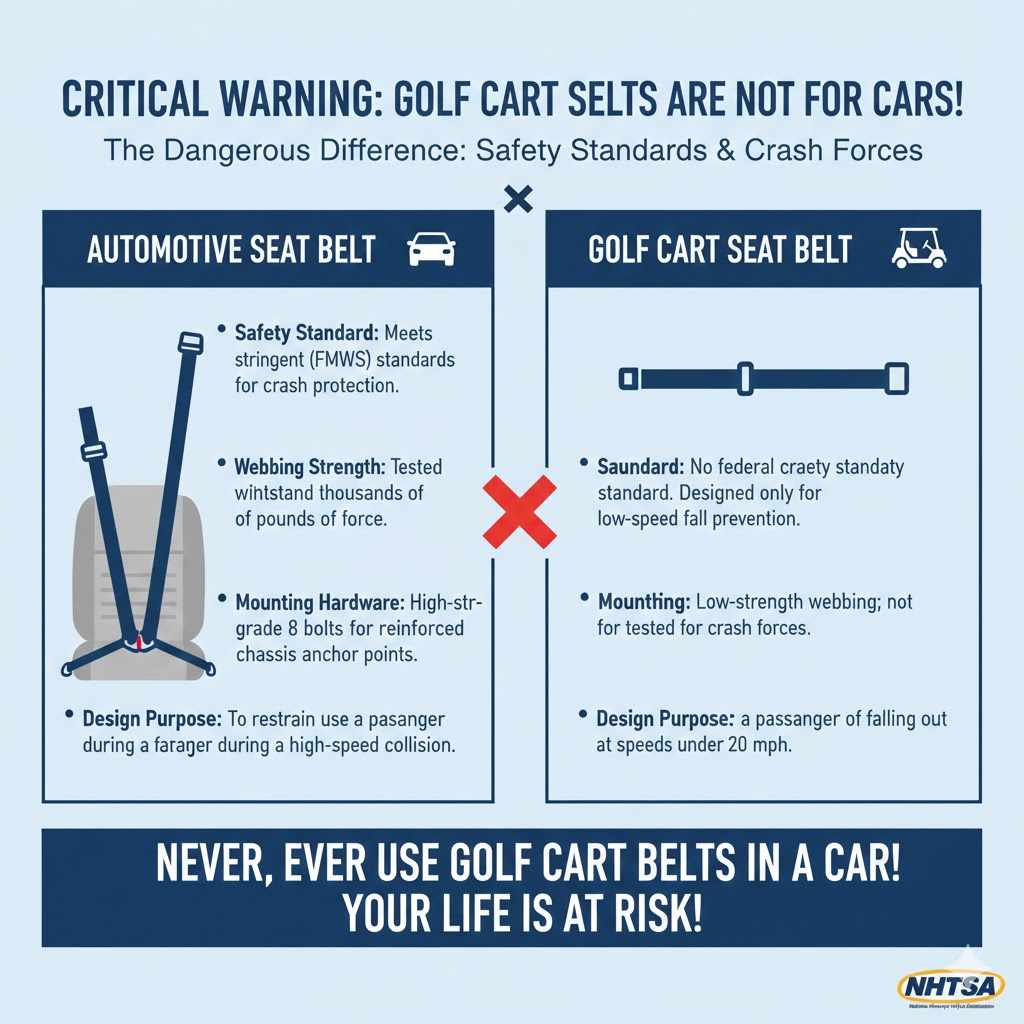
| Feature | Automotive Seat Belt (e.g., for a Ford Maverick) | Golf Cart Seat Belt |
|---|---|---|
| Safety Standard | Meets stringent Federal (FMVSS) standards for crash protection. | No federal crash safety standard. Designed only for low-speed fall prevention. |
| Webbing Strength | Tested to withstand thousands of pounds of force. | Low-strength webbing; not tested for crash forces. |
| Mounting Hardware | High-strength, grade 8 bolts designed for reinforced chassis anchor points. | Standard-grade bolts designed for a lightweight frame or add-on bracket. |
| Design Purpose | To restrain a passenger during a high-speed collision. | To prevent a passenger from falling out at speeds under 20 mph. |
If you need to replace the seat belts in your classic car like a 1971 Ford Maverick, you must buy proper, DOT-approved automotive replacement seat belts from a reputable classic car parts supplier. Never, ever substitute a part designed for a golf cart.
Frequently Asked Questions (FAQ)
1. Are seat belts required on all golf carts?
No, not on standard golf carts used on a golf course. However, they are often required if you want to register your cart as a Low-Speed Vehicle (LSV) to be driven on public roads. Laws vary by state and city, so always check your local regulations.
2. Can I install a 3-point (shoulder) seat belt on my golf cart?
Yes, but it is much more complex. A 3-point belt requires a secure anchor point high up on the vehicle’s frame for the shoulder strap. Most golf carts do not have this. It often requires welding a support bar or roll cage structure, making it a much more involved project than installing simple lap belts.
3. How much does a golf cart seat belt kit cost?
Prices vary, but you can typically find a complete kit for two people (including a universal mounting bracket) for $50 to $100. Retractable belts are usually a bit more expensive than non-retractable ones.
4. Do I need a professional to install them?
For most handy DIYers, this is a very doable project. The key is ensuring the mounting bracket is securely attached to the cart’s main frame, not just the body. If you are unsure or not comfortable drilling into your cart’s frame, it’s always best to hire a professional from a local golf cart shop.
5. How do I clean and maintain my new seat belts?
You can clean the webbing with mild soap and water. Avoid using harsh chemicals or bleach, as they can weaken the fabric. Periodically check that all the mounting bolts are still tight and that the retractors and buckles are working smoothly.
6. Will adding seat belts increase my golf cart’s value?
It can! In areas where street-legal carts are popular, having safety features like seat belts already installed can be a great selling point and may slightly increase its resale value.
7. What if my golf cart doesn’t have a metal frame under the seat?
Some older or more basic models may have different constructions. If you cannot find a solid metal frame to bolt the mounting bracket to, do not proceed. Attaching seat belts to the plastic body, wood seat, or thin sheet metal will provide no real protection as they will rip out under force.
Conclusion: A Smart Mod When Done Right
So, are golf cart seat belts a genius mod or a dangerous mistake? The answer is clear: when installed correctly on a golf cart, they are a genius safety modification. They provide a real, tangible benefit by keeping passengers, especially children, safely in their seats during the bumps and turns of a typical ride.
The “dangerous mistake” comes from misunderstanding their purpose. These belts are for low-speed fall prevention, not high-speed crash protection. Using them in any vehicle that travels at automotive speeds, like a classic Ford Maverick, is a life-threatening error. Always use parts that are specifically designed and tested for the vehicle you are working on.
For a small investment of time and money, you can make your golf cart a safer ride for everyone. Just follow the steps, use the right hardware, and always remember the limits of your vehicle. Happy and safe driving!