Kicker Car Audio Amplifier Review: Is It Worth It?
Choose a Kicker mono amp for one subwoofer at its RMS load, a 2-channel amp for front speakers, and a 4-channel or multichannel amp for full-system upgrades. Match RMS power to the speaker or sub load, not peak watts. Peak numbers can mislead. Mismatched power wastes money, clips early, and can overheat the amp or damage drivers. This guide compares Kicker amplifier types for bass, speaker upgrades, and budget builds, with space, heat, and wiring fit in mind.
This guide is part of our Car audio systems guide series.
Verdict

Based on the published specs and buyer feedback, Kicker’s amplifier lineup is worth buying when you match the channel count to the system, the RMS rating to the driver load, and the chassis size to the install bay. It is less compelling when you need a tiny footprint, very high output from a small electrical system, or a bargain amp that hides weak power claims behind inflated peak numbers.
Pros and cons
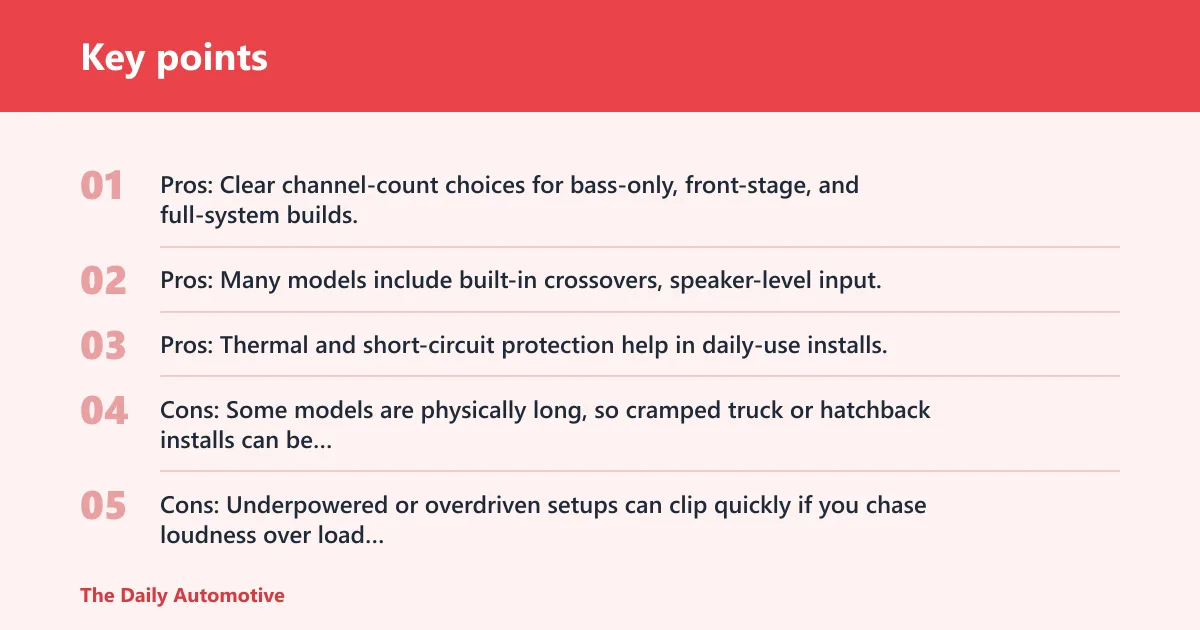
- Pros: Clear channel-count choices for bass-only, front-stage, and full-system builds.
- Pros: Many models include built-in crossovers, speaker-level input, and bass remote control support.
- Pros: Thermal and short-circuit protection help in daily-use installs.
- Cons: Some models are physically long, so cramped truck or hatchback installs can be tight.
- Cons: Underpowered or overdriven setups can clip quickly if you chase loudness over load match.
- Cons: Dealer verification matters, because counterfeit risk is real in gray-market listings.
Specs at a glance
| Spec | Kicker amplifier take |
|---|---|
| Channel count | Single-channel mono, 2-channel, 4-channel, and 5-channel options |
| RMS power output | Varies by model and load; match to speaker and sub RMS, not peak watts |
| Bridged power | Available on many multichannel amps for higher output to fewer speakers |
| Built-in crossovers | Common on Kicker amps; the ZX700.5 includes a 50Hz-200Hz crossover with a 24dB slope |
| Speaker-level input | Available on many models for factory-radio integration |
| Bass remote control | Supported on many subwoofer-focused amps |
| Protection | Thermal and short-circuit protection are key buying checks |
| Dimensions | Size varies by model; the ZX700.5 measures 9-5/8 in. x 2-1/8 in. x 20 in. |
Kicker says its car audio business has operated since 1973, and it continues to split the line into speaker, subwoofer, and amplifier families that target different installs. That matters because the right amp for a door-speaker swap is rarely the right amp for a sealed sub box.
Kicker also says prolonged amplified distortion can cause overheating and fire, so the safe answer is not “more watts.” It is the right load, the right gain setting, and enough clearance for airflow. Kicker says amplifier clearance can be up to 4 inches, recommends professional installation in its safety guidance, and warns not to cover amplifiers or subwoofers.
Kicker amp matching table
| Build type | Channel count | Target RMS range | Likely speaker/sub pairings | Installation risk | Who should skip it | Failure modes |
|---|---|---|---|---|---|---|
| Front-stage-only upgrade | 2-channel or 4-channel | 40W to 100W per channel at the speaker load | CS, DS, KS, or QS component/coaxial front pair | Low to medium; easiest in sedan or SUV dash-to-trunk runs | Skip if you only need sub bass, or if factory speakers will stay in place | Clipping if gains are pushed too far; impedance mismatch if bridged on the wrong load; overheating in sealed trim spaces |
| Sub-only build | Mono | Match the sub’s RMS rating closely | Comp, CompC, CompR, CompQ, Solo-Baric L7S, SoloX L7X, SoloXS L7XS | Medium; sub box volume and electrical draw matter | Skip if you want rear-seat fill or active front staging | Clipping from low-voltage headroom, overheating from poor airflow, impedance mismatch from the wrong coil wiring |
| Full-system daily driver | 5-channel | Front channels around 50W to 100W each, sub channel sized to one matched sub | Front CS/DS/KS/QS set plus one CompR or Solo-Baric L7S sub | Medium to high; wiring and chassis length can be tight | Skip if you need very high sub power or a tiny amp footprint | Clipping if the sub channel is underfed, overheating in cramped installs, impedance mismatch if the sub is wired below the amp’s safe load |
| Space-limited factory-radio upgrade | Compact 4-channel | Modest-to-mid RMS, matched to efficient speakers | DS or CS speakers with a simple four-speaker refresh | Low to medium; speaker-level input helps | Skip if the plan is one or two large subs | Clipping when low-sensitivity speakers are asked to play too loud; heat buildup if buried under trim |
Are Kicker amps good?
Kicker amps are good when you want a system-matched amplifier with clear output tiers, practical install features, and enough protection to live in a daily driver. They are ordinary when compared only on headline wattage, because the real value is in choosing the right channel count, crossover range, and load match.
What Kicker does well
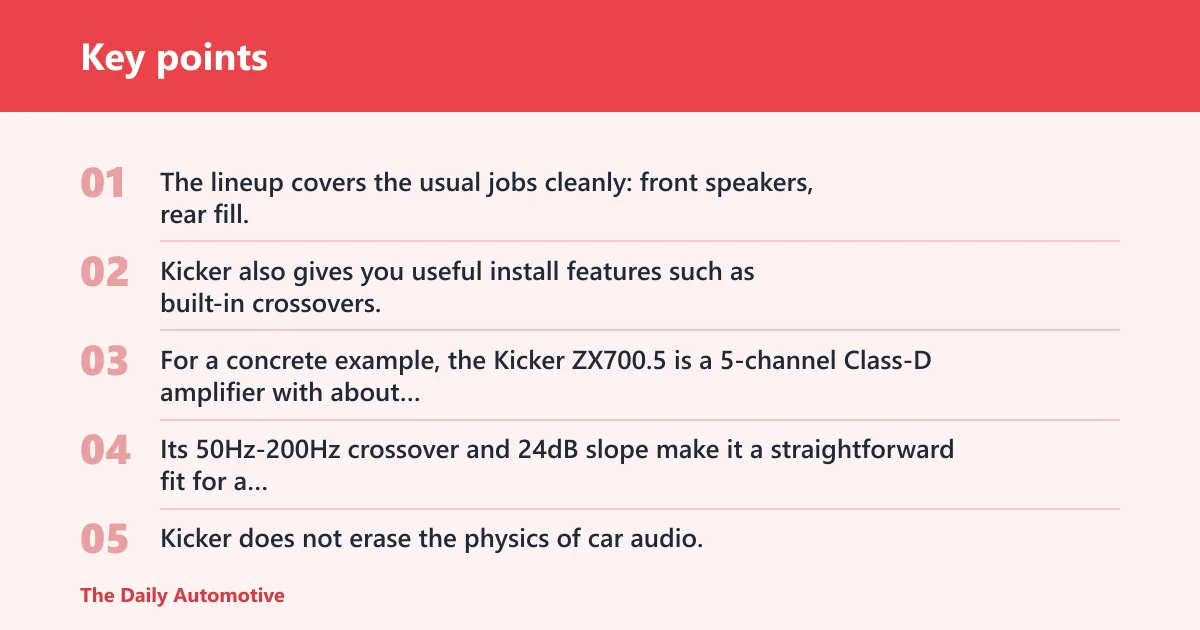
The lineup covers the usual jobs cleanly: front speakers, rear fill, one-sub bass systems, and full-system builds. Kicker also gives you useful install features such as built-in crossovers, speaker-level input on many models, and bass remote control support on bass-focused amplifiers.
For a concrete example, the Kicker ZX700.5 is a 5-channel Class-D amplifier with about 70W x 4 at 4 ohms, about 85W x 4 at 2 ohms, about 210W x 1 at 4 ohms, and about 420W x 1 at 2 ohms. Its 50Hz-200Hz crossover and 24dB slope make it a straightforward fit for a front-stage-plus-sub setup, especially when you want one chassis instead of two.
Where the lineup is ordinary
Kicker does not erase the physics of car audio. If a speaker is inefficient, if the wiring load is wrong, or if the amp is stuffed into a dead-air pocket, the result can still be thin output or heat buildup. Brand name does not fix clipped gain.
Say your hatchback only gives you a shallow under-floor cavity. A long 5-channel amplifier may fit on paper, but the thermal margin shrinks fast if the carpet and spare-tire cover block airflow. In that case, a shorter 4-channel plus separate mono amp can be the safer layout.
What spec checks matter before buying
Check RMS output at the actual load you plan to wire, not the biggest number on the box. Check whether the amp supports speaker-level input if you are keeping the factory radio. Check whether the amp includes a bass remote if you plan to trim sub level from the driver seat.
CEA-2006 compliance matters because it standardizes how amplifier power is measured, so the listed specs are more comparable across brands. That does not tell you everything about sound quality, but it helps you compare advertised output without relying on inflated peak claims.
Who it
Kicker amps fit budget upgrade shoppers who want a clear path from factory sound to a better system without overbuying channels or wattage. They also fit bass-focused systems that need a mono amp or a 5-channel layout with one matched sub. They are less attractive for buyers who need the smallest possible chassis or who plan to run unknown speaker loads.
Speaker and sub families to match
Kicker’s speaker tiers help you pick a sensible amp target. The CS series is positioned as power and value, the DS series as an ideal stock upgrade, the KS series as upscale quality, and the ST series for PA-style high output. The QS series sits above the typical stock-refresh tier and suits higher-end front-stage goals.
For subs, the Comp line is priced from $69.90 to $149.90, which points to entry and budget builds. The CompR line is rated from 300 to 800W RMS, and the Solo-Baric L7S line is rated from 450 to 1000W RMS. That puts the L7S into a stronger amp class than a basic Comp woofer, and it is one reason the amp choice has to track the sub choice.
What works
The best thing Kicker gets right is channel-count coverage. If you need a simple speaker refresh, a 2-channel or 4-channel amp gets the job done. If you want one chassis for front speakers and a sub, a 5-channel like the ZX700.5 is the obvious fit.
The second strength is built-in crossover behavior. A 50Hz-200Hz crossover range is useful for typical sub duties, and a 24dB slope helps keep bass duties away from the door speakers. That is not a luxury feature. It is basic system control.
Protection matters too. Thermal and short-circuit protection are not bragging rights; they are the features that can keep a mistake from turning into a dead amp. That still does not excuse bad wiring or a blocked heatsink, but it gives you a larger safety margin.
Authorized buying matters as much as the amp itself. Kicker says to use its dealer locator, verify purchase through authorized internet retailers, and treat counterfeit risk seriously. If a listing cannot be traced back to an authorized seller, the savings can disappear the moment the unit arrives with questionable support or spec claims.
What does not?
The weak point is fit, not brand. Kicker amps can be awkward in cramped installs when the chassis is long or when the enclosure leaves little airflow. The ZX700.5, for example, measures 9-5/8 in. x 2-1/8 in. x 20 in., so it is not a tiny hidden-install piece.
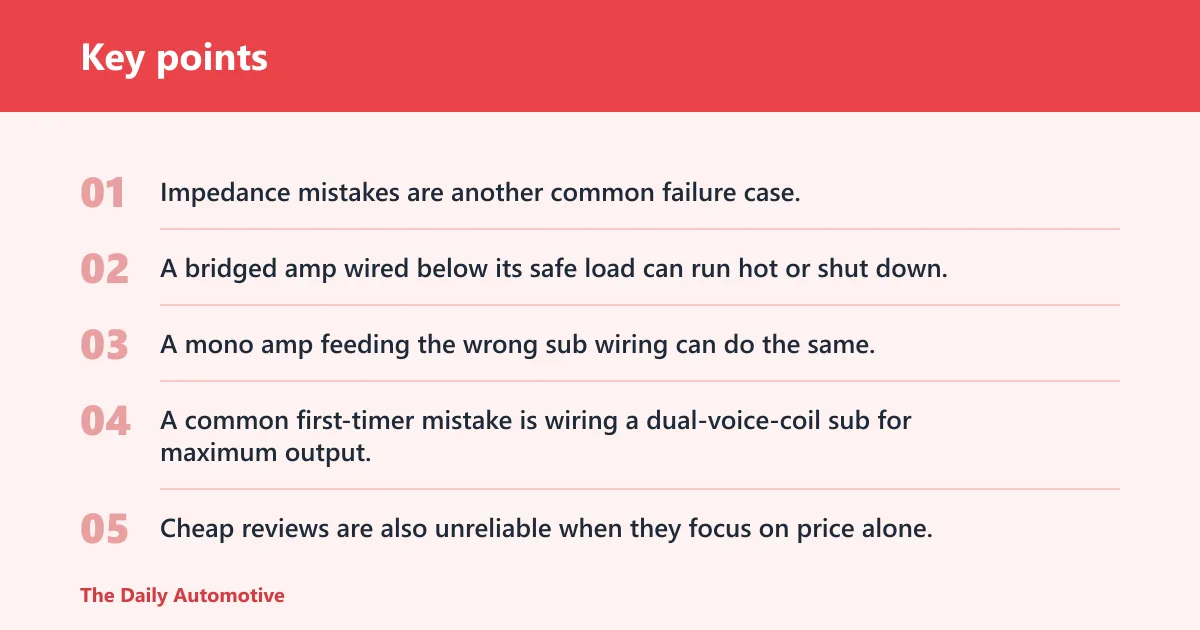
Impedance mistakes are another common failure case. A bridged amp wired below its safe load can run hot or shut down. A mono amp feeding the wrong sub wiring can do the same. A common first-timer mistake is wiring a dual-voice-coil sub for maximum output, then discovering the amp no longer likes the final load.
Cheap reviews are also unreliable when they focus on price alone. A low rating or glowing praise means little if the listing is not from an authorized retailer or if the specs are not CEA-2006 based. Check the stated RMS rating, the supported load, and the seller status before you buy.
How Kicker compares with Pioneer, Polk Audio, and JBL
Kicker is usually the better fit when the build starts with bass output, load matching, and upgrade path planning. Pioneer, Polk Audio, and JBL can make more sense if you are prioritizing a speaker set or a general-purpose head-unit ecosystem rather than a bass-centric amp family.
In similar budget bands, Kicker tends to read as the more system-directed choice: mono for subs, multichannel for fuller builds, with practical crossover and remote-control support. If your plan is a simple factory-speaker refresh and no sub, a competing amp package from Pioneer, Polk Audio, or JBL may be enough, especially if it fits the car more cleanly.
Alternatives

The BOSS Audio Systems R1002 is the cheaper-looking alternative on paper, with a 2-channel bridgeable layout that suits basic speaker or small-sub duties. Based on the manufacturer’s specs and buyer feedback, it can work in low-cost builds, but it is a narrower fit than a Kicker 4-channel or 5-channel amp, and it offers less room for future expansion.
Its main drawback is the class of install you should expect: it is a budget bridgeable amp, so you should be realistic about headroom, thermal margin, and long-term output consistency. If the goal is a matched Kicker-style system with stronger bass control and more precise channel planning, this is the less complete choice.
The Kicker IQ10001 Q Class monoblock is the stronger alternative when the job is one serious subwoofer and little else. It is a 1000W Q-Class monoblock, so it suits a dedicated bass build better than a speaker-and-sub all-in-one amp. The drawback is obvious: it does not solve front-stage amplification, and it may be overkill for smaller subs.
Choose this type only when the sub’s RMS demand and enclosure plan justify it. If your system needs door speakers, rear fill, and one bass channel in a single chassis, a 5-channel amp is the better match.
Should you buy it?
Buy a Kicker amp if your system plan is clear: one sub, a pair of front speakers, or a full setup that needs a known channel count and a known load. Skip Kicker if you are shopping by wattage alone, because the better buy is the amp that fits the driver RMS, the box wiring, and the available space.
For a 4-channel setup, start with a Kicker amp that can cleanly run your front and rear speakers at the load they present, then leave extra headroom rather than chasing peak output. For a 5-channel setup, the ZX700.5 is the most useful reference point here because it combines four speaker channels with a dedicated sub channel and an adjustable crossover.
Suppose you want a daily-driver hatch with front CS speakers and a single CompR sub. A 5-channel amp can keep the wiring simple and the layout tidy. Suppose the car is tight on space and the sub is a high-power L7S. In that case, a mono amp plus a separate 4-channel may be the cleaner answer.
Frequently asked questions
What makes a Kicker car audio amplifier worth buying?
It is worth buying when the amp gives you the channel count you need, the RMS range your speakers or sub can actually use, and extras like built-in crossovers, speaker-level input, and bass remote control. Those features matter more than a big peak-watt headline.
Which Kicker amplifier is best for a 4-channel setup?
The best 4-channel choice is the one that matches your front and rear speaker RMS rating at the final impedance you plan to wire. For stock upgrade jobs, a modest 4-channel that supports speaker-level input makes the most sense. For stronger front-stage builds, use a unit with clean crossover control.
Which Kicker amplifier is best for a 5-channel setup?
The Kicker ZX700.5 is the clearest reference point for a 5-channel setup.
How do I match a Kicker amp to Kicker speakers and subs?
Match the amp to the product family and the RMS range. DS is aimed at stock upgrades, CS at power and value, KS at upscale quality, and ST at high-output PA-style use. On the bass side, Comp is the lightest lift, while CompR and Solo-Baric L7S need more amp behind them.
Are cheap Kicker amp reviews reliable?
Not by themselves. Cheap reviews often ignore whether the seller is authorized, whether the specs are CEA-2006 based, and whether the reviewer matched impedance correctly. A low price can still hide a poor fit, a fake listing, or a setup that clips as soon as the gain is raised.
Do Kicker amps have built-in crossovers and bass remote control?
Many do. Built-in crossovers are common across the range, and bass remote control support is typical on sub-focused models. The exact control set varies by model, so check the listed features before you buy, especially if you need a factory-radio integration or a dash-mounted bass knob.
Are Kicker amps good for bass builds compared with Pioneer, Polk Audio, or JBL?
Yes, especially when the build centers on one or more subs and you want a dedicated mono or 5-channel path. Pioneer, Polk Audio, and JBL can be better if your main goal is a simple speaker refresh or a broader system bundle, but Kicker is usually more direct for bass-first planning.
Products related to this article
Sponsored / affiliate links. As an Amazon Associate I earn from qualifying purchases. I may earn additional commission from eligible campaigns.