Bike Carrier for Car Hitch: Types, Sizing and How to Choose
A bike carrier for a car hitch slides into your vehicle’s trailer hitch receiver and holds one to five bikes off the ground, without needing roof access or trunk space. Prices run from about $100 for a basic 2-bike platform rack to $250-$400+ for a heavy-duty model rated for e-bikes.
The right choice depends on two things most buyers overlook until it is too late: your car’s hitch class (a 1.25-inch Class I receiver cannot take the same rack as a 2-inch Class III receiver), and the actual weight rating of the rack itself, which is a separate number from your hitch’s towing capacity. Get either one wrong and the rack either will not fit or will not safely hold the bikes you own.
This guide covers the three hitch rack types, how to match a rack to your hitch class, how much weight they really hold, installation and theft-security basics, and how hitch-mounted racks compare to roof and trunk options.
What Is a Bike Carrier for a Car Hitch?
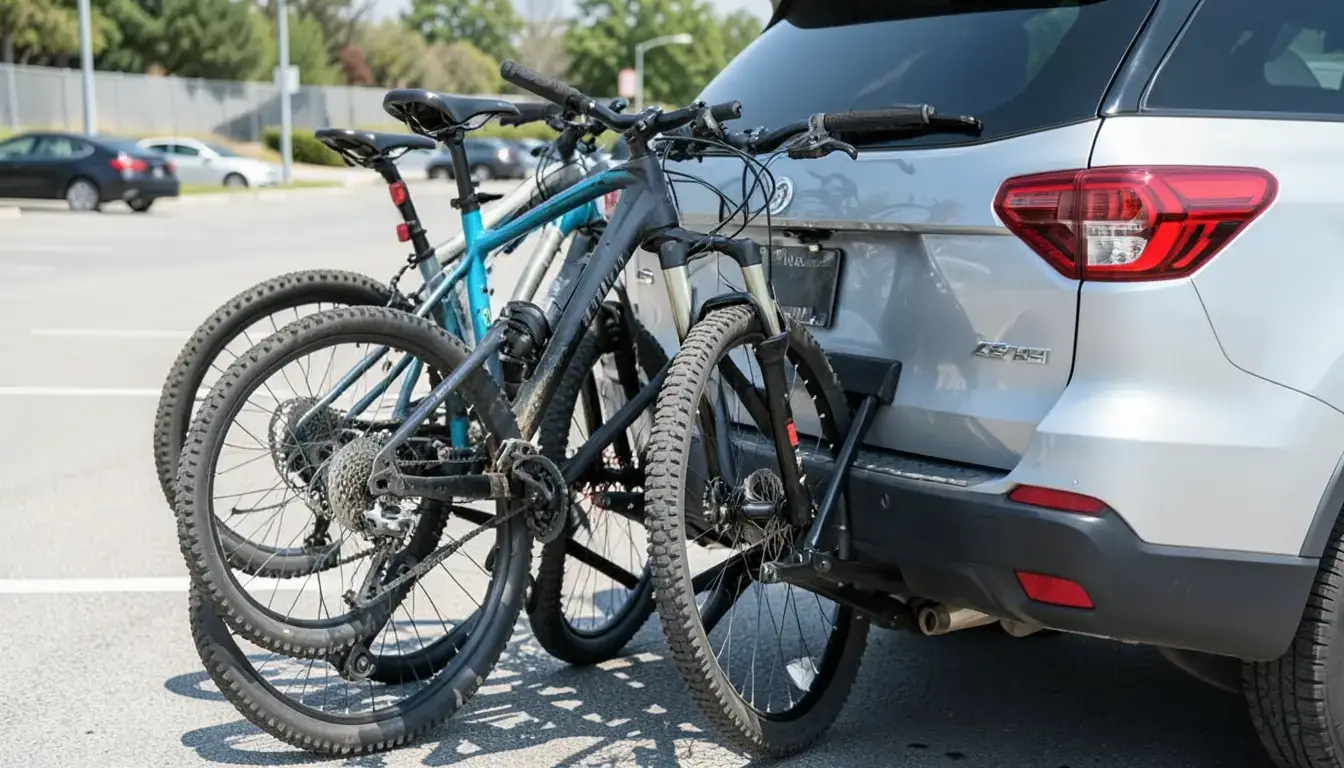
A hitch-mounted bike carrier is a rack that inserts into the 1.25-inch or 2-inch square receiver tube on the back of a car, truck, or SUV and locks in place with a hitch pin. The bikes attach to the rack itself, not to the car, so there is no risk of the frame-scraping or bumper-scratching that comes with trunk-mounted straps. Because the rack sits low and behind the vehicle, it also does not add height, which matters if you park in a garage or drive under low clearances.
Most hitch racks fall into one of three designs: hanging racks that hold bikes by the frame, platform racks that support bikes by the wheels, and vertical racks that clamp the front wheel and stand each bike upright. Each trades off differently on price, frame protection, and how many bikes it can carry.
Solid 2-Bike Platform Pick
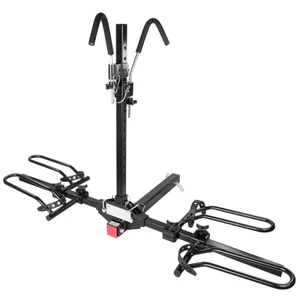 |
MaxxHaul Platform Bike Rack for 2 Bikes – $109.99 A platform-style rack like this holds bikes by the wheels instead of the frame, which is the type this guide recommends for most 2-inch Class III/IV receivers.
|
The 3 Types of Hitch-Mounted Bike Racks
All hitch racks accomplish the same basic job, but they hold the bike differently, and that difference affects price, weight limits, and how easy loading is.
| Type | How It Holds the Bike | Typical Capacity | Best For |
|---|---|---|---|
| Hanging (arm) | Suspends the bike by its top tube | 2-5 bikes | Budget buyers with standard-frame bikes |
| Platform (tray) | Wheels sit in trays, frame is untouched | 1-4 bikes | E-bikes, carbon frames, mixed frame styles |
| Vertical | Clamps the front wheel, bike stands upright | 4-6 bikes | Groups hauling many bikes on one hitch |
Hanging racks are the cheapest option and work fine for standard road or hybrid bikes with a horizontal top tube, but they can scratch paint on step-through or full-suspension frames that were not designed to hang from that point. Platform racks cost more but never touch the frame, which is why most e-bike and carbon-frame owners choose them despite the higher price. Vertical racks are the space-efficient choice when you need to carry four or more bikes without a trailer, since each bike takes up only its own width instead of stacking depth.
Which Hitch Class Do You Need?
Bike racks are built for one of two receiver sizes: 1.25 inches or 2 inches. The receiver size is tied to your vehicle’s hitch class, and mismatching them is the single most common reason a rack does not fit.
| Hitch Class | Receiver Size | Typical Tow Rating | Common On |
|---|---|---|---|
| Class I | 1.25 inch | Up to 2,000 lbs | Sedans, coupes, small crossovers |
| Class II | 1.25 inch | Up to 3,500 lbs | Midsize sedans, crossovers, minivans |
| Class III | 2 inch | Up to 8,000 lbs | SUVs, minivans, trucks – most common for bike racks |
| Class IV | 2 or 2.5 inch | Up to 10,000-12,000 lbs | Full-size trucks and SUVs |
Class I and Class II hitches use a smaller 1.25-inch opening, which limits you to lighter 1- or 2-bike racks rated for that size. Class III and Class IV hitches use the larger 2-inch opening and can run heavier 4- and 5-bike racks, including most platform and e-bike-rated models. A reducer sleeve can let a 2-inch rack fit into a 1.25-inch receiver, but doing so lowers the rack’s effective weight rating, so it is only a fallback, not a first choice.
If you do not already have a hitch installed, check your owner’s manual or a hitch-fitment tool by your vehicle’s year, make, and model before buying either the hitch or the rack — installation typically runs $100-$250 for parts and labor on a vehicle that does not already have a factory tow package.
How Many Bikes and How Much Weight Can It Actually Hold?
Here is the mistake a lot of buyers make: they assume their hitch’s tow rating and the bike rack’s weight rating are the same number. They are not. Your hitch’s tow rating (2,000-12,000+ lbs, depending on class) describes how much a trailer being towed behind the vehicle can weigh. The bike rack’s weight rating is a much smaller, separate figure set by the rack manufacturer, and it is the number that actually matters when you are loading bikes.
- 2-bike platform racks typically top out around 120-180 lbs of total bike weight, or roughly 60-90 lbs per bike.
- 4-bike hanging racks usually cap around 140 lbs total, meaning 35 lbs per bike on average — fine for most road and hybrid bikes, tight for anything heavier.
- E-bike-rated platform racks are built for 50-70 lb bikes and commonly rate 180-200 lbs per bike, often with a fold-down ramp since e-bikes are too heavy to lift onto a standard tray.
If your bikes are heavier than average — e-bikes, full-suspension mountain bikes, or fat-tire bikes — a standard hanging rack is the wrong choice regardless of how many bikes it claims to hold. For that situation, see our heavy-duty bike rack roundup, which covers racks specifically rated for e-bikes and fat tires up to 5 inches wide.
Installing and Locking a Hitch Bike Rack
Most hitch racks install without tools in under five minutes once the hitch itself is in place, but skipping any of these steps is how racks come loose on the highway.
- Slide the rack’s shank fully into the receiver tube until the holes line up.
- Insert the hitch pin through both holes and secure it with the attached clip, or use a locking hitch pin for theft resistance.
- Tighten any anti-wobble bolt or cam lever built into the rack — this is what stops the rack from rattling at speed.
- Load bikes heaviest-to-lightest if the rack allows it, since this keeps the load balanced closer to the vehicle.
- Strap down both wheels and the frame, then tug on each bike to confirm nothing shifts before pulling out of the driveway.
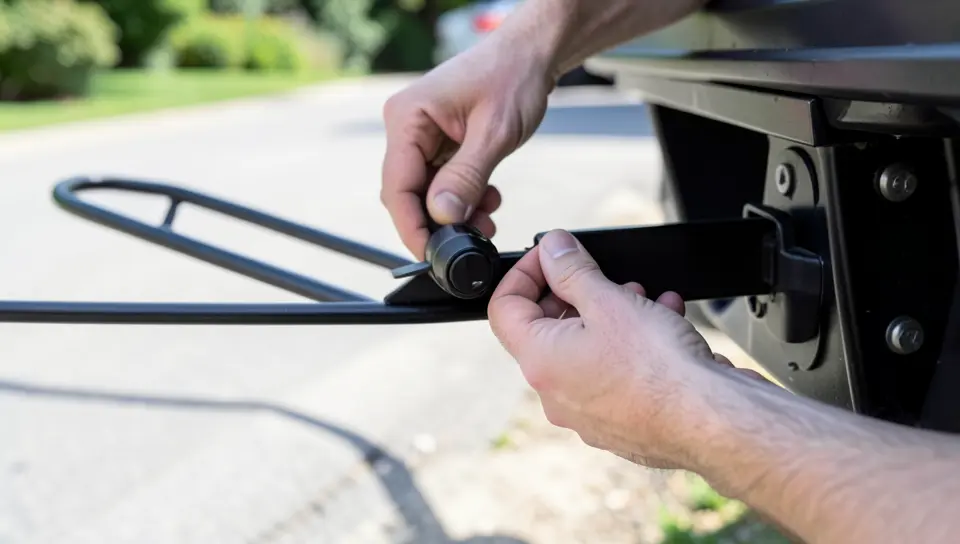
A basic hitch pin with a plastic clip works, but a locking hitch pin (usually $15-$30) does two jobs at once: it deters someone from unbolting the rack itself, and most models also let you loop a secondary cable lock through the bike frames. Neither replaces a proper bike U-lock if you are leaving the car unattended for more than a quick stop.
Hitch-Mounted vs. Roof-Mounted vs. Trunk-Mounted Racks
Hitch racks are not the only option, and they are not always the right one. Here is how the three main styles compare.
| Style | Typical Cost | Fuel Impact | Requires |
|---|---|---|---|
| Hitch-mounted | $100-$400 | Low | A hitch receiver |
| Roof-mounted | $150-$500+ | Higher (wind drag) | Roof rails or crossbars |
| Trunk-mounted | $40-$100 | Minimal | Nothing extra — straps to the trunk or hatch |
Hitch racks generally win on ease of loading, since you are not lifting a bike overhead, and on fuel economy compared to roof racks, since less of the bike sits in the wind. Roof racks free up the space behind the car and clear the way to still use a trailer hitch for towing, but they do add measurable wind noise and a small fuel-economy penalty on longer drives — see our guide on installing a car roof rack if that is the direction you are leaning. Trunk-mounted racks are the cheapest entry point and need no permanent hardware, but the straps sit directly against your paint and rear glass, which is the trade-off most hitch-rack buyers are trying to avoid in the first place.
Frequently Asked Questions
What Size Hitch Do I Need for a Bike Rack?
Most bike racks are built for either a 1.25-inch (Class I/II) or a 2-inch (Class III/IV) receiver. Check your vehicle’s hitch class before buying, since a rack sized for a 2-inch receiver will not fit a 1.25-inch opening without a reducer sleeve, and using one lowers the rack’s rated capacity.
How Many Bikes Can a Hitch Rack Hold?
Most hitch racks hold 2 to 4 bikes, though vertical-style racks can carry up to 6. The real limit is total weight, not just the number of slots — a rack rated for 4 lightweight road bikes may not safely handle 2 heavy e-bikes.
Do Bike Carriers Fit All Car Hitches?
No. A rack is built for one receiver size, either 1.25 inches or 2 inches, and will not fit a hitch of the other size without an adapter. Always check the rack’s listed receiver size against your vehicle’s hitch class before ordering.
Are Hitch Bike Carriers Safe to Drive With?
Yes, when installed and loaded correctly. Use a locking hitch pin, tighten any anti-wobble mechanism, and strap both wheels and the frame before driving. Most states also require a rear light and visible license plate if the rack blocks either one, so check local rules if the rack fully covers your plate.
Can I Still Open My Trunk or Tailgate With a Hitch Rack?
It depends on the rack. Many platform and hanging racks include a tilt-away or swing-away feature that lets the loaded rack pivot down and away from the vehicle, clearing the trunk or tailgate without removing any bikes. If a model does not list a tilt or swing-away feature, assume it blocks rear access while bikes are loaded.
How Much Does a Hitch Bike Rack Cost?
Basic 2-bike hanging or platform racks start around $100-$180. Sturdier 4-bike platform racks typically run $180-$300, and heavy-duty racks built for e-bikes or fat tires, often with a loading ramp, run $250-$400 or more. Add $100-$250 if your vehicle needs a hitch installed before you can mount a rack at all.
Conclusion
A hitch-mounted bike carrier is worth the setup cost if you are hauling bikes more than a couple of times a year: it keeps the frame off your paint, loads faster than a roof rack, and, once you match it to the right hitch class and weight rating, it is one of the more reliable ways to move bikes without a trailer. Confirm your receiver size first, then pick platform over hanging if you own an e-bike or a carbon frame, and check the rack’s actual weight rating rather than assuming it matches your hitch’s tow rating.
Products related to this article
Sponsored / affiliate links. As an Amazon Associate I earn from qualifying purchases. I may earn additional commission from eligible campaigns.