Hot Wheels Flippin Fast: The Real Autism-Friendly Design
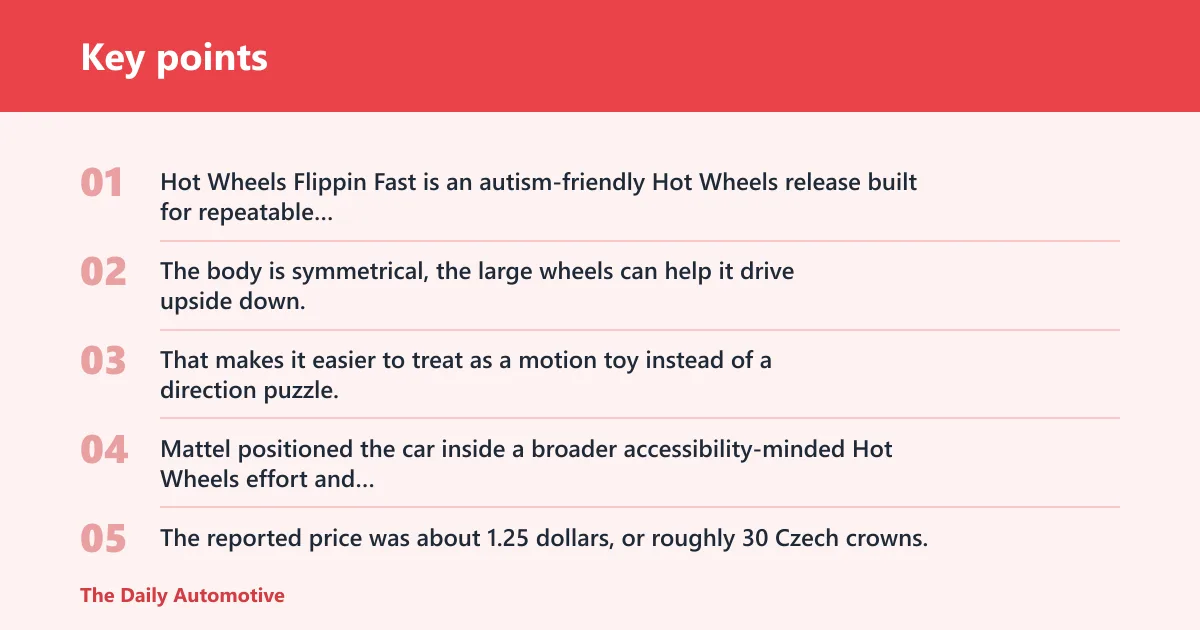
Hot Wheels Flippin Fast is an autism-friendly Hot Wheels release built for repeatable play without a fixed orientation. The body is symmetrical, the large wheels can help it drive upside down, and the car has no set front, back, top, or bottom. That makes it easier to treat as a motion toy instead of a direction puzzle.
Mattel positioned the car inside a broader accessibility-minded Hot Wheels effort and set the launch for April, tying it to Autism Awareness Month. The reported price was about 1.25 dollars, or roughly 30 Czech crowns, which keeps it in the same price band as ordinary impulse-buy die-cast cars rather than a premium specialty item.
Quick answer

That price says a lot about the role it is meant to fill. This is not a large intervention product with a long setup routine. It is a small car that changes play by changing geometry.
Hot Wheels Flippin Fast is described as part of the Flippin Fast collection, not as a one-off idea. That matters when you compare it with standard Hot Wheels releases, because the inclusion goal is built into the line, not added later in the packaging copy.
How does Flippin Fast change play?
It changes play by cutting down the number of orientation choices a child has to make. The car’s symmetry, upside-down capability, and spinning cockpit can shift attention from “which way is it?” to “what does it do next?” That can appeal to autistic children who prefer clear cause-and-effect play.
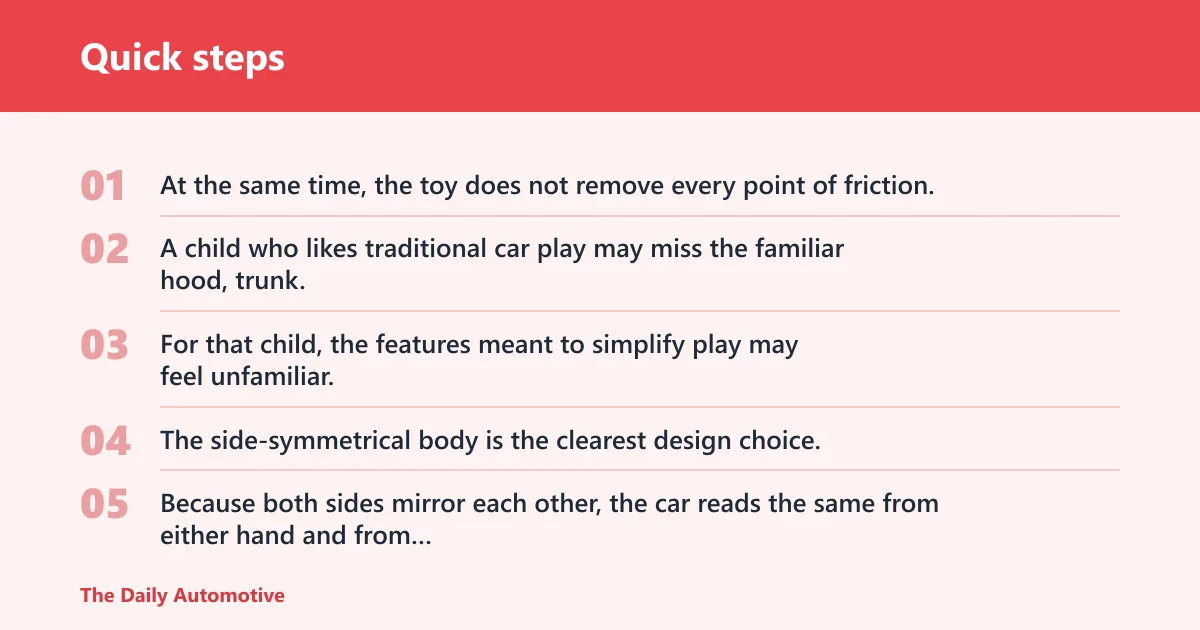
At the same time, the toy does not remove every point of friction. A child who likes traditional car play may miss the familiar hood, trunk, and driver-facing cues that standard Hot Wheels use to create a forward direction. For that child, the features meant to simplify play may feel unfamiliar.
Symmetry and orientation-free handling
The side-symmetrical body is the clearest design choice. Because both sides mirror each other, the car reads the same from either hand and from either side of a play surface. That can cut down the need to reset the toy before moving it again.
For some children, that means fewer pauses. The toy still moves like a car, but it does not demand the same amount of visual sorting before play begins.
Upside-down driving and no fixed top or bottom
Flippin Fast is described as using big wheels that let it drive upside down. The car also does not separate top and bottom. In practical terms, that gives the child more than one valid way to pick it up and send it moving without being “wrong.”
That can help when a child prefers repetitive motion over pretend driving. It can also fall short if the child wants a standard car story, because upside-down play changes the usual meaning of the vehicle.
Large wheels and easier grip cues
The large wheels do two jobs. They support the upside-down driving claim, and they give a thicker visual and tactile cue for how the toy is meant to move. For a child who wants a clear hand target, those larger shapes can make the car easier to grab and reset.
They may also make the toy feel less fragile than a tiny, low-profile casting. But that is not the same as proving better durability, and it does not tell you how the car will behave on every track or surface.
Rotating cockpit and spinner-like motion
The rotating cockpit is the most fidget-like feature. The toy can be used like a fidget spinner, and the rotating motion is described as calming for many children while also said to increase attention. That makes the car more than a static vehicle; it becomes a repeat-motion object.
That said, a spinner-like motion is not the same as a dedicated fidget toy. The cockpit may invite repeated handling, but it still has a car body attached to it. Some children will like that mix. Others will want either a pure car or a pure fidget, not both.
Design breakdown table
| Feature | Likely play effect | Autism-related rationale | Caveat |
|---|---|---|---|
| Symmetry | Less need to orient the car before play | Can reduce visual decision-making and support repeatable, simple handling | Children who prefer a clear front and back may find it less satisfying |
| Upside-down play | More ways to roll and reset the car | Offers flexible rules and multiple valid interactions with the same toy | Does not guarantee better track performance on every set |
| Spinner-like handling | Encourages repeated spinning and hand-to-hand play | May support focused, rhythmic motion that feels regulating | Repeated motion can also become overstimulating for some children |
| Rotating cockpit | Creates a moving center point that invites attention | The rotation is described as calming for many children and said to increase attention | That effect is not a clinical guarantee and will vary by child |
| Large wheels | Stronger visual cue for motion and grip | May make the toy easier to grasp and reset during repetitive play | Larger wheels do not automatically make the car better for all hands or surfaces |
| No fixed front or back | Removes directional cues from the body shape | Can lower the number of orientation choices a child has to process | Some children rely on those cues for pretend play and may miss them |
Why is Flippin Fast called autism-friendly?
The label comes from design intent, not from a clinical endorsement. Flippin Fast was developed with autism advocacy input from the Autistic Self Advocacy Network, and the toy’s geometry favors flexible play patterns instead of one “correct” way to use it. That is why the autism-friendly label fits the product story.
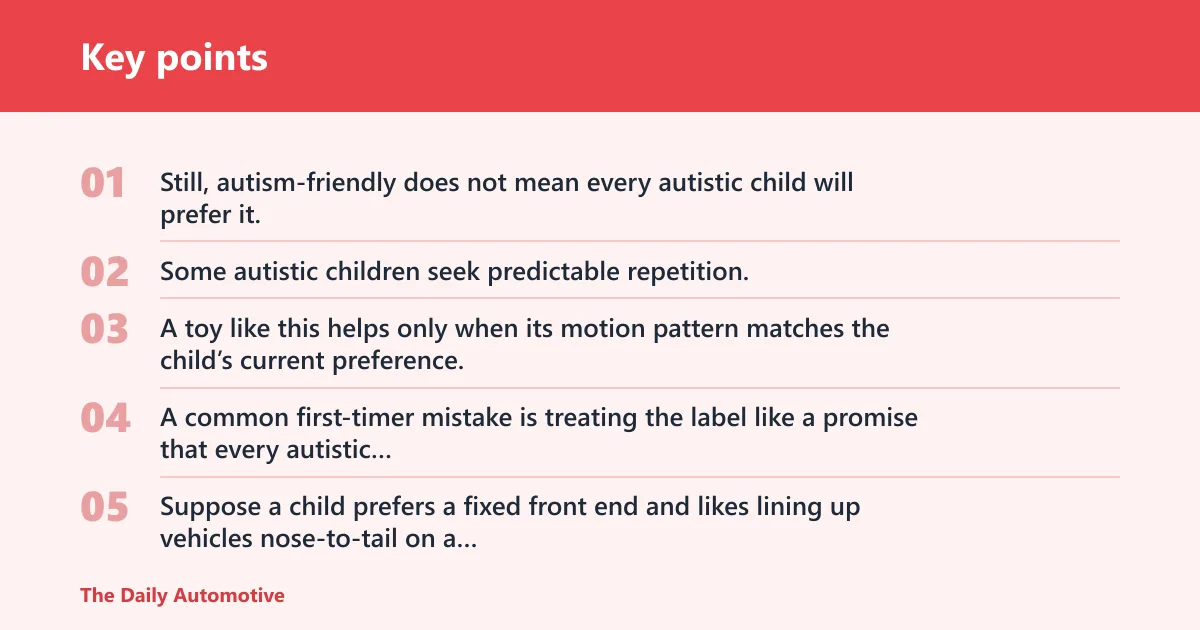
Still, autism-friendly does not mean every autistic child will prefer it. Some autistic children seek predictable repetition; others want detailed pretend scenarios; others move between both. A toy like this helps only when its motion pattern matches the child’s current preference.
A common first-timer mistake is treating the label like a promise that every autistic child will like the car. Suppose a child prefers a fixed front end and likes lining up vehicles nose-to-tail on a mat. In that case, a symmetrical car may feel less intuitive than a conventional Hot Wheels casting.
The narrower reading is more useful: the toy is built to make more than one use pattern feel valid. That helps children who enjoy trying different moves, and it can frustrate children who depend on a single stable visual rule.
Who helped develop the car?
Mattel, the parent brand of Hot Wheels, worked on the product with the Autistic Self Advocacy Network, or ASAN. That matters because the car’s design choices were shaped by autism advocacy input rather than being framed as a medical device or a clinician-led intervention.
ASAN is an autism advocacy organization, and its role points toward flexible play patterns, not a promise of therapy. The collaboration helps explain why the toy uses geometry and motion as its main accessibility tools instead of adding labels, instructions, or electronic features.
This is also where careful wording matters. Co-development with an advocacy group is not the same thing as formal clinical endorsement. The toy may fit the preferences that many autistic children report, but that is not proof that it will suit every child or every sensory profile.
Mattel’s inclusion work
Hot Wheels’ broader inclusion work shows up in the choice to build a specialty release around accessible play rather than around novelty packaging alone. The line is part of a larger direction for the brand, one that treats toy geometry as part of access.
That approach is practical. It changes what the car does in a child’s hand, not just what the box says.
ASAN’s role in development
ASAN helped develop the product with Hot Wheels, and that collaboration is the core reason the release reads as autism-aware rather than merely inclusive in a general sense. The partnership suggests the car was shaped by advocacy priorities, especially around flexible and repeatable interaction.
It does not mean ASAN “certified” the toy. It means the product was co-shaped with an organization that advocates for autistic people and for play that allows different interpretations.
How does it compare with Braille Twin Mill?
Flippin Fast follows an earlier accessibility-themed Hot Wheels release, Braille Twin Mill. The earlier car had Braille embossed directly on the toy body, and it also came with adapted packaging. Together, the two products show a line moving from tactile text access toward motion-based access.
That difference matters. Braille Twin Mill focused on making information physically readable. Flippin Fast focuses on making the toy itself more forgiving in play. One changes how you read the car. The other changes how you use it.
Say your child does not care about car branding but does care about repeated hand motion. Flippin Fast may make more sense than a Braille-focused model because the benefit is in the movement, not the labeling. If the child likes tactile text and collecting details, Braille Twin Mill may be the more interesting piece.
The shift also suggests that Hot Wheels is testing different paths to inclusion. One release can focus on accessibility of information. Another can focus on accessibility of motion. Those are related goals, but they solve different problems.
When did hot Wheels Flippin Fast launch?
Hot Wheels Flippin Fast was set to arrive in April and was framed as part of an Autism Awareness Month release. That timing is not incidental. It places the product in the same promotional window as other autism-focused consumer goods that aim to get attention while the topic is already in public view.
The April launch also helps explain the language around the product. It is not presented as a holiday novelty or a collector-only special. It is positioned as a timely accessibility release that sits alongside the month’s awareness messaging.
Frequently asked questions
What is special about Hot Wheels Flippin Fast for autism?
Its special value is the way it lowers orientation pressure. The car is symmetrical, has no fixed front or back, and can drive upside down, so the child can focus on motion and repetition instead of on correct placement. That can suit autistic children who prefer simple, cause-and-effect play.
How does Hot Wheels Flippin Fast work as a fidget toy?
The rotating cockpit gives it a spinner-like quality, so the toy can invite repeated turning and hand-based motion. It is not a dedicated fidget toy, though. Its value comes from combining car play with a rotating action that some children may find calming and attention-sustaining.
Why are Hot Wheels Flippin Fast cars symmetrical?
The symmetry supports flexible play by making the car easier to use from either side. A child does not need to spend as much time deciding which end is “right.” That can reduce friction for kids who like clear, repeatable actions and dislike unnecessary orientation checks.
Is Hot Wheels Flippin Fast the same price as regular Hot Wheels?
The reported price was about 1.25 dollars, or roughly 30 Czech crowns, which places it in the same low-price range as many basic Hot Wheels cars. That matters because it suggests an inclusion-focused design without a specialty-toy price tag.
Who helped develop the Hot Wheels autism-friendly collection?
Mattel worked with the Autistic Self Advocacy Network, or ASAN. That partnership matters because it ties the line to autism advocacy input rather than to a clinical endorsement. The result is a toy shaped around flexible play, not a medical claim.
Can children play with Hot Wheels Flippin Fast upside down?
Yes. The car uses big wheels that let it drive upside down, and that is one of its defining design features. For some children, that opens up more ways to play. For others, it may simply feel less like a traditional car and more like a motion toy.
Products related to this article
Sponsored / affiliate links. As an Amazon Associate I earn from qualifying purchases. I may earn additional commission from eligible campaigns.