How Much Is the Mileage Overage Penalty on a Car Lease?
Many leases charge about 15 to 25 cents per extra mile, though some run lower or higher. Buying miles up front is often cheaper than paying the overage later if you already know you will exceed the limit. Ignore it, and a 5,000-mile overage can turn into a four-figure bill at lease end. This guide shows how mileage penalties are calculated, when you can avoid them, and how to compare prepaid miles with end-of-lease charges.
This guide is part of our Car Dealer Money Guide: Negotiating, Financing, Leasing, Trading In and Selling series.
How much is the penalty?
The per-mile fee is set by the lease contract rather than by a single national rule. A common range is 15 to 25 cents per extra mile, but some leases sit below that and some sit above it. The charge is usually assessed when the lessor tallies your miles at the end of the lease, though some contracts can charge after early termination or buyout if the mileage shortfall is already known.
Why the rate varies by lease
The lease contract sets the mileage limit and the overage fee terms, so two vehicles from the same brand can have different charges. Drivers who rack up more miles usually pay more upfront through a higher monthly payment, because the lessor is taking on more depreciation risk over the term. That payment is shaped by depreciation and the interest rate, along with the residual value the lender predicts the car will have at lease end.
Leasing can involve yearly mileage caps, and lease terms are usually short, commonly 24 to 36 months. If you drive far more than the allowance, a higher-mileage lease from the start is usually the cleaner choice. The monthly bill may be lower than a car loan payment, but the mileage limit is part of what makes that possible.
How lease mileage limits work
Annual mileage allowance is the number of miles a lease permits each year, commonly about 10,000, 12,000, or 15,000 miles. That allowance shapes the monthly payment because the lessor uses it to estimate how much value the car will retain when the lease ends. If you choose too little mileage, the payment can look attractive at signing and expensive later.
Why residual value matters
The residual value is what the lender predicts the car will be worth at lease end. If a car is expected to be worth less after heavy use, the lease needs to collect more of that loss during the term. That is one reason mileage limits exist, and why drivers who routinely travel more should match the contract to their habits before signing.
What lease math usually reflects
A lease payment is built from depreciation plus the money factor, which is the lease financing rate expressed as a decimal. For reference, a money factor of 0.0025 equals 6% interest, and 0.0035 equals 8.4% interest. Experian says the average monthly payment for a leased car is $595, and the average credit score for a new car lease was 751 in early 2024.
How the overage fee is calculated
The formula is simple: miles driven over the allowance multiplied by the contract rate. If a lease allows 36,000 miles over three years and the odometer shows 41,000 at return, the excess is about 5,000 miles. At about 20 cents per mile, that works out to roughly a $1,000 charge before any tax or extra fees.
The mileage formula
Use the allowance stated in the lease, not an estimate from memory. Then subtract the allowed miles from the ending odometer reading, and multiply the excess by the per-mile fee in the contract. If the result is negative, there is no overage charge for mileage.
Tax and administrative charges
Depending on the state and lessor, the mileage fee may be subject to tax or may be combined with administrative charges. That means the bill can be a little higher than the raw math suggests. Lease-end bills can also include disposition fees and wear-and-tear charges, which are separate from mileage.
When the fee shows up
The mileage bill usually appears during lease-end reconciliation after the vehicle is turned in and inspected. The inspection can also trigger wear-and-tear charges for items such as tire damage, excess scratches, or broken trim. If the contract allows it, mileage charges can also appear after an early termination or a buyout review.
Mileage overage cost table
This table shows what different contract rates mean in real money. It uses four common overage scenarios and three per-mile rates so you can compare the bill against prepaid miles before you sign or before you return the vehicle.
| Excess miles | 10 cents per mile | 15 cents per mile | 25 cents per mile |
|---|---|---|---|
| 500 | $50 | $75 | $125 |
| 1,000 | $100 | $150 | $250 |
| 2,500 | $250 | $375 | $625 |
| 5,000 | $500 | $750 | $1,250 |
Break-even note: prepaying miles is cheaper when the per-mile buy-in price is below the lease-end overage rate. If the contract charges 25 cents per extra mile, any prepaid mileage plan below 25 cents per mile is the better deal on paper. If the prepaid rate is higher than the overage rate, paying later is cheaper.
Suppose your lease offers extra miles at 18 cents each and your contract overage fee is 25 cents each. If you know you will exceed the limit by 2,500 miles, buying miles up front saves $175 before tax and fees. If your driving turns out to be only 500 miles over, the gap narrows, but the prepaid rate is still the lower per-mile price.
Can you avoid mileage penalties?
Yes, sometimes. Set the annual mileage allowance before you sign, because the lease contract is where the mileage limit and fee are fixed. You can also buy extra miles before lease end if the lessor allows it, which can reduce the total bill compared with waiting until turn-in.
Choose the right allowance upfront
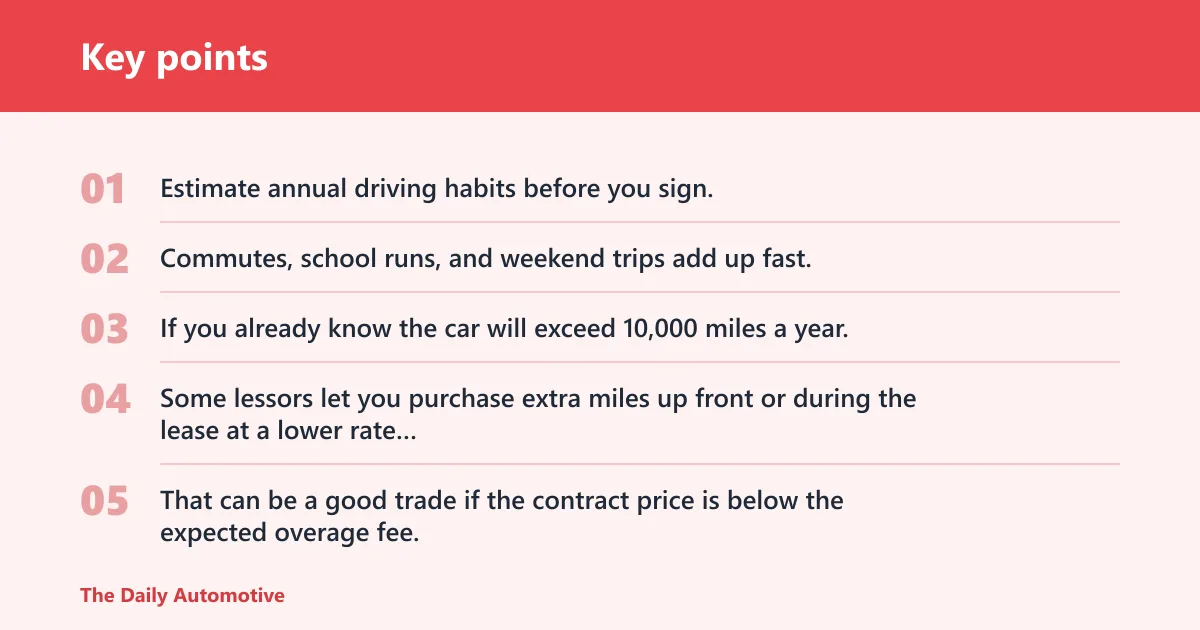
Estimate annual driving habits before you sign. Commutes, school runs, and weekend trips add up fast, especially on a 24- to 36-month lease.
Buy extra miles before lease end
Some lessors let you purchase extra miles up front or during the lease at a lower rate than the excess charge. That can be a good trade if the contract price is below the expected overage fee. Read the lease agreement carefully, because not every lease allows the same prepayment terms.
Watch the inspection and wear bill
The lease-end inspection may arrive with a mileage bill and a wear-and-tear bill. Those are different charges. A car with acceptable miles can still cost money at turn-in if the tires are worn out, the windshield is cracked, or the body shows damage beyond normal use.
A common first-timer mistake is to focus only on the monthly payment and ignore the mileage cap. A $20 lower payment can disappear quickly if the lease ends 3,000 miles over and the contract charges 20 cents per mile, before tax and inspection fees are even added.
Should you buy extra miles or pay later?
Prepaying miles is cheaper when the upfront rate is lower than the lease-end penalty, but it is not always the best move. If your driving is uncertain, paying later may be safer because you avoid buying miles you never use. If the overage will be large and obvious, prepaid miles usually win on cost.
How much mileage overage checklist
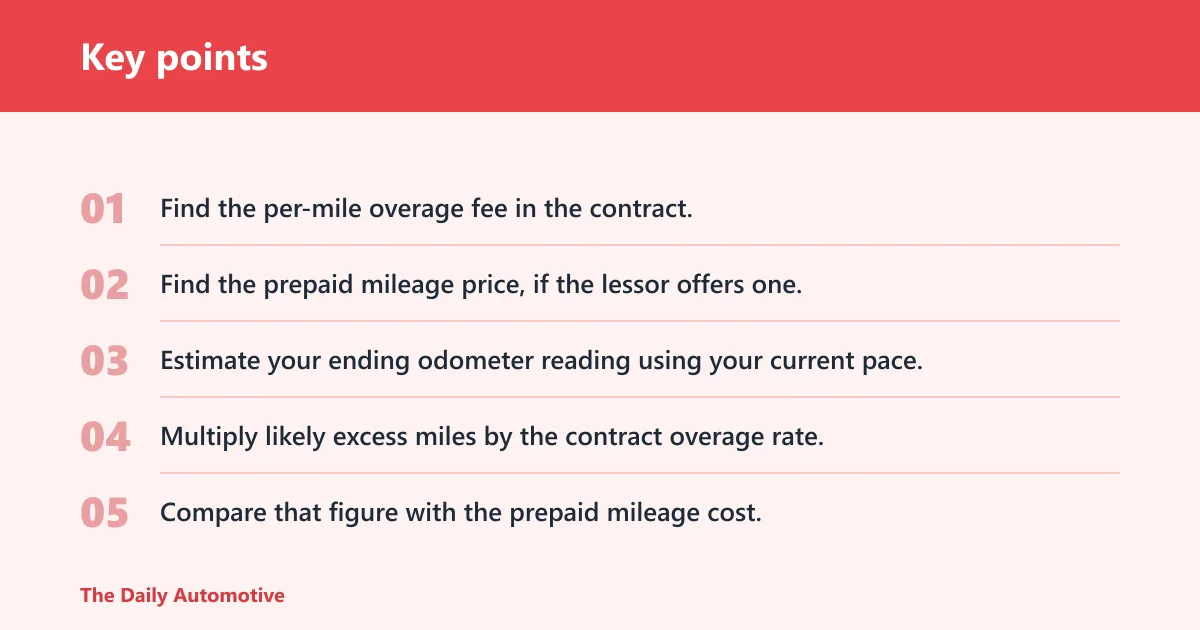
- Find the per-mile overage fee in the contract.
- Find the prepaid mileage price, if the lessor offers one.
- Estimate your ending odometer reading using your current pace.
- Multiply likely excess miles by the contract overage rate.
- Compare that figure with the prepaid mileage cost.
- Add possible tax, disposition fees, and wear-and-tear charges.
When a buyout may make sense
If you are far over the limit, a lease buyout can matter. In some cases, buying the car may be cheaper than turning it in and paying mileage plus wear-and-tear charges, especially if the market value is close to the residual value. That depends on the buyout price, the car’s condition, and the terms in the lease contract.
Picture a 36-month lease with a 12,000-mile annual limit and a planned turn-in at 41,500 miles after 36 months. That is 5,500 excess miles. At 15 cents per mile, the mileage charge alone is $825. If the inspection also finds tire damage and the lessor adds a disposition fee, the final bill climbs fast.
How do lease mileage overage fees get calculated?
They are calculated by subtracting the allowed miles from the miles on the odometer at the end of the lease, then multiplying the excess by the per-mile rate in the contract. Some lessors add tax or administrative charges, so the final invoice can be slightly higher than the mileage math alone.
What is the per-mile fee for going over a lease limit?
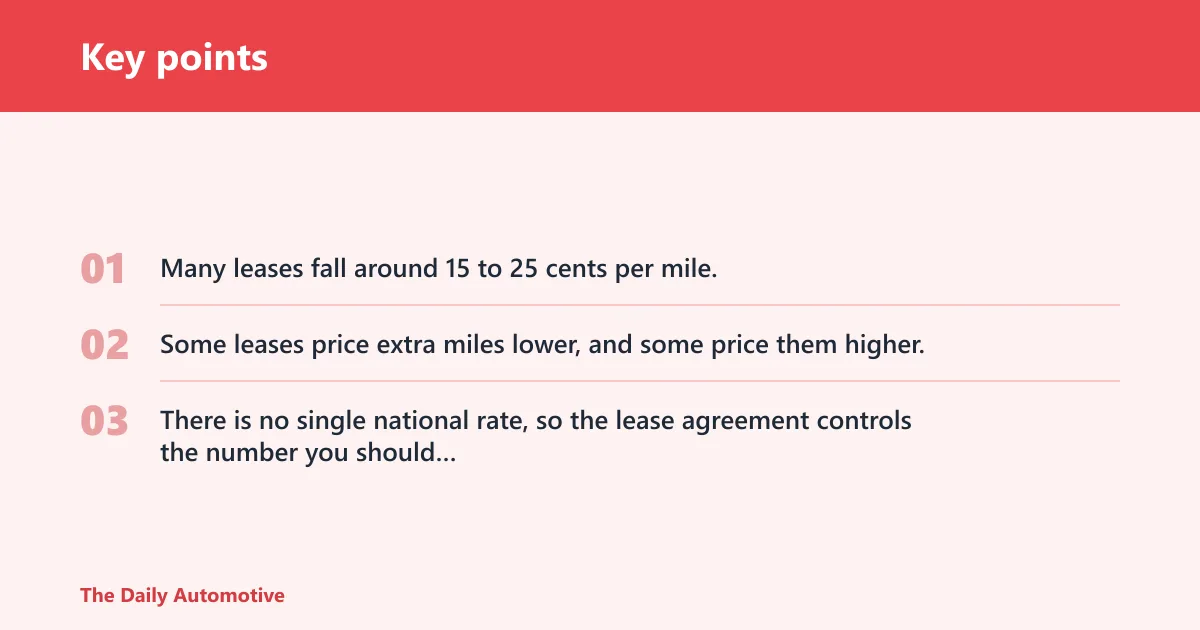
Many leases fall around 15 to 25 cents per mile, though the actual rate depends on the contract and the vehicle. Some leases price extra miles lower, and some price them higher. There is no single national rate, so the lease agreement controls the number you should use.
Can you negotiate mileage penalties before signing a lease?
Sometimes, yes. Dealers and lessors may allow a higher mileage allowance, different prepaid-mile pricing, or a different lease structure before you sign. The easiest time to negotiate is before the contract is final, because the mileage cap is part of the lease terms and monthly payment math.
What happens if you go over mileage on a leased car?
You usually pay the excess mileage charge at lease-end reconciliation after the vehicle inspection. The lessor may also bill for disposition fees or wear-and-tear items at the same time. If the contract permits, mileage may also be charged after an early return or during a buyout review.
Frequently asked questions
How much is the mileage overage penalty on a car lease?
Most leases charge about 15 to 25 cents per extra mile, though the contract can set a lower or higher rate. A 5,000-mile overage can therefore range from $750 to $1,250 before tax and other end-of-lease charges. The lease agreement always controls the final rate.
Is it cheaper to buy extra miles upfront or pay the overage fee?
It is cheaper when the prepaid mileage price is lower than the lease-end overage rate. If the contract charges 25 cents per mile and the prepaid option costs 18 cents per mile, buying miles upfront wins on price. If the prepaid price is higher, paying later is cheaper.
Do all leased cars have the same mileage penalty?
No. The mileage penalty varies by lease contract and vehicle. Two leases from the same brand can have different allowances and different per-mile fees. That is why you should read the mileage section before signing and compare the rate with your expected driving.
Can you avoid mileage penalties at lease end?
Yes, if you stay within the allowance, buy extra miles before return, or choose a higher-mileage lease from the start. You can also reduce surprises by keeping an eye on your annual driving and by checking the contract for inspection, disposition, and wear-and-tear charges.
Products related to this article
Sponsored / affiliate links. As an Amazon Associate I earn from qualifying purchases. I may earn additional commission from eligible campaigns.