Can You Trade in a Car with Damage or a Check Engine Light?
Yes, dealers will usually take a car with body damage or a check engine light, but the offer can fall by hundreds or thousands. Major mechanical faults can wipe out most of the trade-in value. Ignore repair costs and you can leave money on the table or lose the deal entirely. This guide spells out which defects cut hardest, which fixes may pay back, and when selling as-is beats trading it in.
This guide is part of our Car Dealer Money Guide: Negotiating, Financing, Leasing, Trading In and Selling series.
Can you trade in a damaged car?
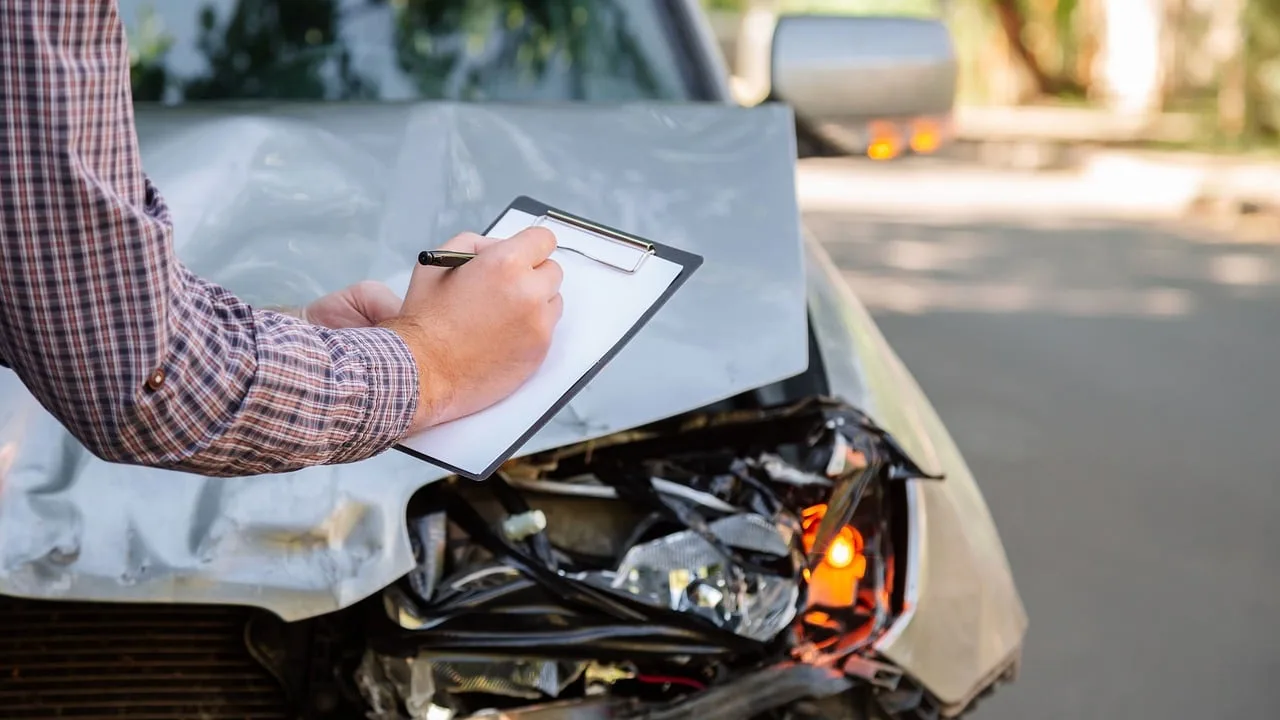


Yes, in most cases. A damaged trade-in is mainly a valuation problem: the dealer starts with market value, then subtracts reconditioning costs, expected profit margin, and the risk that the car will need more work before it can be sold. Severe damage may move the car from retail sale to auction or other wholesale disposal.
The main question is whether the damage changes the car’s expected resale path. Cosmetic scuffs are one thing. Structural damage, a branded title, or a no-start condition can move the car from retail inventory to wholesale disposal, which cuts the offer much harder.
How dealers price trade-ins
Trade-in value is not the same as retail price. Retail value is what a dealer hopes to sell the car for after cleanup and repairs; wholesale value is closer to what the car would bring in a dealer-only channel. The actual offer usually lands below retail because the dealer must cover reconditioning, overhead, and profit.
That is why damage matters twice. First, it lowers the expected sale price. Second, it raises reconditioning costs. Damage is appraised by subtracting reconditioning costs from market value. Dealers start with vehicle history before inspection.
What the dealer subtracts first
Used-car managers usually look at the biggest risk items first: vehicle history, visible body damage, tires, warning lights, and under-hood concerns. If anything points to frame or unibody damage, the appraisal can change fast because that shifts the car from a straightforward retail unit to a higher-risk wholesale unit.
Actual cash value, or ACV, is the dealer’s working appraisal basis. It is the amount the car is expected to bring in the market before the dealer deducts reconditioning and profit expectations. That number is why two similar cars can get different offers if one has accident history or warning lights and the other does not.
Damage type trade-in table
| Issue | Typical dealer concern | Likely appraisal effect | Repair before trade-in? | Get a second offer? |
|---|---|---|---|---|
| Cosmetic dents/scratches | Refinish labor, paint match, lot presentation | Usually a modest deduction; can be larger if panels need repainting | Often yes, if the fix is small and under $100 | Yes, especially if the damage is obvious |
| Cracked windshield | Safety concern and replacement cost | Moderate deduction based on glass replacement price and state rules | Often yes if replacement is affordable | Yes |
| Hail damage | Panel repair count and retail appeal | Moderate to heavy deduction depending on panel count and severity | Sometimes, if cosmetic repair cost is low relative to the hit | Yes |
| Accident history | History report disclosure and hidden repair risk | Variable; more if repairs were major or uneven | Usually no, unless a minor cosmetic fix is cheap | Yes |
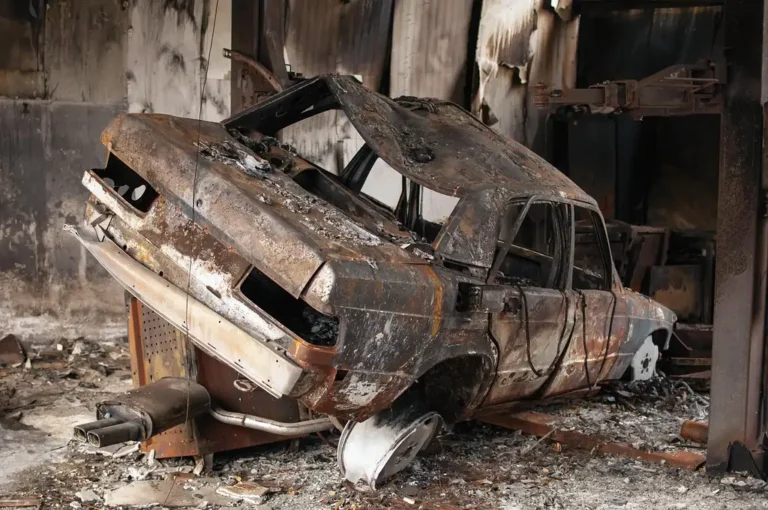
| Frame or unibody damage | Safety, alignment, and salvage-title risk | Heavy deduction; CarXplorer says structural damage can reduce value by 50-70% | Usually no unless the damage is minor and documented repair is already complete | Yes |
| Non-blinking check engine light | Unknown repair and code diagnosis | Could be a small deduction or a larger one; BuyCarBlog says a dealer may discount a check-engine-light trade by thousands | Maybe, if the cause is simple and cheap to verify | Yes |
| Blinking check engine light | Severe misfire risk and possible catalyst damage | Heavy deduction; may make the car hard to retail | Often yes if the repair is straightforward, but only if the cost is lower than the value recovered | Yes |
| Failed emissions readiness | Inspection or smog-test failure risk | Moderate deduction, especially in states with strict testing | Sometimes, if the issue is simple and the car can complete monitors | Yes |
| Non-running condition | Tow risk, diagnosis cost, and uncertainty | Heavy deduction; often treated as wholesale only | Rarely, unless the repair is clearly minor | Yes |
Say your sedan has a 3-inch dent on the rear door and a scratched bumper, but it starts, drives, and passes inspection. A dealer may treat that as a cleanup item. Say the same car has frame damage and an airbag deployment in the history report. That changes the appraisal from cosmetic wear to structural risk.
Can you trade in a car with the check engine light on?
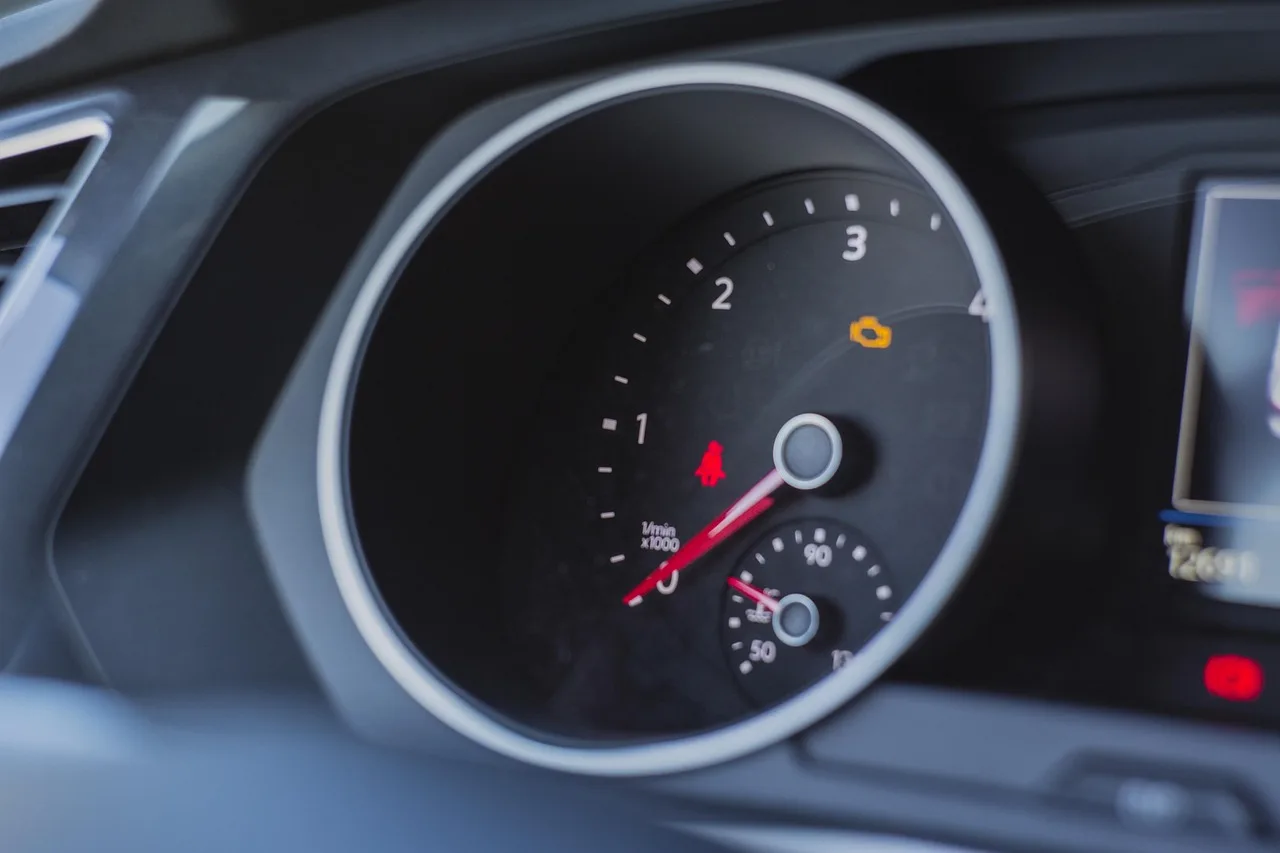
Yes, usually. Most dealerships will take a vehicle with the light on, but the price can drop sharply because the dealer does not know whether the fault is minor or expensive. A loose gas cap is far different from a catalytic converter, misfire, or transmission issue.
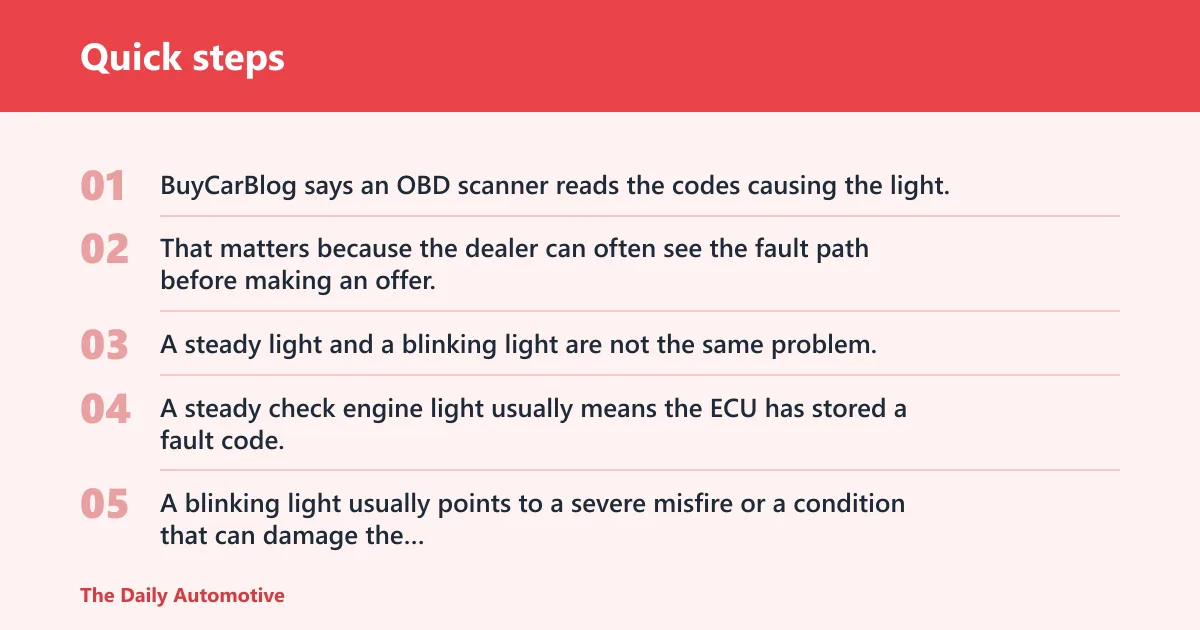
BuyCarBlog says an OBD scanner reads the codes causing the light, and OBD-II scanners plug under the dashboard. That matters because the dealer can often see the fault path before making an offer. A steady light and a blinking light are not the same problem.
Steady light versus blinking light
A steady check engine light usually means the ECU has stored a fault code, but the car may still drive normally. A blinking light usually points to a severe misfire or a condition that can damage the catalytic converter. That is a much bigger appraisal problem and can move the car out of retail territory fast.
The light can reflect minor or major issues. Catalytic converter failure is commonly listed as a costly example. On the low end, a loose gas cap can trigger the lamp. On the high end, the fault may involve ignition, fuel, emissions, or transmission controls.
Emissions readiness and inspection failure
The check engine light can also affect emissions readiness. If monitors have not completed, or if the car fails a smog test, some states may not allow registration transfer until the issue is fixed. A dealer may still buy the car, but the offer will usually reflect the repair time and compliance risk.
The same source says a running vehicle may be worth at least $750, but that does not mean every running vehicle is worth fixing. If the lamp is tied to a hard emissions failure or a blinking misfire, the likely appraisal hit can be much larger than the cost of the code scan alone.
What dealers look for on a damaged car
Dealers usually begin with the vehicle history report, then move to the visible body, tires, and warning lights, and then inspect the engine bay or underbody if needed. Carfax and AutoCheck are commonly listed as common history-report sources. The history report comes first for a reason: it frames the rest of the inspection.
History report, title, and structural checks
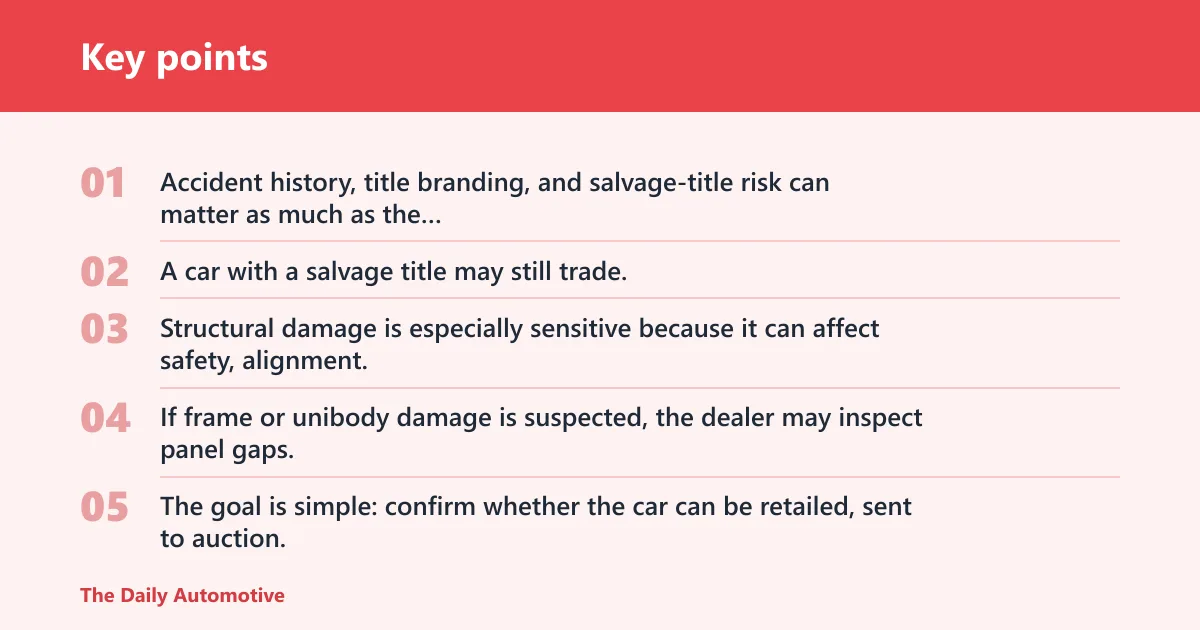
Accident history, title branding, and salvage-title risk can matter as much as the visible damage. A car with a salvage title may still trade, but the dealer knows retail demand will be limited. Structural damage is especially sensitive because it can affect safety, alignment, and future resale.
If frame or unibody damage is suspected, the dealer may inspect panel gaps, underside damage, suspension points, and repair records. The goal is simple: confirm whether the car can be retailed, sent to auction, or priced only as a wholesale unit.
Picture a compact SUV with a clean exterior but a history report that shows an insurance payout for front-end collision damage. If the hood, radiator support, and alignment points were repaired well, the car may still trade. If the frame rails were pulled or the title is branded, the offer drops much more.
Should you fix the car first?
Sometimes. Repair only when the cost is likely to return more than it spends. Minor cosmetic fixes under $100 may be worth it. That is sensible when a small repair makes the car easier to retail and the dealer would otherwise subtract more than the repair cost.
Heavy mechanical or structural repairs often do not pay back before trade-in. The dealer will still factor age, mileage, and market demand into the offer, so spending a large sum does not guarantee a dollar-for-dollar return.
Repairs that often pay back
- Touch-up work on small scratches or chips
- Replacing a loose gas cap that sets the check engine light
- Simple bulbs, wipers, or trim pieces that affect presentation
- Glass repair when the crack is small and inexpensive to fix
Repairs that usually do not
- Transmission work
- Catalytic converter replacement
- Major suspension or frame repairs
- Extensive hail or body-panel refinishing
A simple rule of thumb: if a repair costs less than the likely deduction and it clearly removes a buyer objection, it may be worth doing. If the repair is expensive, hidden, or likely to expose more issues, an as-is offer is often the cleaner exit.
What if the car is financed?
A financed trade-in adds a loan payoff to the appraisal, but the loan is separate from the car’s value. The dealer values the vehicle first, then the lender payoff is handled as a second number. If the payoff is higher than the offer, the shortfall is negative equity.
That shortfall does not vanish because the car is damaged. It is either paid in cash or rolled into the next deal. Rolling it in can make sense if the replacement vehicle is affordable and the payment still works, but it does not change the underlying appraisal.
Negative equity and payoff math
- Get the payoff amount from the lender.
- Get the trade-in offer from the dealer.
- Subtract the offer from the payoff.
- If the payoff is higher, you owe the difference or roll it forward.
Do not mix up payoff and value. A damaged car can still have trade-in value even if the loan balance is upside down. The two numbers answer different questions.
Where to get a second offer
Compare offers before accepting one. CarXplorer recommends comparing offers from CarMax and Carvana. That does not mean they will buy every car in every condition, but they are useful baseline checks when you want to see how another buyer prices the same defect.
Use those offers to test the dealer’s number, especially if the car has visible damage, warning lights, or a title issue. Severe-condition cars may still go to auction, but a second offer can tell you whether the first bid is tied to real market risk or padded with extra margin.
How to compare offers fairly
- Disclose the same damage to every buyer.
- Use the same trim, mileage, and option list.
- Ask whether the offer assumes repairs are already complete.
- Check whether the buyer is adjusting for title branding, warning lights, or no-start condition.
The same source says trade-ins can save sales tax in most states. That can make trading in more attractive than selling privately, even if the private-sale price looks higher on paper. The tax savings matter because they reduce the real cost of the next vehicle.
Frequently asked questions
Can you trade in a car with damage?
Yes. Dealers usually accept damaged cars, but they price in reconditioning, resale risk, and the chance that the unit will go to auction. Cosmetic damage may only shave off a little value, while structural damage, title branding, or major mechanical issues can cut the offer hard.
How much does damage lower a trade-in value?
It depends on the type of damage and the repair path. Small cosmetic issues may only reduce the offer modestly, while structural damage can reduce value by 50-70%. Dealers usually subtract expected reconditioning costs first, then adjust for resale risk and profit margin.
Should I fix the car before trading it in?
Fix it only when the repair is cheap enough to return more than it costs. Small cosmetic work and simple warning-light causes can pay back. Major mechanical, structural, or emission repairs often do not, because the dealer will still discount the car for age, mileage, and market uncertainty.
Will a dealer find hidden damage during an appraisal?
Sometimes. Dealers start with the vehicle history report, then inspect visible damage, tires, warning lights, and likely frame or unibody issues. Hidden damage may be missed at first, but history reports, panel gaps, alignment clues, underbody checks, and title branding often bring it to light.
What happens if I trade in a damaged financed car?
The dealer appraises the car first, then the loan payoff is handled separately. If the payoff is higher than the offer, you have negative equity. You can pay the difference in cash or roll it into the next loan, but that does not change the damaged car’s appraised value.
Can I trade in a car that won’t start?
Yes, but the offer is usually much lower because the dealer must pay for towing, diagnosis, and higher risk. A non-running car is often treated as a wholesale unit. If the repair is simple, fixing it first may help, but if the cause is unknown, an as-is offer is often cleaner.
Is it better to sell a damaged car privately or trade it in?
Private sale can bring more money if you can find a buyer willing to take the damage and manage the repair risk. Trade-in is usually faster, simpler, and may save sales tax in most states. The better choice depends on how much time, hassle, and disclosure you want to handle.
Products related to this article
Sponsored / affiliate links. As an Amazon Associate I earn from qualifying purchases. I may earn additional commission from eligible campaigns.
 OBD2 Scanner Diagnostic Tool - Check Engine Light Code Reader, Reset Function, Data Stream, I/M Readiness, Full Features, Modes 6 & 8, for All 1996+ Vehicles, Automotriz Scanner
 OBD2 Scanner Diagnostic Tool - Check Engine Light Code Scanner Tool with Reset, DTC, Data Stream, I/M Readiness, Car & Truck Scan Tool for All Vehicles Since 1996, escaner automotriz