How Long Can a Car Sit in the Cold Before the Battery Dies?
A healthy 12-volt battery can sometimes sit through cold weather without issue, while a weak battery may fail after very little time, especially around 0°F or with parasitic draw. A flat battery can leave you stuck and can add towing or replacement costs. This guide explains healthy-battery storage time, weak-battery failure windows, and what different winter temperatures mean for overnight, weekend, and weeklong parking.
This guide is part of our Winter Car Care: The Complete Cold-Weather Guide series.
Cold battery sit times
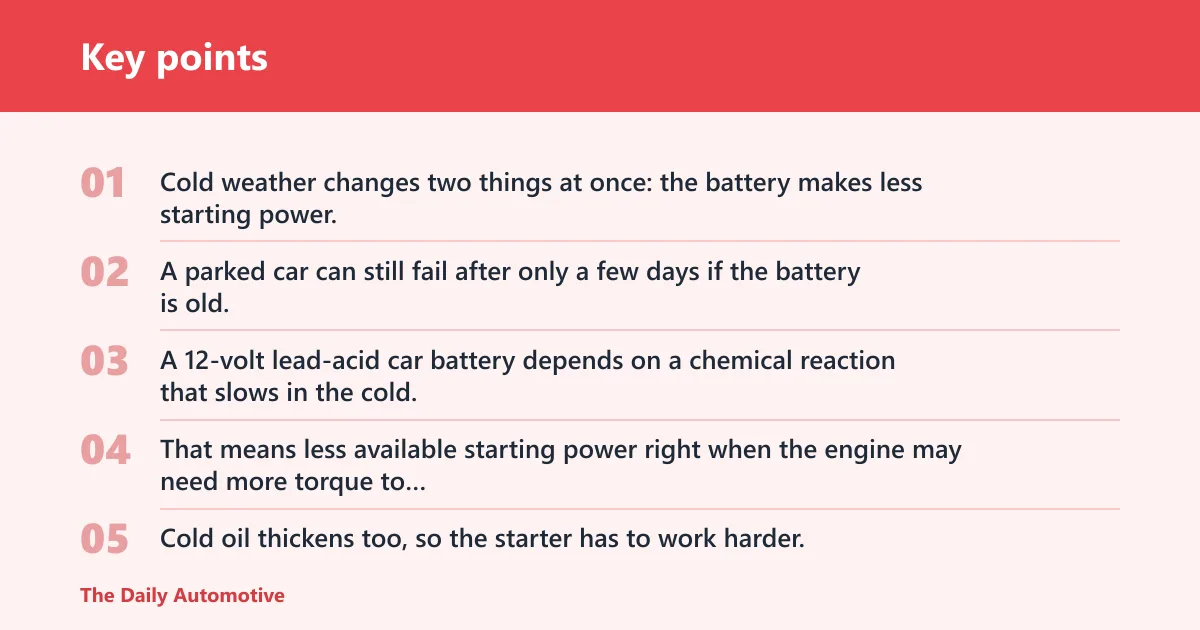


Cold weather changes two things at once: the battery makes less starting power, and the engine takes more effort to turn over. A parked car can still fail after only a few days if the battery is old, partly discharged, or feeding a higher-than-normal rest draw.
What changes as temperature falls
A 12-volt lead-acid car battery depends on a chemical reaction that slows in the cold. That means less available starting power right when the engine may need more torque to crank. Cold oil thickens too, so the starter has to work harder.
Why a parked car can still fail after only a few days
Self-discharge alone is usually slow, but a vehicle does not sit completely idle. The ECU, clock, security system, and other modules create a normal rest draw, also called parasitic drain or quiescent current draw.
When rest draw climbs higher than normal, the battery can drain much faster than expected. That is why two cars can sit for the same length of time and have very different outcomes.
Healthy battery versus weak battery
A healthy, fully charged battery usually sits at 12.6–12.8 volts. A battery below 12.0 volts after sitting overnight suggests abnormal drain or a battery that is already weakened. Voltage alone is not enough to judge cranking ability, though.
Weak batteries show up first in cold weather. Battery age matters, and most 12-volt batteries last about 3 to 5 years. Once a battery is older than that window, winter starts to expose the weak cell or low reserve capacity that warm weather hid.
How cold affects battery power
Cold weather cuts starting performance, raises cranking effort, and makes marginal batteries fail faster. The battery still works, but it has less reserve to deliver high current when the starter asks for it.
12-volt lead-acid reaction slows in the cold
Lead-acid chemistry slows as temperature drops. That slows the battery’s ability to deliver current fast enough for starting.
Why cold oil makes starting harder
Oil thickens in the cold, which adds drag to the engine. The starter motor has to overcome that extra resistance, so a battery with reduced cold-weather output can run out of reserve sooner.
What CCA tells you in winter
Cold cranking amps, or CCA, is the battery’s starting-performance rating. It matters in winter because it reflects how much current the battery can provide for cranking in cold conditions. The battery should meet or exceed the vehicle spec on the label or in the owner’s manual.
Say your sedan uses a battery rated at the vehicle’s specified CCA, and the temperature drops to 0°F. The car may still start fine after an overnight park if the battery is healthy, but the same car can struggle after a week if the battery is five years old and the alarm system has been drawing current all along.
How long car sit decision table
| Temperature band | Battery condition | Likely safe sit time before a no-start risk rises |
|---|---|---|
| 32°F to 20°F | Healthy battery | About 1 to 3 weeks if the vehicle has normal rest draw and the battery starts fully charged |
| 32°F to 20°F | 3+ year-old battery | Several days to about 1 week, with weekend parking often still okay if the battery is strong |
| 32°F to 20°F | Weak battery with parasitic draw | Overnight to a few days; if draw is high, the battery may not survive the night |
| 20°F to 0°F | Healthy battery | About several days to 2 weeks; cold starts become less forgiving as temperature drops |
| 20°F to 0°F | 3+ year-old battery | About 2 to 7 days, depending on battery health and quiescent current draw |
| 20°F to 0°F | Weak battery with parasitic draw | One night to a weekend; risk rises fast below 0°F |
| Below 0°F | Healthy battery | Several days to about 1 week, but reserve drops sharply and no-start risk rises quickly |
| Below 0°F | 3+ year-old battery | Often only a few days; winter exposes weak capacity fast |
| Below 0°F | Weak battery with parasitic draw | One cold night can be enough for a no-start |
Maintainer note: Use a battery maintainer for any car that will sit for weeks, especially in below-freezing weather or if the battery is older than 3 years. A maintainer helps keep charge up during storage and reduces freeze-related weakness.
How long can a car sit before the battery dies?
The short answer depends on battery condition, temperature, and rest draw. A healthy battery can usually handle overnight parking and often a weekend. A weak battery may fail much sooner, especially in single-digit temperatures or if the car has an abnormal parasitic drain.
Overnight parking
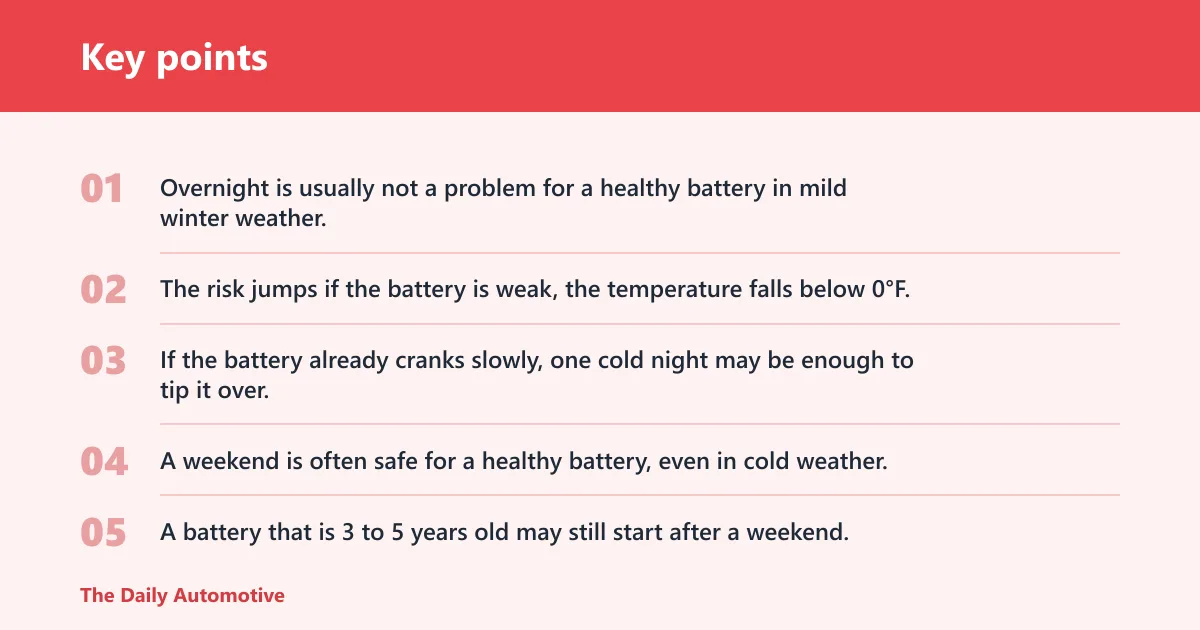
Overnight is usually not a problem for a healthy battery in mild winter weather. The risk jumps if the battery is weak, the temperature falls below 0°F, or the vehicle has a higher-than-normal rest draw. If the battery already cranks slowly, one cold night may be enough to tip it over.
Weekend parking
A weekend is often safe for a healthy battery, even in cold weather, as long as the battery is fully charged and the car’s rest draw stays in the normal range. A battery that is 3 to 5 years old may still start after a weekend, but reserve margins shrink fast in the cold.
One to two weeks
One to two weeks is the point where condition matters more than convenience. A healthy battery with normal rest draw can often sit that long, but an older battery may not. If the car is going to sit for two weeks or more, a maintainer is the better plan.
Longer storage without starting
For storage beyond two weeks, do not count on occasional short starts to protect the battery. Short drives often do not replace all the charge lost to cold starts and rest draw. A maintainer is a better choice than idling the car for a few minutes.
Picture a compact SUV left outside at 10°F for 10 days. If the battery is four years old and the vehicle has a normal alarm draw, it may still start. If the same SUV has a weak battery and a glove-box light that stays on, the no-start problem can show up much sooner.
Is it the battery or the alternator?
After sitting, a no-start can come from either the battery or the charging system. A bad alternator can mimic a dead battery, and a weak battery can make the alternator look guilty. The fastest clue is what happens after a proper jump start.
Slow cranking and clicking
Slow cranking, repeated clicking, and dim lights point first to battery weakness or a high parasitic draw. If the car was parked for a while, the battery may simply not have enough reserve left to spin the starter.
Charging-system clues after a jump start
If the engine starts with a jump but dies again soon after, look at the alternator or the battery. A healthy alternator should produce 13.8–14.4 volts at idle, although some smart charging systems vary output and may not hold a steady voltage all the time. Weak output or diode bleed can leave the battery undercharged even when the engine has been running.
When a load test beats a voltage check
A battery load test checks cranking ability under load, which is more revealing than voltage alone. Parts stores often offer it free. That matters because a battery can show near-normal voltage and still fail when asked to crank in the cold.
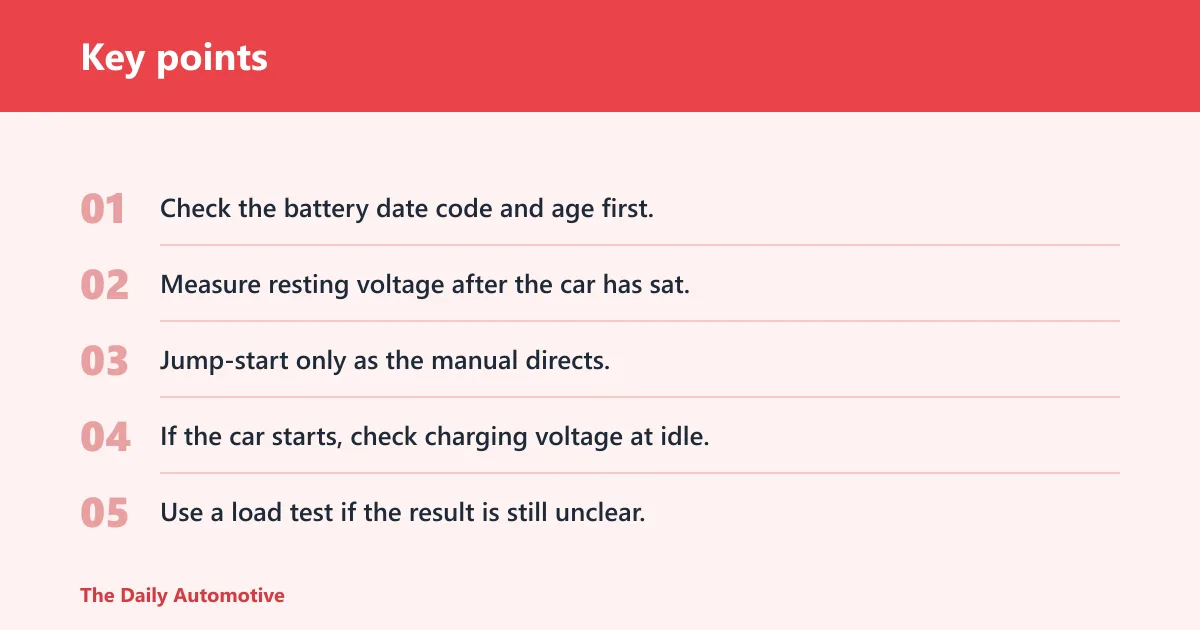
- Check the battery date code and age first.
- Measure resting voltage after the car has sat.
- Jump-start only as the manual directs.
- If the car starts, check charging voltage at idle.
- Use a load test if the result is still unclear.
How to know if your battery is weak before winter
Look for age, cranking behavior, and test results together. A battery can pass a simple voltage check and still be too weak for a cold morning. Winter prep works best before the first hard freeze.
Check the battery date code
Battery age is one of the best early clues. Most 12-volt batteries last about 3 to 5 years, and many fail sooner once winter arrives. Check the date code on the case, then compare it with the battery’s age in the vehicle.
Look for slow cranking and dim lights
Slow cranking is one of the clearest warning signs. So are dim interior lights, repeated jump starts, or a starter that clicks and stalls instead of turning the engine. Those symptoms usually mean the battery is weak, the draw is excessive, or both.
Use a load test, not voltage alone
A healthy, fully charged battery sits at 12.6–12.8 volts, but that does not prove it can supply current under load. Below 12.0 volts after sitting overnight suggests abnormal drain. A load test is the better winter check because it measures cranking ability.
Inspect terminals and cable tightness
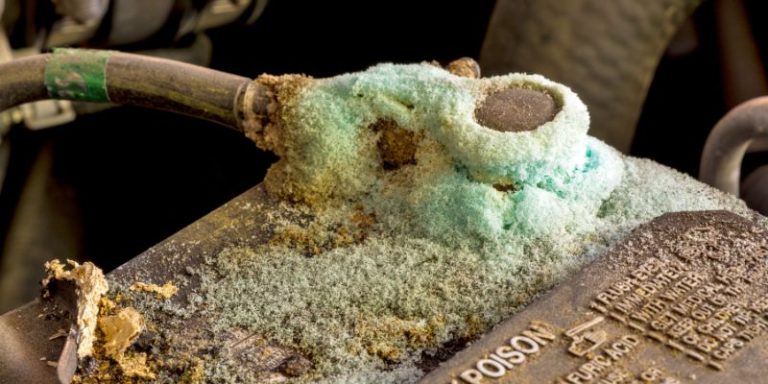
Loose or corroded terminals can steal starting performance. Clean, tight connections matter because poor contact adds resistance exactly when the starter needs current fast. A bad connection can look like a weak battery.
Battery freeze and maintainer guide
Freeze risk rises when the battery is discharged. A fully charged battery will not freeze until around -76°F, but a weak battery can freeze at temperatures as warm as 20°F. Once the electrolyte freezes, the case can crack and the battery may be permanently damaged.
Why discharge raises freeze risk
Battery electrolyte freezes more easily when the battery is low on charge. That is why a battery that barely starts the car in mild weather can be vulnerable on a cold night in the driveway.
When a battery can freeze and crack
The colder the battery and the lower its charge, the more likely the electrolyte is to freeze. If that happens, the case can split or the internal plates can be damaged. A frozen battery is not one to keep reusing without inspection.
When a maintainer is the better choice
A battery maintainer is the right tool for a vehicle that sits for weeks. It keeps the battery charged in storage and helps prevent winter weakness. That is a better choice than starting the car for a few minutes every so often.
When short drives are not enough
Short winter drives often replace only part of what the starter and accessories used. If the car sits for a week, then makes a few short trips, the battery may still drift lower over time. A maintainer is the more reliable option for storage.
Frequently asked questions
How long can a car sit in the cold before the battery dies?
A healthy battery can usually handle overnight parking and often a weekend if rest draw is normal. An older battery may only handle a shorter stay, and a weak battery with parasitic draw can fail after one night, especially below 0°F.
How cold weather affects a car battery?
Cold slows the chemical reaction inside a 12-volt lead-acid battery, so it delivers less starting power. At the same time, the engine is harder to crank because oil thickens. A battery that works in mild weather may struggle once temperatures fall.
Can a car battery freeze in winter?
Yes, especially if it is discharged. A fully charged battery will not freeze until around -76°F, but a weak battery can freeze at temperatures as warm as 20°F. If the electrolyte freezes, the case can crack and the battery may be permanently damaged.
How much battery power is lost at 32°F?
A fully charged battery loses about 35% of its starting power at 32°F. That loss matters because the starter still needs strong current to turn the engine, and cold oil makes the job harder at the same time.
How can I keep my battery from dying if the car sits for weeks?
Use a battery maintainer, especially in cold weather. It keeps charge up during storage and reduces freeze-related weakness. If the car will sit longer than two weeks, a maintainer is a better choice than hoping a short drive will refill the battery.
Is it the battery or the alternator if my car won’t start after sitting?
If the car cranks slowly or clicks after sitting, suspect the battery or excessive parasitic draw first. If it starts with a jump but dies again, the alternator may be undercharging, although a severely discharged or failed battery can produce a similar symptom. A load test and charging-voltage check help separate the two.
How long before car battery dies with radio on?
It depends on battery size, state of charge, and radio draw. You can estimate runtime by comparing the radio’s current draw with the battery’s remaining charge; higher draw and a lower state of charge mean less time. In cold weather, even a short period can matter.
Products related to this article
Sponsored / affiliate links. As an Amazon Associate I earn from qualifying purchases. I may earn additional commission from eligible campaigns.