How Much Does It Cost to Repair Rodent-Chewed Car Wires?
Rodent-chewed car wire repairs are often reported in the roughly $150 to $1,500 range, though complex wiring-loom damage can sometimes run around $2,500 or more; if the quote includes module damage or a full wiring loom, consider getting a second estimate. Ignore it, and you can face misfires, no-starts, warning lights, or a much larger bill after hidden damage spreads. This article shows how to read the estimate, judge whether it is fair, and decide when insurance makes sense.
This guide is part of our Rodents, Pests and Animals in Cars: Prevention, Removal and Damage Costs series.
How much does rodent wire repair cost?
Most rodent wire jobs land somewhere between a few hundred dollars and several thousand, depending on how many circuits are damaged and where the damage sits. A diagnosis often starts at $150–$400, simple wire repair at $200–$800, and a full wiring-loom job can reach $2,500–$8,000+.
The same warning light can point to very different quotes. A chewed oxygen-sensor lead near the engine bay may need a splice and rewrap, while the same symptom on a buried dash loom can mean hours of trim removal, tracing, and retesting. That labor is where the bill usually grows.
When the first estimate is only for diagnosis, that is not a repair quote yet. Shops often need to scan codes, check live data, inspect visible damage, and trace the fault before they can tell you whether the fix is a splice, a connector, or a loom section.
Why the first number is often just diagnosis
Electrical faults are rarely visible from one glance. Rodents can chew insulation in several places, leave a wire barely hanging by a few strands, or damage a connector terminal that looks fine from the outside.
That is why inspection and electrical diagnosis are estimated at $150–$400. The shop may need to test continuity, scan fault codes, and isolate which circuit failed before authorizing parts. If the estimate skips diagnosis, ask how they identified the damaged section.
Why rodent damage gets expensive
The bill climbs when the shop must search before it can repair. Diagnostic time, access, and disassembly account for much of the cost, especially when wiring is buried under intake parts, dash panels, or interior trim. Hidden damage can also add sensors, modules, belts, hoses, and calibration work.
Diagnostic time and code scanning
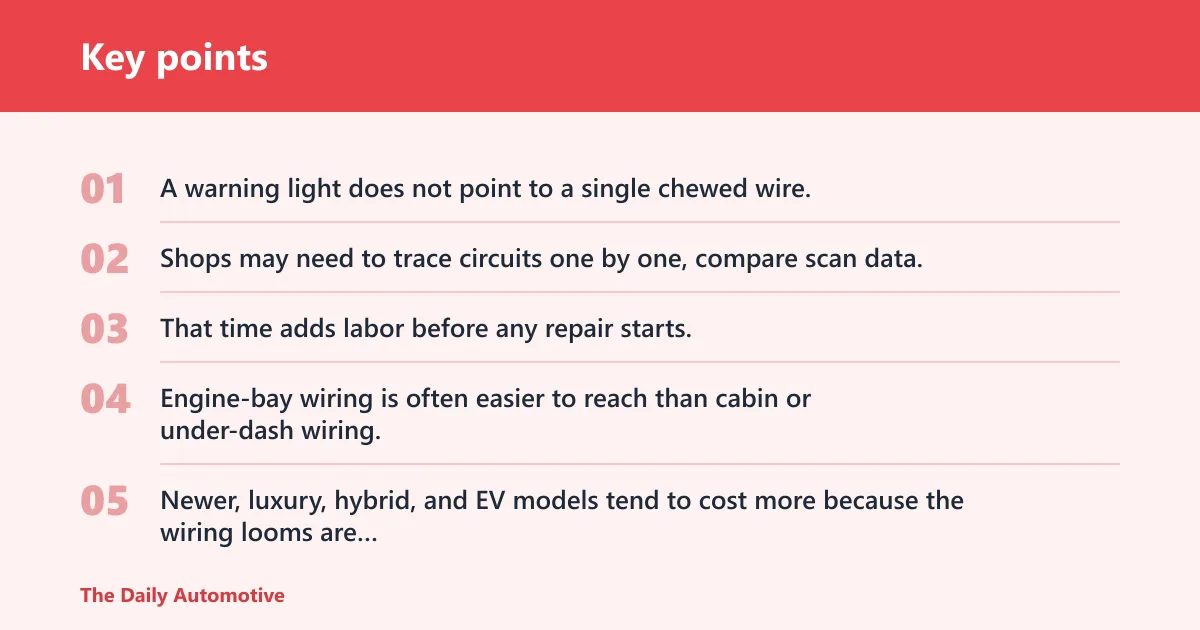
A warning light does not point to a single chewed wire. Shops may need to trace circuits one by one, compare scan data, and check whether a failed signal is the cause or the result of another damaged component. That time adds labor before any repair starts.
Access, disassembly, and buried wiring looms
Engine-bay wiring is often easier to reach than cabin or under-dash wiring. Newer, luxury, hybrid, and EV models tend to cost more because the wiring looms are buried deeper and the access steps are longer. More disassembly means more labor, even if the damaged section is small.
Suppose a compact SUV shows a no-start and a traction-control light after a rodent visit. If the wiring-loom section sits behind the battery tray, the quote can jump from a simple repair to several hours of removal, tracing, and reassembly. The symptom is the same. The access is not.
Secondary damage that changes the estimate
Rodents often chew more than wires. Consumer Reports notes that rodents chew wiring, hoses, belts, and other critical car parts. If the shop finds a damaged sensor connector, a cracked vacuum hose, or a chewed belt in the same area, the total can move into the worst-case range of $8,000+. (Consumerreports)
| Symptom | Likely damaged component | Typical shop action | Typical cost band | Claim insurance? |
|---|---|---|---|---|
| One warning light, visible nick in one wire | Single wire insulation or conductor | Splice, seal, and rewrap | $200–$800 | Maybe, if the deductible is low |
| No-start, one circuit fault, exposed terminal | Connector or pigtail end | Replace connector ends and repair leads | $300–$1,200 | Often, if more than one part is damaged |
| Misfire, sensor code, multiple damaged strands | Multiple wires in one branch | Repair several wires and retest | $200–$800 | Maybe |
| Several faults in one area | Wiring-loom section | Replace one wiring-loom section | $800–$2,500 | Often worth asking about |
| Many warning lights, widespread open circuits | Full wiring loom | Replace full loom and calibrate or relearn if needed | $2,500–$8,000+ | Usually yes, if comprehensive applies |
| Check engine light plus rough running | Sensor wiring or related connector | Repair wiring, replace sensor if failed | $300–$1,200 | Maybe |
| Battery drain, intermittent electrical loss | Module feed, ground, or fuse-box lead | Trace circuit, repair damaged feed, verify module operation | $300–$2,500 | Often if confirmed rodent damage exists |
| Engine warning light plus belt noise or fluid smell | Secondary hose, belt, or nearby component | Replace non-wire part and inspect adjacent wiring | Can push total to $8,000+ | Yes, if the policy and damage support it |
What counts as minor vs major damage?
Minor damage usually means one or a few wires, limited to a short section, with no evidence that connectors or modules were hit. Major damage starts when the rodent reaches terminals, multiple branches, or a buried wiring loom that requires major disassembly. The quote should reflect that difference.
Single-wire damage and splice repairs
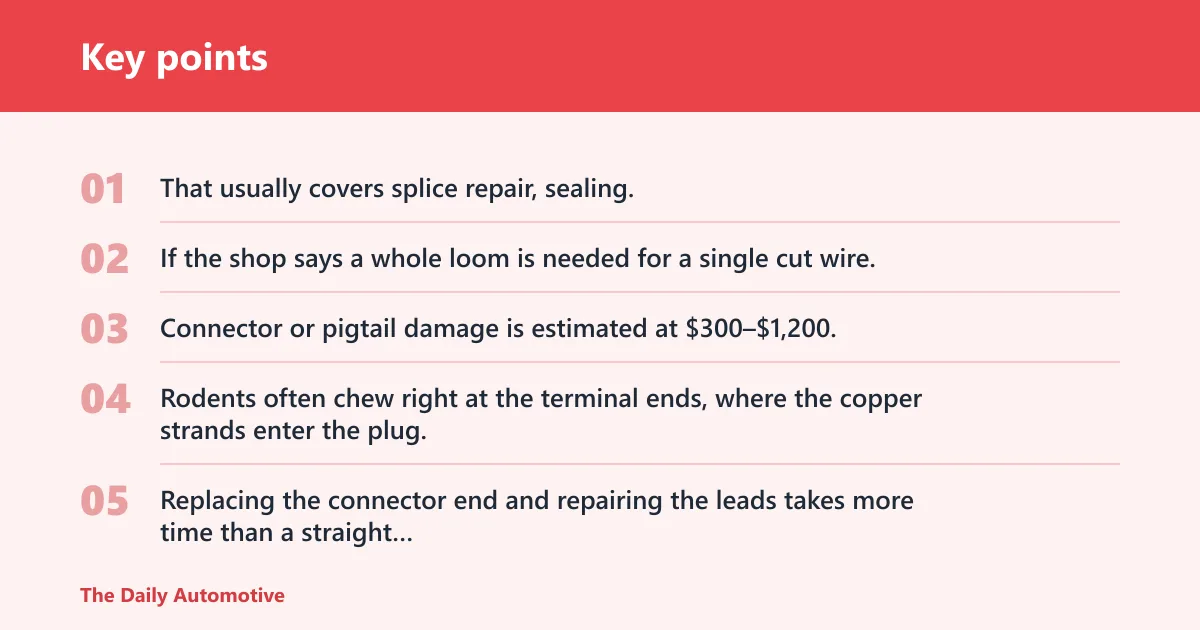
Minor wire repair is estimated at $200–$800. That usually covers splice repair, sealing, and rewrapping when only one or a few wires are damaged. If the shop says a whole loom is needed for a single cut wire, ask what made the repair impossible.
Connector, terminal, and pigtail damage
Connector or pigtail damage is estimated at $300–$1,200. Rodents often chew right at the terminal ends, where the copper strands enter the plug. Replacing the connector end and repairing the leads takes more time than a straight splice because the shop must preserve proper pin fit and signal quality.
Wiring-loom section and full loom replacement
Multiple wires or one wiring-loom section are estimated at $800–$2,500. Full wiring loom replacement is estimated at $2,500–$8,000+, and the bill can include calibration or relearn work after installation. A chewed engine wiring loom can cost thousands of dollars to replace.
A common first-timer mistake is approving full loom replacement before the shop shows the damaged section. Ask for the failed circuit, the test result, and the reason a section repair will not hold. That is the cleanest way to spot an overreach.
Can you drive it safely?
If the car has warning lights, stalling, a no-start, or any sign of shorting, do not assume it is safe to keep driving. Some rodent damage is limited to a light circuit. Some of it affects fuel, ignition, charging, or safety systems. The right move is an inspection first when symptoms are electrical.
Warning lights, no-start, and stalling
A check engine light alone does not always mean the car must be towed. But a no-start, misfire, stall, or multiple unrelated warning lights can point to a damaged power, ground, or control circuit. In that case, continued driving can make the fault harder to trace.
When to stop driving and inspect first
Stop driving and arrange inspection first if the car cranks and will not start, runs rough, loses power, or shows several electrical warnings after rodent activity. Rodent damage in the United States is estimated to cause nearly $200 million in repair costs annually, and the longer the fault is ignored, the more likely hidden damage becomes part of the bill.
What a shop should check before release
Before the car goes back on the road, the shop should confirm the repaired circuit passes a retest, scan for stored and pending codes, and verify there are no secondary faults nearby. If the repair touched a safety or emissions circuit, ask whether a relearn or calibration is required.
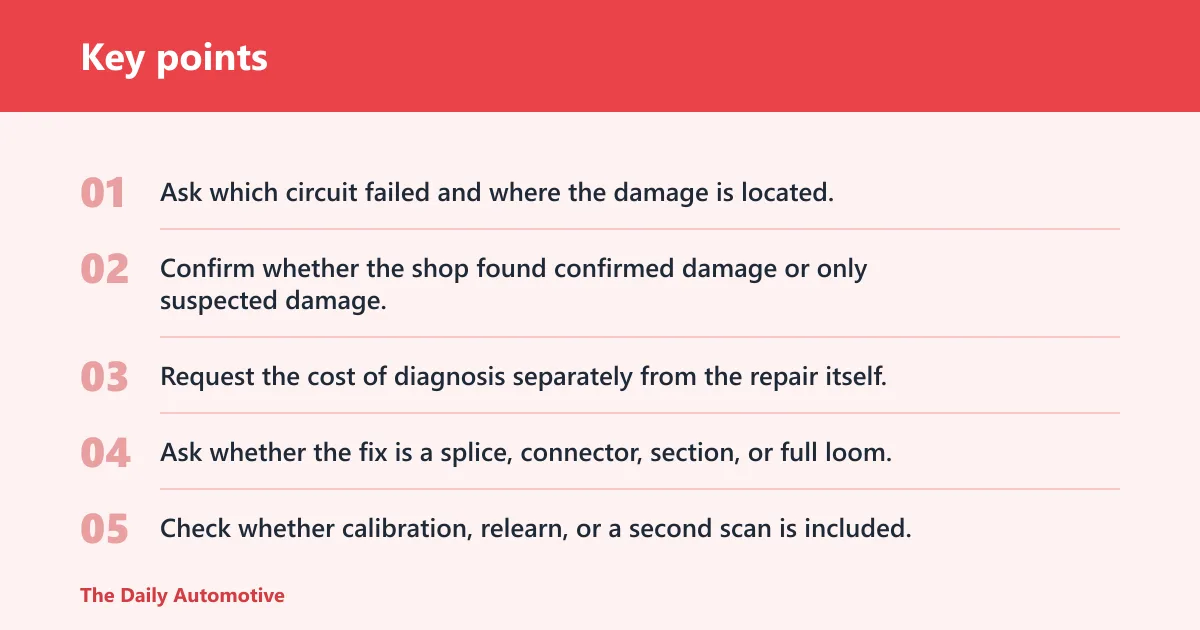
- Ask which circuit failed and where the damage is located.
- Confirm whether the shop found confirmed damage or only suspected damage.
- Request the cost of diagnosis separately from the repair itself.
- Ask whether the fix is a splice, connector, section, or full loom.
- Check whether calibration, relearn, or a second scan is included.
Does insurance cover chewed wires?
Comprehensive auto insurance may cover rodent-related damage, while basic liability insurance does not cover animal damage. The deductible matters because it can decide whether a claim is worth filing. If the repair is close to the deductible, paying out of pocket may make more sense than opening a claim.
Comprehensive coverage versus liability
If you carry comprehensive coverage, rodent damage is often covered. Liability insurance pays for damage you cause to other people, not damage caused by animals inside your own vehicle. That is why coverage type matters before you approve a repair plan.
Deductible math and claim timing
Deductibles can range from $250 to $1,000 depending on the policy. If the estimate is $600 and the deductible is $500, the claim benefit may be small after paperwork and possible premium effects. If the estimate is $2,800, the claim is more likely to make sense.
Save photos of droppings, nests, chewed insulation, and any visible wiring damage before the car is moved or cleaned. Keep the first estimate, the final repair order, and any scan report. If there is hidden damage later, those records help show the original scope.
What to ask before you approve repairs
Before you sign, make the shop define the damage, not just the symptom. You want the exact circuit, the repair method, and the reason for each part on the estimate. That keeps the quote tied to confirmed damage instead of worst-case guesswork.
Ask about the damaged parts
Which wires, connectors, or modules are damaged? Is the issue in the engine bay, the cabin, or an under-dash loom? The location matters because access time can change the bill as much as the part itself.
Ask what is confirmed versus suspected
Is the quote based on confirmed damage or likely damage? If the shop cannot show the failed section, ask where they expect to find it and what tests support that assumption. A fair estimate should separate diagnosis from approved repair.
Ask about calibration and follow-up testing
Do you need calibration, relearn, or a second scan after repair? Some sensors and modules need post-repair verification, and that can add labor. If the estimate leaves that out, the final invoice can be higher than the first quote.
How do you repair chewed car wires?
Repair starts with inspection, then scanning and tracing the fault, then choosing the least invasive fix that restores the circuit. A good shop matches the repair to the damage: splice the wire if possible, replace the connector if the end is gone, or replace a wiring-loom section when the damage is wider.
If the damage is spread across several circuits or hidden in a loom, the shop may need to remove intake parts, trim panels, or under-dash covers before it can confirm the real scope. That is normal. What is not normal is a replacement decision made without showing the failed area.
Rodent damage is more common than many owners expect, and the repair path can change fast once the wiring loom is opened up. The best quote is one that states what was found, what was tested, and what still needs confirmation.
Should I get a second opinion on rodent wiring repairs?
Yes, especially if the first quote jumps straight to a full loom, a module replacement, or a large bill with little detail. A second opinion is most useful when the car still runs, the damaged area is visible, or the estimate includes several expensive parts without a clear test trail.
If the second shop agrees on the failed circuit and cost band, that supports the estimate. If the diagnosis changes from one wire repair to a wiring-loom replacement, ask both shops to show the damaged section and the test results they used.
Frequently asked questions
How much does it cost to repair rodent-chewed car wires?
The usual range is from a few hundred to several thousand dollars. Hidden damage and access issues are what push a quote upward.
Does car insurance cover chewed wires?
Comprehensive auto insurance may cover rodent-related damage, but liability insurance does not cover animal damage. The deductible still applies, and deductibles can range from $250 to $1,000 depending on the policy. If the repair cost is close to the deductible, a claim may not be worth it.
Can I drive with rodent-chewed wires?
Sometimes, but not if the car has a no-start, stalling, multiple warning lights, or any sign of electrical shorting. Those symptoms mean the problem may be affecting more than one circuit. If the damage is visible or the vehicle runs poorly, get an inspection before driving farther.
How much does a wiring loom replacement cost after rodent damage?
A full wiring loom replacement is estimated at $2,500–$8,000+, and the final number can go higher if the shop finds secondary damage or needs calibration after installation. Newer, luxury, hybrid, and EV models often cost more because the loom is harder to reach.
What should I ask the shop before approving rodent wire repairs?
Ask which wires, connectors, or modules are damaged, whether the quote is based on confirmed damage, and whether the repair needs calibration or relearn after installation. Also ask for the diagnosis fee separately and request a second scan if the first estimate feels vague or too broad.
Products related to this article
Sponsored / affiliate links. As an Amazon Associate I earn from qualifying purchases. I may earn additional commission from eligible campaigns.
 Car A/C Repair Kit, 270PCS Rubber O-Ring Seal Kit + 40PCS Car Air Conditioner Valve Core Kit for R12 R134a A/C with Remover & Install Tool+10pcs R134a AC Valve Caps, Fix Refrigeration System
 Car Fuel Pressure Gauge - Auto Repair Tester with 6.3, 7.89, and 9.49 Connectors for Gasoline Injection Testing