Best Blend Door Actuator Tools for HVAC Repair: We Compared
The best blend door actuator tools match the job: a scan tool for diagnosis, trim tools and a ratchet set for access and removal, a torque screwdriver for installation, and a calibration-capable scan tool when the HVAC module needs relearning. Skip the wrong tool and you can replace a good actuator, crack dash trim, or leave the air stuck on hot or cold. This guide focuses on the tools that actually help with diagnosis, access, calibration, and repair-kit work, so you buy only what you need.
Quick comparison
| Product | Badge | Best for | Price | ||
|---|---|---|---|---|---|
 |
Innova 5610 OBD2 Bidirectional Scan Tool – Understand YourInnova | Our pick | Diagnosis, commanded tests, and verification | $325.00
Price as of 28 Oct 2026
|
View |
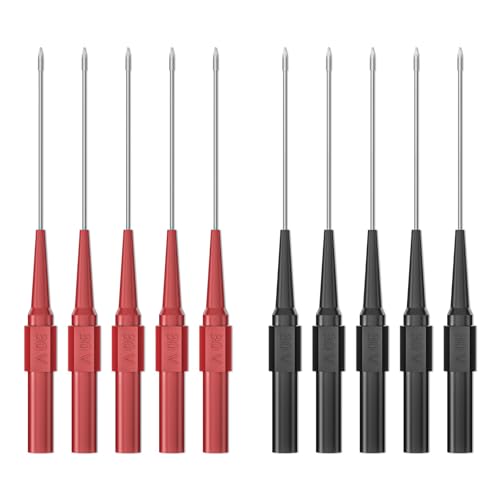 |
Back Probe Kit for Multimeter Test Lead for AutomotiveCNHIDEE | Pair with it | Connector testing and non-destructive voltage checks | $8.99
Price as of 28 Oct 2026
|
View |
 |
604-234 Blend Door Actuator HVAC Actuator Compatible withRLP | Fitment-specific replacement | Vehicle-specific actuator replacement for supported Ford platforms | $16.99
Price as of 28 Oct 2026
|
View |
Most DIY repairs start with diagnosis and under-dash access. A scan tool plus trim tools and a small socket set cover the widest range of jobs, while tight-access trucks and SUVs make a bidirectional scan tool and better probe leads more useful.
How we chose
This guide prioritizes tools that match the repair stage: diagnose first, access second, calibrate third, then verify the fix. It leans on vehicle service information and scan-tool coverage guidance because HVAC relearn behavior varies by platform, and OEM procedures often differ from one model year to the next.
For trust signals, the recommendations are organized around common real-world scenarios: under-dash actuator swaps, center-stack access jobs, and HVAC complaints that need commanded tests or relearn support. Coverage notes from service manuals, OEM service information, and scan-tool makers are the right reference points for that workflow because they show when a vehicle supports HVAC module access, actuator calibration, or manual reset.
Vehicle-specific fitment matters more than price alone. HVAC temperature-control parts are often tied to year, make, model, engine, and sometimes the exact blend door position. That is why this guide separates diagnosis tools from repair kits and actuator replacements instead of treating them as interchangeable.
Best blend door actuator tools by job
The best tools for blend door work are the ones that solve the stage you are in, not a random mix of parts and accessories. Use the rankings below to match the tool to diagnosis, access, calibration, or repair-kit work.
1) Diagnostic scan tool for symptom checking
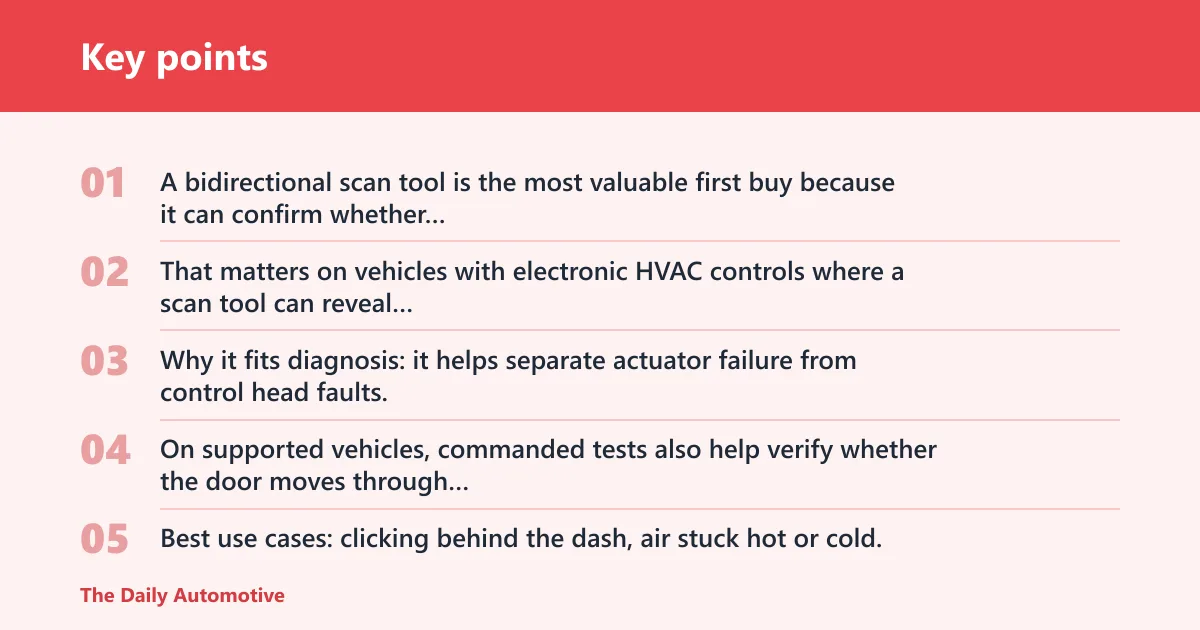
A bidirectional scan tool is the most valuable first buy because it can confirm whether the HVAC module is commanding the actuator, whether the vehicle supports relearn, and whether a temperature complaint is actually a control or communication issue. That matters on vehicles with electronic HVAC controls where a scan tool can reveal commanded blend door position, actuator response, or stored codes before you remove any trim.
Why it fits diagnosis: it helps separate actuator failure from control head faults, wiring problems, and unrelated HVAC faults. On supported vehicles, commanded tests also help verify whether the door moves through range or stalls at one position.
Best use cases: clicking behind the dash, air stuck hot or cold, mixed left/right temperature complaints, and post-repair verification after a replacement.
2) Back probe kit for wiring checks and connector testing
A back probe kit is the simplest companion to a meter when you need to test power, ground, and signal at the actuator connector without damaging the harness. It is especially useful when the symptom looks like a failed actuator but the real issue may be an open circuit, a poor ground, or a missing command signal from the HVAC module.
Why it fits diagnosis: it gives you access to the circuit without piercing insulation or forcing a terminal out of place. That makes it a practical tool for confirming whether the actuator is being fed correctly before you replace parts.
Best use cases: no-move symptoms, intermittent operation, and vehicles where the actuator is hard to reach but the connector is still accessible by feel.
3) Trim removal tools for clean access
Trim removal tools are the first physical access tool to buy. They let you remove glovebox panels, lower dash trim, and center-stack pieces without breaking clips or scarring soft plastic surfaces, which is especially important on vehicles where the actuator sits behind multiple layers of trim.
Why it fits access: many HVAC actuator jobs fail before they start because the trim is forced off with metal tools. Plastic trim tools reduce the chance of cracked clips, warped panels, and avoidable noise after reassembly.
Best use cases: under-dash passenger-side access, glovebox-based access, and center-stack work where panels are held in by hidden clips.
4) Compact socket set with extensions for removal and installation
A compact socket set is the other universal must-have because blend door actuators often use small metric fasteners in cramped locations. Short sockets, extensions, and a compact ratchet matter more than raw size when the fasteners are buried above the footwell or tucked behind ducting.
Why it fits access and repair: it removes the fasteners that hold the actuator, bracket, or related trim in place, and it helps reinstall the new part without overreaching or stripping heads.
Best use cases: under-dash actuators, tight passenger-side mounts, and jobs where the last bolt is more awkward than the first one.
5) Torque screwdriver for delicate fasteners
A torque screwdriver is useful when the vehicle or replacement part calls for light tightening on small screws or fragile plastic housings. It is not a universal need, but it is helpful on jobs where overtightening can crack a case or distort the mounting tab.
Why it fits repair work: small HVAC fasteners are easy to overdo by hand. A torque screwdriver adds control when the installation point is small, shallow, or close to brittle trim.
Best use cases: compact actuators, small screws in brittle housings, and jobs where the service information specifies light torque.
6) Calibration-capable scan tool for relearn and verification
A calibration-capable scan tool matters when the HVAC module needs a relearn after repair or battery disconnect. OEM service information and scan-tool coverage docs vary by platform, so the useful feature is not just code reading; it is module access, actuator sweep, and relearn support when the vehicle requires it.
Why it fits calibration: some vehicles complete a reset on their own, while others need a commanded procedure. A tool that can access body or HVAC modules is the difference between a finished repair and a dash that still blows the wrong temperature.
Best use cases: post-replacement relearn, module-controlled HVAC systems, and vehicles that continue clicking or misbehaving after a new actuator goes in.
Which tool set fits your vehicle?
Match the tool set to the symptom and access pattern first. A simple under-dash swap may need only trim tools, a small socket set, and a scan tool for verification. A tighter SUV or truck job may also need back probe leads, longer extensions, and a calibration-capable scan tool if the HVAC module expects relearn support.
Vehicle-specific fitment is still the deciding factor for replacement parts. For example, verified listings in this category include Ford 2011-2019 Explorer, Flex, Police Sedan Police, and Taurus applications for one actuator; Jeep Grand Cherokee 2004-99 for one repair-kit listing; Dodge Ram 1500 2009-02 for another repair-kit listing; and Cadillac Catera 2001-97 for a heater control valve listing. Those are not universal matches, and they should not be treated like tool recommendations.
Blend door tools decision table
| Symptom or access pattern | Vehicle type | Diagnosis tools | Removal tools | Calibration tools | Repair kit or full actuator? |
|---|---|---|---|---|---|
| Clicking at startup, temperature drifts, dash access is easy | Under-dash passenger access | Basic scan tool or back probe kit | Trim removal tools, small socket set | Manual reset first, scan tool if relearn is listed | Full actuator unless gear damage is confirmed |
| Noisy movement, air stuck hot or cold, actuator responds but output is wrong | Module-controlled HVAC | Bidirectional scan tool, live data, back probing | Trim removal tools, socket set with extensions | Calibration-capable scan tool | Actuator first; gear kit only if gears are stripped |
| No temperature change, linkage feels loose, repair is behind center stack | Tight-access SUV or truck | Scan tool plus wiring checks | Trim removal tools, socket set, probe leads | Scan tool if module relearn is required | Blend door repair kit if the door or linkage is damaged |
| Blend issue appears after battery work or part swap | Any vehicle with relearn support | Scan tool that can access body/HVAC modules | Removal tools already used for the swap | Relearn-capable scan tool or manual reset per manual | Whichever part failed before the reset |
| Left/right temperature split on dual-zone HVAC | Late-model sedan, crossover, or truck with electronic climate control | Bidirectional scan tool and connector test leads | Trim tools plus compact sockets | Platform-specific HVAC relearn procedure | Actuator or control-side diagnosis before buying a kit |
What tools do I need to replace a blend door actuator?
You usually need trim removal tools, a small socket set with extensions, and the replacement actuator itself. Add a scan tool if the vehicle needs relearn or module access after installation. A torque screwdriver can help with small fasteners, especially where access is cramped.
For a simple under-dash swap, that is often enough. For harder jobs, add back probe leads so you can verify power and command signals before you bolt the new part in.
Do you need a scan tool to calibrate a blend door actuator?
Sometimes yes, sometimes no. A basic reset may be enough on vehicles that relearn after battery disconnect, key cycling, or a manual procedure in the owner’s manual. A bidirectional or reset-capable HVAC diagnostic scan tool matters when the module needs commanded calibration.
OEM service information and scan-tool coverage docs are the best source for this because relearn behavior varies by platform. If the tool does not mention body or HVAC module access, it may still read codes but not run the relearn you need.
A common first-timer mistake is replacing the actuator, reassembling the trim, and stopping there. If the temperature still stays out of range, the repair may need a calibration step rather than another part.
Which HVAC tools help diagnose a bad blend door actuator?
The most useful diagnosis tools are an HVAC diagnostic scan tool and a back probe kit. The scan tool can read data and command tests on supported vehicles, while the probe kit lets you confirm voltage, ground, and control signals at the connector without damaging it.
These tools help separate actuator failure from a bad control head, wiring fault, heater control valve problem, or vacuum issue. That is especially useful on systems where temperature and mode complaints appear together.
Service manuals and scan-tool coverage documents are particularly important here because some platforms support commanded HVAC tests while others only support code reading. That difference changes the tool choice before any trim comes off.
Can I fix a blend door actuator without removing the whole dash?
Often yes. Many blend door actuator jobs are under the glovebox, under the center stack, or low in the passenger footwell, so you can reach them with trim tools and a socket set instead of removing the full dash. Difficult access changes the tool list, not the basic repair logic.
If the door itself is broken, the job can become much larger. A blend door repair kit may require more labor than a simple actuator swap, and some vehicles place the parts deep enough that partial dash disassembly is still unavoidable.
How do I tell if the actuator, blend door, or repair kit is the real problem?
Use symptom pattern and movement behavior. Clicking with no temperature change often points to stripped actuator gears. A motor that runs but does not move the door can point to linkage damage or a broken blend door. A temperature issue that changes with engine vacuum or control inputs may involve another HVAC part instead.
If the actuator responds to a scan tool command but cabin temperature does not change, the door or linkage deserves more suspicion. If the actuator does not respond at all, check power, ground, and module command before buying another part.
Are cheap blend door actuator tools worth buying?
Cheap tools are worth buying when you need them once for a straightforward job, especially trim tools and a basic socket set. They are less appealing for repeated HVAC work, tight-access vehicles, or jobs that need scan functions, where better probe leads and a calibration-capable tool save time.
For one-off use, buy the minimum that gets the trim off cleanly and the fasteners out. For repeat work, spend more on tools that can diagnose and verify, not just remove parts.
What vehicles commonly use blend door repair kits instead of a full actuator?
Repair kits are more common when the door or linkage design is known to wear or break and the actuator motor is still usable. Some vehicle-specific listings cover older trucks and SUVs, which is why fitment data matters more than a universal claim.
That does not mean every vehicle in those ranges needs a kit. It means the listing exists for those applications, and the right choice still depends on whether the fault is in the door, linkage, or actuator gears.
How do I reset a blend door actuator after replacement?
Start with the vehicle manual. Some systems reset with a simple key-cycle or battery disconnect procedure, while others need a scan tool to command an HVAC relearn. If the manual calls for module calibration, follow that instead of guessing.
Do not skip verification. After the reset, confirm the temperature changes through the full range and listen for repeat clicking. If the fault returns, the problem may be fitment, calibration, or the wrong repair part.
When should I replace the actuator gear kit instead of the actuator?
Choose the gear kit when the actuator motor still works but the gears are stripped, cracked, or slipping. That is a narrower fix than a full actuator and only makes sense if the housing and motor are still serviceable and the listing matches your vehicle.
If the motor is weak, the connector is damaged, or the part does not respond to command input, a full actuator is usually the better path. Gear kits are useful, but they are not a cure for every HVAC temperature fault.
Which one should you buy?
If you are on a budget and only need under-dash access, start with trim removal tools and a compact socket set. Add back probe leads only if you need to check wiring. That keeps the spend focused on the repair stage you actually face.
If this is a one-time DIY repair, a basic actuator swap kit plus a scan tool only if your manual calls for relearn is the safer buy. Do not pay for calibration features you will never use.
If you work on multiple vehicles or expect more HVAC jobs, a bidirectional scan tool is the most flexible buy. It helps with diagnosis, calibration, and verification across supported systems.
Choose a blend door repair kit when the door or linkage is damaged. Choose a gear kit when the motor works but the gears fail. Choose a full actuator when the part itself is the weak link and the door is still sound.
Frequently asked questions
What size sockets or trim tools are usually needed for blend door repair?
Small metric sockets are common, along with extensions for cramped under-dash work. For trim, use plastic removal tools that can pop clips without marring the dash. Exact sizes vary by vehicle, so confirm the service information or parts listing for your year, make, model, and engine.
Products related to this article
Sponsored / affiliate links. As an Amazon Associate I earn from qualifying purchases. I may earn additional commission from eligible campaigns.