How Much Does a Car AC Blend Door Repair Cost?
A car AC blend door repair usually costs $150 to $700 for an actuator or simple linkage fix, but a dash-out blend door job can run $800 to $1,500 or more at a shop. Leave it alone, and you can end up with heat only, cold air only, or an HVAC system that clicks and fails again. This guide breaks down what the quote includes, how to tell actuator failure from a broken door, and when DIY or dealer pricing makes sense.
What a blend door repair actually fixes
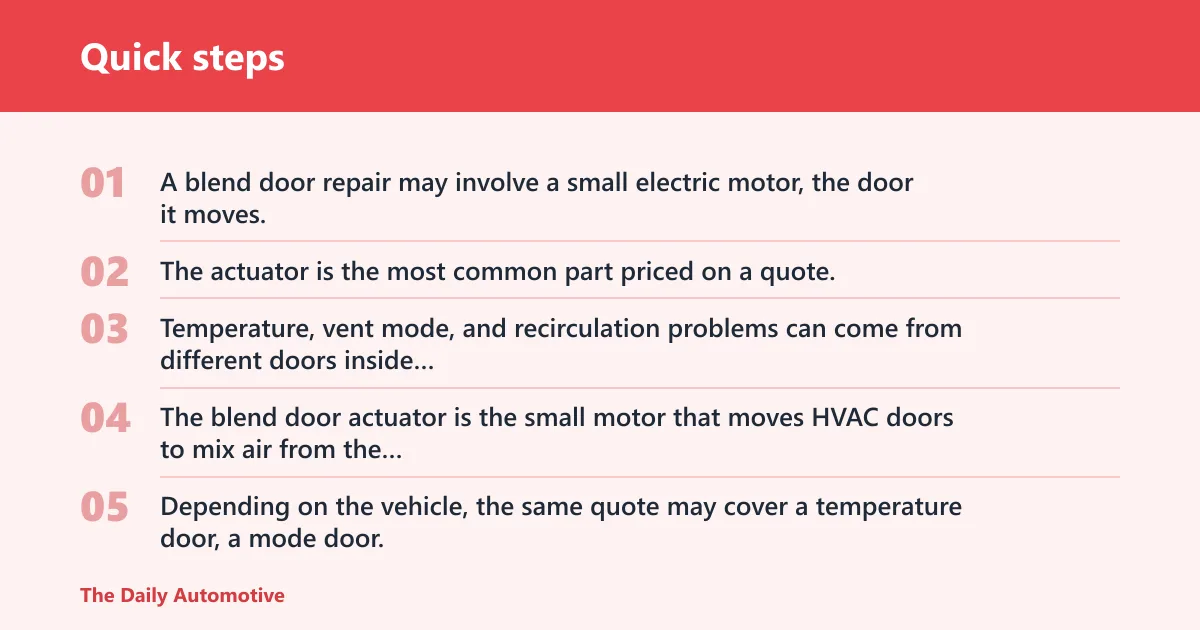


A blend door repair may involve a small electric motor, the door it moves, the control head, wiring, or calibration. The actuator is the most common part priced on a quote, but it is not the only failure point. Temperature, vent mode, and recirculation problems can come from different doors inside the HVAC case.
The blend door actuator is the small motor that moves HVAC doors to mix air from the heater core and AC evaporator. The HVAC blend door is the flap itself. Depending on the vehicle, the same quote may cover a temperature door, a mode door, or a recirculation door, and those are not the same job.
Common failure signs you can verify
A failing actuator often makes clicking or tapping behind the dashboard. It may also leave you with air stuck on hot, stuck on cold, or blowing from the wrong vents. In dual-zone systems, one side may blow different air than the other. That symptom matters, because it often points to a second actuator or a calibration issue.
Suppose the driver side stays warm while the passenger side turns cold. That is more suggestive of a dual-zone temperature control issue than a single broken main blend door. A different symptom, such as air only coming from the defrost vents, can point to a mode door fault instead.
How much does a car AC blend door repair cost?
For many U.S. vehicles, the repair usually lands between $200 and $600, with accessible actuator swaps sometimes under $200 and deep dash work pushing past $1,000. RepairPal’s September 2026 national estimate is $452 to $592, including about $153 for the actuator and $299 to $439 for labor.
That spread reflects the type of repair, not just the part. A simple actuator replacement and a full HVAC-case repair can appear similar on paper until labor is added. Local shop rate, diagnostic time, and calibration charges can move the final bill quickly.
Parts, labor, and diagnostic fee breakdown
The part is often the smallest line item. Labor is the bigger variable, especially if the mechanic must remove trim, ducts, the glove box, or the dashboard. A diagnostic fee may be billed separately, often waived with repair authorization, so ask whether diagnosis is credited back before you approve the job.
- Part: often a low-cost actuator, but the wrong part number can waste time and money.
- Labor: rises with access difficulty and calibration steps.
- Diagnostic fee: may be separate and should be confirmed before approval.
How RepairPal fits into the estimate
RepairPal is useful as a benchmark, not a promise. Its national estimate gives you a rough range, but it will not match every vehicle or city. A compact car with the actuator behind the glove box can price very differently from a sedan with buried HVAC hardware.
Blend door repair quote decoder
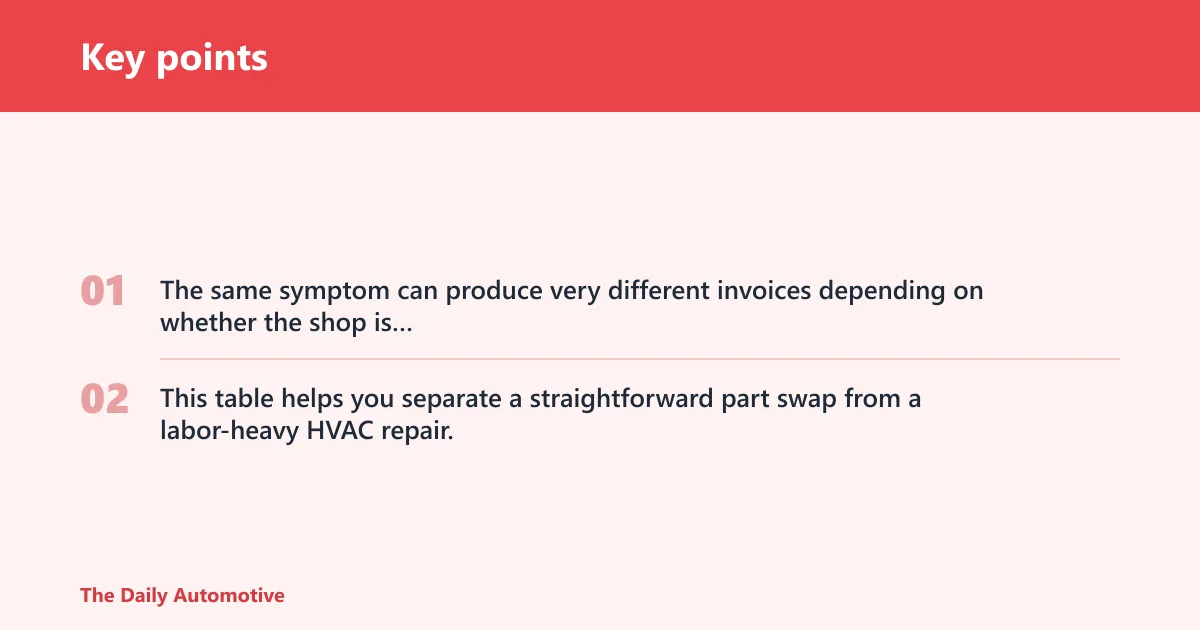
Read the estimate line by line. The same symptom can produce very different invoices depending on whether the shop is replacing a visible actuator, chasing a wiring fault, or removing the dashboard. This table helps you separate a straightforward part swap from a labor-heavy HVAC repair.
| Symptom | Likely failed component | Access level | Estimated labor hours | Parts range | Red-flag add-ons |
|---|---|---|---|---|---|
| Clicking behind dash, temperature still changes some | Easy-access blend door actuator | Glove box or side panel | 0.5–1.5 | $22.99 to $150 | Calibration, scan tool relearn |
| Stuck hot or cold air with no vent change | Temperature actuator or blend door | Moderate trim and duct access | 1.5–3.0 | $40 to $150 | Control head test, post-repair calibration |
| Air only comes from defrost or floor | Mode door actuator | Behind dash paneling | 1.5–4.0 | $40 to $150 | Vacuum or wiring diagnosis |
| One side hot, one side cold | Dual-zone left or right actuator | Moderate to buried access | 2.0–5.0 | $80 to $300 for one or two actuators | Pair replacement, calibration, control head scan |
| Cold air returns only after reset | Calibration or relearn issue | Scan-tool or battery reset | 0.3–1.0 | $0 to $50 | Further diagnosis if codes return |
| No change after actuator replacement quote | Wiring fault or failed control head | Electrical diagnosis | 1.0–2.5 | $0 to $150 | Harness repair, module testing |
| Knocking plus broken airflow after impact or broken clip | Stuck HVAC door or broken linkage | May require case opening | 3.0–8.0 | $40 to $200 | Case repair, extra disassembly |
| Estimate mentions full dashboard removal | Deeply buried actuator or door | Full dash access | 6.0–12.0+ | $40 to $300+ | Dash removal, refrigerant work if HVAC box is opened |
| Diagnostic fee only | Not yet confirmed | Inspection only | 0.5–1.0 | $50 to $120 | No repair credit unless stated |
| Two actuators on a dual-zone vehicle | Matched left/right actuators | Mixed access | 3.0–6.0 | $80 to $300 | Pair labor, relearn, scan time |
Why does the quote jump so much from car to car?
The biggest cost driver is access. A compact car or sedan is often behind a glove box or panel, while other models bury the actuator in the HVAC housing. Once the dash has to come apart, labor can jump into the hundreds of dollars and sometimes well above that.
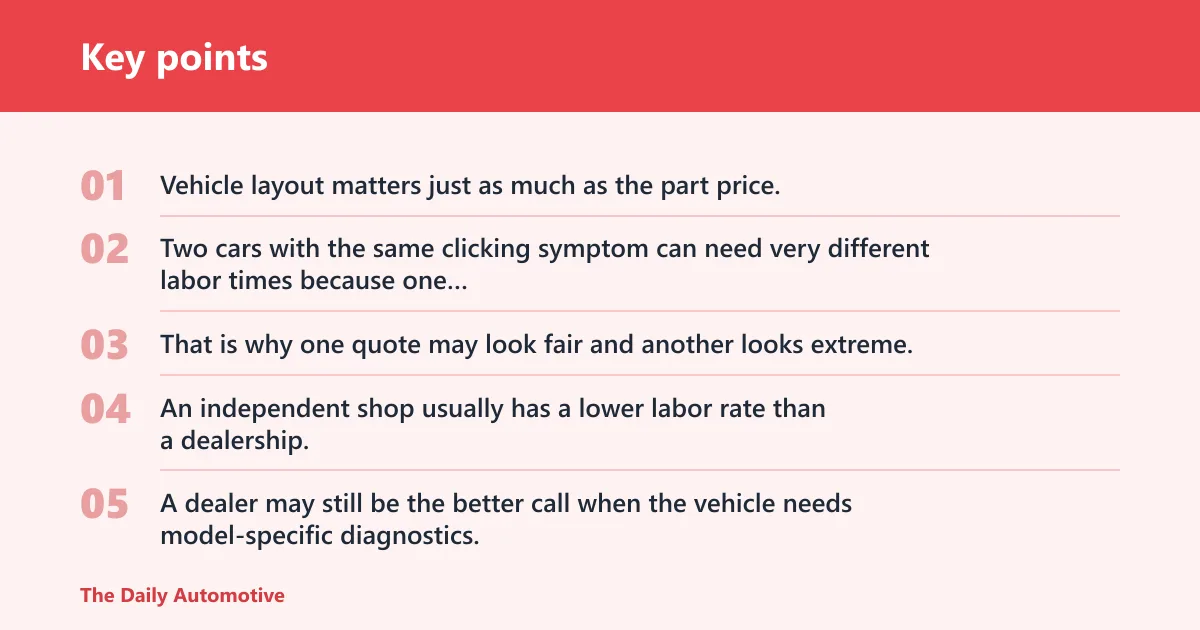
Vehicle layout matters just as much as the part price. Two cars with the same clicking symptom can need very different labor times because one has a simple access panel and the other needs trim, ducts, or the dashboard removed. That is why one quote may look fair and another looks extreme.
Independent shop versus dealership
An independent shop usually has a lower labor rate than a dealership, so the same repair can total less there. A dealer may still be the better call when the vehicle needs model-specific diagnostics, a factory scan tool, or a warranty-compliant repair. The quote should say which labor rate is being used.
OEM or aftermarket actuator: which costs more?
OEM actuators usually cost more than aftermarket units, but the lower part price on an aftermarket piece does not guarantee an easier repair. Fitment depends on the exact vehicle, the part number, and whether the shaft orientation matches the original. The labor can cost more than the part either way.
Selected aftermarket actuator options were listed for approximately $22.99 to $49.99, while other guides put the actuator itself at $40 to $150. That is why a quote should separate part price from labor. A cheaper part can still become a costly repair if access is poor or the wrong unit is ordered.
When aftermarket makes sense
Aftermarket can make sense when the part number is confirmed and the vehicle is a common application with solid fitment history. It is riskier when the actuator is buried, the HVAC control strategy is complex, or the vehicle has already had repeated failures. In those cases, the cheaper part may not save enough to justify a return trip.
Can a bad blend door actuator cause hot and cold air at the same time?
Yes. In dual-zone climate control, a failed actuator can leave one side hot and the other cold. That is one of the clearest clues that the issue is not a whole-system AC failure. It often means the driver and passenger temperature doors are no longer moving together.
Dual-zone systems may use separate left and right temperature actuators, which increases the part count and the chance that only one side fails first. A clicking actuator on one side and a normal sound on the other is a common clue that you are not dealing with a single universal fault.
Mode or recirculation problems that look like temperature failure
Not every complaint that sounds like “no cold air” is a temperature door problem. A mode door can send air to the wrong vents, and a recirculation door can let outside air in when it should not. That can feel like weak cooling even when the AC system itself is working.
Should you replace one actuator or several at once?
Replace only the failed unit when the diagnosis is clear and the other doors move normally. Replace multiple actuators when the vehicle has matched failures, dual-zone mismatch, or easy access to the other unit while the dash is already open. The labor saved can be real, but only if the other units are actually weak.
Calibration matters after the repair. Many vehicles need a relearn or scan-tool procedure so the HVAC control head knows the door positions again. Skipping that step can make a good part look bad, or bring the clicking back.
Buyer-friendly checklist before you approve the quote
- Ask whether the quote is for diagnosis, actuator replacement, calibration, or dashboard removal.
- Ask which door failed: temperature, mode, or recirculation.
- Confirm whether the part is OEM or aftermarket.
- Ask if the actuator is easy-access or buried behind trim, ducting, or the dash.
- Ask whether the diagnostic fee is separate and whether it is credited toward repair.
- Ask whether the vehicle needs one actuator or a matched pair.
- Ask whether calibration or relearn is included in the estimate.
A common first-timer mistake is approving a “blend door” quote without asking which door is actually at fault. A $180 actuator swap can turn into a $1,200 dash job if the real problem is a broken HVAC door or a wiring fault hidden deeper in the system.
Frequently asked questions
Why is blend door actuator replacement so expensive on some cars?
The part is often inexpensive; the access is what hurts. If the actuator sits behind the glove box, the quote may stay modest. If the dashboard, ducts, or HVAC box must come apart, labor can climb fast. That is why two similar symptoms can produce very different totals.
Is blend door repair cheaper at an independent shop or dealership?
Independent shops usually charge less for labor, so the same repair often totals less there. Dealerships may cost more, but they can be the better option for complex HVAC diagnosis, factory-level scan work, or warranty-related repairs. Ask each shop what labor time and rate they are using.
How much is the part for a blend door actuator?
Part pricing varies widely. Some aftermarket options were listed at approximately $22.99 to $49.99, while broader pricing guides put many actuators around $40 to $150. OEM parts are usually more expensive, and the exact fit depends on the vehicle and part number.
Can a bad blend door actuator cause hot air on one side and cold on the other?
Yes, especially on dual-zone systems. A failed left or right temperature actuator can leave one side hot and the other cold. That symptom often means one actuator is out of sync or broken, not that the entire AC system failed at once.
Does a blend door actuator replacement need dashboard removal?
Not always. Some actuators are reachable through the glove box or a side panel, which keeps labor lower. Others sit deep in the HVAC case and can require major dash disassembly. If the quote mentions dashboard removal, expect the labor line to be much higher.
Is a blend door actuator repair covered under warranty?
It may be, depending on the vehicle’s age, mileage, and the warranty terms. Factory coverage, extended service contracts, and some powertrain-adjacent plans may apply only in specific cases. Confirm whether the issue is covered before paying for diagnosis, because warranty approval can change the bill completely.
Products related to this article
Sponsored / affiliate links. As an Amazon Associate I earn from qualifying purchases. I may earn additional commission from eligible campaigns.