How Much Does Freon Cost for a Car? 2026 Can & Shop Prices
Freon for a car costs about $15 for a 12-oz can of R-134a, about $31 to $37 for a can of the newer R-1234yf, and roughly $283 to $366 for a typical shop recharge. Those figures are prices we checked or read in October 2026, and each one is dated and sourced below because refrigerant prices move. Which one applies to you depends on the refrigerant in your car, and the label under the hood tells you. This guide gives the real numbers side by side, explains why the per-pound price looks so different between the two types, and covers what the EPA says you can and cannot do yourself.
What Is Freon, and Why Does Your Car Need It?
Best Leak-Check Add-On Pick
|
ERRECOM Brilliant UV Dye for Vehicle A/C Leak Detection, $13.00 A fluorescent dye in a 7.5 ml syringe with a reusable R134a adapter. Dye shows up under UV light, so it can help locate where refrigerant is escaping before you pay for another recharge.
As an Amazon Associate we earn from qualifying purchases. Price and availability change; check the listing. |
“Freon” is the everyday word for the refrigerant that makes a car’s air conditioning cold. The refrigerant absorbs heat from the cabin and releases it outside as it cycles through the compressor, condenser and evaporator. Refrigerant is not used up the way fuel or oil is, so a system that is low on charge almost always has a leak somewhere. That is the reason a recharge can feel like money wasted: if the leak is not found, the new charge can escape too.
For the diagnostic side, see why a car AC keeps losing refrigerant and our comparison of home leak detectors. This page stays on one question: what the refrigerant itself costs.
Types of Refrigerant Used in Cars
Per EPA, automakers began moving from the old CFC-12 (R-12) to HFC-134a (R-134a) with 1992 model-year vehicles, and by the 1995 model year every new U.S. vehicle with air conditioning used R-134a. Automakers then began transitioning to lower-global-warming refrigerants in 2012, and EPA says HFO-1234yf (R-1234yf) is now used in the majority of light-duty vehicles. Which one your car has depends on the model year and maker, so do not guess from age alone. Our guide to what kind of freon your car takes shows where to look.
- R-134a: Used in most cars from the mid-1990s into the 2010s. EPA lists its global warming potential as 1,430.
- R-1234yf: Global warming potential of 4 per EPA, and classed as mildly flammable (ASHRAE A2L). EPA says it can be used safely, and requires systems designed for it to carry a flammable-refrigerant warning label and use unique fittings.
- R-12: The original freon, in pre-1995 vehicles. We did not find a current price from a source we could read, so we are not quoting one.
The two modern refrigerants use different service fittings on purpose, and EPA says adapters should not be used to convert between them. If the can, hose or adapter in your hand does not match your car’s port, stop and take it to a shop.
How Much Does Freon Cost for a Car in 2026?
The table compares the refrigerants by what you pay for a DIY can and for a shop recharge. Can prices for R-1234yf come from Amazon listings we pulled on October 12, 2026 and change often. The R-134a can price and the shop figure are from ThePricer’s article updated September 2, 2026, which says it took the shop average from RepairPal’s estimate (updated August 7, 2026) and the can price from an AutoZone listing.
| Refrigerant | DIY can (as of Oct 2026) | Shop recharge | Notes |
|---|---|---|---|
| R-134a | 12 oz at $14.99 (about $20 per pound), AutoZone example per ThePricer | About $283 to $366 national average, per RepairPal as reported by ThePricer (labor roughly $178 to $261, parts roughly $104) | Most common in cars from the 1990s to the 2010s. Price varies by store and brand |
| R-1234yf | 8 oz at $31.48 (about $63 per pound) or 12 oz at $36.99 (about $49 per pound), Amazon listings Oct 12, 2026 | The national average above is not split by refrigerant. Ask any shop to quote it by type | Per ThePricer, a Honeywell 8-oz can at $46.99 works out to about $94 per pound. Fittings differ from R-134a, and the refrigerant is mildly flammable |
| “R134a replacement” hydrocarbon cans | 6-oz cans listed at roughly $25 to $38 (Amazon, Oct 12, 2026) | Not applicable | EPA says hydrocarbon refrigerants are not acceptable for car A/C because of fire and explosion risk. Do not buy these |
All prices are before tax, vary by region and store, and are a snapshot. Treat them as a way to sanity-check a quote, not a promise.
Why Price per Pound Is the Wrong Way to Compare
The old advice on this topic quotes one price per pound for each refrigerant. The math is simple but easy to misread: a can’s price divided by its weight in pounds. A 12-oz can is 0.75 pounds, so $14.99 gives about $19.99 per pound, and $36.99 gives about $49.32 per pound. An 8-oz can is 0.5 pounds, so $31.48 gives about $62.96. The small-can price per pound is a retail number. It tells you roughly how much more R-1234yf costs than R-134a (a factor of about 2.5 to 4.7 across the cans we checked), but it is not what a shop pays or charges, and the shop price also covers labor and equipment.
What Is in the Shop Price
ThePricer describes a normal professional recharge as inspecting the system, identifying the refrigerant, measuring pressures and vent temperatures, recovering any refrigerant already in the system, pulling a vacuum if the system was opened, checking for problems and refilling to the specified charge. It stresses that the charge should be set by weight, not by topping off until the air feels cold. That last point is the real difference between a shop recharge and a can with a gauge: the label specifies a weight, and a pressure reading alone does not tell you the weight.
Vehicle-Specific Shop Estimates
The same ThePricer article lists vehicle estimates, which it attributes to RepairPal’s estimator. They show how much the vehicle matters:
| Vehicle | Estimated shop recharge |
|---|---|
| Honda CR-V | $250 to $333 |
| Honda Civic | $255 to $342 |
| Toyota Camry | $272 to $354 |
| Ford F-150 | $316 to $399 |
| 2026 Toyota Prius | $319 to $416 |
| 2024 BMW X5 | $381 to $478 |
ThePricer says many vehicles fall between about $250 and $440 and that some exceed $500. Your local labor rate and any leak repair sit on top of that.
What the Law Says Before You Buy or Recharge
The old version of this page said R-1234yf could not legally be handled by anyone without certification. The EPA pages we read do not say that, so here is what they do say, with the page named:
- Small cans for DIY: The EPA refrigerant sales restriction page (last updated March 23, 2026) says small cans of non-exempt MVAC refrigerant, designed to hold two pounds or less, with unique fittings and self-sealing valves, can continue to be sold to people without certification for DIY use on their own vehicles. The page does not mention R-1234yf by name, so we cannot confirm it for that refrigerant, and we suggest a shop for R-1234yf cars.
- Bigger containers: The same page says Section 609 certified technicians and their employers can buy MVAC refrigerant in larger containers.
- Paid service: The EPA servicing requirements for motor vehicle A/C says Section 609 certification is required to service any MVAC system for consideration, regardless of refrigerant.
- No venting: The same page says intentionally releasing refrigerant during servicing, repair or disposal is prohibited, and that refrigerant must be recovered with EPA-certified equipment before service where discharge is expected. Never open a line or release refrigerant to the air to “lower” a charge.
- Hydrocarbon cans: The EPA hydrocarbon safety Q&A says hydrocarbon refrigerants are not acceptable for car A/C and can cause fire or explosion, and it names ZeroR and Arctic Air as products sold in small cans online and in stores.
This is a summary of EPA pages as of October 2026, not legal advice. Rules and enforcement can change, so check EPA before relying on any detail.
DIY Can or Shop Recharge: What You Actually Save
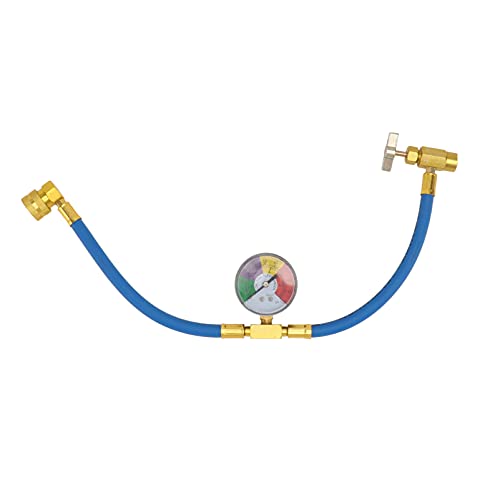
Reusable hose-and-gauge kits were listed at $19.99 to $22.49 on Amazon on October 12, 2026. Add the $14.99 can from the R-134a example and the DIY outlay is about $35 to $37, against $283 to $366 at a shop. That gap is real, but it only buys a top-up. It does not recover old refrigerant, pull a vacuum, weigh in the charge or find the leak. If the system is low because of a leak, you may pay the DIY cost again and again.
- DIY can be reasonable when: the car uses R-134a, the system has simply drifted low after years, you read the can and the car’s label first, and you stop if anything seems off.
- Go to a shop when: the car uses R-1234yf, the AC went warm again soon after a previous recharge, you hear hissing, you see oily residue at a fitting, or you are not sure which refrigerant is in the system.
- Stop and get help immediately when: you suspect a hydrocarbon product was added, or you smell anything flammable near the engine. EPA says to contact a certified Section 609 technician or your fire marshal in that case.
For the DIY steps themselves, read the can’s own instructions and our guide to recharging refrigerant yourself. We do not publish a pressure target here because it depends on your vehicle and the outside temperature.
What Else Changes the Price
- Refrigerant type: The biggest swing, as the table shows.
- Vehicle: Look at the spread from a CR-V to an X5 above.
- Leaks: A recharge is the cheap part when a leak must be fixed. Our AC leak repair cost guide covers that.
- Shop labor rate and region: Rates differ by shop and area, so compare written quotes.
- What the quote includes: Ask whether recovery, vacuum, dye or a leak check are included, and whether the charge is by weight.
If your question is the whole service bill rather than the refrigerant, our car AC recharge cost guide covers the shop-versus-store comparison.
Why Freon Prices Have Moved
EPA’s background page says the AIM Act gives it authority to phase down the production and consumption of listed HFCs. R-134a is an HFC. EPA’s refrigerants page says new nonroad vehicles can no longer use it from January 1, 2028, and that servicing existing R-134a vehicles remains allowed. EPA’s servicing page adds that its 2023 Technology Transitions rule restricts HFCs with a global warming potential of 150 or more in newly manufactured vehicles, but not HFC use in servicing existing systems. We did not find an official page giving a price history, so we are not quoting year-over-year price increases; the dated prices above are the ones to use.
Tips to Save Money Without Cutting Corners
- Check the label first: Buying the wrong refrigerant or adapter wastes money and is unsafe.
- Get two or three written quotes: Ask each for the refrigerant type, the charge by weight, and what is included.
- Pay for the leak check: If your AC has needed refrigerant before, a leak check costs less than repeated recharges. Our vent temperature chart helps you note how cold the air is before and after service.
- Skip bargain “replacement” cans: The cheapest cans online are often the ones EPA warns about.
- Never vent refrigerant: It is prohibited, and recovery is part of what a shop’s labor covers.
Curious why the old name stuck? Do cars still use Freon? covers it.
Frequently Asked Questions
How much does freon cost for a car?
It depends on the refrigerant and who does the work. As of October 12, 2026, an 8-oz can of R-1234yf listed at $31.48 and a 12-oz can at $36.99 on Amazon, and ThePricer’s example of a 12-oz R-134a can at AutoZone was $14.99. A shop recharge averaged about $283 to $366 in the RepairPal estimate that ThePricer reports. Prices vary by location and vehicle.
Is R-1234yf more expensive than R-134a?
Yes, per can and per pound. Using the can prices above, R-134a works out to about $20 per pound and R-1234yf to roughly $49 to $94 per pound, depending on the can. These are consumer prices; shops buy refrigerant differently.
Can I buy freon for my car without a license?
EPA’s sales restriction page says small cans of non-exempt MVAC refrigerant, meaning containers designed to hold two pounds or less, with unique fittings and self-sealing valves, can be sold to people without certification for DIY use on their own vehicles. Larger containers are limited to certified technicians and their employers, and servicing a vehicle for pay requires Section 609 certification.
Are the cheap “R134a replacement” cans safe?
Many of them contain hydrocarbons such as propane. EPA says hydrocarbon refrigerants are highly flammable and are not acceptable for motor vehicle air conditioners, and warns that using them can cause fire or explosion. Check the can’s ingredients, and if you are unsure what is in your system, ask a Section 609 certified technician.
Why is my AC still warm after a recharge?
Refrigerant is not consumed like oil, so a system that needed a recharge usually has a leak, and the new charge can escape again. A leak check at a shop, or a dye check, shows where it is going. Weak cooling can also come from other parts, so a diagnosis beats a second can.
Conclusion
Freon for a car costs about $15 a can for R-134a and about $31 to $37 a can for R-1234yf at consumer prices we checked in October 2026, and a shop recharge averaged about $283 to $366 in the estimate we read. Read the under-hood label, avoid hydrocarbon “replacement” cans, never vent refrigerant, and get a leak check if the cold air keeps fading.
This article is general education, not repair or legal advice. Prices are snapshots from October 2026 and vary by store and shop. Refrigerants are regulated and R-1234yf is flammable, so when in doubt see a Section 609 certified technician.
Products related to this article
Sponsored / affiliate links. As an Amazon Associate I earn from qualifying purchases. I may earn additional commission from eligible campaigns.