How Much Does GAP Insurance Cost for a Financed Car?
GAP insurance for a financed car is commonly reported to cost about $20 to $50 a year from an insurer, or about $300 to $700 as a one-time dealer add-on; it is often worth considering only if you owe more than the car is worth. Without it, a total loss can leave you paying the loan balance on a car you no longer have. This guide explains how loan term, down payment, depreciation, and dealer markup change that decision.
Why dealer premiums cost more than standalone policies
For a financed car, GAP insurance often comes as a low annual premium from an insurer or specialist provider, or as a larger one-time fee folded into the deal. The right price depends on how much negative equity you are carrying, because that determines how much real risk the policy removes.
Typical one-time fees and annual premiums
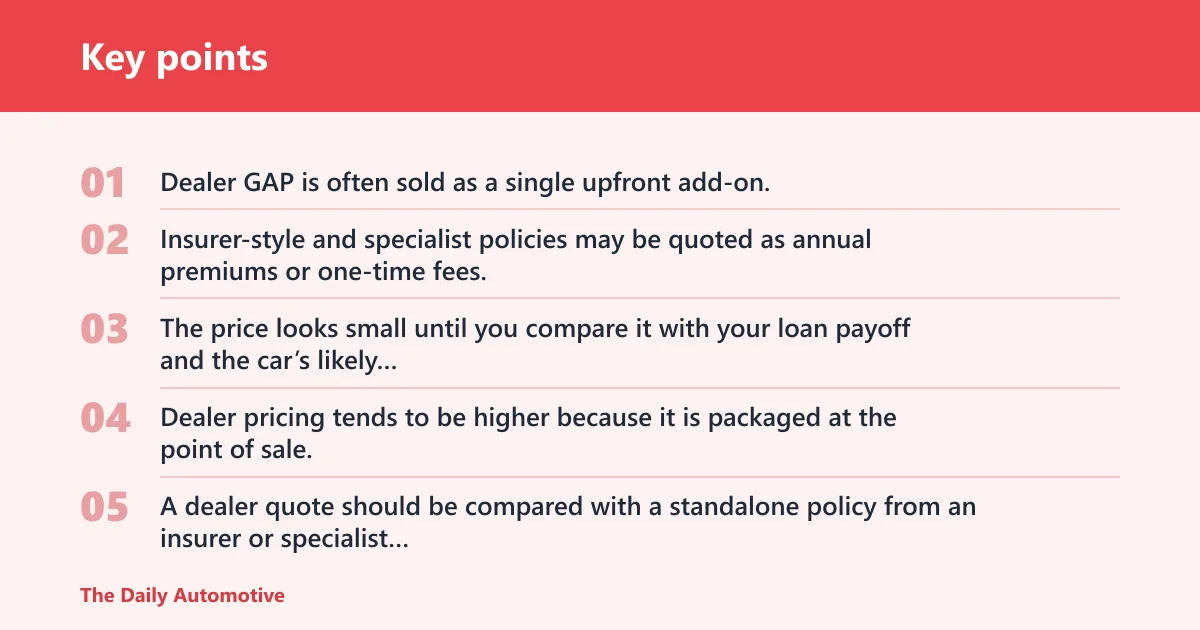
Dealer GAP is often sold as a single upfront add-on. Insurer-style and specialist policies may be quoted as annual premiums or one-time fees, depending on the provider and market. The price looks small until you compare it with your loan payoff and the car’s likely actual cash value.
Why dealer prices often run higher
Dealer pricing tends to be higher because it is packaged at the point of sale, where buyers are already focused on monthly payments and delivery timing. That convenience can add markup. A dealer quote should be compared with a standalone policy from an insurer or specialist provider before you accept it.
What changes the price the most
The biggest price driver is not the sticker premium; it is the size of the gap you are trying to insure. Longer terms, tiny deposits, rolled-in debt, and higher APR usually create more negative equity, which makes the coverage more valuable and, in some cases, harder to price cheaply.
How loan terms change the price you should pay
Loan structure matters more than the badge on the car. A longer term keeps you underwater for longer, and that is the period when GAP insurance can matter most. Shorter terms and larger deposits reduce the risk window and should lower what you are willing to pay for cover.
36, 60, 72, and 84-month loans
Sixty-month loans were considered long in the 1990s. Seventy-two-month loans were common by the 2010s, and eighty-four-month loans are widely available today. The longer the term, the longer you may owe more than the car is worth, especially in the early years when depreciation is fastest.
Small deposits and rolled-in debt
A small deposit leaves a larger opening between what you borrow and what the car is worth on day one. Rolling in negative equity from a trade-in makes that gap wider immediately. That is one of the clearest signs that GAP may be worth the price.
APR and payoff balance
APR affects the loan payoff balance because many payoff quotes include accrued interest, not just the principal you borrowed. A higher rate can keep the balance above the car’s value for longer. Gap exposure equals loan payoff minus vehicle value when the result is positive.
When is GAP insurance worth it?
GAP is worth considering when your payoff is likely to exceed the car’s actual cash value for a meaningful stretch of the loan. It is less useful once the loan balance drops below market value, or if your deposit and term already keep you comfortably out of negative equity.
Simple break-even signs
If the expected shortfall would be several thousand dollars after a total loss, GAP can be a sensible buy. A $24,000 payoff and $19,000 value creates a $5,000 gap. That is the kind of difference a modest policy premium can protect, especially early in the finance term.
Cases where GAP is usually poor value
If you put down a strong deposit, chose a short term, and kept the loan well below the car’s value, GAP may be wasted money. The same is true if the policy cap is lower than your likely shortfall, because the unpaid balance can still land on you.
New vs used financed cars
New financed cars usually lose value fastest in the first years, so they create the clearest GAP case. Used financed cars can still qualify if the loan is long or the down payment is small. Private-sale finance can also create risk, especially if the car was already priced near its depreciation floor.
GAP insurance decision table
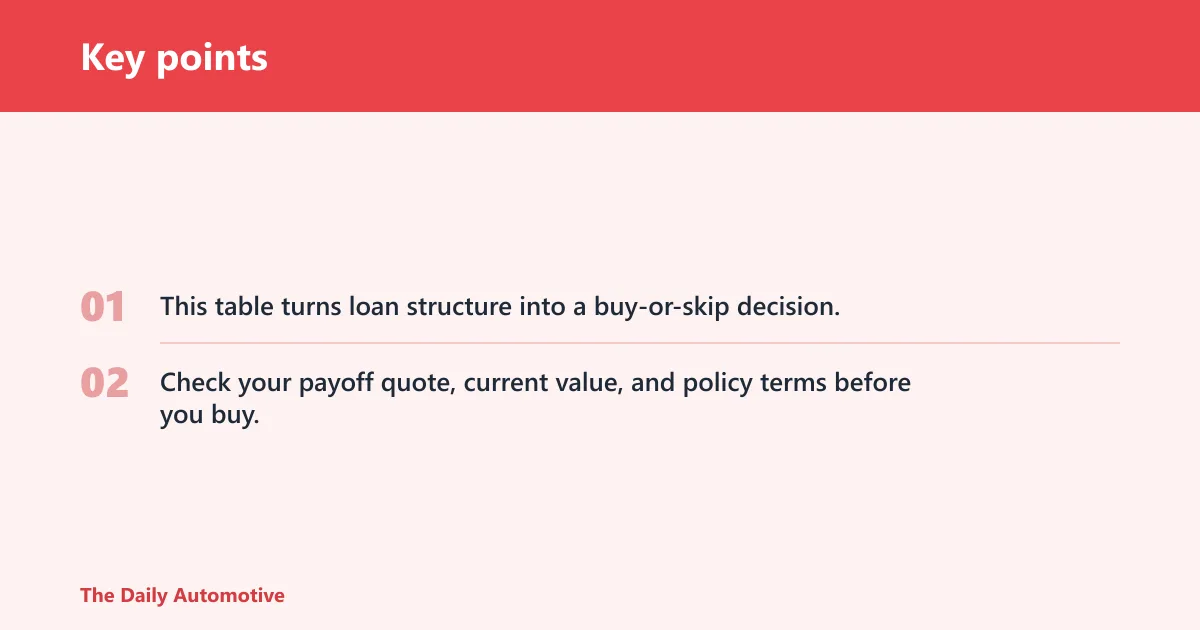
This table turns loan structure into a buy-or-skip decision. It is a guide, not a promise. Check your payoff quote, current value, and policy terms before you buy, because gap exposure should be checked every six months as the loan balance and vehicle value move in different directions.
| Loan term | Deposit size | APR | Vehicle age | Negative equity risk | Likely GAP type | Buy or skip |
|---|---|---|---|---|---|---|
| 36 months | 20% down | Low | New | Low after the first months | RTI GAP | Skip if the loan balance is already below value; the risk window is short. |
| 60 months | 10% down | Moderate | New | Moderate | RTI GAP | Buy if you would struggle to cover a several-thousand-dollar shortfall after a total loss. |
| 72 months | 5% down | Moderate to high | New or lightly used | High | Finance GAP | Buy; long terms keep you underwater longer, so the premium usually earns its keep. |
| 84 months | 0% to 5% down | High | New | Very high | Finance GAP | Buy; this structure is one of the clearest GAP cases because depreciation outruns payoff. |
| 60 to 72 months | Small, with trade-in rollover | Moderate | Used | High at the start | RTV GAP or finance GAP | Buy if the rolled-in debt pushes the payoff above current value. |
| 36 to 48 months | Large | Low | Private-sale used car | Low to moderate | RTV GAP | Skip unless the car is already hard to value or the lender balance starts above market value. |
How GAP insurance works after a total loss
After an accident, theft, fire, or flood damage that totals the car, the auto insurer usually pays actual cash value, not your original purchase price. If that settlement is lower than the loan payoff balance, GAP can cover the shortfall. It does not pay if there is no shortfall.
ACV settlement versus loan payoff
Actual cash value is the market value used in total-loss settlements. It is often lower than the remaining finance balance on newer financed cars. Use Kelley Blue Book, NADA Guides, or Edmunds to estimate the vehicle value before you assume the payout will clear the loan.
Where negative equity comes
Negative equity occurs when the loan balance exceeds the vehicle value. Small down payments, long finance terms, higher APR, and rolled-in debt all increase it. If the car depreciates faster than the loan amortises, the shortfall can be large enough to matter after a total loss.
What GAP pays in a claim
GAP insurance covers the difference between the insurer’s payout and the remaining finance balance, subject to policy limits and exclusions. MotorEasy says GAP can pay off remaining finance or lease agreements, but only within its eligibility rules. That means the paperwork matters as much as the premium.
Which GAP type fits your finance deal?
The right product depends on how you bought the car and how old it is. RTI, RTV, and finance GAP sound similar, but they do different jobs. Choosing the wrong one can leave a buyer paying for cover that does not match the loan structure or purchase date.
RTI GAP for recent purchases
Return to Invoice GAP covers the difference between the insurer settlement and the original purchase price. It is often used for cars purchased within the last 6 months and is common for both new and used vehicles bought through dealers. It suits buyers who want invoice-based protection early in ownership.
RTV GAP for older or private-sale cars
Return to Value GAP covers the difference to a vehicle’s current value benchmark. It is used more often for older purchases or private-sale cars, and it is a common specialist UK GAP option. It is the better fit when invoice protection is no longer the right reference point.
Finance GAP for loan shortfalls
Finance GAP targets the remaining loan balance itself. That makes it useful when the finance deal, not the invoice price, is the bigger problem. If the loan is stretched, or if trade-in debt was rolled in, finance GAP may fit better than an invoice-based product.
Can you buy GAP insurance after financing the car?
Yes, but timing matters. You can often buy GAP at delivery from a dealer or later from a specialist provider, provided the car still meets age, mileage, and value rules. Wait too long, and the vehicle may no longer qualify or the gap may have already narrowed.
Buying from the dealer at delivery
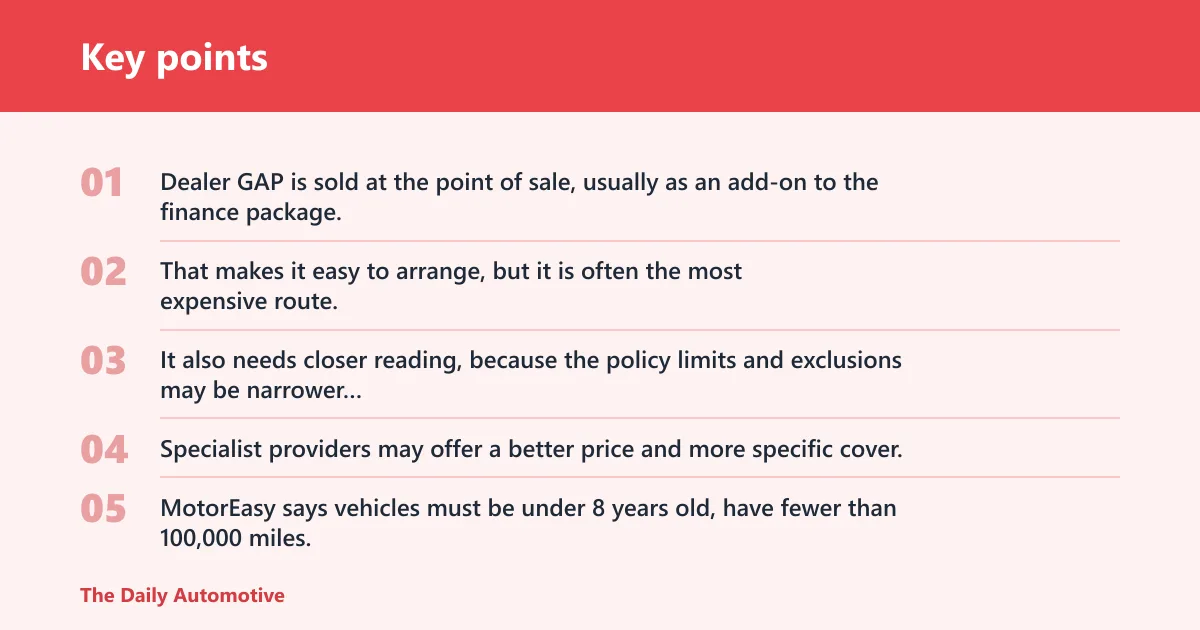
Dealer GAP is sold at the point of sale, usually as an add-on to the finance package. That makes it easy to arrange, but it is often the most expensive route. It also needs closer reading, because the policy limits and exclusions may be narrower than the sales pitch suggests.
Buying later from a specialist provider
Specialist providers may offer a better price and more specific cover, especially for older cars or private-sale finance. The same source says vehicles must be under 8 years old, have fewer than 100,000 miles, and have an insured value below £75,000 to qualify. Those limits can rule out some cars quickly.
When the coverage window is already closing
If the loan balance has already fallen below the car’s value, GAP may be unnecessary. If the car is close to the provider’s age or mileage limit, buying later may add little value. A common first-timer mistake is waiting until the loan is nearly paid down and then buying cover for a gap that no longer exists.
What to check before you buy
Read the policy, not the brochure. Gap insurance varies by claim cap, eligible vehicle age, mileage, settlement basis, and waiting rules. A cheap premium can still be poor value if the policy excludes your financing setup or limits the payout below your real exposure.
- Check whether the policy pays RTI, RTV, or finance shortfall.
- Compare the policy cap with your likely gap exposure.
- Ask whether the settlement is based on ACV, invoice price, or another benchmark.
- Confirm age, mileage, and value limits before you buy.
- Ask what happens if you refinance, sell early, or change vehicles.
- Keep your finance agreement, settlement letter, and value estimate with the policy.
Suppose you buy a £28,000 car with a 72-month loan, put down about 5%, and roll in about £2,000 from a previous trade-in. A year later, the car is worth £21,000 and the payoff is £24,500. That is a real shortfall, and GAP is doing an actual job there.
Frequently asked questions
How much does GAP insurance cost for a financed car?
The better question is whether the premium is lower than the shortfall you could face after a total loss. If not, the policy may be reasonable.
Is GAP insurance worth it on a financed car?
It is worth it when your payoff is likely to stay above the car’s value for a meaningful stretch of the loan. That is common with long terms, small deposits, and rolled-in debt. If you are already building equity quickly, the value of GAP drops fast.
How is GAP insurance price calculated?
Price is tied less to the car’s sticker price and more to the size and timing of the likely shortfall. Dealers, insurers, and specialist providers all price differently, but the loan term, deposit size, APR, and vehicle depreciation are the main factors that shape the quote.
Do I need GAP insurance with a low down payment?
A low down payment makes GAP more relevant because you start out closer to negative equity. If the car is written off early, the insurer’s ACV payout may fall well short of the payoff balance. That is especially true on long loans and high-rate finance.
What does GAP insurance cover on a financed car?
It covers the difference between the insurer’s total-loss settlement and the remaining finance balance, subject to policy limits. It applies after a total loss from accident, theft, fire, or flood damage. It does not cover repairs, routine depreciation, or every unpaid fee.
Products related to this article
Sponsored / affiliate links. As an Amazon Associate I earn from qualifying purchases. I may earn additional commission from eligible campaigns.