NOCO Genius Winter Battery Charger Review: Best Fits
NOCO Genius chargers are a strong winter battery choice for 12V lead-acid and some LiFePO4 batteries, but choose at least 5A for most passenger cars and 10A or more for larger truck batteries; they maintain and recover healthy batteries, not dead ones. Pick the wrong size, and you spend hours waiting while a weak battery still leaves you stranded in the cold. This guide sorts the NOCO Genius lineup by battery type, vehicle size, cold-weather behavior, and the point where replacement beats charging.
Verdict
Based on the spec sheet and owner feedback, the NOCO Genius family works better as a winter toolchain than as one answer for every battery. The safest default for many drivers is the Genius 5, because it is quick enough for typical car batteries without moving straight to the larger, pricier Genius 10. If you own a large battery, deal with frequent subfreezing starts, or want faster recovery after a long sit, the 10A model is the better call.
Pros and cons
- Pros: Model-by-model sizing is clear once you match amp output to battery capacity.
- Pros: In winter, charging behavior changes with temperature, and the higher-output models cut recovery time.
- Pros: Select models add AGM, lithium, Repair, and Force modes, which broadens real-world use.
- Cons: 1A and 2A units are maintenance-first chargers; they are slow for winter recovery on larger batteries.
- Cons: Repair mode is limited to lead-acid batteries and does not fix a worn-out battery.
- Cons: A battery that is too cold, too sulfated, or too far gone may still need testing or replacement.
Specs at a glance
| Model | Voltage support | Battery size range | Charge output | Best winter role |
|---|---|---|---|---|
| NOCO Genius 1 | 6V / 12V | 1 to 30Ah | 1A | Small batteries and maintenance |
| NOCO Genius 2 | 6V / 12V | Up to 40Ah | 2A | Low-cost maintainer for modest batteries |
| NOCO Genius 5 | 6V / 12V | Up to about 120Ah | 5A | All-round winter charger for cars and many SUVs |
| NOCO Genius 10 | 6V / 12V | Up to 230Ah | 10A | Large batteries and faster cold-weather recovery |
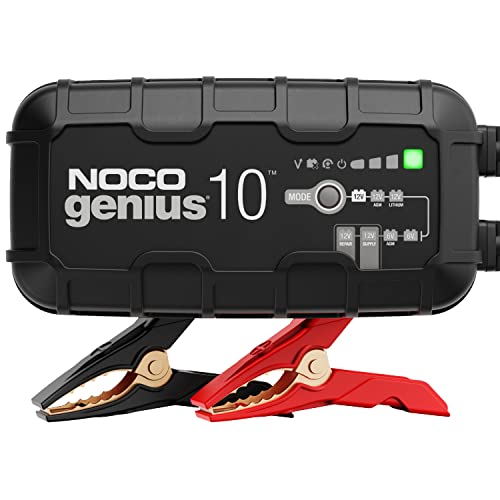
The Genius 5 handles lead-acid, AGM, and lithium batteries, uses a 5-amp charge rate, supports batteries up to about 120Ah, includes Repair mode and Force mode, has an onboard thermal sensor that adjusts charging in cold weather, carries an IP65 ingress rating, and comes with a 3-year warranty. The Genius 10 has a maximum charging current of 10A, supports batteries up to 230Ah, can charge completely discharged batteries below 1V, uses an integrated temperature sensor, and can be left connected for a long time without overcharging.
Who it is for
This fits daily drivers parked outside, seasonal vehicles that sit for weeks, and owners of AGM or lithium batteries who need the correct charging profile. It is less useful for someone with a tiny battery and a cheap maintainer already in place, or for a vehicle whose battery has already failed testing.
Say your sedan uses a 60Ah AGM battery and you park outside in January. A 1A maintainer can help hold charge during storage, but it is too slow for real winter recovery. A 5A or 10A unit is the better fit when the battery has dropped low and you need usable charge sooner.
Pros and cons for buyers
- Good match for winter maintenance, storage charging, and occasional recovery.
- Better fit than a tiny maintainer when battery size climbs past compact-bike territory.
- Not a universal fix for a battery that fails load testing, holds no charge, or freezes.
- Some model features are chemistry-specific, so you need to check the mode before connecting.
What works
Cold-weather charging is where the Genius family earns its place. Smart charging changes with temperature, and higher-output models shorten the time a weak battery spends recovering. The Genius 10 goes further with an integrated temperature sensor, which is useful when the car sits in an unheated garage or outside.
AGM batteries deserve special attention. They are common in newer start-stop vehicles, they are more sensitive in cold weather, and they should be charged with an AGM-specific profile rather than a generic setting. The Genius 5 covers that need, and the family’s broader mode support makes it more adaptable than a simple float maintainer.
LiFePO4 support is useful, but only on select models and only in the correct lithium mode. The battery management system still matters. A charger that supports lithium does not override a battery pack that has shut itself down, limited acceptance, or disconnected protection because it is too cold.
What does not
Low-amp units are not quick winter recovery tools. The Genius 1 and Genius 2 are maintenance-first chargers, which makes them sensible for smaller batteries and storage, but frustrating if you expect them to bring a big starter battery back to life before the next morning. That is where many winter buyers choose too little charger and then blame the brand.
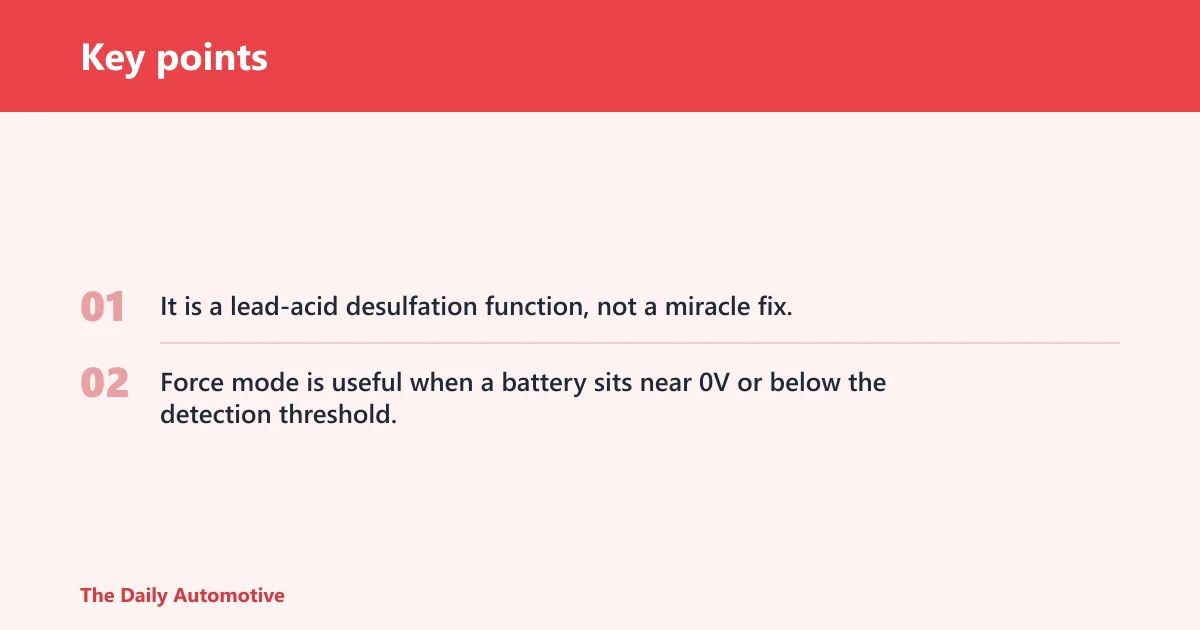
Repair mode also gets overstated. It is a lead-acid desulfation function, not a miracle fix, and it is not for sealed batteries. Force mode is useful when a battery sits near 0V or below the detection threshold, but that still does not guarantee the battery will accept charge or hold it after the session ends.
Which NOCO Genius model should you buy for winter?
Choose the model by battery size first, then by how fast you need recovery. Genius 1 and 2 are for maintenance and very small batteries. Genius 5 is the best fit for most passenger cars, while Genius 10 is the safer buy for large truck batteries, repeated winter starts, and situations where you need more current to recover a low battery faster.
NOCO Genius 1
The Genius 1 is best for small batteries and maintenance. Its 1A output, 6V/12V support, and 1 to 30Ah battery range make sense for motorcycles, small powersports batteries, and very light winter upkeep. It is a poor fit for a regular car battery if the goal is faster recovery after a cold snap.
NOCO Genius 2
The Genius 2 is the low-cost maintenance charger for modest batteries. With 2A output, 6V/12V support, and a rating up to 40Ah, it works for smaller cars and seasonal storage. It is still slow for winter recovery, so it is better when you want to preserve charge than when you need to rebuild it quickly.
NOCO Genius 5
The Genius 5 is the best all-rounder for larger batteries and faster recovery. At 5A, it is the first model in the family that makes sense for many passenger cars, especially if the battery is AGM or the vehicle sits outside. The added Repair and Force modes, plus lithium support on this model, make it the most flexible pick for most households.
NOCO Genius 10
The Genius 10 is the best choice for large batteries and colder, faster charging needs. Its 10A output, 230Ah support, sub-1V recovery capability, and temperature sensing make it the most capable winter option here. If the vehicle is a truck, large SUV, RV, or equipment with a bigger battery, this is the model that most cleanly matches the job.
| Product | Badge | Best for | Price | ||
|---|---|---|---|---|---|
|
NOCO GENIUS10 10A 6/12V Smart Battery Charger, TrickleNOCO | Our pick | 10A smart charger for 6/12V lead-acid & LiFePO4 | $99.95
Price as of 13 Oct 2026
|
View |
 |
CTEK – 40-206 MXS 5.0 Fully Automatic 4.3 amp BatteryCTEK | Budget pick | 4.3A automatic charger for 12V lead-acid batteries | $94.99
Price as of 13 Oct 2026
|
View |
Winter charger decision table
| Model | Battery type | Battery size | Charge speed | Use this if… | Setup note |
|---|---|---|---|---|---|
| Genius 1 | Small lead-acid batteries | 1 to 30Ah | Very slow | You need a maintainer for a motorcycle or small seasonal battery. | Good for garage use where the battery is easy to reach. |
| Genius 2 | Small to modest lead-acid batteries | Up to 40Ah | Slow | You want basic winter maintenance without paying for more output. | Works well in apartments if the outlet is close to the parking spot. |
| Genius 5 | Lead-acid, AGM, lithium on supported mode | Up to about 120Ah | Moderate | You own a car or crossover and want the best balance of speed and flexibility. | Best all-around pick when extension-cord access is reasonable. |
| Genius 10 | Lead-acid, AGM, lithium on supported mode | Up to 230Ah | Fastest here | You need winter recovery for a big battery, truck, RV, or deeply discharged vehicle. | Useful when the charger may sit in an unheated garage for long periods. |
Garage, outdoor, and apartment setup notes
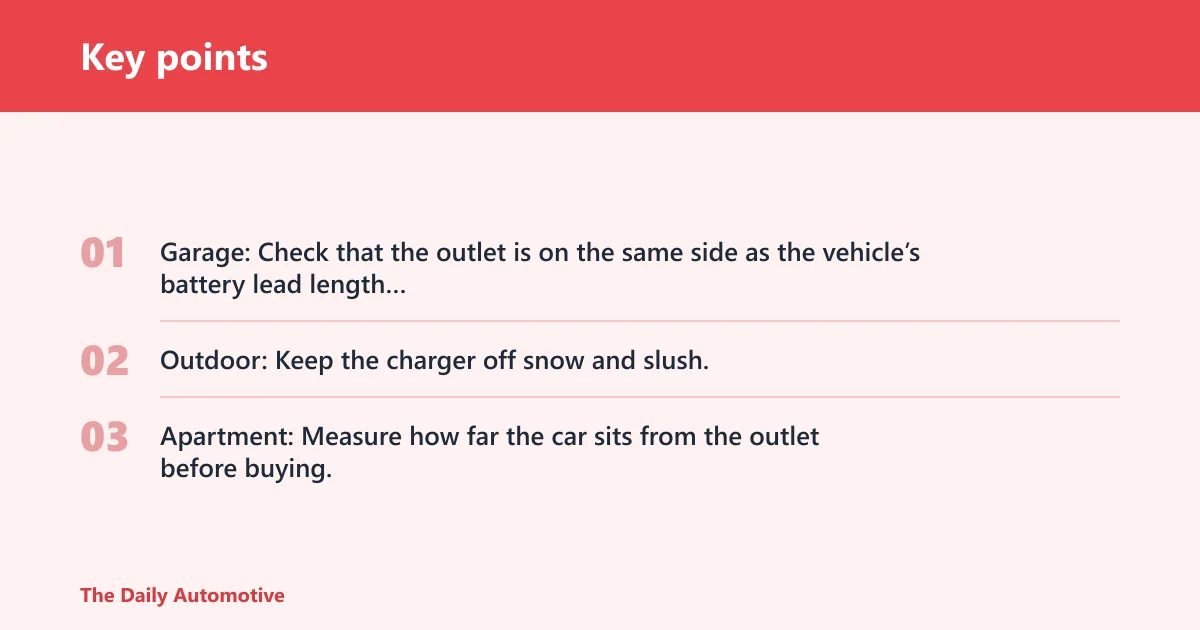
- Garage: Check that the outlet is on the same side as the vehicle’s battery lead length or use a safe extension cord rated for outdoor or garage use.
- Outdoor: Keep the charger off snow and slush, and make sure the connection points stay dry and accessible.
- Apartment: Measure how far the car sits from the outlet before buying. A 1A or 2A charger that cannot physically reach the battery is useless.
What works in cold weather, and what does not?
Cold-weather charging depends on temperature compensation. In cold weather, a smart charger may slow the process, adjust its charge strategy, or refuse to proceed until conditions are safer for the battery. That is normal behavior, not a defect, because cold batteries accept charge more slowly and may be too stiff chemically to take much current right away.
A battery can also be too cold or too damaged to recover cleanly. A battery that reads weak after sitting outside may simply need more time. A battery that fails to hold voltage after a proper charge, however, is usually moving from “needs charging” to “needs diagnosis.”
Picture a 12V AGM battery in an SUV that sat for two weeks at below-freezing temperatures. If the charger seems hesitant, the first question is whether the battery is genuinely cold, deeply discharged, or already worn out. Those are different problems, and the charger cannot solve all three.
Can it recover a dead battery?
Sometimes, but not always. Repair mode can help with sulfation on lead-acid batteries, and Force mode can push into batteries that are near 0V or below the detection threshold. If the battery is physically damaged, internally shorted, frozen, or unable to hold a charge afterward, replacement is still the right answer.
Force mode is the more relevant winter rescue tool. It is made for deeply discharged batteries that a normal smart charger refuses to recognize. That said, a battery that went flat because it is old, sulfated, or exposed to repeated deep discharge may only appear to recover before failing again under load.
Recovery limits
- Check voltage and condition first, if you have a meter or a shop test.
- Use the correct chemistry and voltage mode before attempting recovery.
- Try normal charging before Force mode.
- Use Repair mode only on lead-acid batteries, not sealed batteries that should not receive that function.
- Replace the battery if it fails to hold charge or fails a load test after charging.
Troubleshooting: why is my NOCO Genius not charging in the cold?
The usual causes are a cold battery, the wrong mode, a bad connection, a blown fuse, a dead outlet, or a battery that is too far gone to accept charge. Start with the easy checks first. Winter adds enough friction already; do not assume the charger is bad before confirming the battery and the hookup.
Likely causes and next checks
- Cold battery lockout or low-temperature behavior: Move the battery to a warmer space if possible, then retry.
- Wrong chemistry or voltage setting: Make sure you selected 6V or 12V and the correct battery type.
- Bad connection: Clean the terminals and clamps, then reconnect firmly.
- Blown fuse or dead outlet: Verify power at the outlet and inspect any inline protection.
- Battery too far gone: If it still will not accept charge after Force mode and proper setup, test or replace the battery.
A common first-timer mistake is leaving a 2A charger on a large truck battery overnight and expecting winter recovery by morning. Another is assuming a “dead” battery is actually dead charger hardware. In practice, both diagnosis and charger sizing matter.
Should you buy a NOCO Genius or a Battery Tender?
Choose NOCO if you want a broader winter toolset, especially for AGM, supported lithium modes, higher output options, and recovery functions like Force mode. Choose a simpler maintainer if your only job is keeping a small battery topped off in storage and you do not need extra modes or faster charging.
On ownership cost, compare charger price against replacing a battery or paying for a test-and-charge service. A charger only pays off if the battery is still healthy enough to save. If diagnosis says the battery has failed, spending more on recovery attempts is often false economy.
Alternatives
The CTEK MXS 5.0 is the cleaner choice if you want a fully automatic 12V lead-acid maintainer with an 8-step process and rugged splash-, dust-, spark-, and shock-resistant design. Based on the specs and reviews, it is a strong winter storage charger, but it lacks the broader chemistry and recovery flexibility of the NOCO Genius 5 and does not match the Genius 10 for faster, larger-battery work.
Should you buy it
Buy into the NOCO Genius family if your winter problem is battery care, not battery denial. Genius 1 and 2 are for maintenance. Genius 5 is the best fit for most drivers who want a smart winter charger with enough output for a typical car battery. Genius 10 is the right step up when the battery is larger, colder, or more deeply discharged.
Skip the charger if the battery already fails testing, will not hold charge after a proper session, or repeatedly drops to dead in spite of a known-good charging setup. At that point, replacement or diagnosis beats more charging time.
Frequently asked questions
are noco genius chargers good
Yes, for winter maintenance and controlled recovery they are a strong fit, especially when you choose the model that matches battery size and chemistry. They are not a cure for every dead battery, and they work best when the battery is still serviceable rather than failed.
Which NOCO Genius charger is best for winter battery maintenance?
The Genius 5 is the safest default for most drivers because it balances speed, chemistry support, and practical battery size range. The Genius 2 is fine for smaller batteries, while the Genius 10 is better if you need faster recovery or have a larger truck or SUV battery.
Is the NOCO Genius 1 enough for a car battery?
Usually not for winter recovery. The Genius 1 is rated for 1 to 30Ah batteries, so it is mainly a maintainer for small batteries. For a normal passenger car battery, especially in cold weather, a 5A model is the more realistic choice.
What is the difference between NOCO Genius 1, 2, 5, and 10?
The differences are output, battery range, and intended use. The Genius 1 is 1A and best for small batteries; the Genius 2 is 2A and suited to modest batteries; the Genius 5 is 5A and handles larger batteries plus more modes; the Genius 10 is 10A and is built for faster recovery and bigger batteries.
Can a NOCO Genius charger charge a dead battery in winter?
Sometimes. Force mode can help revive batteries near 0V or below the detection threshold, and Repair mode can help with lead-acid sulfation. But a battery that is frozen, internally damaged, or too worn out may not recover, even if the charger powers on normally.
Does the NOCO Genius work on AGM and lithium batteries?
Yes, but not every model supports every chemistry. The Genius 5 handles lead-acid, AGM, and lithium batteries, and select other models add lithium support too. AGM batteries need the correct charging profile, and lithium batteries still depend on the pack’s BMS and temperature limits.
Products related to this article
Sponsored / affiliate links. As an Amazon Associate I earn from qualifying purchases. I may earn additional commission from eligible campaigns.