Remote Starter Installation Cost
Expect about $250 to $700 installed for a remote starter on most mainstream vehicles, while newer push-button, diesel, or immobilizer-equipped models often run about $600 to $1,200. A bad quote can hide bypass modules, extra labor, or app fees that add hundreds. This guide breaks down normal line items, price drivers, and red flags so you can compare itemized shop quotes with the same parts and labor.
Typical cost range
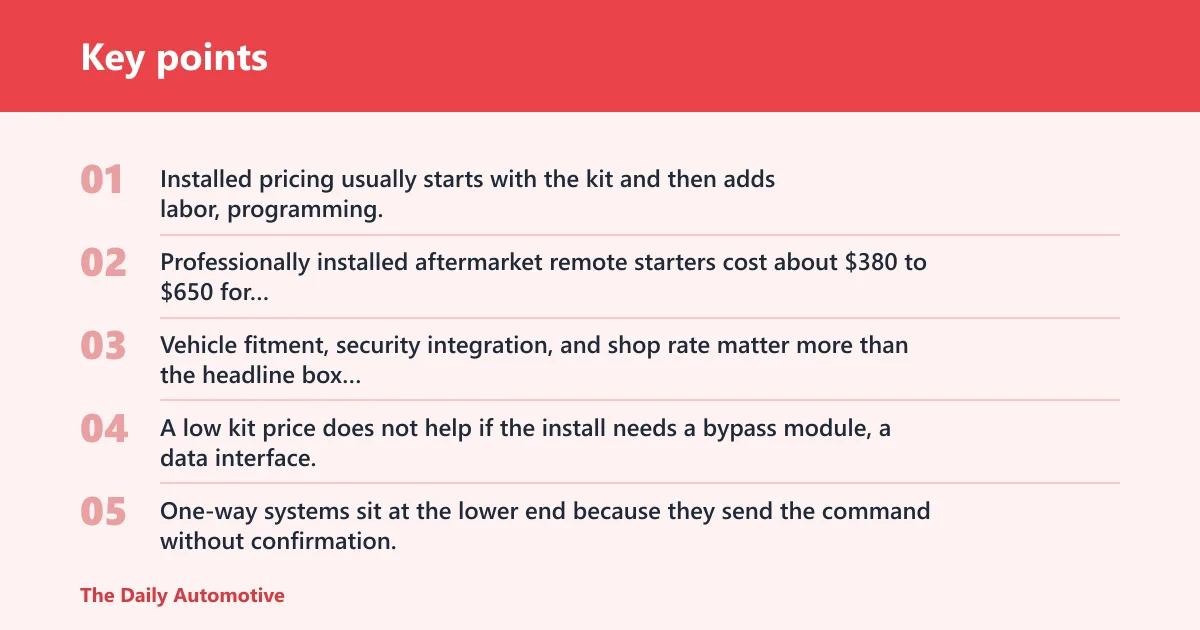


Installed pricing usually starts with the kit and then adds labor, programming, and any vehicle-specific hardware. Professionally installed aftermarket remote starters cost about $380 to $650 for mainstream systems, while premium packages can cost about $650 to $900+.
That total can shift fast. Vehicle fitment, security integration, and shop rate matter more than the headline box price. A low kit price does not help if the install needs a bypass module, a data interface, or more programming time.
Typical installed price bands by system type
One-way systems sit at the lower end because they send the command without confirmation. Two-way systems cost more because the remote confirms the start, and smartphone or LTE systems cost more again because they add the control hardware and app layer. VehicleGrip says basic systems generally cost between $150 and $400 installed, two-way systems between $300 and $700, and smartphone-controlled systems between $500 and $1,200 installed.
Current product pricing gives a useful benchmark. A current Compustar one-way installed package costs $399.99. A current Compustar two-way package costs $549.99. Compustar LTE-equipped systems cost $649.99 installed.
What usually makes up the total
The bill usually breaks into four parts: the remote starter system itself, the install labor, any bypass or data hardware, and the final testing or setup time. Labor is often the largest variable because the same kit can take very different time on a basic keyed sedan than on a push-to-start SUV with factory security integration.
Current Cost says labor can be $100 to $180 on the average line. LatestCost says basic aftermarket remote start kits with installation usually fall in the $250 to $500 range. Those figures are useful only as a starting point; they are not a substitute for a vehicle-specific quote.
What does a shop quote usually include?
A complete quote should separate the remote starter kit, labor, required vehicle interface hardware, and any added programming or support. If a shop gives only one total, ask what is included and whether the price changes for a bypass module, extra wiring, or your exact trim level.
Remote starter kit parts
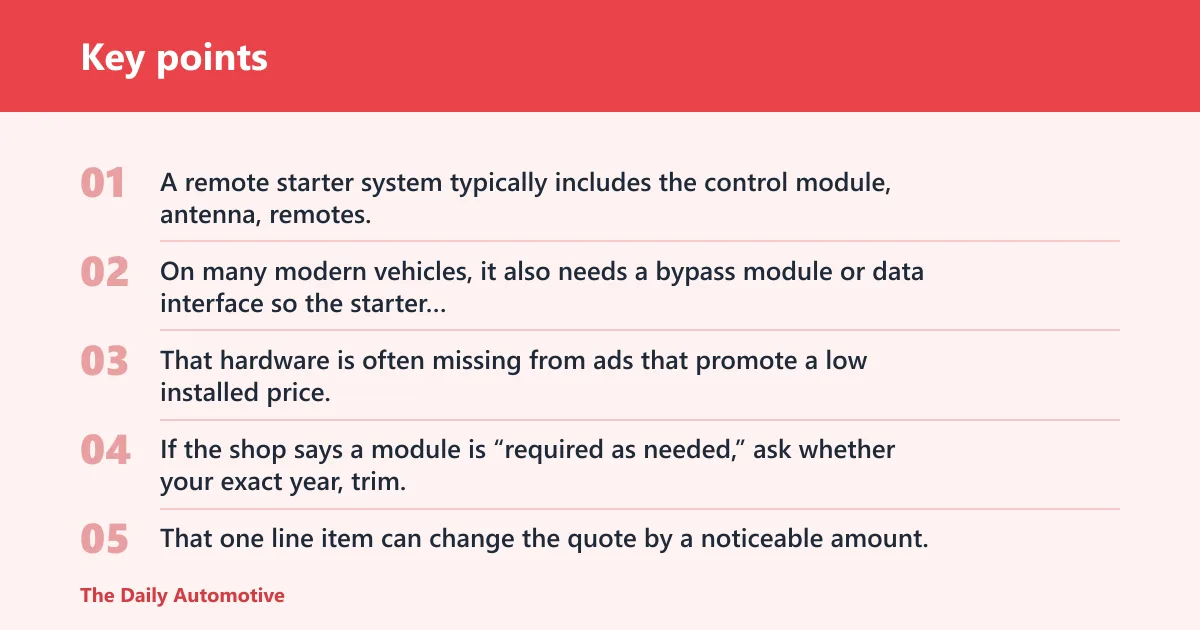
A remote starter system typically includes the control module, antenna, remotes, and wiring harness. On many modern vehicles, it also needs a bypass module or data interface so the starter can talk with the factory immobilizer and security system.
That hardware is often missing from ads that promote a low installed price. If the shop says a module is “required as needed,” ask whether your exact year, trim, and ignition type need it. That one line item can change the quote by a noticeable amount.
Labor, programming, and testing
Labor should cover mounting the module, fitting the wiring, programming the system, and testing remote start function under normal conditions. VehicleGrip estimates typical installations take 2 to 4 hours for simple setups, while more complex vehicles can take much longer. The broader guidance for installers is roughly 1 to 8 hours depending on complexity.
Warranty or support line items
Shop warranty and support may be included or listed as an add-on. Either way, it should appear on the estimate. A shop that prices aggressively but leaves out support terms may be charging separately for follow-up programming, feature adjustments, or future troubleshooting.
Remote starter quote checklist
Use this checklist to decode a quote before you book. The right estimate names the vehicle, the exact kit, the needed interface hardware, the expected labor, and the charges that should not appear without explanation. If one of those parts is missing, ask for a revised itemized estimate.
| Vehicle type | Required module or harness | Labor hours | Expected add-ons | Red-flag charges |
|---|---|---|---|---|
| Basic sedan, keyed ignition, older CAN bus | Standard wiring lead; bypass module may be needed | 2 to 3 | Programming, antenna placement, basic testing | “Universal install” with no vehicle verification; separate fee for every wire splice |
| Push-to-start SUV with factory immobilizer | Data interface and bypass module | 4 to 6 | Security integration, extended programming, extra test cycle | No mention of immobilizer integration; quoted labor capped at 1 hour |
| Premium or luxury vehicle with advanced security | Vehicle-specific wiring lead, data interface, bypass module | 5 to 8 | Deeper programming, higher trim compatibility parts, possible OEM restrictions | Price quote that excludes “compatibility hardware”; vague “electrical work” fee |
- Confirm your exact year, make, model, trim, and ignition type.
- Ask whether the quote includes the starter module, remotes, antenna, and wiring.
- Ask whether a bypass module or data interface is required for your vehicle.
- Ask for labor hours and the shop’s hourly rate or flat install price.
- Ask whether programming, testing, and warranty support are included.
- Compare the same parts list across at least two shops.
Why do remote start prices vary by vehicle?
Vehicle make, model, year, trim, and ignition type drive the price more than the remote itself. Newer vehicles, push-to-start systems, CAN bus architectures, and luxury models usually need more integration work, more programming, and more vehicle-specific hardware.
Make, model, and year differences
Older cars often accept a simpler install because the wiring is direct and the security system is less demanding. Newer cars may require digital communication with factory modules, and the installer may need a model-specific lead rather than a generic connection.
Say your 2011 sedan has a basic keyed ignition and no factory alarm complications. The quote may stay near the lower end because the installer can use standard hardware and less programming time. Change only the vehicle to a 2023 push-button SUV, and the price can rise quickly because the security integration changes.
Push-to-start, CAN bus, and immobilizer systems
Push-to-start cars often need a bypass module because the starter has to work around the factory immobilizer or security logic. CAN bus vehicles can also require more careful data integration. Factory alarm or immobilizer systems may add programming, parts, and labor, which is why a quote that looks cheap on paper can rise at the bay.
Luxury and premium vehicle complexity
Premium vehicles often carry tighter integration, stricter compatibility rules, and more sensitive electrical systems. That means more labor time and a higher chance that the quote includes brand-specific hardware. Some luxury vehicles also limit generic remote-start paths, which pushes the job toward a more expensive interface package.
One-way, two-way, or smartphone remote start?
One-way is the lowest-cost tier, two-way adds confirmation and usually costs more, and smartphone or LTE systems usually sit at the top because they add a connected module and possible recurring service. The right choice depends on whether you want basic convenience, confirmation, longer range, or app control.
One-way remote start costs
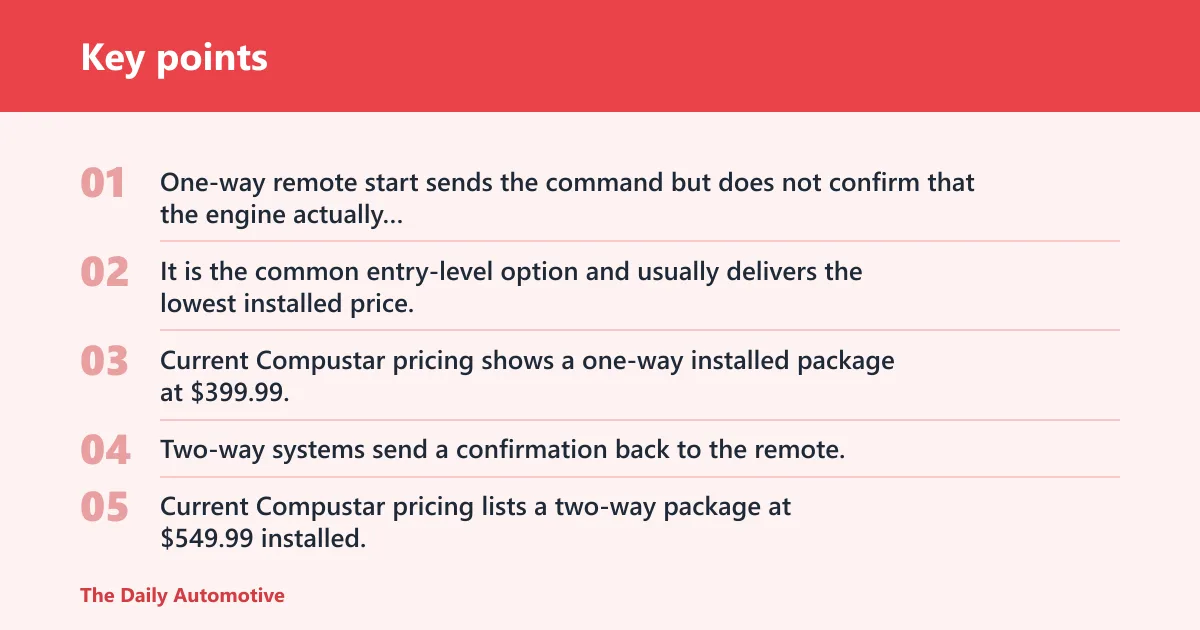
One-way remote start sends the command but does not confirm that the engine actually started. It is the common entry-level option and usually delivers the lowest installed price. Current Compustar pricing shows a one-way installed package at $399.99.
Two-way remote start costs
Two-way systems send a confirmation back to the remote, which is useful when the car is parked farther away or blocked from view. That extra feedback usually costs more. Current Compustar pricing lists a two-way package at $549.99 installed.
Is a two-way remote start worth the extra cost? It often is if you want confirmation in a crowded lot, on a long driveway, or in winter weather. If you only need basic start and stop control, one-way can be the better value.
Smartphone and LTE system costs
Smartphone-based systems add app control, and some include GPS tracking. Current Compustar LTE-equipped systems cost $649.99 installed. The same source says smartphone-controlled systems commonly fall between $500 and $1,200 installed.
Do smartphone remote start systems have recurring fees? Often yes. DroneMobile Basic service starts as low as $3.99 per month, and DroneMobile Premium service with GPS tracking starts around $7.99 per month. Over 3 years, that is about $143.64 at the basic rate or about $287.64 at the premium rate. Over 5 years, it is about $239.40 or $479.40, before taxes or other charges.
How much does installation labor add?
Labor is often the biggest variable in the quote because the same starter kit can be simple on one vehicle and time-consuming on another. Labor also reflects local rates, the installer’s experience with your platform, and whether the job needs extra programming or wiring work.
Why labor is the biggest variable
Simple setups may be finished in 2 to 4 hours, but more complex vehicles can take longer. The difference usually comes from access, security integration, and the amount of disassembly required to reach the right circuits. VehicleGrip’s range of 2 to 4 hours for simple setups is a useful baseline, not a guarantee.
Regional shop rates and job time
One shop may charge less per hour but need more time because the technician has to work around tight packaging. Another may charge more per hour and finish sooner because it handles your exact vehicle regularly. Ask for the rate or flat labor charge, and ask whether that number includes programming and road testing.
Suppose one quote says $349 installed and another says $499 installed. If the cheaper one excludes the bypass module and the second includes it, the expensive quote may actually be the cleaner estimate.
Remote starter pricing examples
These sample quotes show how the same keyword can hide very different totals. Use them as benchmarks, not promises. The right number depends on the exact vehicle, the hardware needed, and the labor the installer has to add.
Basic sedan quote
A straightforward sedan with a keyed ignition and no extra security hurdles can land near the lower end of the market. A realistic quote may include a basic one-way kit, standard wiring, and a few hours of labor. That kind of job is the closest to the entry-level pricing range.
- Kit: one-way starter package
- Hardware: standard harness, possible bypass module
- Labor: 2 to 3 hours
- Likely total: about $250 to $500 installed
Push-to-start SUV quote
A push-to-start SUV usually needs more integration because of the immobilizer and digital security system. The quote should name the bypass module or data interface and include the extra programming time. If it does not, ask for a revised estimate before you book.
- Kit: two-way starter package
- Hardware: data interface and bypass module
- Labor: 4 to 6 hours
- Likely total: about $500 to $900 installed
Premium or luxury vehicle quote
A premium vehicle can push the total into the upper range because compatibility parts and labor both rise. If the vehicle has advanced security, the installer may need a model-specific harness and more time for testing. That is where premium package pricing and installation complexity can stack together.
- Kit: premium or LTE-capable package
- Hardware: vehicle-specific harness, data interface, bypass module
- Labor: 5 to 8 hours
- Likely total: about $700 to $1,200+ installed
How to compare quotes and save
Ask for itemized parts and labor before you compare totals. Then check whether each quote includes the same hardware, the same programming, and the same support terms. A cheaper quote that omits compatibility parts is not a better quote.
Ask for itemized parts and labor
The estimate should name the remote starter kit, the bypass module or data interface if needed, labor hours or a flat labor charge, and any support or warranty item. If the shop gives only a lump sum, ask for a written breakdown before you agree.
Compare compatibility hardware across shops
Vehicle-specific hardware is where prices often diverge. One shop may quote a starter kit only, while another includes the bypass module and data interface. Compare the same parts list across shops, not just the box price.
Check bundle deals and warranty terms
Bundled installs can save money if the shop is already doing other work on the car, or if it can combine the remote start with a second accessory job. That said, do not accept a bundle unless the warranty and support terms are written down. A small savings is not worth losing clarity on future service.
Frequently asked questions
How much does a remote start cost with installation?
For most mainstream vehicles, expect about $250 to $700 installed. Newer push-button, diesel, or immobilizer-equipped vehicles often cost more because they need added hardware, more programming, and more labor time.
How much does it cost to install a remote car starter?
The installed cost depends on the vehicle and the system tier. Basic one-way systems are usually the lowest priced, two-way systems cost more, and smartphone or LTE systems cost the most. Labor and compatibility hardware often make up a large share of the final bill.
What does a remote starter installation quote usually include?
A proper quote should list the starter module, remotes, antenna, wiring, labor, and any bypass module or data interface needed for your vehicle. It should also mention programming, testing, and whether warranty or support is included or extra.
Why do remote start installation prices vary by vehicle?
Prices vary because make, model, year, trim, ignition type, and factory security systems change the amount of work. Push-to-start cars, CAN bus vehicles, and luxury models often need more integration and more labor than a basic keyed sedan.
Is a two-way remote start worth the extra cost?
It can be worth it if you want confirmation that the vehicle actually started, especially in large parking lots, at distance, or in bad weather. If you mainly want basic convenience, one-way can be the better value and usually costs less.
Do smartphone remote start systems have recurring fees?
Often yes. App-based systems may require a subscription, and LTE or GPS features can add monthly charges. DroneMobile Basic service starts as low as $3.99 per month, while DroneMobile Premium service with GPS tracking starts around $7.99 per month, which adds up over a 3 to 5 year ownership period.
Products related to this article
Sponsored / affiliate links. As an Amazon Associate I earn from qualifying purchases. I may earn additional commission from eligible campaigns.