The Cultural Impact of Automotive Lifestyle Influencers
Automotive lifestyle influencers shape car culture by turning vehicles into identity signals, shortening trend cycles, and shifting purchase consideration through repeated social proof across subcultures. Ignore them, and brands misread audience intent, waste spend, and chase trends that never convert. This guide explains how their content changes car-culture norms, audience behavior, and buying signals across major platforms.
Who gets influenced and what cues drive each audience
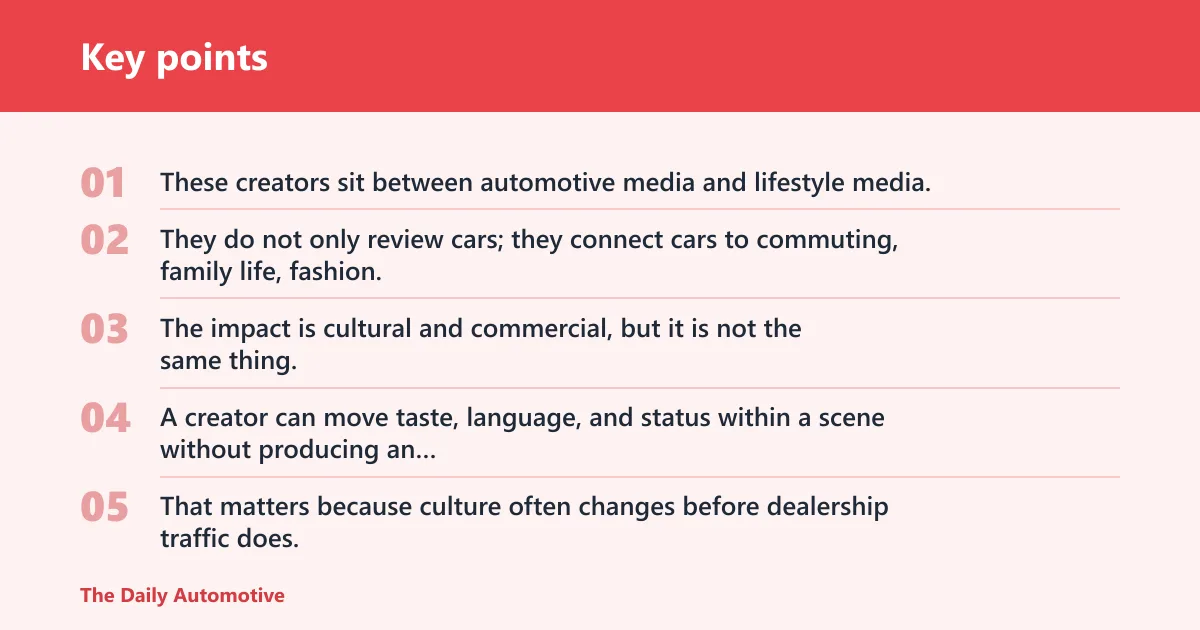
These creators sit between automotive media and lifestyle media. They do not only review cars; they connect cars to commuting, family life, fashion, travel, sound, status, and modification choices, then repeat those cues until a subculture absorbs them.
The impact is cultural and commercial, but it is not the same thing. A creator can move taste, language, and status within a scene without producing an immediate sale. That matters because culture often changes before dealership traffic does.
Who they shape
Different audiences respond to different cues. Enthusiasts may care about fitment, powertrain detail, and modification logic. Commuters want practicality and price. EV shoppers often want charging clarity and ownership confidence. Gen Z audiences react faster to style, humor, and creator identity. Luxury buyers respond to signal, exclusivity, and polish.
How social media changed car culture
Car culture moved from magazines, TV, and auto shows into always-on feeds, and that shift changed the pace of taste formation. Social media gives local builds, niche events, and small creators a route to large audiences without a publisher or booth.
That same structure speeds up trend turnover. A build style that once took years to spread can now move from one platform to another in days, then flatten into imitation faster than older media cycles allowed.
From print and shows to feeds
Print and broadcast media rewarded a slower rhythm. Social feeds often reward repetition, comments, reposts, and quick reaction. That means event coverage, street-level footage, and reaction clips can shape what counts as current before a show season ends.
The stance movement is a useful marker. It was the last major car-culture trend, and its late ‘00s and early ‘10s run shows how long a style once had to breathe. Today, similar visual cues can peak and fade much faster because algorithms keep pushing novelty.
Why the pace changed
Algorithms reward immediate engagement, so a loud build, a controversial take, or a dramatic reveal can travel farther than a careful technical breakdown. That is good for reach. It also means trend lifespans are shorter and copied builds often appear before a style fully settles.
Say your local scene watches one viral widebody sedan with neon lighting, then copies the look for six months. The result is not only more similar cars; it is a narrower definition of what counts as current, which can crowd out older regional styles like lowrider, overlanding, or sleeper culture.
Which platforms matter most?
YouTube, Instagram, TikTok, and Facebook matter most because each platform rewards a different kind of automotive attention. YouTube works best for depth and research. Instagram is strongest for visual identity. TikTok drives discovery and fast-cycle attention. Facebook still matters for groups, local scenes, and comment-heavy debate.
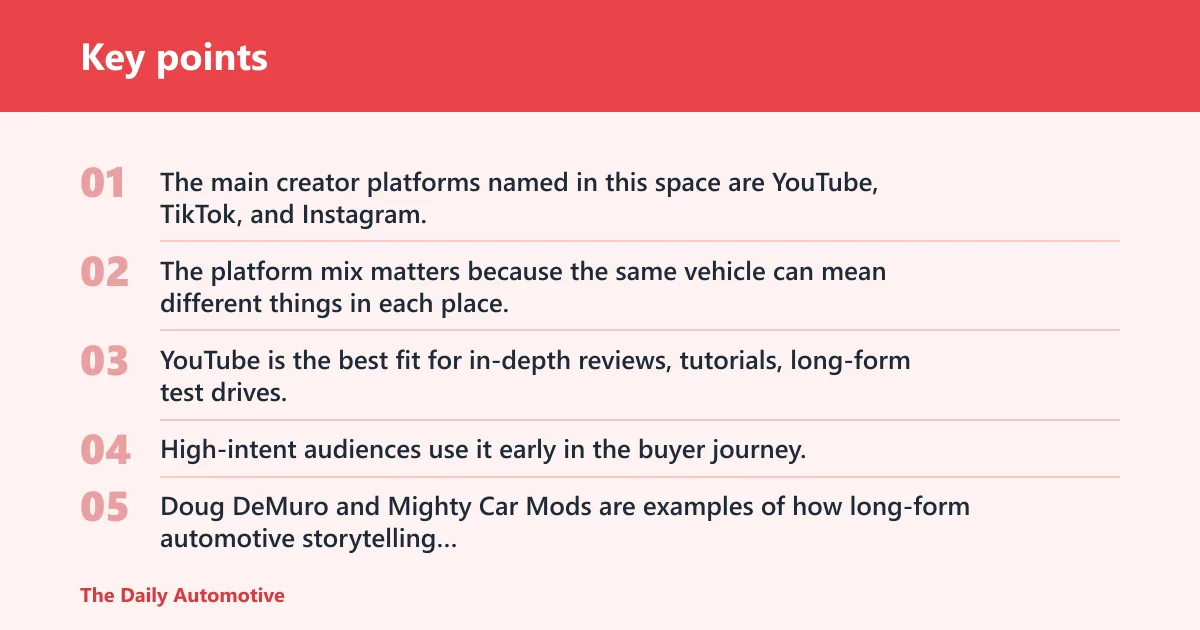
The main creator platforms named in this space are YouTube, TikTok, and Instagram, while automotive influencers also use Facebook. The platform mix matters because the same vehicle can mean different things in each place.
YouTube for depth and research
YouTube is the best fit for in-depth reviews, tutorials, long-form test drives, and comparison content. High-intent audiences use it early in the buyer journey, especially when they want a clear answer before visiting a dealership. Doug DeMuro and Mighty Car Mods are examples of how long-form automotive storytelling can build repeat attention.
This platform matters because it supports explanation. A 20-minute review can cover ergonomics, cargo space, steering feel, and ownership tradeoffs in a way that short-form clips rarely can.
Instagram for visual identity
Instagram works as a visual portfolio. It is strong for car photography, event coverage, and lifestyle framing, and it often presents cars as aspirational objects. Larry Chen Photography and Amy Kate are cited examples of automotive storytelling that uses image-first composition to shape taste and status cues.
On Instagram, the car is often part of a wider identity signal: apparel, location, scenery, and peer group all matter. That makes it powerful for aspiration and scene-building.
TikTok for fast-cycle discovery
TikTok favors short-form, highly engaging content, often with humor, quick edits, or surprise reveals. It can accelerate trend turnover because the format pushes fast reactions and easy imitation. That makes it useful for discovery, but weaker for detailed ownership education.
Brands should treat TikTok as a high-speed attention layer, not a full decision environment. A clip may spark curiosity without building enough conviction to close a sale.
Facebook for local discussion
Facebook still matters in local groups, event threads, and regional communities where comments, photos, and practical advice carry weight. It is especially useful for older enthusiast clusters and local meet-up coordination, where discussion can continue after a post leaves the feed.
Why do audiences trust these creators?
Audiences trust automotive creators because believable ownership beats polished ad copy. Real use cases, repeated exposure, and specific opinions create a stronger trust signal than a glossy campaign that never shows the car outside a studio.
That trust is fragile. Once sponsorships outpace credibility, audiences notice the gap between the creator’s claims and their actual use of the vehicle.
Ownership and repetition matter
Trust grows when a creator shows the same vehicle across multiple situations: daily driving, road trips, maintenance, charging, family errands, or track days. Repeated use proves that the opinion comes from experience, not from a one-off press event.
Specificity matters too. A creator who explains visibility, tire wear, charging routine, or back-seat fit usually sounds more credible than one who only repeats brand language.
Where trust breaks
Trust breaks when every post becomes a paid pitch, when the creator praises incompatible products too often, or when the content feels detached from real ownership. Audiences are quick to spot mismatch between a creator’s audience and the product being sold.
A common first-timer mistake is assuming a creator’s huge follower count means their automotive recommendations will automatically shape real-world car culture. A creator may have millions of views, but if the audience sees too many unrelated sponsored posts, the comments will shift from admiration to skepticism.
Cultural impact automotive lifestyle table
This table maps several common automotive lifestyle creator types to audience intent, platform fit, cultural pull, and inauthenticity risk. The point is not to rank them. It is to show how different creator forms move different parts of car culture.
| Archetype | Audience intent | Strongest platform | Cultural influence | Risk of inauthenticity |
|---|---|---|---|---|
| Reviewer | Research, comparison, purchase narrowing | YouTube | Sets expectations for value, comfort, and ownership tradeoffs | High if the script sounds like ad copy or the car never returns |
| Modifier | Build ideas, parts selection, style cues | YouTube, TikTok | Shapes stance, lowrider, off-road, and street-mod norms | High if the build exists mainly for reveal content |
| Photographer | Inspiration, scene awareness, aesthetic taste | Turns cars into visual status objects and community symbols | Moderate if cars are always static and never shown in use | |
| EV educator | Charging confidence, ownership clarity, first-time EV research | YouTube | Normalizes EV use and reduces fear around range and charging | High if charging claims ignore real ownership friction |
| Family/lifestyle creator | Practicality, safety, daily utility | Instagram, Facebook | Makes cars feel compatible with parenting, errands, and travel | Moderate if the vehicle never appears in real family routines |
| Luxury aspirational creator | Status, taste, brand association | Instagram, TikTok | Raises perceived prestige and shapes premium-brand desirability | High if access looks rented, staged, or disconnected from ownership |
What content actually shifts behavior?
Reviews, tutorials, event coverage, and repeated ownership content move behavior most often because they answer different parts of the digital buyer journey. Social media now affects early consideration before dealership visits, and many shoppers research vehicles online before purchase.
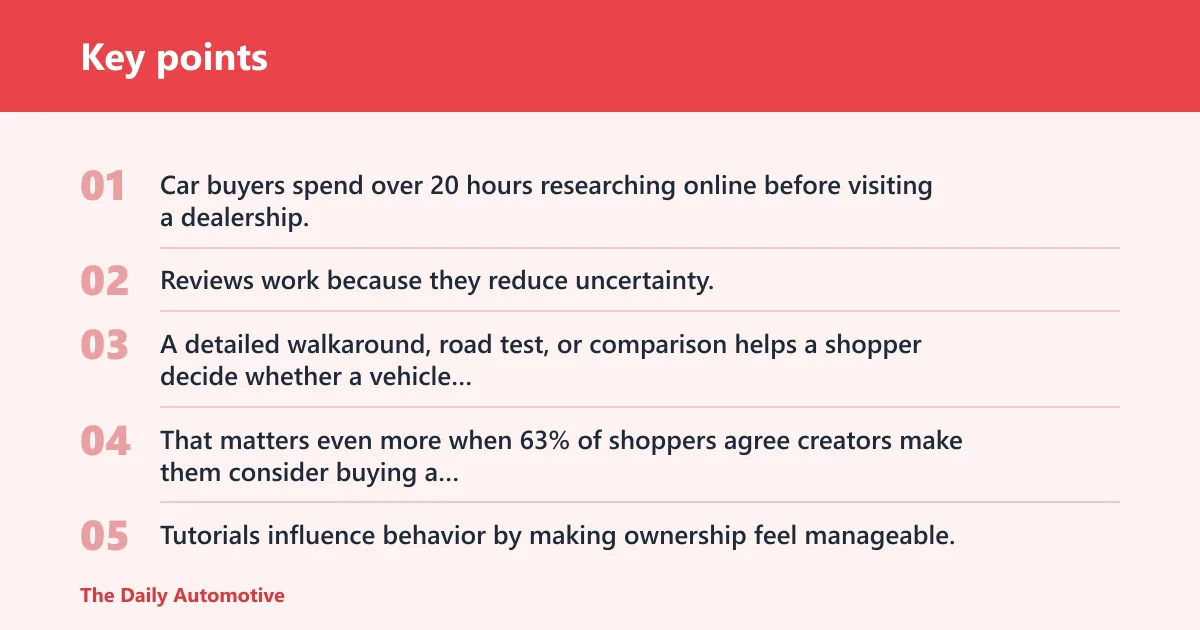
Car buyers spend over 20 hours researching online before visiting a dealership, which means creator content often enters the decision long before a salesperson does. That is where social proof starts to matter.
Reviews and long-form test drives
Reviews work because they reduce uncertainty. A detailed walkaround, road test, or comparison helps a shopper decide whether a vehicle is worth deeper research. That matters even more when 63% of shoppers agree creators make them consider buying a brand/model.
Tutorials and ownership explainers
Tutorials influence behavior by making ownership feel manageable. Charging guides, modification install videos, maintenance explainers, and setup walkthroughs are especially useful for first-time owners and EV shoppers who need practical reassurance.
Event coverage and community clips
Event coverage spreads scene norms. It shows what a subculture values, which parts matter, and how a build is judged in public. That matters for modification scenes, drift meets, lowrider events, stance gatherings, and overlanding meets, where peer approval carries real weight.
Builds, styling, and daily-use framing
Build content influences taste, but it only changes behavior when the car is shown in ordinary use too. That is where lifestyle framing matters: the vehicle becomes more than a display piece. It becomes part of errands, travel, weather, cargo, and family life.
Suppose a creator posts a lowered coupe only in polished night shots. Then the same car appears the next week with the rear seats folded for grocery runs and a child seat installed. That shift changes the audience read from pure aesthetics to usable identity.
What are the cultural downsides?
The downsides are real. Social media can flatten trend variety, push shock-value builds, reward over-commercialization, and shorten the lifespan of styles that once had time to mature. Influence is not always the same as depth.
When every feed rewards novelty, the scene can start copying what performs best instead of what a local culture actually values.
Trend flattening and copied builds
Algorithms can compress a niche into a template. Once a style performs well, the same wheel choice, wrap color, camera angle, or lighting setup gets repeated until regional difference fades.
Shock value over substance
Some content wins attention by being loud, extreme, or impractical. That can crowd out technically strong builds or long-term ownership stories that matter more to serious enthusiasts and buyers.
Commercial pressure
As sponsorships increase, creator feeds can drift from documentation toward promotion. That weakens trust, especially with enthusiasts who expect clear opinions and visible ownership. The more a creator sounds like a media plan, the less cultural authority they tend to have.
Shorter trend lifespans
Trend turnover is faster now, and that can be good for discovery. It also means some scenes lose continuity. A style may go from niche to oversaturated before the broader audience fully understands why it mattered in the first place.
How do automotive influencers change buying decisions and brand perception?
They change both by shaping the first impression and the later proof point. A creator may make a brand feel aspirational, practical, or trustworthy long before a buyer reaches the dealership. That early framing can make one model feel obvious and another feel forgettable.
This is where cultural influence and marketing influence overlap. Culture shapes what people admire, while marketing shapes what they notice. Automotive creators affect both, but they do not do it in the same way.
Brand perception before the visit
Because shoppers research online first, creator content often becomes the lens through which a brand is judged. If a vehicle appears useful, well built, or well loved in creator content, that perception can carry into the store visit.
Decision narrowing
Creators help buyers eliminate options. A review can remove doubt about one model’s interior, a tutorial can answer charging concerns, and an ownership video can make a brand feel more credible than an ad ever could.
Where influence stops
Influence does not always equal purchase intent. Some content is entertainment first. A viral reaction clip may shape awareness and attitude without producing a direct sale, especially if the audience is not in-market.
Frequently asked questions
How do automotive influencers shape car culture on social media?
They shape car culture by setting what gets copied, debated, and admired. Their posts can normalize a build style, give more visibility to a niche scene, or turn a vehicle into a status marker. Because social platforms reward repetition and reaction, those signals travel faster than in print or TV.
Why do automotive creators feel more trustworthy than traditional car ads?
They feel more trustworthy when audiences see real ownership, repeated use, and specific opinions. Traditional ads are designed to persuade. Creator content often looks like lived experience, even when it is sponsored, so it can feel less scripted and more useful to shoppers.
Which social platforms matter most for automotive lifestyle influencers?
YouTube matters most for depth and research, Instagram for visual identity, TikTok for fast discovery, and Facebook for groups and local discussion. The platform choice changes the message. A long review helps a buyer decide; a short clip may only start the conversation.
What kinds of automotive creator content actually influence audiences?
Reviews, tutorials, ownership explainers, event coverage, and daily-use framing tend to influence audiences most. These formats answer practical questions and show the car in context. Pure entertainment may still build awareness, but it usually has weaker effect on conviction and purchase intent.
What makes an automotive influencer authentic to car enthusiasts?
Authenticity comes from believable ownership, repeated use, and opinions that sound grounded in the vehicle’s real strengths and flaws. Enthusiasts look for consistency. If the creator’s car, story, and sponsorships do not match the audience’s expectations, trust fades quickly.
Products related to this article
Sponsored / affiliate links. As an Amazon Associate I earn from qualifying purchases. I may earn additional commission from eligible campaigns.