Hybrid Battery vs 12V Battery
In many hybrids, a weak 12V battery causes dash warnings, no-start behavior, and communication faults. Replace the traction battery only after low-voltage tests rule it out. Swapping the wrong part can cost hundreds or thousands and leave the real fault in place. This guide shows how to separate a 12V failure from a traction-battery fault, where symptoms overlap, and which checks to run first.
| Factor | Hybrid Battery | 12V Battery | Winner |
|---|---|---|---|
| Job in the vehicle | Drives the motor, supports energy recovery, and works with the inverter system. | Powers computers, relays, locks, lights, and accessory loads. | tie |
| Failure effect | Can limit propulsion, trigger hybrid faults, or force limp mode. | Can stop the car from booting, block READY, or break communication. | 12V Battery |
| Diagnostic priority for a no-start | Check after the 12V system and scan data rule out low-voltage faults. | Check first when the dash is dark, resets, or the car will not wake up. | 12V Battery |
| Typical replacement complexity | Higher. Pack access, safety steps, and code verification matter. | Usually simpler, though location varies by model. | 12V Battery |
Comparing their functions, voltage, and diagnosis
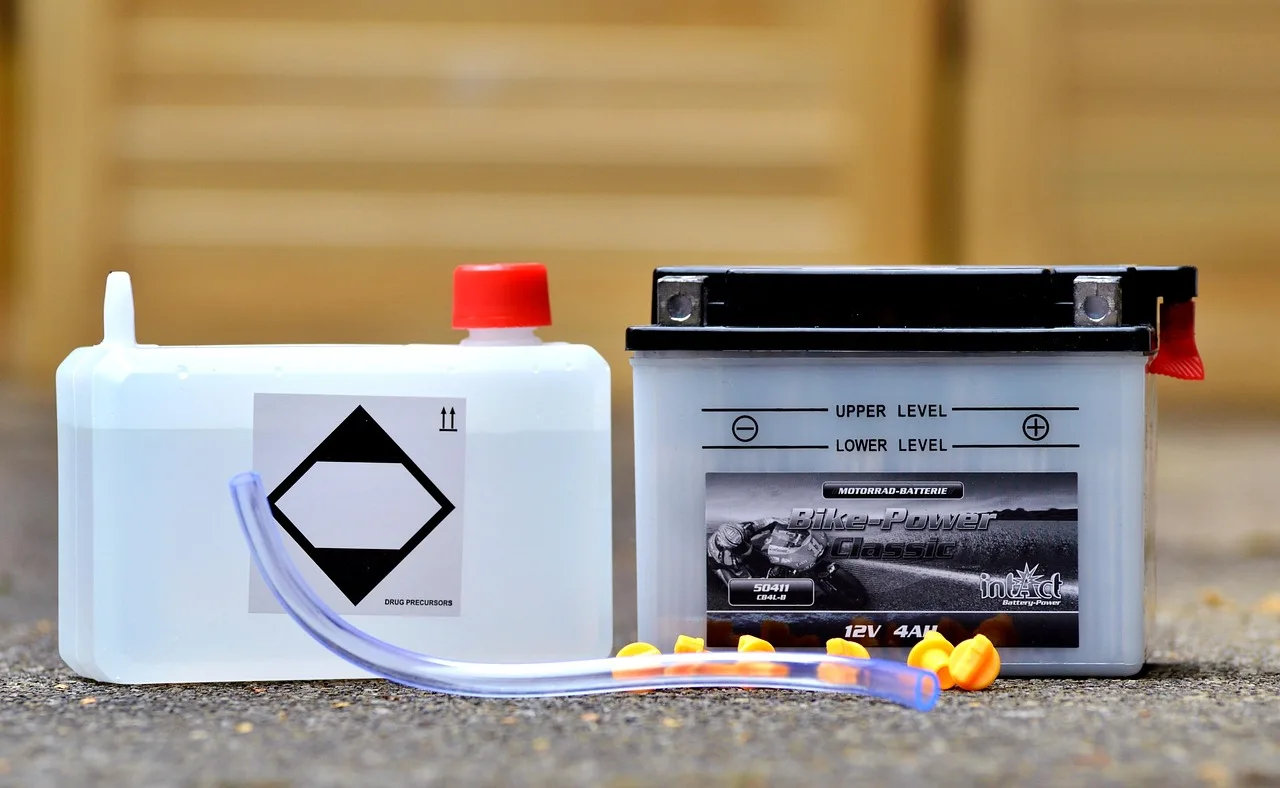
The hybrid traction battery is the high-voltage drive battery. The 12V battery is the auxiliary battery that wakes the car, powers the control modules, and closes the relays that let the system enter READY. They are not interchangeable, and a fault in one can look like a fault in the other.
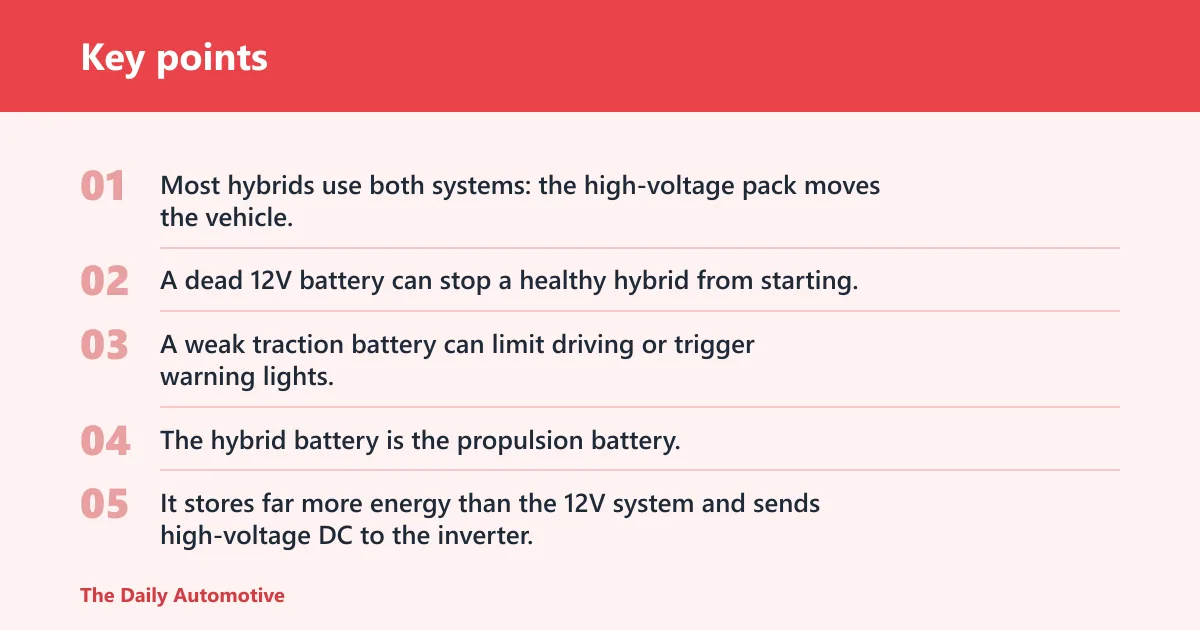
Most hybrids use both systems: the high-voltage pack moves the vehicle, while the low-voltage battery handles boot-up and daily electronics. A dead 12V battery can stop a healthy hybrid from starting. A weak traction battery can limit driving or trigger warning lights, but it usually does not explain a dead dash by itself.
| Comparison point | Hybrid Battery | 12V Battery | Winner |
|---|---|---|---|
| Voltage range | Typically around 100 to 300+ volts, depending on the vehicle. | About 12 volts. | tie |
| Main purpose | Propulsion and energy recovery. | Booting modules and supporting low-voltage loads. | tie |
| Diagnostic clue | Hybrid-system codes, reduced power, battery management faults. | No READY, dead dash, resets, weak lights, communication errors. | tie |
| Replacement risk if guessed wrong | High, because traction packs are expensive and model-specific. | Lower, and often the first part to inspect. | 12V Battery |
Voltage and role
The hybrid battery is the propulsion battery. It stores far more energy than the 12V system and sends high-voltage DC to the inverter, which feeds the motor for drive and regeneration. The 12V battery never handles that job.
The 12V battery exists so the vehicle can wake up. It powers ECUs, relays, door locks, interior electronics, and the computers that decide when the car can enter READY. If that battery is weak, the hybrid may never get far enough into its own start sequence to prove the traction pack is fine.
Cost and replacement risk
A traction battery replacement carries more risk because the pack is vehicle-specific and tied to the high-voltage system. A 12V battery is usually cheaper and easier to verify before larger parts are ordered. That is why low-voltage testing should come first when the symptoms point there.
Picture a Prius that will not boot, the dash flickers, and the door locks sound weak. That pattern points first to the 12V side, not to a failed traction pack. If the car later enters READY and then logs hybrid-system codes, the diagnosis shifts.
Diagnostic priority
For a no-start, the 12V battery usually comes first unless the car already shows clear traction-battery codes. Low voltage can keep scan tools from reading modules correctly, which is why a weak auxiliary battery can hide the real fault or create false ones. A hybrid battery is not the first suspect every time a warning appears.
Suppose the car starts, shifts into READY, and then shows a battery warning after a minute of driving. That is a different pattern from a completely dead dash. The first leans toward traction-battery or charging-system diagnosis; the second leans toward the 12V battery or its charging path.
What the 12V battery does in a hybrid
The 12V battery powers the computers, relays, locks, lights, and accessory circuits that let a hybrid wake up. It is the gatekeeper. If its state of charge is too low, the car may not close the high-voltage relays, may not power the scan network, and may not reach READY even if the hybrid pack is healthy.
That low-voltage problem can look like a traction-battery failure because the dash may light up with warning messages, the brake system may complain, and the shifter may act normal for a moment before the car shuts down. Many “hybrid battery” complaints are really 12V issues that stop the system before it can boot.
What the hybrid traction battery does
The traction battery is the high-voltage battery that moves the vehicle and stores recovered energy from braking. Depending on the model, it is usually nickel-metal hydride or lithium-ion, and it works with the inverter and motor control system to send power where it is needed. It does not replace the 12V battery.
The battery management system monitors cell health, temperature, and state of charge inside the pack. It can command reduced power or no-start behavior when it finds a fault. Even so, the pack can be fine while the 12V battery is too weak to wake the car.
State of charge matters on both systems
Low state of charge in the 12V battery can prevent boot-up, distort scan results, and cause slow or failed wake-up sequences. Low state of charge in the traction battery can affect drive mode behavior, power output, and regeneration. The symptoms overlap, but the causes are different.
How the DC-DC converter replaces an alternator
Most hybrids do not use a conventional alternator. Instead, a DC-DC converter steps high-voltage power down to 12V and charges the auxiliary battery while the vehicle is in READY. That is why the car can keep the 12V system alive even though the engine may stop and start often.
The inverter sits in the high-voltage system and helps convert DC to AC for the motor while managing power flow between the battery and the drive system. The DC-DC converter is the low-voltage charging path. If the converter or its control path fails, the 12V battery may keep draining even though the traction battery is still usable.
- Check whether the car enters READY.
- Inspect the 12V battery state of charge and terminals.
- Scan the car with an OBD2 diagnostic scan tool.
- Read codes from both the low-voltage and hybrid systems.
- If low-voltage faults are absent, inspect the traction battery and related hybrid codes next.
Do hybrid cars have a 12V battery?
Almost all hybrids are reported to have a 12V battery. It powers the computers, relays, locks, lights, and the start sequence that gets the car into READY. A hybrid can have a healthy traction battery and still fail to boot if the 12V battery is weak.
Toyota hybrid auxiliary battery locations
Searches for “Toyota hybrid auxiliary battery” usually point to a low-voltage battery that may be in the rear or cargo area on many models. The exact size and location vary by model and trim. Do not assume the battery sits in the same place across all Toyota hybrids.
That matters during replacement because access changes the job. Some models have easy cargo-area access; others require trim removal or different battery dimensions. Model-specific fit is the safe approach.
Common symptoms and what they usually mean
Warning lights can point to either battery system, so the pattern matters more than the icon alone. A battery warning light or master warning light does not automatically mean the traction battery is bad. You need system-specific codes from an OBD2 diagnostic scan tool before buying parts.
Low-voltage clues
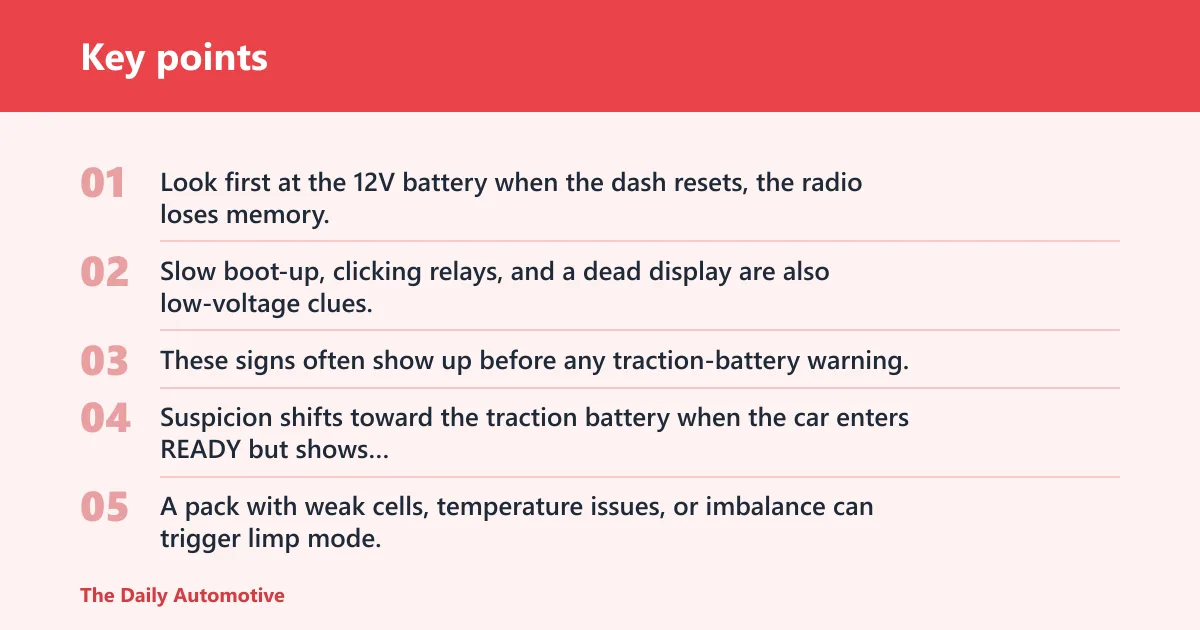
Look first at the 12V battery when the dash resets, the radio loses memory, the keyless entry acts weak, or the car needs repeated jump-starts. Slow boot-up, clicking relays, and a dead display are also low-voltage clues. These signs often show up before any traction-battery warning.
High-voltage clues
Suspicion shifts toward the traction battery when the car enters READY but shows hybrid-system codes, reduced power, or battery-state warnings after starting. A pack with weak cells, temperature issues, or imbalance can trigger limp mode. The vehicle may still wake normally because the 12V side is not the main problem.
When both systems need diagnosis
Some faults overlap. A weak 12V battery can block the code reader, and a traction-battery fault can also cause the DC-DC converter to stop charging the low-voltage battery properly. If the symptoms are mixed, scan first, then test the 12V battery, then inspect the traction battery path.
Hybrid battery symptom decision table
| Symptom | Likely 12V cause | Likely hybrid-pack cause | Test first |
|---|---|---|---|
| No READY light, dash stays dark | Weak or dead 12V battery | Less likely unless hybrid codes are already stored | Check the 12V battery |
| Dash resets when you press the start button | Low 12V state of charge | Uncommon as the first cause | Check the 12V battery |
| Repeated jump-start need | Failing 12V battery or charging path | Possible if the DC-DC converter is not charging | Check the 12V battery |
| Brake warning light with no other drive symptoms | Low voltage affecting modules or sensors | Possible, but not the first assumption | Check the 12V battery |
| Intermittent start failure | Weak 12V battery, loose terminals, or poor ground | Possible if hybrid codes accompany the failure | Check the 12V battery |
| Battery warning light after READY is reached | DC-DC converter or 12V charging problem | Possible pack or inverter fault | Scan codes |
| Reduced power while driving | Possible if low voltage disturbs control modules | More likely if the pack or battery management system faults | Scan codes |
| Master warning light with hybrid-system message | Sometimes caused by low voltage, but not always | Often traction-battery or hybrid-system related | Scan codes |
| Car starts, then stalls or shuts off from READY | Weak 12V supply to modules or relays | Possible if the pack or inverter faults under load | Check the 12V battery |
| Scan tool will not communicate with several modules | Low 12V voltage | Less likely until voltage is stabilized | Check the 12V battery |
| Battery fan runs often, then a hybrid warning appears | Possible secondary voltage issue | Possible thermal or cell-balance issue in the pack | Scan codes |
| Car enters READY only after a jump start | Strong sign of a weak 12V battery | Only if charging does not recover the 12V system | Check the 12V battery |
Should you replace the 12V battery or the hybrid battery first?
Start with the 12V battery when the car will not boot, the dash is dead, the system needs jump starts, or multiple low-voltage glitches appear together. That battery is cheaper, easier to verify, and the most common reason a hybrid seems dead when the traction pack is still fine.
Scan codes before buying a traction battery when the car enters READY, the warning light appears after startup, or the vehicle still drives but with reduced power. An OBD2 diagnostic scan tool can separate low-voltage codes from hybrid-system codes and point you toward the right repair path.
Choose hybrid battery if…
Choose Hybrid Battery if the car reaches READY, logs hybrid-system faults, shows reduced propulsion, or has codes tied to the pack, cells, or battery management system. Choose Hybrid Battery if the low-voltage battery tests good and the charging path is stable, but the hybrid-system warning remains.
Choose 12V Battery if…
Choose 12V Battery if the dash is dark, the car will not boot, locks and lights act weak, or the vehicle needs repeated jump starts. Choose 12V Battery if the symptoms point to low-voltage communication failure and the scan tool shows 12V-related codes or no reliable module communication until voltage is restored.
Can a hybrid run without the battery?
It depends on which battery you mean. A hybrid cannot run normally without the 12V battery because the car needs that low-voltage system to wake the computers and close the relays. The traction battery is also essential for hybrid drive operation, so the answer is no for normal use either way.
If the 12V battery is dead, the car may not enter READY at all. If the traction battery is dead or heavily faulted, the car may enter a limited mode or refuse to provide propulsion. Those are different failures, and they point to different tests.


Frequently asked questions
How is a hybrid battery different from a 12V battery?
The hybrid battery is the high-voltage propulsion battery, typically around 100 to 300+ volts depending on the vehicle. The 12V battery powers the control modules, relays, and accessories that let the car wake up. One moves the car; the other starts the electronic sequence that makes hybrid operation possible.
How many volts is a hybrid battery?
Exact voltage varies by vehicle and battery architecture. The key point is that it is a high-voltage pack tied to the inverter and motor system, not a normal low-voltage starter battery.
Can a hybrid car start if the 12V battery is dead?
No, not in the normal sense. A dead 12V battery can stop the car from booting, block READY, and prevent the relays from closing even if the traction battery is healthy. Some cars may respond to a jump start, which is another clue that the low-voltage system is the problem.
What does the 12V battery do in a hybrid?
It powers the computers, locks, lights, relays, and the control circuits that let the hybrid wake up. It also supports communication between modules and helps the car enter READY. In many hybrids, it is charged by a DC-DC converter once the vehicle is on, not by a conventional alternator.
What does the high-voltage hybrid battery do?
It supplies the energy used for electric drive, assists the engine, and stores power recovered during braking. The inverter and motor control system manage how that energy is used. If the pack or battery management system faults, the car may limit power or refuse to operate normally.
Is a hybrid battery the same as an EV battery?
Not always. Some plug-in hybrids and battery-electric vehicles use large lithium-ion packs that are closer in size and function to EV batteries, while many standard hybrids use smaller nickel-metal hydride or lithium-ion traction packs. The shared idea is high-voltage propulsion storage, but the design and capacity vary a lot by vehicle.
What are the signs of a failing 12V battery in a hybrid?
Slow wake-up, dim or dead dash lights, repeated jump-starts, weak door locks, and intermittent start failure are common signs. You may also see communication faults or warning lights that disappear after the low-voltage system is restored. Those clues matter more than the battery icon alone.
Hybrid battery vs regular battery
A hybrid battery is the traction battery that powers the drive system, while a regular 12V battery supports starting, electronics, and accessories. They are built for different jobs and use different voltage levels. In a hybrid, the 12V battery still matters even though it is not the main drive source.
Products related to this article
Sponsored / affiliate links. As an Amazon Associate I earn from qualifying purchases. I may earn additional commission from eligible campaigns.