Interior Detail Spray vs All-Purpose Cleaner
Use Interior Detail Spray for light dust, fingerprints, and routine wipe-downs; use All-Purpose Cleaner for heavier grime, sticky spills, and built-up contamination on durable interior surfaces. Using the wrong product can leave residue, dull trim, or strip protective finishes. This guide explains when to choose each cleaner by soil level and surface risk.
| Factor | Interior Detail Spray | All-Purpose Cleaner | Winner |
|---|---|---|---|
| Light maintenance on dashboards and trim | Made for spray-and-wipe maintenance on dust, fingerprints, and quick touch-ups. | Can clean these surfaces, but often does more work than the job needs. | Interior Detail Spray |
| Heavier soil removal | Best on light soil; may stall on greasy buildup or sticky residue. | Built for stronger soil removal and more embedded grime. | All-Purpose Cleaner |
| Finish risk | Usually aimed at an OEM matte finish with low residue and less shine. | Can leave streaks, haze, or extra sheen if too strong or left to dry. | Interior Detail Spray |
| Protection and add-ons | Often includes UV protection or antistatic claims, but not every formula does. | Primarily a cleaner; it is not inherently a protectant. | Interior Detail Spray |
| Mixing and control | Usually ready to use. | May need dilution, which gives you more control over strength. | All-Purpose Cleaner |
How the two cleaners differ
These products overlap on common cabin surfaces, but they do not solve the same problem. Interior detail spray is the maintenance cleaner for light soil and low residue. All-purpose cleaner is the stronger option when contamination is bonded, oily, or embedded.
Cleaning strength and dilution
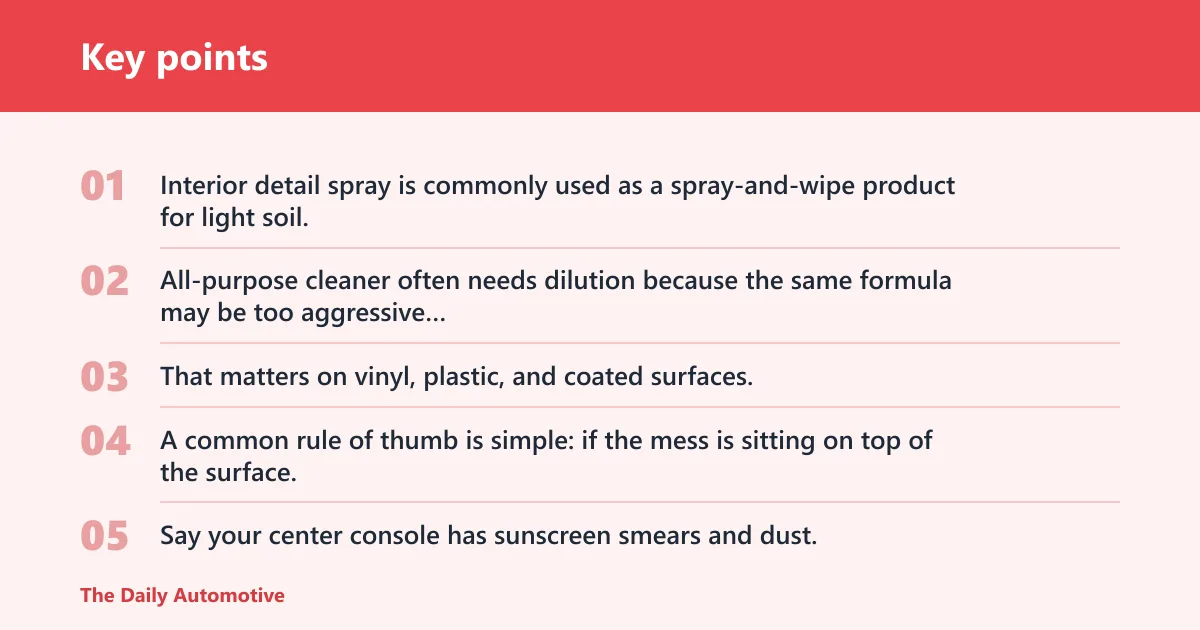
Interior detail spray is commonly used as a spray-and-wipe product for light soil. All-purpose cleaner often needs dilution because the same formula may be too aggressive on interiors if used full strength. That matters on vinyl, plastic, and coated surfaces, where strong chemistry can change the look before it finishes the job.
A common rule of thumb is simple: if the mess is sitting on top of the surface, start with the milder product; if it has been rubbed in, spread, or dried hard, reach for the stronger one. Say your center console has sunscreen smears and dust. The detail spray handles the dust; the APC is the better match for the greasy film after you dilute it to a safer interior strength.
Finish: matte, satin, or glossy residue
Interior detail spray is usually the safer choice when you want an OEM matte finish on dashboards, door trim, and console plastics. Many drivers prefer that factory look because it avoids greasy shine and makes the cabin look clean rather than dressed up.
All-purpose cleaner can leave a trim panel looking uneven if it is too strong, not wiped fully, or allowed to dry on the surface. On vinyl and plastic trim, that can show up as streaking or haze. On screens, the risk is worse because the wrong chemistry can leave film on the display surface.
Protection: UV claim vs plain cleaning
Some interior detail sprays include UV protection, and some do not. That matters on sun-exposed dashboards, but it is not the same thing as cleaning power. A cleaner can remove grime without offering any protection against fading or cracking.
All-purpose cleaner is mainly about soil removal. If you need UV protection, check the product listing for that claim instead of assuming every interior cleaner includes it. 303 Aerospace Protectant is rated 9.9/10 on a competitor page, Chemical Guys InnerClean is described as an interior quick detailer and protectant, and Jay Leno’s Garage Interior Detailer is listed separately from Jay Leno’s Garage All Purpose Interior Cleaner at 16 oz.
When is interior detail spray enough?
Interior detail spray is enough when the surface has light dust, fingerprints, or fresh smudges and you want a fast wipe-down with a factory-look finish. It is the better fit for dashboards, door panels, center consoles, and other trim where residue stands out. It is also the safer first choice when finish risk matters more than raw cleaning strength.
Dust and fingerprints
Dust and fingerprints sit near the top of the surface, so a low-residue spray usually clears them without leaving shine. That makes interior detail spray a good routine cleaner for vinyl, plastic trim, and touch points that need frequent wipe-downs. It is especially useful when you want the panel to look clean, not glossy.
Dashboards, door trim, and quick touch-ups
Dashboards and door trim are the classic use case. Interior detail spray is designed for a spray-and-wipe routine that keeps a matte or satin factory appearance. If the surface is already clean and you only need to remove handling marks, APC is usually unnecessary.
When should you reach for APC?
All-purpose cleaner is the better choice when the mess is heavier than normal dusting. Use it on sticky cupholders, greasy plastics, carpet spots, fabric stains, and rubber mats where embedded contamination needs more cleaning strength. It is more effective on soil that has bonded to the surface or worked into pores and texture.
Sticky cupholders and greasy door panels
Sticky cupholders usually collect dried soda, coffee residue, and mixed grime. Greasy door panels pick up skin oils and hand lotion transfer. Those are the kinds of jobs where APC earns its place, provided you dilute it to an interior-safe strength and wipe it fully dry.
Fabric stains and carpet soil
Fabric upholstery and carpet absorb spills instead of keeping them on top. That changes the job from surface cleaning to spot treatment. APC is often the more useful starting point here because detail spray is usually too light for absorbed stains, though you may still need a dedicated spot remover for stubborn marks.
Rubber mats and heavier interior grime
Rubber mats and some rubber trim tolerate stronger cleaning better than screens or finished leather. They can hold mud, road film, and grit, so a stronger cleaner makes sense. Dilution still matters, because even durable rubber can look dull if left with cleaner residue.
Interior mess decision table
This table matches common interior messes to the safer choice, the strength approach, and the finish risk. Use it as a quick rule: light soil and finish sensitivity point to detail spray, while bonded, oily, or embedded grime points to APC.
| Interior mess | Safer choice | Recommended strength approach | Finish risk |
|---|---|---|---|
| Dust | Interior Detail Spray | Ready to use; spray lightly and wipe with a clean microfiber. | Low |
| Fingerprints | Interior Detail Spray | Ready to use; one pass is often enough on trim and screens. | Low |
| Drink spills | All-Purpose Cleaner | Dilute for interiors first; spot clean and dry the area fully. | Medium |
| Sunscreen film | All-Purpose Cleaner | Use a diluted interior mix; do not let it dry on vinyl or plastic. | Medium |
| Greasy plastics | All-Purpose Cleaner | Start diluted; repeat with a fresh towel instead of stronger solvent use. | Medium |
| Sticky cupholders | All-Purpose Cleaner | Dilute; agitate gently if needed; remove residue before it dries. | Medium |
| Fabric stains | All-Purpose Cleaner | Dilute and blot; use more than one pass rather than a stronger mix. | Medium |
| Rubber mats | All-Purpose Cleaner | Interior-safe dilution; rinse or wipe clean after agitation. | Low to medium |
| Infotainment screens | Interior Detail Spray | Use only a screen-safe, low-residue application; avoid heavy wetting. | High if the wrong cleaner is used |
| Leather touch points | Interior Detail Spray | Use a leather-safe cleaner if possible; keep APC dilute only if the label allows it. | High |
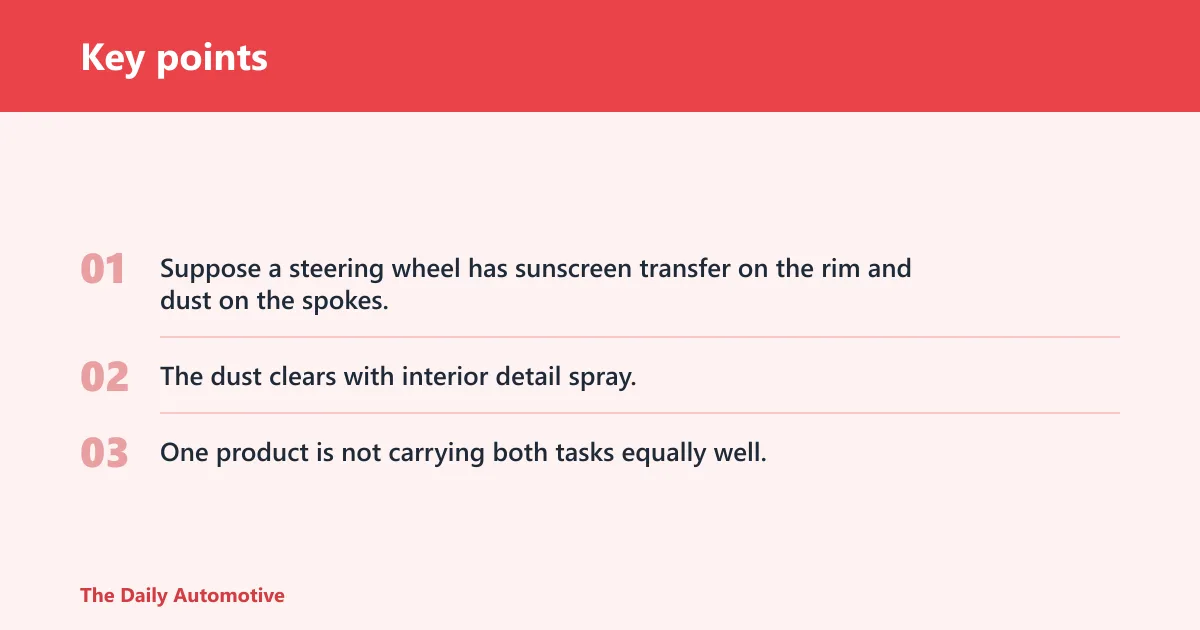
Suppose a steering wheel has sunscreen transfer on the rim and dust on the spokes. The dust clears with interior detail spray, but the sunscreen film is a better APC job on a cloth, not a heavy soak on the leather or coated trim. One product is not carrying both tasks equally well.
Can APC damage leather or screens?
Yes, it can if you use the wrong strength or the wrong type of APC. Finished leather generally needs gentler chemistry than a general APC, and screens need even more caution because coatings and anti-glare layers can react badly to strong cleaners. Dilution helps, but it does not make every APC safe for every surface.
Finished leather and why pH matters
Finished leather is not the same as suede or raw hide. It usually has a protective coating, but that coating can still be affected by strong cleaner, heavy scrubbing, or repeated overuse. A pH-balanced leather cleaner is often the safer recommendation, and separate conditioning or protection is commonly part of the care routine.
Why screens and coated displays need caution
Infotainment screens should not be treated like hard plastic trim. Even a diluted APC can leave haze, streaks, or residue on a display if it is not designed for that surface. Use a screen-safe product or the mildest cleaner the manufacturer permits, then dry the panel immediately.
Where dilution still may not be enough
Some surfaces need a different chemistry, not just a weaker mix. That includes suede, coated leather, and some coated screens. If the label does not specifically support the surface, pick a dedicated product rather than trying to force APC into the job.
Choose Interior Detail Spray if… / Choose All-Purpose Cleaner if…
Choose Interior Detail Spray if you want routine maintenance, a low-residue wipe-down, and an OEM matte finish on dashboards, trim, or door panels. It is the better call for dust, fingerprints, fresh smudges, and quick touch-ups where appearance matters as much as cleaning.
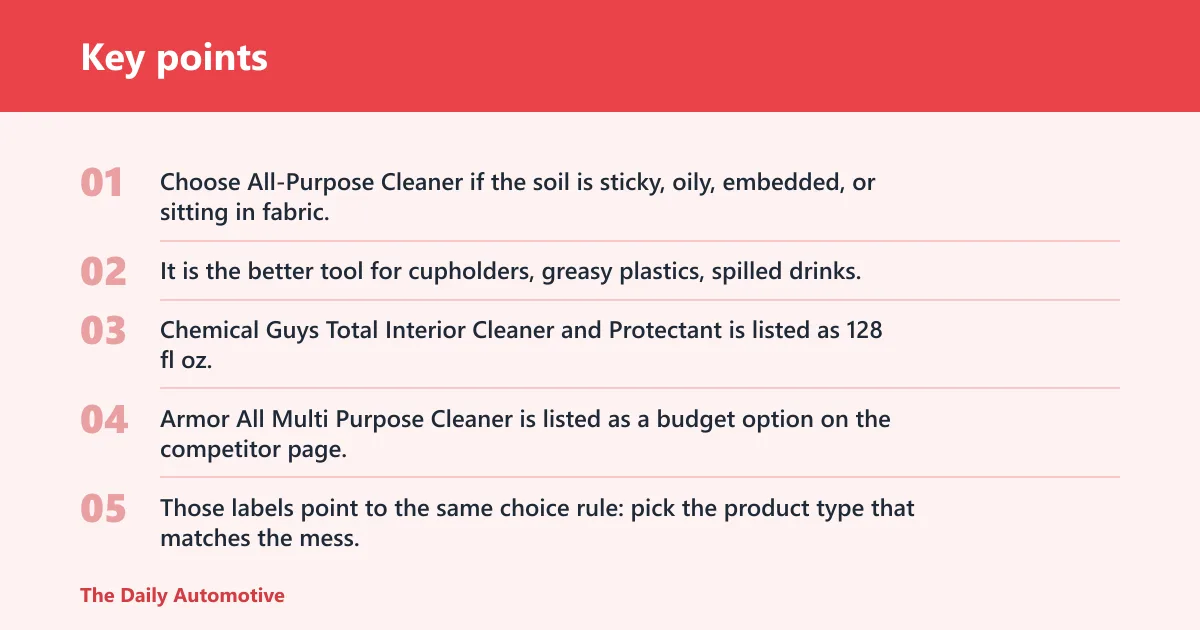
Choose All-Purpose Cleaner if the soil is sticky, oily, embedded, or sitting in fabric, carpet, or rubber texture. It is the better tool for cupholders, greasy plastics, spilled drinks, and heavier interior grime, but use dilution and avoid treating it like a universal safe spray.
A quick shopping note helps here. Chemical Guys Total Interior Cleaner and Protectant is listed as 128 fl oz, Walmart lists Chemical Guys Total Interior Cleaner & Protectant Spray in a 16oz size at 4.6 stars, Walmart lists Jay Leno’s Garage Interior Detailer at 4.4 stars, and Car Guys Super Cleaner is presented in a 1-gallon refill size. Armor All Multi Purpose Cleaner is listed as a budget option on the competitor page. Those labels point to the same choice rule: pick the product type that matches the mess, then check the listing for surface limits and dilution guidance.


Frequently asked questions
What is the difference between interior detail spray and all-purpose cleaner?
Interior detail spray is built for light maintenance, quick wipe-downs, and a low-residue finish on dashboards, trim, and touch points. All-purpose cleaner is meant for stronger soil removal on durable surfaces, and it often needs dilution. If the mess is light, the detail spray is usually safer.
Can I use all-purpose cleaner on car interior plastic and vinyl?
Yes, but only if the label supports interior use and you dilute it to a safe strength. Vinyl and plastic can streak, haze, or look too shiny if the cleaner is too strong or left to dry. For everyday dust and fingerprints, interior detail spray is the safer first choice.
Is interior detail spray better for dashboard cleaning?
Usually yes, because dashboards are one of the main places where residue and shine matter. Interior detail spray is designed for a spray-and-wipe routine that keeps the factory look intact. If the dashboard has sticky sunscreen film or greasy buildup, APC may be needed first.
What should I use for sticky cupholders and greasy door panels?
All-purpose cleaner is the better fit for both. Sticky cupholders and greasy door panels usually need more cleaning strength than a detail spray can provide. Dilute the APC, work in small sections, and wipe fully dry so residue does not sit in seams or texture.
Can all-purpose cleaner damage leather or screens?
It can, especially if used full strength or on the wrong surface. Finished leather needs gentler chemistry, and screens can react badly to strong cleaners or excess moisture. If the label does not clearly approve the surface, use a leather-safe cleaner or a screen-safe product instead.
Is an all-purpose cleaner the same as a disinfectant?
No. Cleaning removes soil and film; disinfecting targets microorganisms, and the label should indicate that it is a disinfectant. An APC may clean a surface well without disinfecting it. Do not assume sanitizing or germ-killing claims from the word “all-purpose” alone.
Products related to this article
Sponsored / affiliate links. As an Amazon Associate I earn from qualifying purchases. I may earn additional commission from eligible campaigns.
 Ethos FRESH - All Purpose Interior Cleaner Detailing Kit Interior Cleaner - Car Interior Detailing - Car Interior Cleaners for Cars, Trucks, SUVs, Jeeps, Motorcycles, RVs & More
 Ethos FRESH - All Purpose Interior Cleaner - Detailing Kit Interior Cleaner - Car Detailing - Car Interior Cleaner for Cars, Trucks, SUVs, Jeeps, Motorcycles, RVs & More - 2 Pack