Is a Car With 200k Miles Bad? A Proven Dangerous Mistake
A car with 200,000 miles is not automatically bad, but buying one without a thorough inspection is a dangerous and costly mistake. The vehicle’s maintenance history and overall condition are far more important than its mileage. A well-cared-for car can be reliable, while a neglected one is a major financial risk.
You found it. The perfect car, at a price that seems too good to be true. You love the color, the features, and it feels right. Then you see the number on the odometer: 200,000 miles. Your heart sinks a little. Is this a great deal or a disaster waiting to happen? It’s a question that stumps many car buyers.
That high number can be scary, and for good reason. We’ve all heard stories of high-mileage cars turning into money pits. But what if I told you that the mileage number is only a small part of the story? Let’s walk through this together. I’ll show you exactly how to tell a hidden gem from a dangerous mistake.
Why 200,000 Miles Scares So Many People
For a long time, 100,000 miles was seen as the finish line for a car. Hitting that number meant the car was old, worn out, and ready for the junkyard. This idea comes from a time when cars simply weren’t built to last as long as they do today. Engine technology, metal quality, and lubricants were not nearly as advanced.
Today, things are completely different. Modern cars are engineered with much higher precision. With proper care, many vehicles can easily drive well past 200,000 or even 300,000 miles. Think of it like this: a person who runs marathons regularly might be in better shape at 50 than a person who never exercises at 30. The car’s “lifestyle” or maintenance history matters more than its age or mileage.
The fear is still there, though, because a high-mileage car has had more time for things to wear out. Parts don’t last forever. But the key is knowing which parts to check and understanding the difference between a car that’s been loved and one that’s been neglected.

The “Dangerous Mistake”: Buying a Car’s Mileage, Not Its History
The single biggest mistake you can make is buying a high-mileage car based on its low price alone. The real danger isn’t the 200,000 miles; it’s the 200,000 miles of unknown history. Without proof of maintenance, you are taking a huge gamble.
Imagine this scenario: you buy a $4,000 car with 210,000 miles. It looks great and drives fine on the test drive. A month later, the transmission starts slipping. The mechanic tells you it needs to be replaced, a repair that costs $3,500. Suddenly, your “great deal” has cost you $7,500, and you still have an old car with other worn-out parts that could fail next.
This is the trap many people fall into. A car that hasn’t had regular oil changes, fluid flushes, or timely repairs is a ticking time bomb. Essential components like the timing belt, water pump, and suspension parts have a limited lifespan. If the previous owner ignored them, you will be the one paying to fix them when they fail, often on the side of the road.
What Really Matters More Than Mileage?
When you’re looking at a car with 200,000 miles, you need to become a detective. The odometer reading is just one clue. Here are the most important things to investigate:
- Complete Maintenance History: This is non-negotiable. Ask for a folder of receipts for oil changes, tire rotations, and major repairs. A responsible owner will have these. No records? That’s a giant red flag.
- Make and Model Reputation: Some cars are famous for their longevity. Brands like Toyota and Honda have built a reputation for reliability, and many of their models are known to run for hundreds of thousands of miles with basic care. Other brands, especially some luxury European cars, can become very expensive to maintain at high mileage due to complex systems and pricey parts.
- Type of Miles Driven: 200,000 highway miles are much easier on a car than 100,000 city miles. Highway driving means less stress on the engine, transmission, and brakes. Constant starting, stopping, and short trips in the city cause much more wear and tear.
- Rust and Body Condition: Check the car’s underbody, wheel wells, and rocker panels. Rust is like cancer for a car. It can compromise the frame’s safety and is very expensive to repair properly. Surface rust can be managed, but structural rot is a deal-breaker.
- Recent Major Services: Have any major components been replaced recently? A new transmission, timing belt, or water pump can be a huge plus, as it means you won’t have to worry about that expensive repair for a long time.
Common Problems to Expect Around 200,000 Miles
Even a well-maintained car will need some parts replaced as it ages. Being aware of these common high-mileage issues can help you budget for future repairs and know what to look for during an inspection.
| Component | What to Look For | Estimated Repair Cost |
|---|---|---|
| Suspension (Shocks, Struts, Bushings) | A bouncy or rough ride, clunking noises over bumps, uneven tire wear. | $500 – $1,500+ |
| Engine Gaskets (Valve Cover, Head Gasket) | Visible oil leaks on the engine, smell of burning oil, white smoke from the exhaust. | $300 – $2,500+ (Head gasket is very expensive) |
| Transmission | Hard shifting, slipping gears, hesitation when accelerating, or dark/burnt-smelling fluid. | $2,000 – $5,000+ |
| Alternator / Starter | Dimming headlights, trouble starting the car, a “clicking” sound when turning the key. | $400 – $800 |
| Fuel Pump | Car struggles to start, sputters at high speeds, or loses power while driving. | $500 – $1,000 |
| Timing Belt / Water Pump | These often have a recommended replacement interval (e.g., every 100k miles). If there’s no proof of replacement, assume it needs to be done. | $600 – $1,200 |
Your Step-by-Step Guide to Inspecting a 200k Mile Car
Feeling overwhelmed? Don’t be. Follow these steps, and you’ll be able to confidently assess any high-mileage vehicle. This is your checklist for avoiding a bad deal.
- Start with the Paperwork: Before you even look at the car, ask the seller for all service records. A neat stack of receipts is a beautiful sight. It shows the owner cared. If they say, “I did all the work myself but have no records,” be very cautious.
- Get a Vehicle History Report: Use services like CarFax or AutoCheck. You’ll need the car’s Vehicle Identification Number (VIN). This report will tell you about reported accidents, salvage titles, flood damage, and the number of previous owners.
- Do a Thorough Walk-Around: Look at the car in broad daylight. Check for mismatched paint, which could signal a past accident. Look for large gaps between body panels. Inspect the tires for uneven wear—this can indicate alignment or suspension problems.
- Look Under the Hood: You don’t have to be a mechanic. Pull the oil dipstick. The oil should be honey-colored, not black and sludgy. Check the coolant; it should be green, orange, or pink, not rusty brown. Look for any visible fluid leaks on the engine block or on the ground beneath the car. Check hoses for cracks and belts for fraying.
- Check for Recalls: Every car has recalls from time to time for safety issues. You can check for any open (unrepaired) recalls for free on the National Highway Traffic Safety Administration (NHTSA) website using the VIN.
-
Take It for a Meaningful Test Drive: Drive the car for at least 20-30 minutes. Try to drive on different types of roads—city streets, and a highway if possible.
- Turn the radio off and listen for any strange noises (clunking, humming, grinding).
- Test the brakes. Do they feel spongy or make screeching sounds?
- Does the car accelerate smoothly? Does the transmission shift without jerking?
- Does the steering wheel vibrate at higher speeds? Does the car pull to one side?
- GET A PRE-PURCHASE INSPECTION (PPI): This is the most important step and is not optional. For around $150-$250, you can hire an independent, certified mechanic to thoroughly inspect the car. They will put it on a lift and check things you can’t see, like the frame, exhaust system, and suspension components. A PPI is the best money you will ever spend when buying a used car. It can save you from a multi-thousand-dollar mistake. If the seller refuses to let you get a PPI, walk away immediately.
High Mileage Heroes vs. High Mileage Headaches
Not all cars are created equal when it comes to aging. Some models are known for their durability, while others can become unreliable and expensive as the miles add up. Here is a general guide to help you know what to look for.
| Category | Examples | Why They Fit Here |
|---|---|---|
| High Mileage Heroes | Toyota Camry, Toyota Corolla, Honda Accord, Honda Civic, many Lexus and Acura models. | These cars are known for their simple, reliable engineering and high-quality manufacturing. Parts are widely available and affordable. They are designed to last with basic maintenance. |
| Can Be Reliable (With Proof) | Ford F-150, Chevrolet Silverado, Subaru Outback, many Hyundai and Kia models from the last decade. | These vehicles can be very durable, but maintenance is key. For trucks, check how they were used (towing vs. commuting). For brands like Subaru, ensure head gaskets and timing belts have been addressed. |
| High Mileage Headaches | Many luxury European brands (BMW, Audi, Mercedes-Benz, Land Rover), certain smaller turbocharged engines. | These cars often have complex electronic systems, air suspensions, and turbochargers that can be extremely expensive to repair. A simple fix on a Toyota could be a four-figure bill on a high-end German sedan. |
Is a High-Mileage Car Right for You?
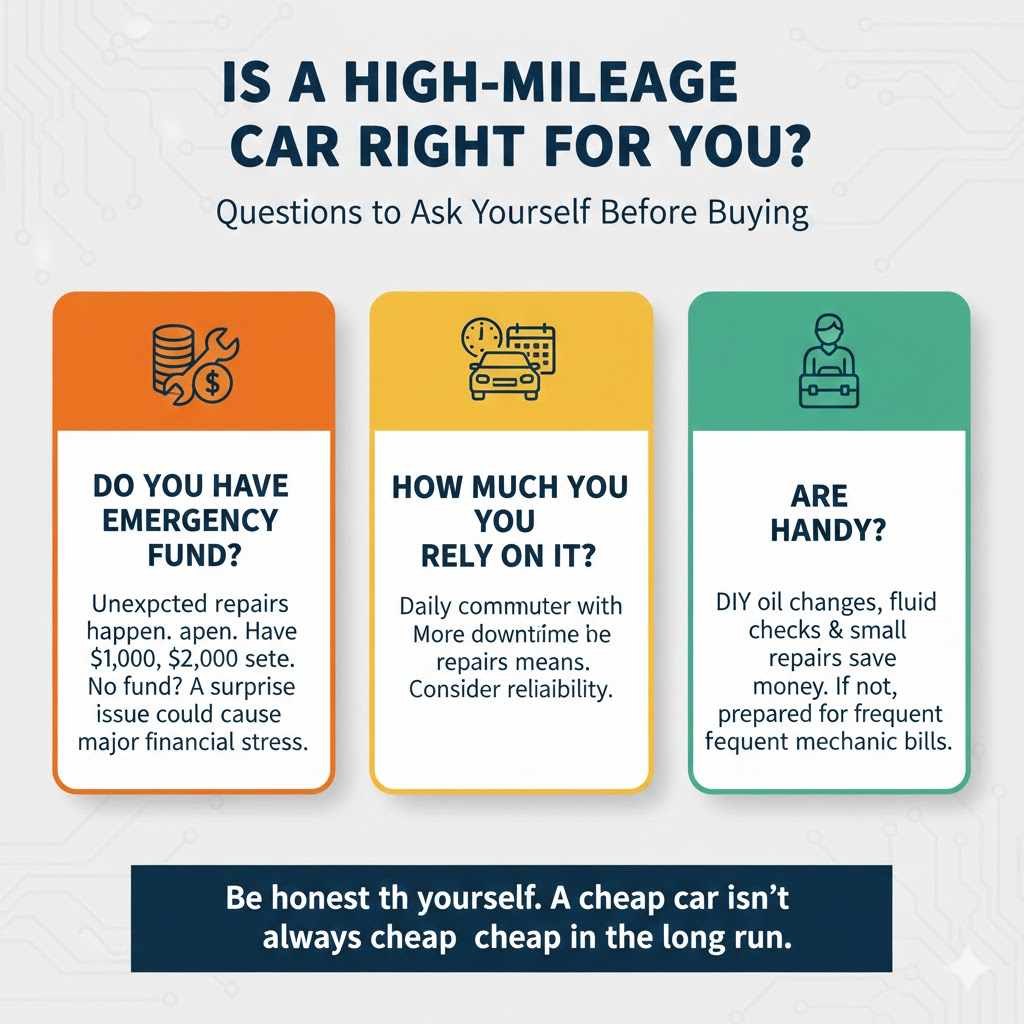
Before you make an offer, be honest with yourself about your own situation. A cheap, high-mileage car might not be a good deal if it doesn’t fit your life.
- Do you have an emergency fund? Even a great high-mileage car will need repairs. You should have at least $1,000-$2,000 set aside for unexpected issues. If you don’t, a surprise repair could put you in a very difficult financial spot.
- How much do you rely on your car? If you need a car to get to work every single day with no backup plan, a 200,000-mile vehicle might not be the most stress-free option. It will likely have more downtime than a newer car.
- Are you handy with basic maintenance? If you can change your own oil, check fluids, and handle small repairs, you can save a lot of money. If not, be prepared to pay a mechanic for every little thing that comes up.
FAQs: Your Top Questions Answered
How many miles is too many for a used car?
There’s no magic number. A well-maintained car with 200,000 miles can be a better buy than a neglected car with 80,000 miles. Focus on the car’s condition and maintenance history, not just the odometer.
Is a 200k mile car reliable for daily driving?
It absolutely can be, provided it’s a model known for reliability, it comes with detailed service records, and it passes a professional pre-purchase inspection. A well-cared-for Toyota or Honda with 200k miles can be a very dependable daily driver.
What’s more important: a car’s age or its mileage?
Maintenance history is the most important factor of all. After that, it’s a balance. A newer car with high highway mileage (e.g., a 3-year-old car with 90,000 miles) is often in better shape than an older car with low city mileage (e.g., a 15-year-old car with 60,000 miles) because highway driving causes less wear.
Should I buy a car with 200,000 miles if it has no service records?
No. This is a huge gamble and one you are likely to lose. The lack of records often means a lack of care. Without proof of maintenance, you must assume that major, expensive services have not been done.
How much does a pre-purchase inspection (PPI) cost?
A PPI typically costs between $150 and $250. It is the best investment you can make when buying any used car, especially a high-mileage one. It can save you from thousands of dollars in hidden problems.
Are highway miles really better than city miles?
Yes, by a lot. Highway driving involves steady speeds, which is very easy on the engine, transmission, and brakes. City driving involves constant starting, stopping, short trips, and potholes, which causes significantly more wear and tear on all of a car’s components.
Can a modern car really last 300,000 miles?
Absolutely. It’s becoming more and more common. With consistent oil changes, preventative maintenance, and timely repairs, many cars built in the last 15-20 years can reach 300,000 miles and beyond.
Conclusion: A Smart Choice, Not a Scary Number
So, is a car with 200,000 miles bad? The answer is clear: the number itself isn’t the problem. The real issue—the dangerous mistake—is buying a car without knowing its full story. A high-mileage vehicle can be a fantastic, affordable, and reliable option if you do your homework.
Think of yourself as an investigator. Your job is to uncover the truth about the car’s past. By demanding service records, getting a vehicle history report, and always investing in a pre-purchase inspection, you take the guesswork out of the equation. You replace fear with facts.
Don’t be scared by the odometer. Instead, be empowered by the knowledge you now have. You can confidently walk away from a potential money pit and spot the hidden gem that will serve you well for years to come. You’re not just buying a car; you’re buying its history. Choose wisely, and you can drive away with a great deal and peace of mind.