Is Auto Tech School Worth It? Costs, Payback, Paths
Auto tech school is worth it when low tuition lets your first 1 to 3 years of earnings cover the cost and you can move into a job with paid training or ASE advancement. Pick the wrong school, and you can spend $10,000 or more for little wage lift, slow payback, and debt that lasts longer than your first shop job. This guide compares cost, time, entry pay, apprenticeship options, and the best path for high school grads, career changers, and adults.
When the Numbers Work For Tech School
Auto tech school is worth it for students who want a faster route into paid shop work, can keep total borrowing low, and plan to build toward diagnostics, ASE certification, or a specialty. It is a weaker buy if local wages are low, the school has poor employer ties, or tool debt will swamp early paychecks.
What has to be true for the math to work
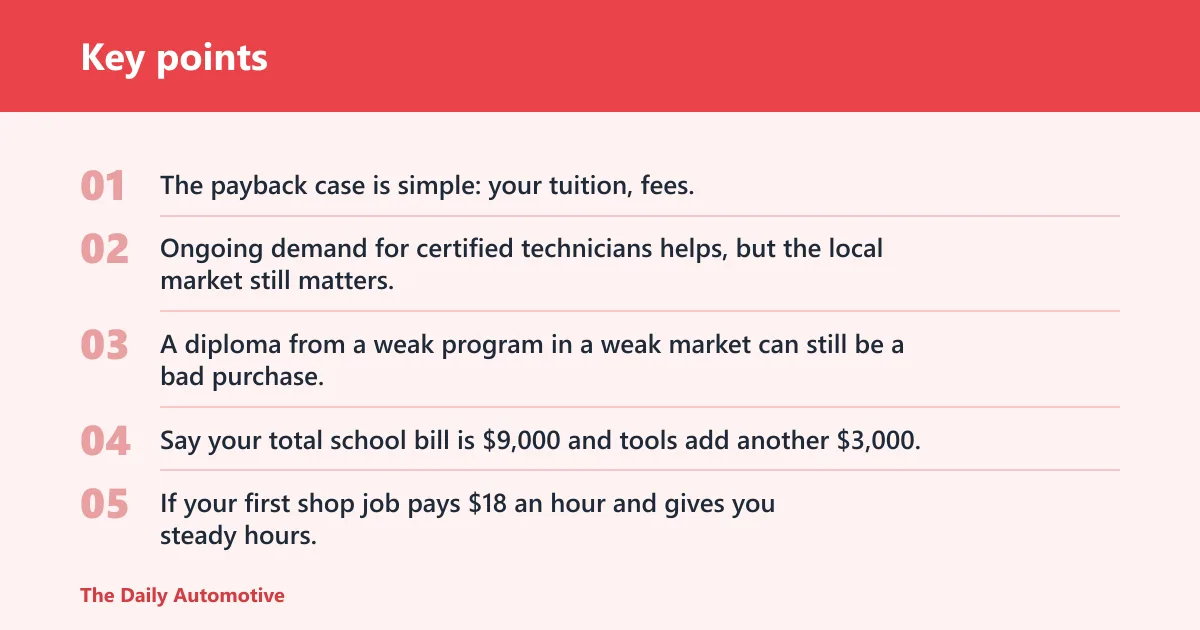
The payback case is simple: your tuition, fees, and tool costs need to stay low enough that a first job can cover them in a reasonable time. Ongoing demand for certified technicians helps, but the local market still matters. A diploma from a weak program in a weak market can still be a bad purchase.
Say your total school bill is $9,000 and tools add another $3,000. If your first shop job pays $18 an hour and gives you steady hours, the training may pay back in a few years. If the same program pushes you into $12,000 of debt and the local wage is barely higher than retail, the math gets ugly fast.
What you pay for at auto tech school
Auto tech school costs are usually a mix of tuition, fees, and the cost of tools and equipment. The school may supply vehicles, lifts, scan tools, and lab bays for training, but you often still need your own starter tool set, boots, and safety gear. That tool buy-in is part of the real price.
Most trade school programs stay focused. That means more time on brakes, steering, electrical basics, engine performance, and diagnostics, with less general education than a community college path. Certificate or credential outcomes usually come faster than a two-year degree, which helps if you want to start earning sooner.
Hands-on training usually means lab work on live systems, component removal and installation, electrical testing, scan tool use, service information lookups, and guided fault-finding on vehicles with real symptoms. The best programs tie those exercises to the repair steps employers expect on day one.
How much can an automotive technician earn?

An automotive technician’s pay can start modestly and improve with skill, certification, and specialization. Graduates without certification may start at lower pay, while technicians who build strong vehicle diagnostics skills or move into EV service can reach better earnings. Master mechanic and ASE certified technician are both stronger earning tracks over time.
Starting pay versus mid-career pay
Entry pay depends on region, shop type, and whether the employer is training you toward flat-rate work or hourly work. Dealerships often pay more for trainees than small independent shops, but they may also expect faster productivity. Mid-career earnings usually improve when you can diagnose problems instead of only replacing parts.
Vehicle diagnostics matters because it cuts guesswork. A tech who can trace a no-start, parasitic draw, or intermittent sensor fault is more valuable than someone who can only follow a basic repair order. That skill matters even more in newer cars and in hybrid and EV service.
Where specialty pay can outpace general repair
Specialization in EV service is highlighted as a stronger value case, and advanced diagnostics is another. Those areas often require more training, better electrical understanding, and comfort with manufacturer service data. Collision work, diesel, drivability, and line diagnostics can also move pay above general maintenance, depending on the market.
Suppose one technician stays on tires, oil changes, and brake pads, while another becomes the shop’s go-to person for electrical faults and EV work. The second tech usually has more room to grow because the skill set is harder to replace.
What master mechanic status can mean for income
Master mechanic is a higher skill milestone, not a starting point. It usually means broader diagnostic ability, more confidence with complex systems, and better earning potential than entry-level roles. ASE certified technician status can also signal stronger capability to employers and support career advancement.
Trade school, community college, or apprenticeship: which path fits you?
The right path depends on your budget, timeline, and tolerance for on-the-job learning. Trade school gives faster workforce entry and a tighter curriculum. Community college gives broader theory plus hands-on instruction. An entry-level shop apprenticeship can cut school costs, but classroom depth usually comes later.
Trade school program: faster entry and narrower focus
A trade school program is the best fit for students who want speed and structure. You get a tighter curriculum, more time in the lab, and a clearer line to a certificate. The tradeoff is cost: tuition and tools can be high, and the credential may be less portable than a broader degree if you later change fields.
Community college program: broader curriculum and possible transfer options
A community college program often blends theory with hands-on instruction and can include general education classes. That broader curriculum may help if you want an associate degree, transfer options, or a backup plan. It can also be a safer financial choice if local tuition is low and you need time to sort out your specialty.
Entry-level shop apprenticeship: lower school cost, slower classroom depth
An apprenticeship or employer-paid pathway can be the leanest route into the field. You start earning sooner, and the shop pays for part of the training. The downside is uneven instruction. Some shops teach well; others mostly need labor and leave you with gaps in electrical work, diagnostics, or service information use.
A common first-timer mistake is signing up for a program based only on flashy ads without confirming that it includes hands-on engine and diagnostics practice. A low-cost apprenticeship that never moves beyond basic maintenance can stall your growth. A slightly pricier school with strong employer ties may be the better long-term buy.
Decision matrix: cost, time, payback, and risk
Use this matrix as a practical filter, not a promise. The best path depends on tuition, tool costs, how soon you can start earning, and how fast you can move into higher-paying work. Local wages and shop demand matter as much as the school brochure.
| Path | Tuition and fees | Time to first paycheck | Likely starting pay | Tool buy-in | Typical payback period |
|---|---|---|---|---|---|
| Trade school program | $8,000 to $25,000 | 6 to 18 months | Often $16 to $22 per hour, region-dependent | $1,500 to $5,000 | 1 to 4 years |
| Community college program | $4,000 to $15,000 | 1 to 2 years | Often $15 to $21 per hour, region-dependent | $1,500 to $4,000 | 2 to 5 years |
| Entry-level shop apprenticeship | $0 to $5,000 | Immediate to a few weeks | Often $14 to $20 per hour, region-dependent | $500 to $3,000 | Fastest, if hours are steady |
A simple break-even example
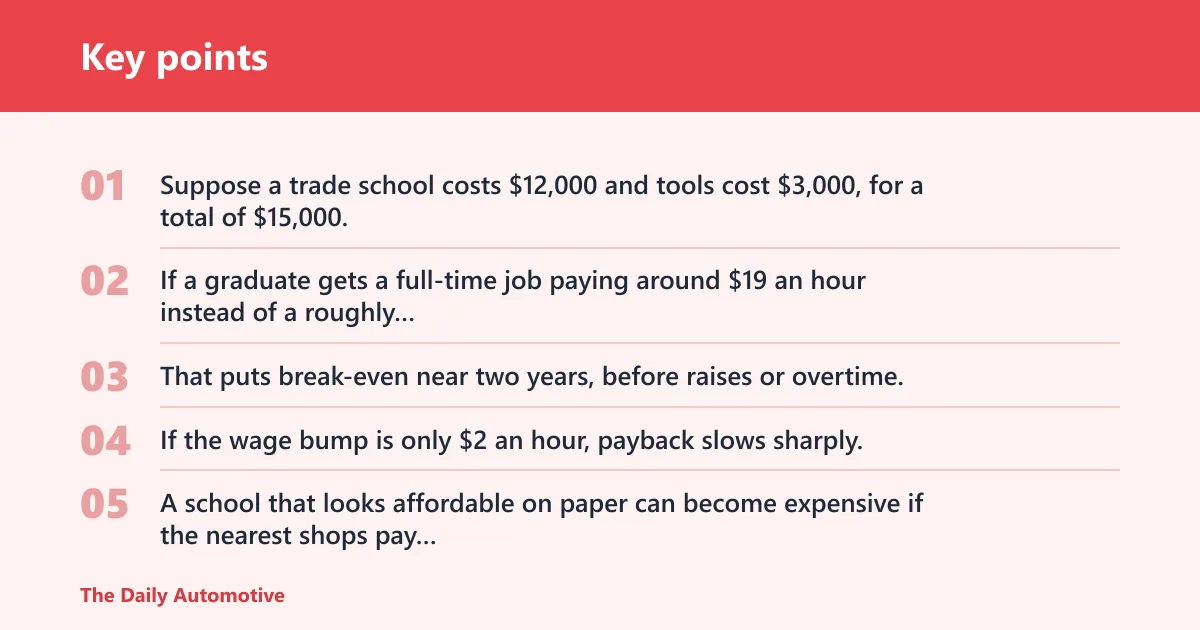
Suppose a trade school costs $12,000 and tools cost $3,000, for a total of $15,000. If a graduate gets a full-time job paying around $19 an hour instead of a roughly $15-an-hour alternative, the annual wage gain is roughly $8,000 a year before taxes on a 40-hour week. That puts break-even near two years, before raises or overtime.
If the wage bump is only $2 an hour, payback slows sharply. That is why local wages matter so much. A school that looks affordable on paper can become expensive if the nearest shops pay poorly or hire slowly.
What changes the payback period most
The biggest drivers are tuition, tool debt, local starting pay, and how quickly you move from lube work into diagnostics or warranty work. ASE certification can help hiring and advancement, but it is not a substitute for skill. It is one signal among several that employers use.
When auto tech school is a good investment
Auto tech school is a good investment when you want fast entry, can keep total costs controlled, and have a clear line to a shop that hires graduates. It is strongest when the program teaches diagnostics, electrical testing, and modern vehicle systems, including EV service relevance. Those skills age better than routine maintenance alone.
You want the fastest route into the field
If you need to start earning soon, a trade school program may beat a longer academic path. Graduates often find employment relatively quickly when the school has employer ties and strong shop placement. For high school grads who want a direct route, that speed can matter more than a broader degree.
You can manage tool costs and living expenses
Tool buy-in can be the hidden bill. If you cannot handle tools plus rent, auto tech school may force too much debt. A community college or apprenticeship can reduce pressure while you build a starter box over time. That matters for adults with debt and anyone supporting a household.
You plan to move into diagnostics or EV service
Advanced diagnostics and EV service are better reasons to attend school than oil changes alone. Those areas need deeper electrical knowledge, software use, and safety habits. They also create room for progression toward higher-paying roles, including specialty bays and master mechanic track work.
When auto tech school is not worth it
Auto tech school is not worth it when debt is high, wages are weak, or the program does not lead to real hiring. It also makes less sense if the school has poor shop ties, outdated equipment, or a weak completion record. Physical limits matter too, because the work can be hard on the body.
High debt and low local wages
If the tuition bill is large and the local labor market pays poorly, the payback may never feel comfortable. A school can be technically solid and still be a bad choice if nearby shops do not pay enough to service the loan. That is a local-market problem, not a training problem.
Low-quality programs with weak employer ties
Some programs teach theory without enough real repair practice. Others have equipment that is too old to reflect current vehicles. If graduates do not move into jobs quickly, the credential loses value. Ask which employers hire graduates, how many students finish, and whether the labs include current scan and diagnostic tools.
Physical limits, poor fit, or a better path elsewhere
The work can involve cramped spaces, standing for long hours, and lifting heavy equipment or parts. If your body cannot handle that load, think carefully before enrolling. A community college program that opens doors to parts management, service advising, or fleet office work may fit better than full-time wrenching.
Picture a 22-year-old student with a bad back and no access to savings. A two-semester program plus tools may look manageable until the first month of 10-hour shifts and heavy brake assemblies. In that case, a lower-cost apprenticeship with lighter duties or a different automotive role may be smarter.
Is auto mechanic school worth it?
Auto mechanic school is worth it when the program gets you into a paid shop role fast, keeps borrowing in check, and builds skills employers actually want. It is less attractive if you are paying full price for weak instruction, low wages, or a market where shops struggle to hire and still pay badly.
What jobs can you get after auto tech school?
Graduates can often start as lube techs, apprentice technicians, entry-level service technicians, or dealership trainees. With time, they may move into drivability, diagnostics, EV service, diesel, fleet work, or collision repair. The exact role depends on the school, the employer, and the region.
Do certifications matter more than hands-on experience?
On day one, hands-on experience usually matters more, but ASE certification matters as a hiring signal and for later advancement. Employers want proof that you can do the work and the credential to back it up. The strongest path is both: real shop time plus a certification stack built over time.
Is being an auto tech worth it for your body?
Being an auto tech is worth it for your body only if you understand the physical load and can manage it. The job can mean long standing, tight spaces, awkward reaches, and lifting heavy parts. Good ergonomics, a careful employer, and the right specialty can reduce strain, but the work is still physical.
Frequently asked questions
How much does auto tech school cost?
Auto tech school cost varies widely, but tuition, fees, tools, and equipment should all be in the budget. A low-cost path can be manageable; a high-cost school with tool debt can take years to recover. Always compare total price, not advertised tuition alone.
How long does auto tech school take?
Time to completion depends on the program. Trade schools are usually faster, while community college programs can take longer but may provide a broader curriculum. If you need income quickly, ask how soon you can start working while still finishing the credential.
What specialties pay best in auto tech?
EV service, advanced diagnostics, diesel, drivability, and some master mechanic tracks often pay better than general maintenance work. The best specialty is the one with local demand and enough training depth to make you harder to replace. National trends matter less than nearby hiring.
Should I choose community college or trade school for auto repair?
Choose community college if you want lower tuition, broader coursework, or possible transfer options. Choose trade school if speed, focused lab time, and fast entry into the workforce matter most. The better choice depends on your budget, timeline, and the quality of local employer connections.
Products related to this article
Sponsored / affiliate links. As an Amazon Associate I earn from qualifying purchases. I may earn additional commission from eligible campaigns.