Best Signal Boosters for Cars (2026): We Compared
Pick the weBoost Drive Reach for the strongest all-around car booster, or the weBoost Drive Reach Overland if your vehicle needs a rugged outside antenna and roof-rack or roll-bar mounting. A booster can only raise a weak outside signal, so if the signal outside is effectively zero, it cannot create service that is not there.
Quick comparison
| Product | Badge | Best for | Price | ||
|---|---|---|---|---|---|
 |
weBoost Drive Reach Overland – Cell Phone Signal BoosterweBoost | Our pick | Overland · 5G & 4G · Outdoor Antenna | $549.99
Price as of 22 Oct 2026
|
View |
 |
weBoost Drive 4G-X OTR (470210R) Factory Refurbished TruckweBoost | Budget pick | Refurbished · Truck · Weather-resistant 17” Antenna | $397.99
Price as of 22 Oct 2026
|
View |
The main trade-off is simple: the Drive Reach fits most cars and daily drivers, while the Drive Reach Overland fits vehicles that need an outside antenna built for rough mounts and rougher terrain. The truck-focused refurbished weBoost Drive 4G-X OTR sits in the middle for larger vehicles, but it is not the same kind of all-around pick.
How we chose
This comparison filters by vehicle fit first, then by antenna mounting, then by carrier and 5G support. That matters because a booster can be compatible on paper and still be the wrong choice for a car, truck, or overland build with limited roof space.
We also weighed installation difficulty, because a tool-free kit and a roof-mounted external antenna solve very different problems. FCC compliance matters too, so the model-specific FCC ID and emissions and interference status are not afterthoughts here.
Finally, the use case has to match the outside signal. A booster helps weak coverage; it does not fix a dead zone with no usable cellular signal.
What is the best car signal booster for your vehicle?
The best all-around pick is the weBoost Drive Reach. It has 50 dB max gain, supports all U.S. carriers, includes 5G and 4G LTE support, and uses a magnetic roof antenna that fits the most common vehicle setup without specialized mounting hardware.
If your vehicle is an overland rig, a roof-rack build, or something with a roll bar and frequent dust, washboard, or weather exposure, the Drive Reach Overland is the more appropriate fit. The truck-focused Drive 4G-X OTR is worth considering for larger vehicles, but the Drive Reach remains the cleaner default when you need broad compatibility and a simpler setup.
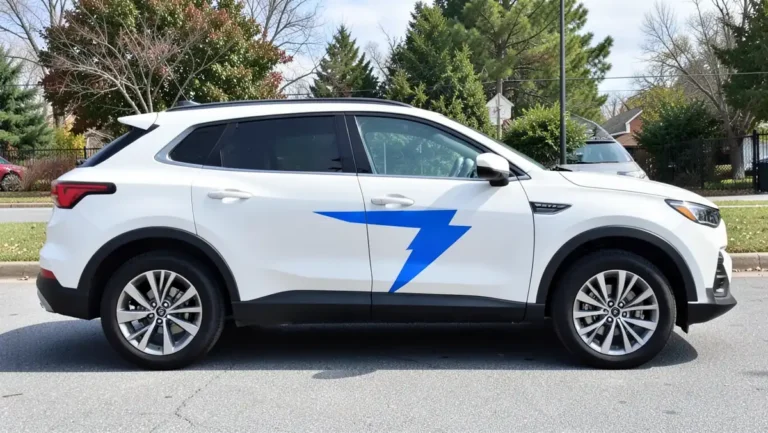
Pick the wrong class of booster and the problem usually shows up at the antenna, not the phone. Say your SUV has a clean roof but the carrier signal fades on county roads; a magnetic roof antenna may be the right answer. Suppose the vehicle already has roof racks and the outside antenna needs a tougher mount; then the Overland version makes more sense.
Quick take on the three-way split
Use the standard Drive Reach for cars and mixed driving. Use Drive Reach Overland when the outside antenna has to live in a harsher environment. Use the truck-oriented Drive 4G-X OTR when the vehicle is larger and the mounting setup favors a weather-resistant antenna over compact packaging.
Do car signal boosters work with Verizon, AT&T, and T-Mobile?
Yes, the main vehicle boosters here are built to work across the major U.S. networks, including Verizon, AT&T, and T-Mobile. The key is band support, not a carrier-specific lock. That also matters for regional band support, since a booster only helps if the installed antennas and radio bands line up with the local network.
For the Drive Reach, the manufacturer lists support for all U.S. carriers. For the Drive X, the same carrier-wide support is listed, along with 5G compatibility. The Overland version carries the same broad carrier support, so the choice comes down more to vehicle fit and antenna mounting than to network branding.
What compatibility does and does not mean
Carrier compatibility means the booster can work with the carrier’s supported bands. It does not mean it can pull a signal out of empty air, and it does not override a weak or absent outside source. If the carrier tower is too far away or terrain blocks the outside antenna, the booster has nothing useful to amplify.
What gain do I need in a car cell signal booster?
For vehicle use, 50 dB max gain is the headline number that matters most here. That level gives the booster more room to strengthen weak outside signal before it reaches the device inside the cabin. By comparison, Drive X is positioned as a more compact, single-user option rather than a max-reach solution.
A useful rule of thumb is that 3 dB doubles signal strength. That does not mean every 3 dB feels like twice the bars on your phone, but it helps frame the scale: higher gain can matter when the outside signal is weak but still usable. It is not magic, and it is not a substitute for coverage that is not there.
One set of published metrics to keep in mind: about 30.0 dBm average uplink power and about 5.0 dBm average downlink power are part of the kind of spec sheet that helps show how the booster behaves in both directions. Uplink matters for getting your phone’s signal back to the tower. Downlink matters for bringing network signal into the cabin.
How to think about gain by use case
Choose higher gain when you are traveling through rural corridors, mountain passes, or wide-open areas where the signal exists but drops to one bar or becomes unstable. Choose a simpler, lower-footprint kit when you are mostly a solo driver and the outside signal is weak, not severe.
Are car signal boosters legal and FCC approved?
Yes, vehicle boosters can be legal when they are FCC approved and used as intended. That approval is tied to emissions and interference compliance, which is why product-specific identification matters. For buyers, the FCC ID tells you which exact model was evaluated, not just the brand name.
The weBoost Drive Reach carries FCC ID PWO460021. The product family also includes model-specific regulatory identification details on the manufacturer side, which is important because buyers should verify the exact unit they are getting. FCC approval is not a vague promise; it is tied to the specific device configuration.
For buyers comparing used or refurbished kits, that detail matters even more. A kit can claim broad carrier support and still need the right regulatory identification to give you confidence that the unit matches the approved design.
How hard is it to install a car signal booster?
Installation ranges from simple to moderately involved. The Drive X is the easiest of the three to place because it is built for tool-free installation and a single-user setup. The Drive Reach adds more capability, but the magnetic roof antenna means you still need to place the outside antenna correctly to get the benefit.
The Drive Reach Overland is the most mounting-sensitive option. Its roof rack or roll bar mounting makes sense for rugged vehicles, but it also means you are planning around external hardware rather than simply placing a magnet on the roof. That is the right trade when the vehicle itself demands it.
Installation checklist
- Confirm that your route usually has some usable outside signal.
- Check whether your vehicle has a metal roof, roof rack, or roll bar.
- Match the external antenna style to that mounting surface.
- Decide whether you need a single-user kit or a multi-user setup.
- Verify the carrier bands and the exact FCC ID on the unit you plan to buy.
Will a car signal booster work in rural areas?
Yes, if there is at least some weak outside signal to amplify. Rural, mountainous, and off-road travel are exactly where these boosters tend to matter most, but the outside antenna still has to see something. No signal outside means no signal to boost inside.
That is why the right antenna mount matters so much in remote areas. A magnetic roof antenna or a ruggedized outdoor antenna can make the difference between catching a weak tower on the horizon and getting nothing useful at all.
Picture a pickup on a back road with a weak but usable data connection near the ridge line. A high-gain booster can stabilize calls and navigation. Now imagine the same truck in a canyon with no outside reception whatsoever; the booster cannot invent coverage.
weBoost Drive Reach: best for most drivers
The weBoost Drive Reach is the best fit for most drivers because it combines 50 dB max gain, all U.S. carrier support, and 5G and 4G LTE compatibility in a package that is easier to justify for everyday vehicles. It also carries a 2-year warranty and uses a magnetic roof antenna that suits common car and SUV installs.
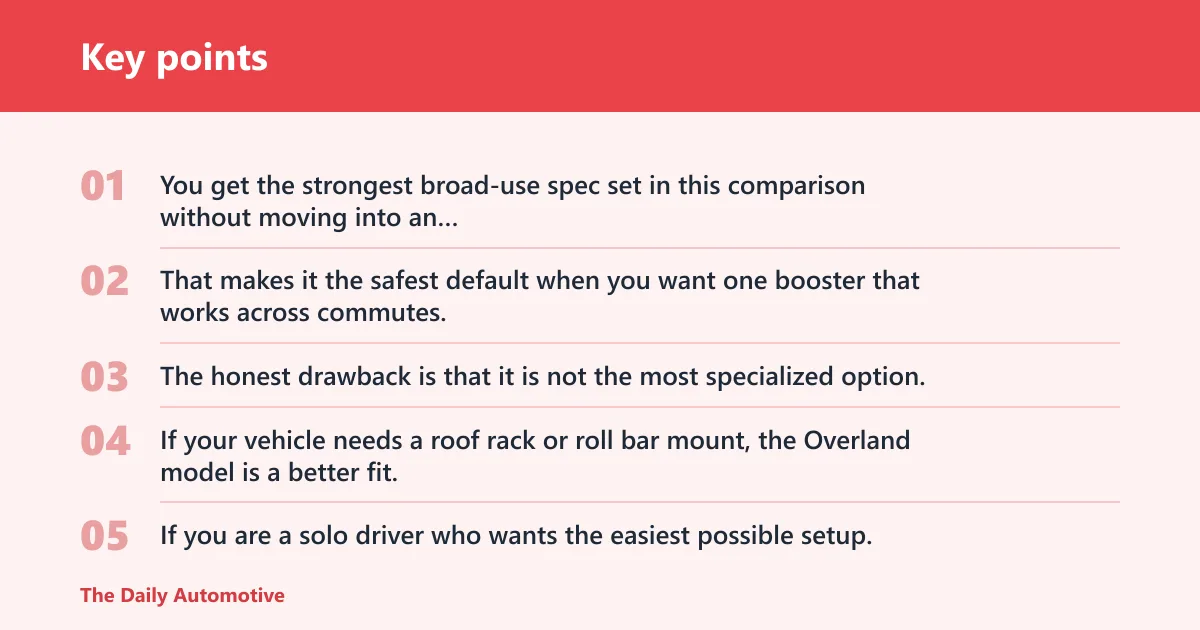
What stands out is the balance. You get the strongest broad-use spec set in this comparison without moving into an overland-only mounting style. That makes it the safest default when you want one booster that works across commutes, road trips, and mixed rural travel.
The honest drawback is that it is not the most specialized option. If your vehicle needs a roof rack or roll bar mount, the Overland model is a better fit. If you are a solo driver who wants the easiest possible setup, Drive X is the lighter-duty choice.
Why the 50 dB max gain matters
Fifty dB max gain gives the Drive Reach more headroom for weak outside signal than a compact single-user kit. That matters when the vehicle is moving between regions with different coverage strength or when the outside signal is unstable rather than simply low.
Who should buy it?
Buy it if you drive a car, crossover, or SUV and want the broadest mix of carrier support, 5G compatibility, and general-purpose performance. It is also the cleaner choice if more than one person in the vehicle expects to use data or calls at the same time.
weBoost Drive Reach Overland: best for rugged rigs
The weBoost Drive Reach Overland is the better pick for off-road vehicles and harsher mounting conditions. It is rated at 50 dB gain, built for extreme environments, and uses a ruggedized outdoor antenna designed for roof rack or roll bar mounting, with the same 2-year warranty as the standard Drive Reach.
Its strength is not just gain. The key difference is durability and mount strategy. If the vehicle spends time in dust, vibration, or repeated exposure to rough conditions, that outdoor antenna design is the reason to choose it over a standard roof-magnet setup.
The drawback is obvious: it is more specialized. A driver who only needs routine road-trip coverage may not need the tougher antenna hardware, and that can make the Overland version more than the situation calls for.
Why the mounting style matters
Roof rack and roll bar mounting solve a real problem. On overland builds, the roof may be crowded, nonstandard, or exposed in ways that make a simple magnetic antenna less practical. The Overland version is built around that reality rather than pretending every vehicle is a sedan with open sheet metal.
weBoost Drive X: best for single drivers
The weBoost Drive X is the best fit for a solo driver who wants a simpler setup. It is described as 33% farther than Drive Sleek, supports all U.S. carriers, includes 5G compatibility, and uses tool-free installation, which makes it the easiest of the three to place and move between compatible vehicles.
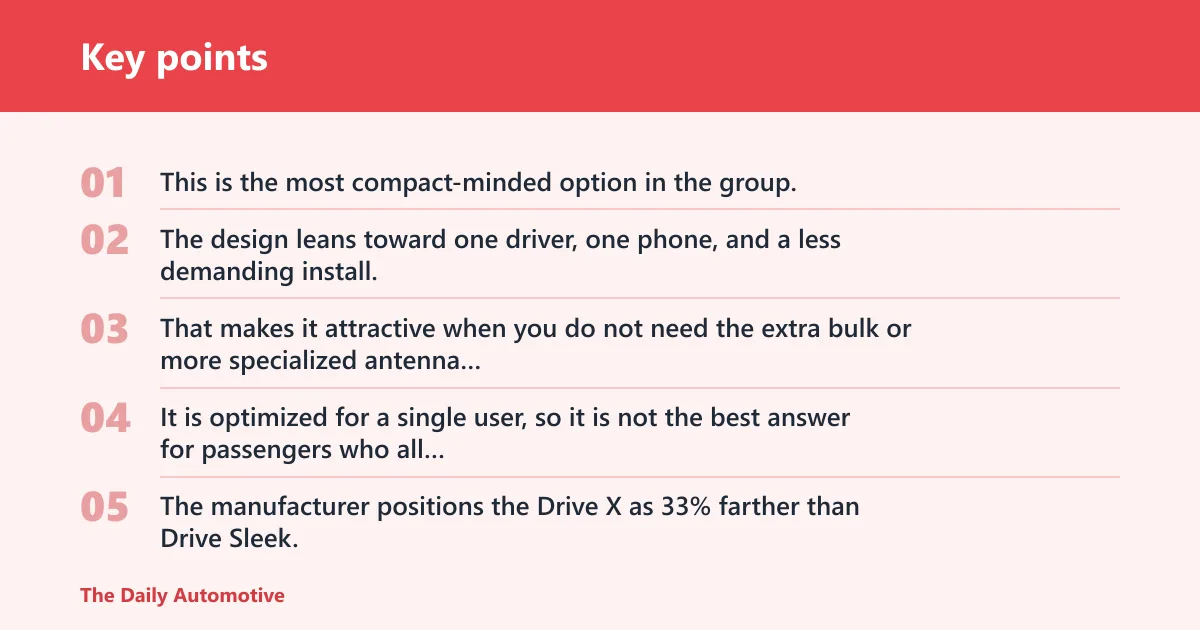
This is the most compact-minded option in the group. The design leans toward one driver, one phone, and a less demanding install. That makes it attractive when you do not need the extra bulk or more specialized antenna choices of the larger kits.
The drawback is capacity and scope. It is optimized for a single user, so it is not the best answer for passengers who all need stronger signal at once, and it is not the most capable fit for the toughest vehicle environments.
What 33% farther reach means here
The manufacturer positions the Drive X as 33% farther than Drive Sleek. That is a relative claim, not a universal coverage promise, so it should be read as a sign that the kit is tuned for more reach than the smaller model it replaces, while still staying in the lightweight category.
Which one should you buy?
Choose the standard weBoost Drive Reach if you drive a normal car, crossover, or SUV and want the best all-around balance of gain, carrier support, and installation practicality. Choose the Drive Reach Overland if your outside antenna has to mount on a roof rack or roll bar, or if the vehicle regularly sees harsh conditions.
Choose the Drive X if you are a single driver and want tool-free installation with a smaller footprint. Skip the booster entirely if the outside signal is effectively zero, if your vehicle setup gives you nowhere sensible to mount an antenna, or if you are expecting one kit to solve a dead zone with no usable carrier signal.
A common first-timer mistake is choosing a signal booster based on flashy claims instead of whether it actually supports their commute, distance, and coverage needs. A compact sedan, a full-size pickup, and a rack-equipped overland rig can all need different mounting solutions even when they use the same carrier.
Car signal booster decision matrix
| Product | Vehicle type | User count | Outside antenna mount | Installation difficulty | Carrier / 5G support | Best-use scenario | Do not buy if |
|---|---|---|---|---|---|---|---|
| weBoost Drive Reach | Cars, crossovers, SUVs | One to several occupants | Magnetic roof antenna | Moderate | All U.S. carriers; 5G and 4G LTE support | Best all-around fit for daily driving and mixed travel | You need rack-mounted hardware or a single-user compact kit |
| weBoost Drive Reach Overland | Off-road vehicles, overland rigs, larger builds | One to several occupants | Roof rack / roll bar mounting | Moderate to more involved | All U.S. carriers; 5G and 4G LTE support | Best when the outside antenna must survive extreme environments | Your vehicle has no practical rack or bar mount, or you want the simplest install |
| weBoost Drive X | Cars and smaller daily drivers | Single driver optimized | Compact vehicle-mounted antenna setup | Easy; tool-free installation | All U.S. carriers; 5G compatibility | Best for a solo commuter who wants the least complicated setup | Multiple passengers will rely on the booster at the same time |
Choose the standard Drive Reach if…
You want the strongest general-purpose option. You drive across varied terrain. You need all U.S. carrier support and a magnetic roof antenna without going to a specialized overland mount.
Choose drive reach overland if…
Your vehicle is built around roof racks or roll bars. You expect dust, vibration, or harsh weather. You want the ruggedized antenna rather than a standard roof-magnet style setup.
Choose Drive X if…
You are the only regular user in the vehicle. You want tool-free installation. You prefer a smaller, simpler kit and do not need the most aggressive multi-user setup.
Frequently asked questions
What is the best car signal booster for my vehicle?
The best choice depends on vehicle fit, not just raw gain. For most cars and SUVs, the standard weBoost Drive Reach is the best all-around option. For rack-equipped or off-road vehicles, the Drive Reach Overland is the better fit. For a solo driver who wants easy installation, Drive X is the lighter-duty choice.
Can a car signal booster support multiple devices at once?
Yes, but the best choice for that is usually the more capable all-around kit rather than a single-user model. A booster inside a vehicle shares the boosted signal among occupants, yet the practical result is better when the system is not tuned only for one phone. Drive X is the most single-user oriented here.
Do car boosters improve 5G and 4G LTE?
They can support those network types when the booster is built for them, but they do not create faster coverage out of nothing. The Drive Reach and Drive Reach Overland list 5G and 4G LTE support, while Drive X lists 5G compatibility. That means compatibility, not guaranteed top-speed performance.
What should I check before buying a booster for a truck or SUV?
Check the outside antenna mount first, then the carrier support, then the user count. Large vehicles often have different roof clearances and mounting constraints than cars. If the truck needs a roof rack or roll bar mount, the Overland version makes more sense than a standard magnetic setup.
Products related to this article
Sponsored / affiliate links. As an Amazon Associate I earn from qualifying purchases. I may earn additional commission from eligible campaigns.