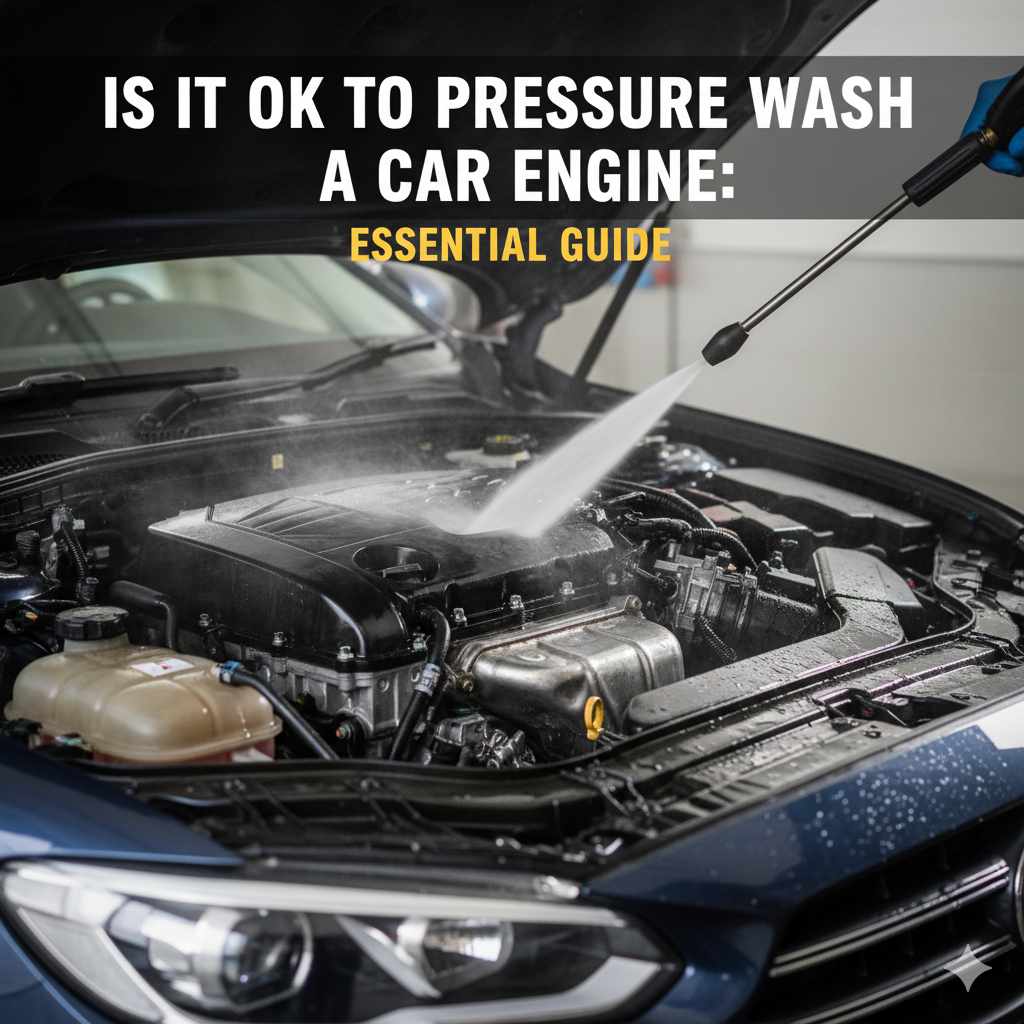
Is It OK to Pressure Wash a Car Engine? Safe PSI & Risks
Yes, you can pressure wash a car engine — but only below about 1,500 PSI, with a 40° wide nozzle and the electronics covered. The damage never comes from water itself; it comes from a narrow jet driving water past seals into the alternator, MAF sensor or fuse box. This guide covers the safe PSI ceiling, exactly what to cover, what fails when it goes wrong, and when steam cleaning is the smarter call.
Quick Answer
Yes, it is OK to pressure wash a car engine if you stay at or below roughly 1,500 PSI, use a 40° wide fan nozzle from at least 2 feet away, let the engine cool first, and cover the alternator, air intake, fuse box and ECU. Never use a 0°, 15° or turbo nozzle in an engine bay.
Why Pressure Is the Real Risk, Not Water
Engine bay water intrusion is a failure mode where pressurised water is forced past a seal or grommet into a component designed only to shrug off rain and road spray. Rain lands at almost no pressure and runs off; a pressure washer arrives as a concentrated jet that can hold force against a seal until it finds a way in. That difference — not the presence of water — is what turns an engine wash into a repair bill.
A residential water supply typically runs at 40–80 PSI. A common home electric pressure washer delivers 1,300–2,000 PSI at the tip. You are aiming roughly 20 to 40 times more force at hardware that was sealed against the first number, not the second.
Sealed Does Not Mean Waterproof
Modern engine bays genuinely are better protected than 1980s ones, but the engineering detail matters. Most engine-bay connectors are specified to IP67 under the automotive IP-code standard. The second digit, 7, describes resistance to temporary immersion in still water — roughly a metre deep for half an hour. It says nothing about resistance to a high-velocity jet.
The rating that does cover close-range, high-pressure washdown is IP69K, and it is deliberately reserved for components expected to face that treatment. Unless a connector is marked IP69K, a pressure washer is testing it well outside the conditions it was certified for.
📊 IP69K — the only ingress rating that actually covers close-range high-pressure washdown — is verified at 1,160–1,450 PSI from just 4–6 inches away. The IP67 rating most engine-bay connectors carry is a still-water immersion test, not a jet test. — Source: ISO 20653 (Road vehicles — Degrees of protection / IP code) and IEC 60529
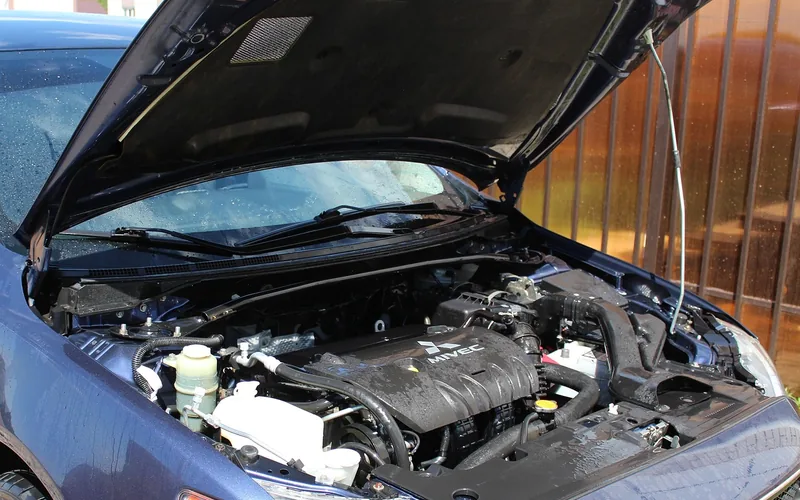
What PSI Is Safe for an Engine Bay?
Keep the washer at or below roughly 1,500 PSI, and treat 1,000–1,200 PSI as the comfortable working range. If your machine only runs at a fixed higher output, compensate with nozzle angle and distance rather than accepting the risk. Nozzle choice matters more than the number on the box: a wide fan spreads the same output over a large area, while a pinpoint tip concentrates all of it into a few square millimetres.
| Setting | Recommended | Never use |
|---|---|---|
| Pressure | 1,000–1,500 PSI | Above 1,900 PSI at close range |
| Nozzle | 40° white fan tip | 0° red, 15° yellow, or turbo/rotor |
| Distance | At least 2 feet (24 in) | Under 12 inches |
| Technique | Sweeping passes, wand always moving | Holding the jet on one component |
| Direct spray | Let runoff do the work | Alternator, intake, fuse box, connectors |
Note that this is a downward revision of the 1,600–1,900 PSI figure that circulates widely for tough grime. Independent detailing guidance now converges on 1,000–1,500 PSI for engine bays, and higher pressure buys no cleaning benefit that a longer degreaser dwell will not achieve more safely.
“Always wash your car with the flat jet and not with the rotor nozzle. Keep a minimum distance of 8-12 inches.”
That guidance is written for painted bodywork, where the panel behind the jet is solid steel. In an engine bay, behind the jet there are connectors, sensors and a fuse box — so it applies with more force, not less.
Best Engine Bay Cleaning Pick
GUNK Original Engine Degreaser Spray
The safest engine wash is the one where the chemical does the lifting and the water only rinses. A dedicated engine degreaser lets you drop to a gentle low-pressure rinse instead of chasing grime with a tighter nozzle.
- Best for: baked-on oil and road grime you would otherwise be tempted to blast off with high pressure
- Why we picked it: it is the chemistry that removes the need for pressure — dwell time does the work, so a gentle rinse is enough
- Main drawback: solvent-based, so it can dull unprotected plastic trim if you let it dry on the surface
Compare more engine bay cleaning options
 Option 1 HOPESPANNER 40° Pressure Washer Nozzle Tips (5-Pack)
|
 Option 2 oesee 10-Piece Engine Bay Cleaning Brush Kit
|
 Option 3 Adam’s Polishes Mini Air Cannon Blower
|
As an Amazon Associate we earn from qualifying purchases.
What to Cover Before You Start
Preparation is the part people skip and the part that actually prevents damage. Bags and masking tape are sufficient; you are deflecting direct spray, not building a waterproof enclosure.
- Alternator — the highest-value item in the bay to protect, because water strips lubricant from the brushes and lets the slip rings corrode.
- Air intake and filter box — water drawn down the intake can reach the cylinders, which is the one failure here that can be catastrophic.
- Fuse box and relay centre — usually a black plastic box; its lid resists rain, not a jet.
- Exposed ECU or control modules — cover any module you can see, along with its connector.
- Unsealed electrical connectors — anything with visible pins or a cracked boot.
- Distributor cap — on older vehicles, this is the classic no-start cause after a wash.
- Battery terminals — a quick wrap prevents corrosion starting at the posts.
Disconnecting the battery is an optional extra step. Taking the negative terminal off first removes any chance of a short if water bridges a live contact — if you are unsure of the order, our guide to which battery terminal to disconnect first covers it. The trade-off is losing radio presets, clock settings and some adaptive values.
When You Should Not Pressure Wash Your Engine
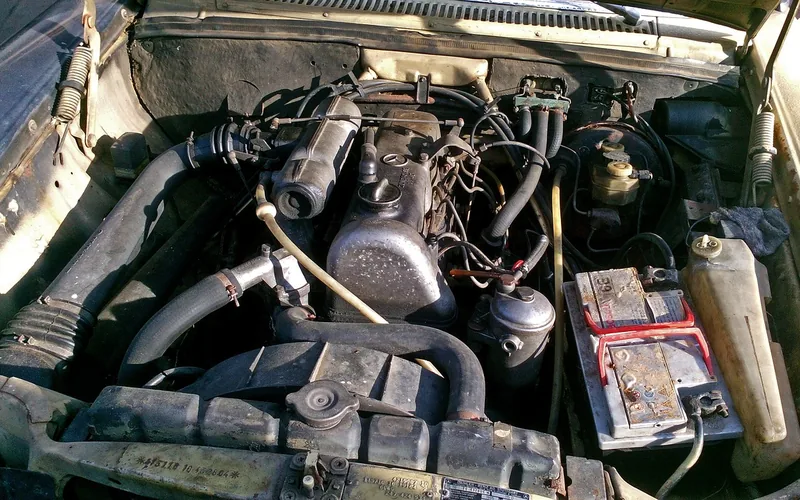
- Older vehicles with exposed wiring — pre-1990s harnesses often have brittle insulation and unsealed connectors.
- Known oil or coolant leaks — you will spread the mess and lose the drip trail that helps locate the leak.
- A hot engine — wait for it to cool completely, without exception.
- Aftermarket or damaged wiring — taped splices and cracked looms are direct routes for water.
- Any real doubt — a degreaser-and-garden-hose wash gets most of the result at a fraction of the risk.
How to Pressure Wash a Car Engine Safely: Step by Step
- Cool the engine completely: Park with the hood open and wait at least one to two hours until every surface, including the exhaust manifold, is cool to the touch.
- Cover the vulnerable parts: Bag and tape the alternator, air intake opening, fuse box, exposed ECU and any unsealed electrical connectors.
- Apply degreaser and let it dwell: Spray engine degreaser onto greasy areas, avoiding the covered electronics, and leave it for the 5 to 10 minutes stated on the label.
- Agitate with brushes: Work the degreaser into stubborn deposits with soft detailing brushes so you do not need extra water pressure.
- Rinse at low pressure: Fit a 40 degree nozzle, stand at least 2 feet back, keep the wand moving in sweeping passes and never dwell on one component.
- Dry thoroughly before starting: Blow water out of connectors and plug wells with compressed air or a blower, wipe accessible surfaces, then run the engine with the hood open to evaporate the rest.
If you would rather work through a low-pressure routine with no washer involved at all, our step-by-step guide to cleaning a car engine safely covers the same job using only a hose and degreaser. Choosing the right chemical matters more than the equipment — see our comparison of the best engine degreasers for heavy grease.
What Actually Fails After a Bad Engine Wash
Most guides stop at the vague warning that you could damage electronics. In practice the failures cluster around a short list of components, and knowing them tells you exactly where not to aim.
| Component | What water does | Symptom you notice |
|---|---|---|
| Mass airflow (MAF) sensor | Wets the hot-wire element | Rough idle, hesitation, check engine light |
| Ignition coils and plug boots | Pools in the spark plug wells | Misfire, shaking, stumbling under load |
| Alternator | Washes lubricant off the brushes, corrodes slip rings | Battery light, undercharging, whine |
| Fuse box and connectors | Sits in the housing and corrodes pins | Intermittent electrical faults weeks later |
| ECU connector | Corrosion on low-current pins | Stored codes, erratic sensor readings |
The pattern worth noticing is the timing. A soaked coil pack announces itself within minutes, but connector corrosion is slow — the intermittent electrical fault that shows up a month later is often traced back to a wash nobody connected to it.
Pressure Washer vs Steam vs Garden Hose
| Method | Pressure | Risk level | Best for |
|---|---|---|---|
| Garden hose and degreaser | 40–80 PSI | Lowest | Most owners, most cars, routine cleaning |
| Pressure washer, 40° tip | 1,000–1,500 PSI | Moderate | Heavy grime on a well-sealed modern bay |
| Steam cleaner | Very low pressure, high heat | Low | Detailing-grade results, sensitive engines |
| Pressure washer, narrow tip | 1,900+ PSI concentrated | High — avoid | Nothing in an engine bay |
Steam is what most professional detailers actually use, and it is worth understanding why: it cleans with heat and dwell time instead of force, so there is no jet to drive water anywhere. If your goal is a genuinely clean bay rather than a fast one, steam or a patient degreaser-and-hose session beats reaching for more PSI.
Where to Wash It: Runoff Rules
Engine bay runoff is not ordinary soapy water — it carries oil, grease and degreaser. Stormwater that enters a street drain generally flows to creeks and rivers without any treatment, so a driveway wash sends that mixture straight into local waterways. The EPA’s stormwater runoff guidance recommends washing on grass or gravel so the ground can absorb the water, or using a commercial wash bay plumbed into the sewer system. Many self-service bays are built for exactly this.
Aftercare and When to Call a Professional
Once the bay is dry, a light automotive dressing on plastic covers and hoses restores the finish and slows UV damage. Apply it sparingly, keep it off belts and pulleys, and wipe away anything that pools. Between deep cleans, a damp microfiber wipe prevents the buildup that tempts you toward high pressure in the first place — the same logic behind a sensible car washing schedule.
Hand the job to a professional if the vehicle has a dense modern electronics package, if it is a classic with fragile wiring insulation, or if you suspect significant fluid leaks. A detailer working with steam, targeted solvents and hand-detailing gets a better result with far less risk than any home pressure washer setup. The same caution applies to adjacent jobs — see our guide on cleaning a car radiator without removing it for how easily fins bend under pressure.
Frequently Asked Questions
Can a pressure washer damage my car engine?
Yes, if the pressure is too high or the nozzle is too narrow. Water itself is not the problem — force is. A 0° or turbo nozzle concentrates the full output into a pinpoint jet that can drive water past connector seals, strip grease from the alternator brushes and bend condenser fins. At 40° and 2 feet away, that same washer is far gentler than a garden hose held close.
What PSI is safe for washing an engine bay?
Stay at or below about 1,500 PSI, and 1,000–1,200 PSI is safer still. Most home electric washers sit in the 1,300–2,000 PSI range, so if yours is at the top of that band you must compensate with a wider nozzle and more distance. There is no cleaning benefit to going higher — degreaser and a brush do the work that extra pressure cannot.
What parts of the engine must be covered before washing?
Cover the alternator, the air intake opening and filter box, the fuse box, the ECU if it is exposed, and any unsealed electrical connectors. On older vehicles, also cover the distributor cap and any exposed ignition components. Plastic bags and masking tape are enough — the goal is deflecting direct spray, not creating a waterproof seal.
Should I disconnect the battery before pressure washing my engine?
It is a sensible precaution. Disconnecting the negative terminal first removes the risk of a short if water bridges a live connector, and it protects the ECU from voltage spikes. The trade-off is that you will likely need to reset the clock, radio presets and some idle-relearn values afterwards, so many people skip it on a modern car and simply avoid spraying near the battery.
Is it OK to pressure wash a hot engine?
No. Spraying cold water on hot metal risks thermal shock, particularly on the exhaust manifold and turbo housing, which run far hotter than coolant temperature. Degreaser also flashes off too fast on hot surfaces and can leave staining. Let the car sit with the hood open for at least one to two hours until every surface is cool to the touch.
My car runs rough or will not start after washing the engine. What now?
This is almost always trapped water in an ignition coil, spark plug well or connector, not permanent damage. Blow the water out with compressed air or a blower, dry any accessible connectors, and leave the hood open for a few hours. If a misfire or warning light persists after everything has fully dried, scan for codes — a soaked coil pack or mass airflow sensor may need replacing.
Is steam cleaning better than pressure washing an engine bay?
For most modern engines, yes. Steam cleaners use very low pressure and a small volume of very hot water, so they lift grease without driving water into anything. That is why professional detailers usually reach for steam rather than a pressure washer. The downside is cost and speed — steam is slower, and the machines are a real investment for occasional home use.
The Bottom Line
Pressure washing a car engine is safe when you treat pressure as the hazard rather than water. Cool the engine, cover the alternator, intake, fuse box and ECU, fit a 40° nozzle, stay at or under about 1,500 PSI from two feet back, and dry everything properly before you turn the key. If your washer cannot go that low, or the car is old enough to have exposed wiring, a degreaser and a garden hose will get you the same clean bay with almost none of the downside.
Products related to this article
Sponsored / affiliate links. As an Amazon Associate I earn from qualifying purchases. I may earn additional commission from eligible campaigns.