Is Uber Car Share Worth It? Pros, Cons and Real Costs
Uber Carshare was worth considering for short, scheduled trips with low mileage. It was a poor fit for full-day use, long drives, toll-heavy routes, or airport runs. It matters now because the Australian service was shut down, so treat it as a history lesson and cost benchmark, not a live booking option. (Wikipedia)
What Uber Carshare was and why it matters now
Car Next Door to Uber Carshare
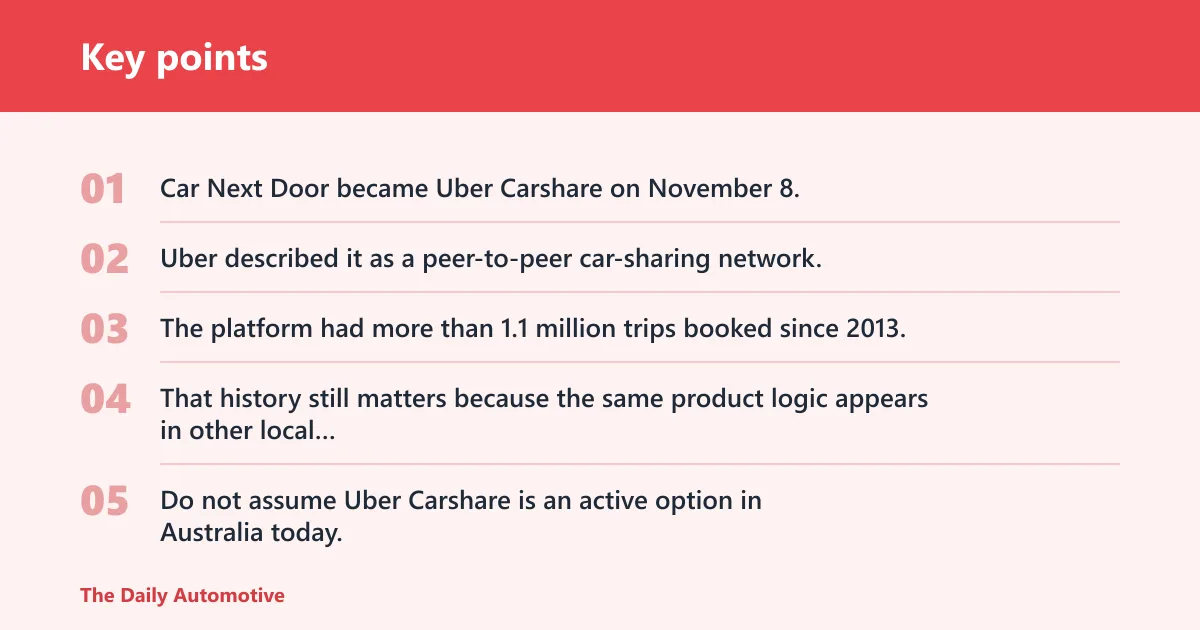
Car Next Door became Uber Carshare on November 8. Uber described it as a peer-to-peer car-sharing network, and Car Next Door said it offered cars nearby to borrow by the hour or day. The platform had more than 1.1 million trips booked since 2013.
That history still matters because the same product logic appears in other local car-share markets: nearby supply, short booking windows, and trip costs that depend on where the car is, when you need it, and how far you drive.
Current availability and the shutdown caveat
Do not assume Uber Carshare is an active option in Australia today. The service was shut down, so any decision based on it needs a current local availability check first. If you are reading old reviews or price posts, treat them as historical, not booking advice.
Where it fit in Uber’s mobility lineup
Uber framed the service as access to cars nearby when you want to drive yourself. That placed it beside rideshare and micro-mobility inside the Uber app ecosystem, which broadened transport options from being driven, to borrowing a car, to using smaller urban transport tools.
For a borrower, the appeal was convenience compared with owning a second car. For an owner, the appeal was earning revenue from an underused car. For both sides, local supply was the hinge.
How Uber Carshare worked for borrowers and owners
Borrowers could hire by the hour or by the day. That made it a short-duration access model rather than a classic rental desk model. The price structure typically needed an hourly rate, a daily cap, mileage or fuel charges, and extra fees to be judged properly.
Borrow by the hour or day
Hourly car hire works best for errands, short pickups, and tightly timed local trips. Daily car hire suits full-day use, but you still need to judge the total cost per day, not the headline rate alone. The platform logic also means the cheapest-looking booking can become expensive once distance and fees stack up.
How local availability changed by suburb and timing
Peer-to-peer car sharing is an owner-to-borrower marketplace, so availability depends on nearby supply. That means the right car may be one suburb away at 9 a.m. and gone by noon. Weekend demand can tighten supply further, especially for vans, larger sedans, or airport-friendly cars.
What owners earned from listing a car
Owners listed cars so they could earn money from vehicles that might otherwise sit idle. Uber’s public statements around the rebrand said the number of cars available to rent nearly doubled, owner community growth reached 60 percent, and borrower growth reached 20 percent. Those figures show how the platform was trying to scale supply and demand together.
Is Uber Carshare worth it?
Uber Carshare was worth it when the trip was short, planned in advance, and close to home, especially if the alternative was several rideshare legs. It was usually not worth it for a full day, high kilometres, airport transfers, or any booking where supply risk could force a more expensive last-minute choice.
The decision rule for short errands versus longer trips
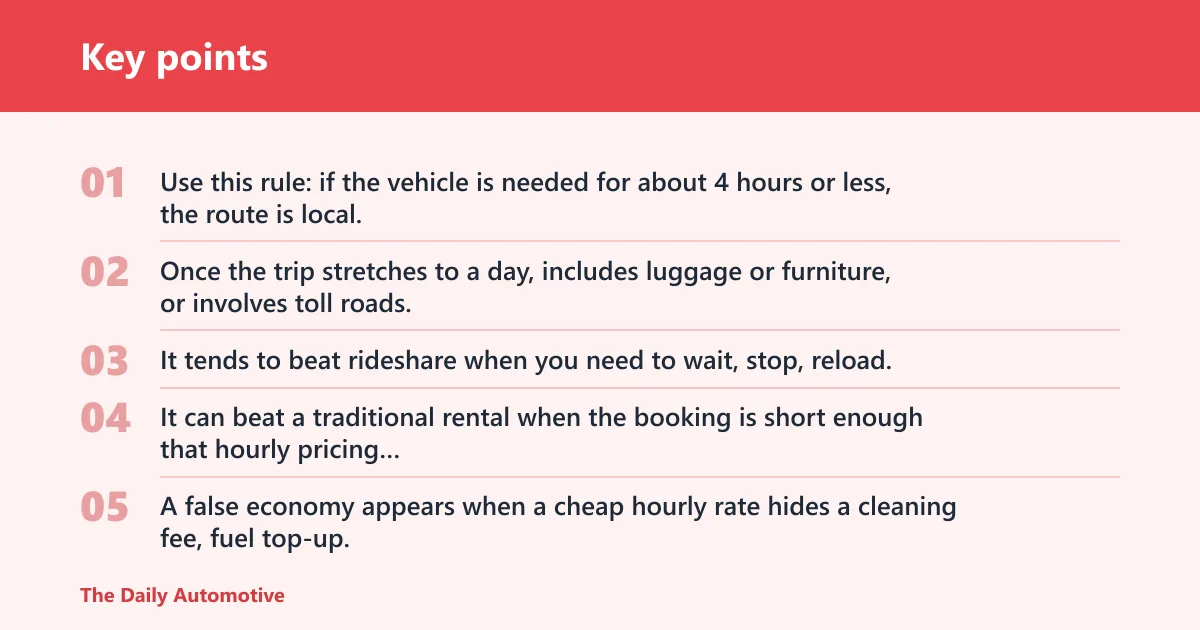
Use this rule: if the vehicle is needed for about 4 hours or less, the route is local, and total distance stays modest, car share can sometimes beat both a rental desk and multiple rideshares. Once the trip stretches to a day, includes luggage or furniture, or involves toll roads, the math often shifts away from car share.
When it beats rideshare or rental
It tends to beat rideshare when you need to wait, stop, reload, or make several short legs in one outing. It can beat a traditional rental when the booking is short enough that hourly pricing and a lower base fee offset the rental desk’s minimum day charge and airport surcharges.
When it is a false economy
A false economy appears when a cheap hourly rate hides a cleaning fee, fuel top-up, excess reduction, and a late return charge. That is where small delays matter. Suppose you book a van for a move and the loading takes longer than expected; the hourly price stops being the main number very quickly.
Carshare cost table
The table below uses modelled borrower costs to show how the all-in total can change. Because Uber Carshare was shut down, these figures are decision examples rather than live quotes. The point is the structure: base hire, distance or fuel, insurance or excess, cleaning, and late-return risk.
| Scenario | Uber Carshare base hire | Distance / fuel | Insurance / excess | Cleaning | Late-return risk | Total estimated cost | Standard rental | Two rideshare trips |
|---|---|---|---|---|---|---|---|---|
| 2-hour errand, 18 km total | $24 | $8 | $12 | $0 | $0 | $44 | $98 | $52 |
| 1-day move, 65 km total | $68 | $22 | $15 | $20 | $10 | $135 | $148 | $128 |
| 48-hour weekend trip, 240 km total | $156 | $72 | $20 | $20 | $15 | $283 | $196 | $164 |
What the tipping point means in practice
In the short errand example, car share wins on flexibility and stays below a rental desk total, but it still trails a simple pair of rideshare trips on pure price. In the one-day move example, the totals are close enough that convenience and cargo space may decide it. By the weekend trip, rental and rideshare alternatives often look cheaper.
That is the real tipping point: car share works best when you need control of the car for a short block of time, not when you are trying to stretch it across a long weekend.
What fees can change the final price?
The final price can rise fast once you include excess reduction, cleaning, fuel, tolls, and any late-return exposure. Those charges matter because the headline hourly or daily rate rarely tells the whole story. The best comparison is always an all-in estimate for your exact trip.
Insurance excess and coverage
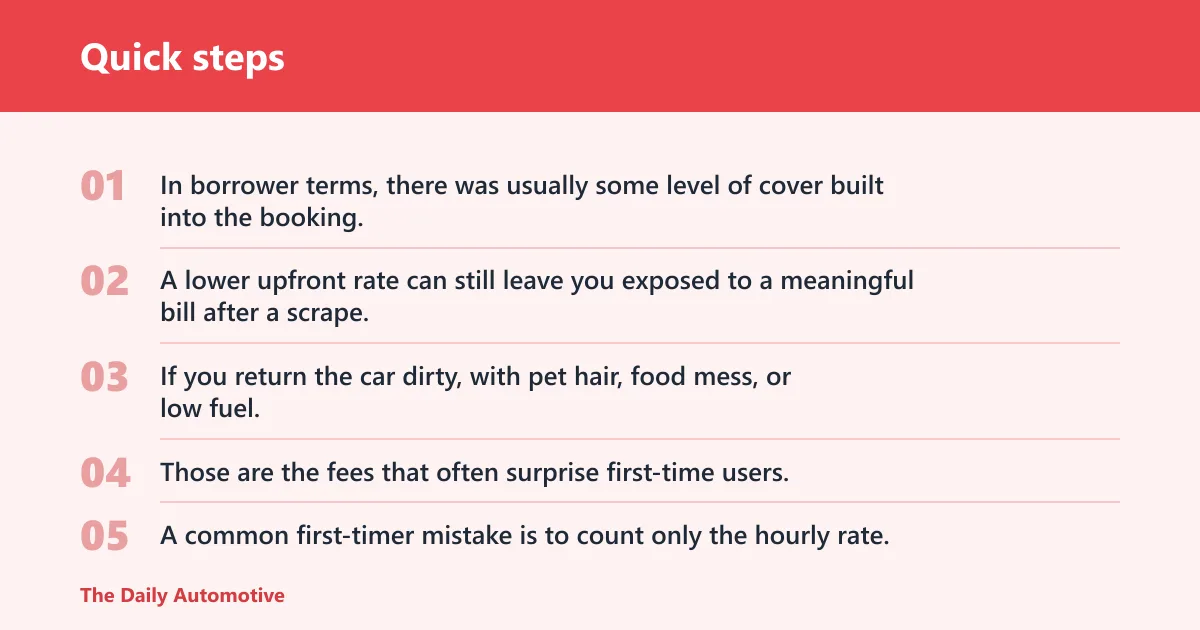
Does Uber Carshare include insurance? In borrower terms, there was usually some level of cover built into the booking, but the real question is the excess if something goes wrong. A lower upfront rate can still leave you exposed to a meaningful bill after a scrape, dent, or at-fault loss.
Cleaning charges and fuel top-ups
If you return the car dirty, with pet hair, food mess, or low fuel, the booking can pick up cleaning or refuelling costs. Those are the fees that often surprise first-time users, especially on short bookings where the base hire looked cheap.
A common first-timer mistake is to count only the hourly rate. A 90-minute hardware-store run can become a bad deal if the vehicle returns late and needs a wash. The car did not get more expensive because of distance alone; the extra cost came from the return conditions.
Tolls, admin fees, and late-return risk
Tolls and toll administration fees can add to the bill after the trip is over. Late returns are also costly because they can affect the next booking and trigger penalties or extra hourly charges. If your schedule is tight, the risk is not theoretical.
That is why the model above includes late-return risk as a line item. It is not always charged, but it is real enough to belong in the decision.
Is Uber Carshare cheaper than renting a car?
Sometimes. Hourly hire can beat a standard rental on short, local trips because you avoid a full-day minimum, but daily hire often loses once the trip gets longer or less predictable. A rental desk can be cheaper for a weekend, especially if it bundles insurance, unlimited kilometres, and a clearer return window.
Hourly hire versus a standard rental
For a 2-hour errand, hourly car share usually has the edge over a traditional rental because the rental minimum is too high for a short outing. Even so, two rideshare trips can still undercut it if you do not need to carry bulky items or stop multiple times.
Daily hire versus a standard rental
For a full day, the gap narrows. Once you add fuel, cleaning, excess, and possible late-return risk, the total can land close to or above a standard rental. If the rental price includes generous kilometres and a straightforward return process, it often wins on certainty.
Why headline rates are misleading
Headline rates hide the extras that matter most. A low hourly price is only useful if you know the mileage charge, the fuel policy, the cleaning terms, and the excess. Without those, you are comparing slogans, not transport costs.
Who was Uber Carshare best for?
Uber Carshare was best for borrowers who needed a car for a short, scheduled task and had nearby supply. It fit errands, small moves, and local day trips better than one-way travel, airport transfers, or bookings made at the last minute.
Errands and short scheduled use
For a supermarket run, clinic visit, or a quick appliance pickup, the model can work well because the car stays in use for a narrow window. The key is timing. If you know when you need it and when you will return it, the risk stays contained.
Moving a few items or making a day trip
Suppose you need a hatchback for a furniture pickup across town. Car share can beat a rideshare with a roof rack you do not have, and it can beat a full rental if you only need the car for a few hours. If the job spills into the evening, the economics change.
Borrowers with flexible timing and nearby supply
Flexibility is a major advantage. If you can shift pickup time by an hour or choose a different suburb, you are more likely to find a suitable car at a better price. If you cannot, peer-to-peer supply becomes the weak point.
How does Uber Carshare work?
Borrowers searched for a nearby car, booked it for an hour or day, picked it up, drove it, and returned it on time and in the condition required. Owners listed the vehicle, set availability, and earned money when someone booked it. The system worked best when both sides followed the timing rules closely.
- Check current local availability before you plan around the service.
- Estimate the full trip distance, not just the drive time.
- Add fuel, tolls, excess, cleaning, and late-return risk to the booking price.
- Compare that total with a rental and with the rideshare alternative.
- Choose car share only if the total stays competitive and the timing is flexible.
Is Uber Carshare available in North America?
Uber said it planned to launch Uber Carshare in North America by mid-2023, but that announcement is historical, not a current booking signal. For a current reader, the useful question is whether the service exists in your city now. If it does not, the better decision is to compare local rental and rideshare options instead.
Frequently asked questions
How much does Uber Carshare cost per hour or day?
There was no single universal price because location, demand, vehicle type, and timing all changed the total. For decision making, a short booking could be economical, but a full-day booking needed a much closer look at fuel, excess, cleaning, and return timing before it beat a standard rental.
What fees does Uber Carshare charge besides the rental price?
Common extras include fuel or distance charges, insurance excess exposure, cleaning fees, tolls, toll administration, and late-return penalties or extra time charges. Those items are why a low headline rate can turn into a much higher all-in bill after the trip ends.
What happens if you return an Uber Carshare late?
A late return can trigger extra charges and can create problems for the next booking, especially if another borrower is waiting. The real cost is not only the fee; it is also the schedule risk. If your itinerary is tight, build in a buffer.
Does Uber Carshare include insurance?
Borrowers generally had cover built into the booking, but the excess mattered more than the broad promise of protection. Before booking any car-share product, you should check the excess amount, what damage is excluded, and whether a lower excess option is available for the trip.
What are the pros and cons of Uber Carshare?
The main pros were convenience, nearby access, and short-term use without owning a car. The main cons were variable availability, added fees, and the risk that a short booking becomes expensive once fuel, excess, cleaning, and late return exposure are included.
Who is Uber Carshare best for?
It was best for people with flexible timing, nearby supply, and a short local use case. If you need a car for a few hours, can plan ahead, and are not chasing a last-minute airport or one-way trip, the model made more sense than many alternatives.
Products related to this article
Sponsored / affiliate links. As an Amazon Associate I earn from qualifying purchases. I may earn additional commission from eligible campaigns.