Masonic Emblems for Cars: Which Mount Fits Best?
Choose a Masonic car emblem by matching the mount to your vehicle: adhesive for flat paint or glass, stud-mounted for grilles, and magnetic only on steel panels. Then pick a finish that stays visible in sun, rain, and wash cycles. The wrong format can peel, scratch, rattle, or fall off, wasting money and risking damage. This guide compares mounting methods, visibility, and durability so you can buy the right emblem or grille ornament.
Bottom line on Masonic car emblems


The safest buy is the format that fits the surface first. For front-end display, a grille ornament makes the most sense; for a painted panel or glass, an adhesive emblem or decal is simpler; for a non-contact display, a custom vanity plate avoids any bond to the vehicle. Outdoor use pushes the choice toward metal over plastic, and toward mounts that fit the surface without stress.
A Masonic car emblem is usually the square and compass symbol used on a vehicle as a grille ornament, decal, or auto emblem. It is a display item, not a functional auto part. That matters because fit, mounting method, and finish matter more than style claims alone.
Best format by vehicle surface
Front grilles usually suit a stud-mounted ornament or emblem because the opening gives the piece a secure place to sit. Painted panels work better with adhesive-backed emblems when the surface is flat and clean. Glass can take an adhesive emblem or decal, while a vanity plate avoids contact with paint, chrome, or trim.
Most durable option for daily outdoor use
For regular weather exposure, a metal grille ornament or metal auto emblem generally makes more sense than a flat decal. Metal handles sun, rain, and wash cycles better when the finish is sound and the mount is right. Rust and corrosion resistance matter here, especially for parts exposed at the front of the vehicle.
When to choose discreet versus high-visibility display
If you want a subtle nod to membership, a small decal on a glass area or a low-profile emblem on a painted panel keeps the look restrained. If you want the symbol to read clearly from a distance, a grille ornament or vanity plate gives more visibility. Daily drivers often do better with the quieter option.
Who it’s for
This suits Masons who want a visible but practical display, gift buyers choosing for a fellow Mason, and buyers who want a custom lodge touch without guessing at fit. It is less suitable for anyone who wants a universal, no-thought accessory. The wrong mount can create more trouble than value.
Daily drivers
Daily drivers need the most attention to installation, weather exposure, and surface type. A clean, dry mounting surface matters more on a car that sees rain, sun, and washes every week.
Gift buyers for fellow Masons
Gift buyers should favor formats with broad fit and simple mounting, such as a decal or an adhesive emblem, unless they know the recipient’s grille style. A safe gift is one that does not assume a specific vehicle surface.
Buyers wanting a custom lodge touch
If you want a lodge name or local identifier, check whether the seller offers customization before you buy. Bricks Masons says most products in its store are customizable, which makes custom text more realistic than on a fixed stock emblem.
Pros and cons
Pros of grille ornaments and metal emblems
- Better visibility from the front of the vehicle.
- More suitable for exterior weather exposure than a flat sticker.
- Metal options can bring better corrosion resistance than plastic.
- Stud-mounted or bolt-on formats can feel more secure on the right grille.
Cons of decals and permanent adhesive mounts
- Surface prep matters a lot, and poor prep can cause peeling.
- Adhesive formats can be harder to remove cleanly later.
- Flat decals can fade faster than metal when parked outdoors often.
- Wrong placement on paint, trim, or glass can look unbalanced or weak.
Which emblem format fits your vehicle?
Match the format to the mounting surface before you think about finish or color. A grille ornament works best on the front end, an adhesive emblem fits flat painted or glass areas, a decal works when you want the lowest profile, and a vanity plate fits buyers who want display without attaching anything to the body.
Grille ornament for front-end display
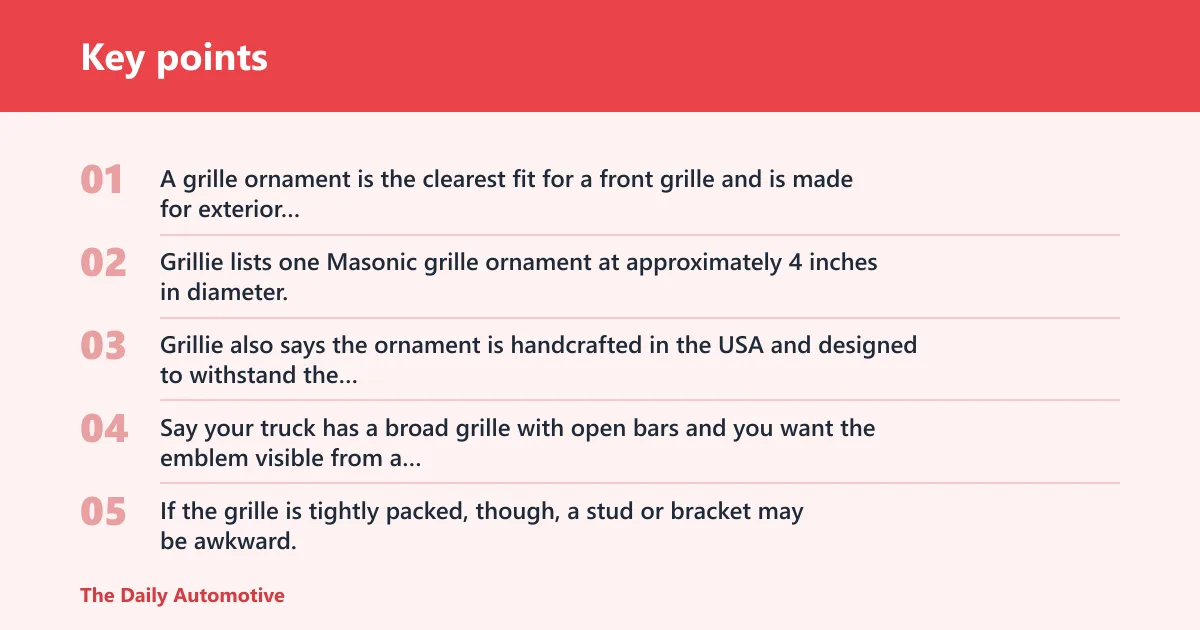
A grille ornament is the clearest fit for a front grille and is made for exterior weather exposure. Grillie lists one Masonic grille ornament at approximately 4 inches in diameter, which is a useful size reference for a front-end piece that should read clearly without dominating the grille. Grillie also says the ornament is handcrafted in the USA and designed to withstand the elements.
Say your truck has a broad grille with open bars and you want the emblem visible from a distance. A grille ornament is the cleanest solution. If the grille is tightly packed, though, a stud or bracket may be awkward, and an adhesive emblem may be the safer choice.
Adhesive emblem for painted panels or glass
An auto emblem with double faced adhesive backing works best on a clean, dry surface. Fratline says its emblems use adhesive backing and recommends applying them above about 60 degrees. It also describes the bond as permanent, so placement needs to be deliberate. This format is best for flat painted panels, smooth trim, or glass.
Use adhesive when you want a firmer look than a decal but do not want holes or hardware. The tradeoff is permanence. Poor prep, cold weather, dust, wax, or moisture can make the bond fail early.
Decal for flat, low-profile use
An auto decal is the simplest low-profile option. Bricks Masons offers Masonic car emblems and decals as a dedicated category, which shows how often buyers want both the raised and flat versions. A decal suits glass or painted surfaces when you want the symbol present without a raised badge.
This is the least obtrusive format. It is also the easiest to underbuy if you actually want front-end visibility. Decals can peel or fade sooner than metal if they face heavy sun and wash cycles.
Vanity plate for a non-contact option
A custom vanity plate is the cleanest choice when you want no adhesive, no studs, and no pressure on paint or grille. Fratline includes auto vanity plates among its fraternal vehicle accessories, which makes it a sensible option for buyers who want to keep the vehicle surface untouched.
Use this when the car is leased, newly detailed, or made of mixed materials that make mounting awkward. It delivers visibility with almost no installation risk.
Car emblem comparison table
| Format | Best vehicle surface | Mount type | Install difficulty | Durability risk | Typical use case | Common failure mode |
|---|---|---|---|---|---|---|
| Grille ornament | Front grille or grille opening | Stud-mounted or bracketed | Moderate | Low if hardware fits; higher if exposed to constant road spray | High-visibility front display | Rattle, loosened fastener, finish wear |
| Adhesive emblem | Flat painted panel or glass | Double faced adhesive backing | Easy to moderate | Moderate; depends on prep and heat | Clean, raised badge without drilling | Peeling, edge lift, residue after removal |
| Decal | Glass or smooth painted panel | Adhesive-backed flat graphic | Easy | Moderate to high fading risk in sun | Low-profile symbol on daily driver | Fading, curling, trapped bubbles |
| Custom vanity plate | Front or rear plate mount | Screw-on plate frame or holder | Easy | Low to moderate; depends on plate finish | Non-contact display with no emblem mounting | Fastener corrosion, plate bending, loss of visibility if blocked |
What materials last outdoors?
For outdoor use, metal usually beats plastic. The same source lists auto emblems in die-struck aluminum, brass, and cast zinc, and also says similar emblems are available in chrome metal, plastic, brass, aluminum, or cast zinc. The best choice depends on where the emblem sits and how much weather it faces.
Chrome metal, brass, aluminum, and cast zinc
Chrome metal gives a bright finish that stands out on front-end display. Brass brings a traditional look. Aluminum is a practical pick for weight and corrosion resistance. Cast zinc suits a more substantial badge feel and can work well when the emblem must hold shape over time.
Plastic versus metal tradeoffs
Plastic usually costs less and can work for protected display on a sheltered surface, but it is more likely to fade, dull, or crack outdoors. Metal costs more, but it tends to hold up better against heat, road film, and repeated washing. For a daily driver, metal usually gives better value.
Rust and corrosion resistance
Rust and corrosion resistance matter most where water, salt, and road grime collect. A grille ornament sees more exposure than a decal on an inside window. If the vehicle lives outdoors or sees winter roads, choose a material and finish that can handle that exposure.
Colored finish and fade resistance
Colored designs need special attention. The same source says colored designs are warranted for one year against fading and separation. That is useful because fading is one of the first problems buyers notice on a daily driver. A bright finish that loses color quickly is poor value, even if the shape remains intact.
How do you install it safely?
Safe installation starts with the surface, not the emblem. Adhesive mounts need a clean, dry area; bolt-on or stud-mounted pieces need the correct openings and hardware; decals need careful alignment and pressure. The wrong prep can lead to peeling, scratching, or loose hardware that rattles and marks the vehicle.
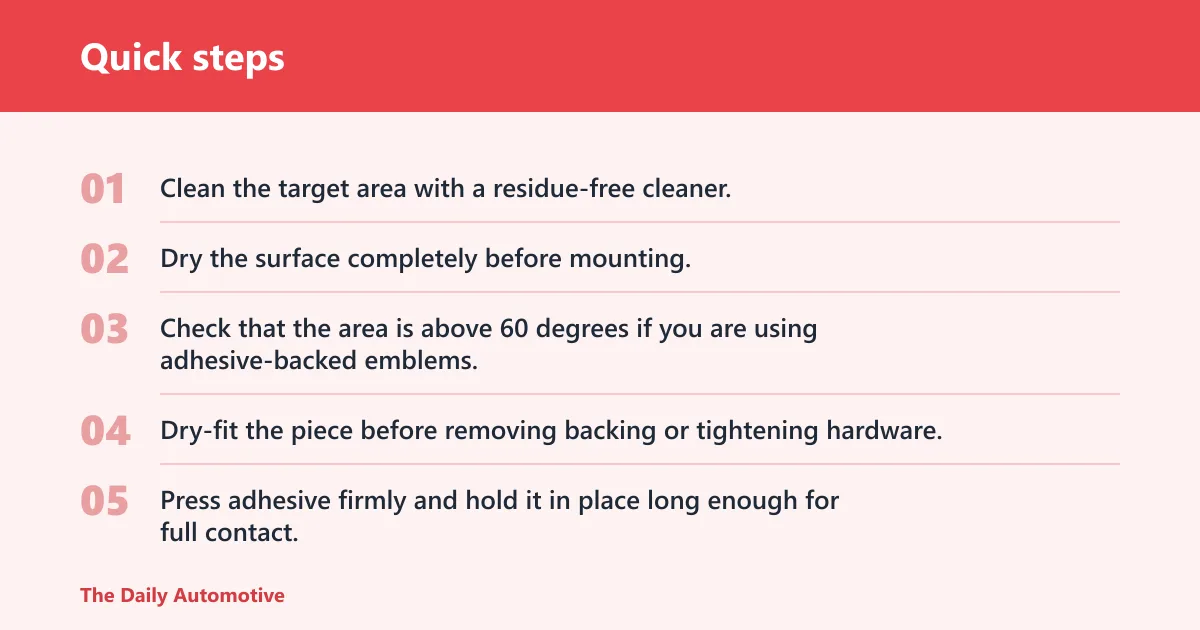
- Clean the target area with a residue-free cleaner.
- Dry the surface completely before mounting.
- Check that the area is above 60 degrees if you are using adhesive-backed emblems.
- Dry-fit the piece before removing backing or tightening hardware.
- Press adhesive firmly and hold it in place long enough for full contact.
- For bolt-on pieces, tighten only enough to secure the emblem without distorting the grille or panel.
Clean, dry surface prep
The same source recommends applying emblems to a clean, dry surface above 60 degrees. That advice matters because dust, wax, water, and cold all work against adhesion. On painted panels, the most common mistake is mounting over residue and then blaming the emblem when it lifts.
Temperature and adhesion
Cold surfaces slow down bond formation. Heat can soften old adhesive or make a decal easier to distort during placement. A mild installation day is safer than trying to mount an emblem in a cold driveway before work.
Bolt-on versus double faced adhesive backing
Bolt-on or stud-mounted emblems are more secure when the grille can accept hardware, but they can be slower to fit and may stress thin trim if the hardware is wrong. Double faced adhesive backing is faster and cleaner, yet it is described as permanent and depends on exact surface prep. Choose permanence only when the placement is final.
Common failure cases
Peeling usually points to poor prep or a surface that flexes too much. Fading points to sun exposure and a finish that is not suited to long outdoor use. Corrosion can appear on low-grade hardware or on metal pieces that spend a lot of time in salt spray. A common first-timer mistake is using an adhesive emblem on a curved, waxed panel and expecting it to behave like a rigid badge.
Picture a sedan with a smooth trunk lid and a small square-and-compass decal. If the lid is clean and warm, the decal can sit flush and stay low-profile. Move the same decal to a textured plastic bumper, and the edges are far more likely to lift.
Frequently asked questions
What is a Masonic car emblem called?
Most buyers call it a Masonic car emblem, Masonic auto emblem, decal, or grille ornament, depending on how it mounts. The square and compass is the core symbol, and on cars it usually appears as a front grille ornament, an adhesive emblem, or a flat decal.
Are Masonic car emblems legal to display on a vehicle?
In general, decorative emblems are legal to display if they do not block required lights, plates, or visibility and do not violate local equipment rules. The practical check is simple: keep the symbol away from headlights, the plate number, and the driver’s line of sight.
What size should a Masonic grille emblem be?
For a grille ornament, size should match the grille opening and the vehicle’s front-end proportions. One Grillie Masonic grille ornament is approximately 4 inches in diameter, which is a useful reference point for many passenger vehicles. Larger trucks may take more size, but the emblem should not overwhelm the grille.
How do you install a Masonic car emblem or decal?
Clean and dry the target area first, then match the mount to the surface. The same source says its emblems use double faced adhesive backing and recommends a clean, dry surface above 60 degrees. For decals, align carefully and press from the center outward to reduce bubbles.
What materials are best for a Masonic auto emblem?
For outdoor use, aluminum, brass, and cast zinc are strong choices because they hold shape and withstand weather better than basic plastic. Chrome metal also gives a bright look. If the emblem will live outside, material quality matters more than a low entry price.
Will a Masonic emblem damage my car’s paint or grille?
It can, if the wrong mount or poor prep is used. Adhesive may pull finish on removal, especially on repainted surfaces. Studs or bolts can scratch or distort thin grille pieces if they are tightened badly. The safer path is to match the mount to the surface and follow the fit instructions exactly.
Can I customize a Masonic car emblem with my lodge name?
Sometimes, yes. The same source says most products in its store are customizable, which suggests personalized lodge text may be available in that catalog. If you want a lodge name, confirm the layout before ordering so the emblem remains readable at a car-appropriate size.
How much do Masonic car emblems cost?
Pricing varies by material, finish, and mounting method. In general, decals are the least expensive, adhesive emblems sit in the middle, and metal grille ornaments or custom pieces cost more. The best value is usually the piece that matches the surface the first time, because replacing a failed mount costs more than buying the right format.
Which Masonic car emblem is best for outdoor durability?
For outdoor durability, a metal grille ornament or metal auto emblem is the strongest choice, especially in aluminum, brass, or cast zinc. The same source says its ornament is designed to withstand the elements, and it also offers a 30-day money-back guarantee, a lifetime warranty against defects in materials and craftsmanship, and one year of coverage for colored designs against fading and separation.
Products related to this article
Sponsored / affiliate links. As an Amazon Associate I earn from qualifying purchases. I may earn additional commission from eligible campaigns.