Meguiar’s Carpet & Upholstery Cleaner Review: Best Use Cases
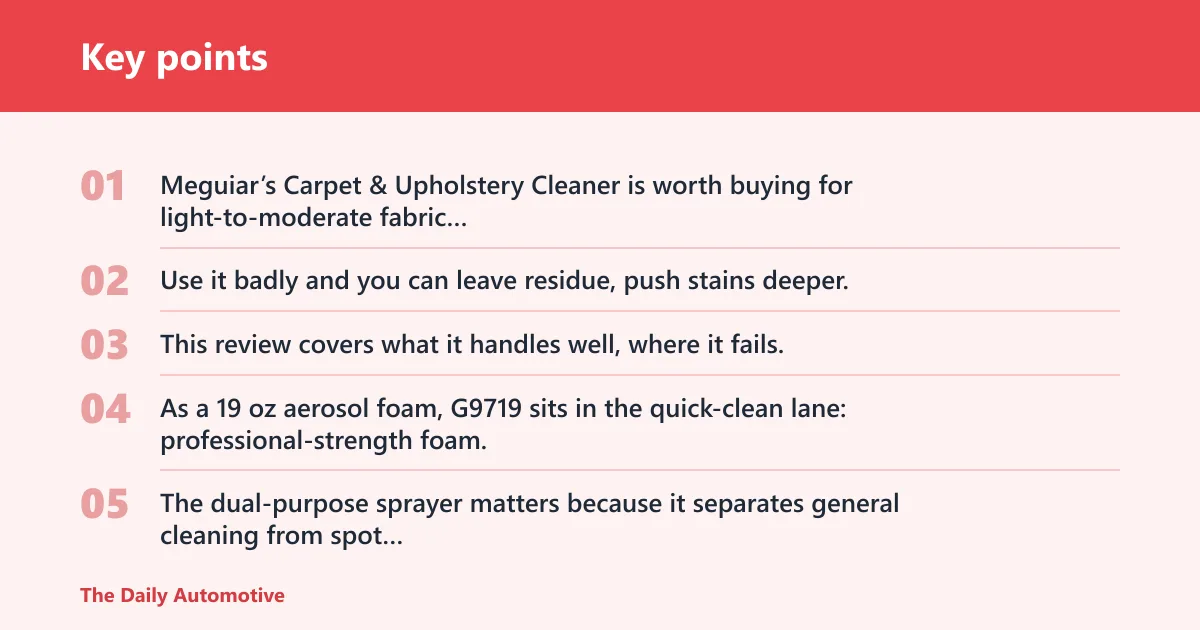
Meguiar’s Carpet & Upholstery Cleaner is worth buying for light-to-moderate fabric stains and spot-cleaning seats or carpet, but skip it for soaked-in spills, old set stains, or odor problems that need hot water extraction. Use it badly and you can leave residue, push stains deeper, or waste time on stains it cannot lift. This review covers what it handles well, where it fails, and when an extractor is the better buy.
Verdict

- Fast-acting foam dissolves stains from the bottom up
- Dries quickly without sticky residue
- Dual-purpose sprayer for spot or all-over cleaning


As a 19 oz aerosol foam, G9719 sits in the quick-clean lane: professional-strength foam, fast stain breakdown, quick-drying behavior, and a no-sticky-residue claim. The dual-purpose sprayer matters because it separates general cleaning from spot treatment. That fits fabric seats, carpet, and other interior textiles, but foam still will not pull grime out of padding or soaked foam.
📊 Meguiar’s Carpet & Upholstery Cleaner is sold as G9719 in a 19 oz aerosol. Source: Meguiars.
Specs at a glance
| Spec | Meguiar’s Carpet & Upholstery Cleaner |
|---|---|
| Model | G9719 |
| Format | 19 oz aerosol |
| Cleaning format | Professional-strength cleaning foam |
| Sprayer | Two modes for different jobs |
| Use modes | General cleaning and spot and stain removal |
| Claimed action | Penetrates and dissolves stains |
| Drying behavior | Quick-drying |
| Residue claim | No sticky residue |
| Positioning | Interior cleaner for carpets and upholstery |
Where it sits in Meguiar’s interior lineup
This cleaner belongs in Meguiar’s interior category, but it is not the same job as a full cabin cleaner. Gold Class Total Interior Cleanser comes across as the more general interior wipe-down product, while Foaming Floor Mat + Carpet Cleaner seems more focused on textile cleaning. G9719 sits on the more focused, professional side of that group.
That positioning matters. If you need one product for dashboards, screens, and trim, this is the wrong pick. If you need foam for seats, floor mats, and carpet spots, it fits better.
Who it is for
This is for DIY car owners who need a spray-on foam for fabric seats, carpet, and other stain-prone surfaces. It fits common messes such as food spills, general grime, and localized stains where a quick pass matters more than deep extraction.
It is not the right first buy for heavily soiled seats, odor-holding padding, or stains that have set for weeks. Delicate fabrics need caution too, especially Alcantara, suede, and leather-adjacent trim that can look clean on top but react badly to over-wetting or hard brushing.
Surface types to treat carefully
Fabric upholstery and carpet are the main targets. Anything more delicate needs a smaller test area and a lighter hand. On Alcantara, suede, or stitched trim near leather, foam and brush agitation can leave texture changes, darkening, or water marks if you oversaturate the area.
What works
Meguiar’s says the foam has deep cleaning power, fast stain removal, and a fresh finish on cleaned surfaces. In practical terms, that suits fresh food spills, dusty floor mats, and localized stains where the cleaner can sit briefly on the surface and then be worked with a brush.
The aerosol foam format helps because foam stays on target longer than a thin liquid. That dwell time gives you a better shot at lifting light contamination from fibers before you blot it away. For spot cleaning, that is the point.
How aerosol foam helps on car fabric
Foam delivery is useful because it spreads across the top of fibers instead of running immediately into the seat or carpet pad. That gives you control. The dual-purpose sprayer adds a second layer of control: one mode for general cleaning, another for spot and stain removal.
For a small 2-inch coffee drip on a seat edge or a tracked-in patch on a floor mat, that is often enough. The cleaner can be applied, agitated, and removed without turning the whole area into a wet project.
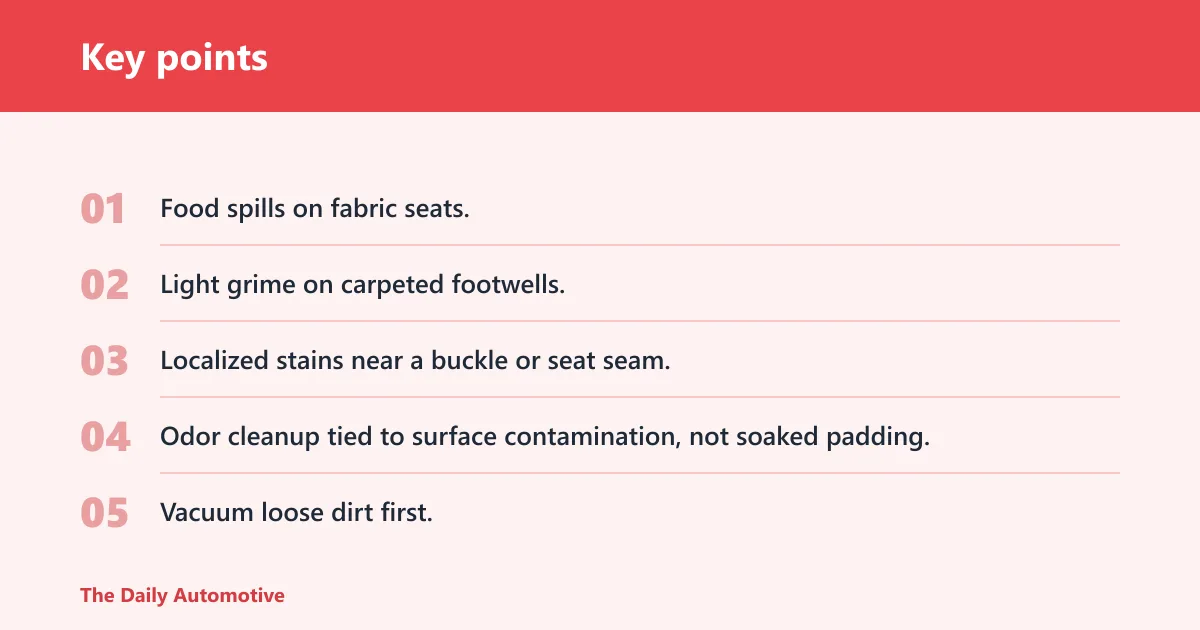
Common use cases where it makes sense
- Food spills on fabric seats.
- Light grime on carpeted footwells.
- Localized stains near a buckle or seat seam.
- Odor cleanup tied to surface contamination, not soaked padding.
Simple use guidance
- Vacuum loose dirt first.
- Use spot mode on a small stain or general mode for a larger section.
- Let the foam dwell briefly, then brush agitation helps break up the stain.
- Blot the area with a clean towel.
- Allow dry time before using the seat or mat again.
Say your kid drops ketchup on a cloth seat during a grocery run. A foam cleaner like this is a reasonable first step if you catch it early, because the stain is localized and still on the surface. Suppose that same seat has a dark ring that has been there for a month. Then the foam may only fade it, not remove it.
What does not
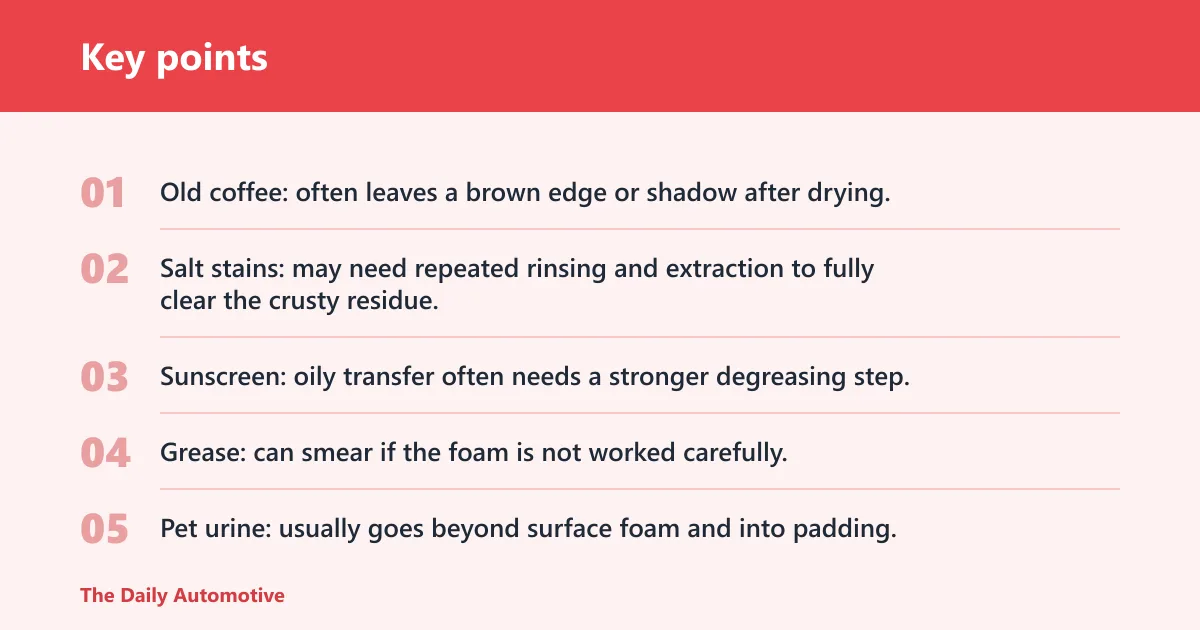
This is where the limits show. Old coffee, salt stains, sunscreen, grease, and pet urine often need more than a surface foam. If the contamination has soaked into padding or set into the fiber structure, aerosol foam may clean the top layer while leaving the deeper problem behind.
The same caution applies to odor. Meguiar’s says the cleaner removes stains and odors and leaves surfaces looking and smelling fresh, but odor removal from a seat is not the same as odor removal from saturated foam under the fabric. If the source is below the face fabric, the smell can return.
Known failure cases
- Old coffee: often leaves a brown edge or shadow after drying.
- Salt stains: may need repeated rinsing and extraction to fully clear the crusty residue.
- Sunscreen: oily transfer often needs a stronger degreasing step.
- Grease: can smear if the foam is not worked carefully.
- Pet urine: usually goes beyond surface foam and into padding.
That is the big failure mode: foam is good at access, not at volume. It reaches fibers, but it does not flood and pull contamination out the way a spray extractor can. For deep contamination, the tool choice matters more than the brand name.
Does it remove odors well?
It can help with odor cleanup when the smell comes from a small, recent stain on fabric. It is less convincing when the odor source sits in padding, foam backing, or carpet underlay. In those cases, the cleaner may mask the problem briefly and then lose the battle as the material dries.
How do you use Meguiar’s Carpet & Upholstery Cleaner on carpet stains?
Use the foam on a dry or lightly damp surface, choose the sprayer mode that matches the job, and agitate the stain before wiping it away. For fresh carpet spots, the key is controlled dwell time, light brushing, and blotting rather than soaking the area.
Meguiar’s calls the sprayer dual-purpose, which fits two cleaning styles: general cleaning over a broader patch and spot-and-stain removal on a smaller area. For carpet, that distinction matters because too much product can drive the soil downward instead of lifting it.
Spray mode versus stream mode
Use the broader cleaning mode for larger panels or general cleaning on floor mats. Use the more focused mode for a spot stain that needs precision. The goal is coverage without overspray, especially near stitched seams, seat belts, and trim edges.
Brush agitation and dwell time
Let the foam sit long enough to loosen the stain, then work it with a soft brush. Do not scrub hard enough to mat the fibers. A common first-timer mistake is flooding a stain, waiting too long, and then spreading the residue around with the brush.
Dry time and follow-up steps
Meguiar’s markets the product as quick-drying and without sticky residue. That is the right expectation for a foam spot cleaner, not a promise of instant dryness in thick carpet. After blotting, let the area dry fully before judging the result or deciding whether a second pass is needed.
Does Meguiar’s Carpet & Upholstery Cleaner leave residue or stickiness?
Meguiar’s says the cleaner is quick-drying and leaves no sticky residue, which is a useful claim for fabric and carpet spot work. Still, that should be read as a product-design goal, not a guarantee that overuse, heavy buildup, or poor blotting cannot leave the surface tacky.
Foam cleaners tend to work best when used sparingly. If you spray too much, let it sit too long, or fail to lift the spent product, any cleaner can leave a faint film. On seats and carpet, the safest approach is light application and thorough removal.
Will Meguiar’s Carpet & Upholstery Cleaner remove pet odors?
It can help with pet odors that come from a fresh surface stain, but it is not the right answer for urine that has soaked into padding or underlay. Foam can treat the visible area and reduce smell on top, yet deep contamination usually needs extraction or steam-based cleaning.
If the odor is localized and recent, foam may be enough after blotting and drying. If the smell returns when the seat warms up, that points to contamination below the fabric. At that point, a spray extractor or a steam cleaner is the better move.
Is Meguiar’s Carpet & Upholstery Cleaner good for car seats?
Yes, for fabric car seats it is a good fit when the stain is light to moderate and still near the surface. It is less suitable for deep, old, or oily contamination, and it should be used cautiously on delicate materials, suede-like surfaces, and leather-adjacent trim.
Fabric seats are the main sweet spot because foam can sit on the stain long enough to work without flooding the cushion. That is different from a soaked-in spill, where the stain may be inside the seat structure and the foam only reaches the top layer.
When a different interior cleaner is better
Choose a broader interior cleaner such as Gold Class Total Interior Cleanser when the job is dashboards, door panels, and mixed trim. Choose a carpet-specific product like this when the problem is on fabric. Choose an extractor when the soil is deep or the odor source is trapped below the surface.
Is Meguiar’s Carpet & Upholstery Cleaner safe on fabric upholstery?
It is meant for fabric upholstery, but safe use depends on the fabric type, the amount applied, and how much agitation you use. Standard cloth seats and carpet are the intended targets. Delicate textures, suede-like surfaces, and Alcantara deserve extra caution or a different cleaner.
Test a hidden area first. That is basic interior care. Some materials can darken, stiffen, or show water marks even if the stain itself improves.
How much does Meguiar’s Carpet & Upholstery Cleaner cost?
Meguiar’s Carpet & Upholstery Cleaner is listed at $19.52 in the product data here. That puts it above some in-house Meguiar’s interior cleaners, including Gold Class Total Interior Cleanser at $9.99 and Foaming Floor Mat + Carpet Cleaner at $9.99 on Meguiar’s Direct.
On value, the real question is coverage. A 19 oz aerosol is best thought of as a spot-treatment can, not a whole-interior restoration product. If you need repeated passes on multiple seats, the per-job cost rises quickly and an extractor may become the cheaper long-term option.
What’s the difference between Meguiar’s Carpet & Upholstery Cleaner and a spray extractor cleaner?
Meguiar’s foam cleaner is for spot treatment. A spray extractor cleaner uses liquid plus suction or recovery to pull soil and moisture back out of the fabric. That difference is why extractors are better for heavy soil, old stains, and smells trapped below the top layer.
Aerosol foam works when the stain is manageable and the goal is fast cleanup. An extractor is the better tool when you need rinse action and removal, not just surface breakdown. For heavily soiled seats, skip straight to extraction instead of spending time on repeated foam passes.
Stain severity decision table
| Stain severity | Is Meguiar’s foam a good fit? | What to do first | When to upgrade to an extractor or steam cleaner |
|---|---|---|---|
| Fresh spill | Yes | Blot first, then use spot mode and light brush agitation | Upgrade if the spill soaked into padding or leaves a ring after drying |
| Set-in stain | Sometimes | Vacuum, pre-treat, agitate, and assess after dry time | Upgrade if a second pass only lightens the stain or the mark returns |
| Odor-only issue | Limited | Confirm the smell is from the fabric surface, not underlay | Upgrade if the odor comes back after drying or worsens with heat |
| Deep contamination | No | Stop surface treatment and target extraction instead | Use an extractor or steam cleaner right away for soaked padding, pet urine, or heavy grime |
Alternatives
When the job is larger than a spot stain, the cleaner family around this product gives you a clearer path. The two alternatives below cover broader interior cleaning and heavier textile contamination.
Meguiar’s Gold Class Total Interior Cleanser
Meguiar’s Gold Class Total Interior Cleanser fits the general interior-cleaning lane better than carpet foam. Based on Meguiar’s lineup and positioning, it makes more sense for mixed interior surfaces than for a single stubborn stain. The drawback is obvious: it is not the dedicated foam spot cleaner you want for a carpet blotch.
Meguiar’s Foaming Floor Mat + Carpet Cleaner
Meguiar’s Foaming Floor Mat + Carpet Cleaner stays close to textile work and is listed at $9.99 through Meguiar’s Direct. It is the simpler sibling in the same general category, but that lower price and narrower setup can mean less emphasis on the more flexible spot-cleaning behavior of G9719.
BISSELL ProHeat 2X Revolution Pet Pro Plus Carpet Cleaner, 3588F
This is the move-up option when the seats or floor mats are beyond foam-cleaning range. It is a hot water extraction machine, so it addresses deep pet stains and odors far better than aerosol foam. The tradeoff is cost, storage space, and setup time, which makes it overkill for a single fresh spill.
What works well, and what does not
Pros
- Useful for light-to-moderate fabric stains.
- Dual-purpose sprayer gives you better control for spot work.
- Quick-drying claim suits interior spot cleaning.
- No sticky residue claim is a plus for fabric and carpet.
- Foam format helps keep product on the stain instead of running off it.
Cons
- Not a deep-clean fix for soaked padding or old stains.
- Weak choice for pet urine and other deep odor sources.
- Can be the wrong tool for delicate fabrics, Alcantara, or suede-like trim.
- Coverage is limited compared with an extractor or larger liquid spot cleaner.
- May need repeated passes on coffee, salt, grease, or sunscreen marks.
Should you buy it
Buy it if your main job is fabric seat spots, carpet stains, and fast cleanup of fresh messes. Skip it if you are trying to rescue a heavily soiled interior or eliminate odors embedded in padding. That is where an extractor or steam cleaner earns its keep.
For DIY car owners, the buying decision is simple: foam for surface stains, extraction for deep contamination. Meguiar’s G9719 is good at the first job and only a partial answer to the second.
Frequently asked questions
Can you use Meguiar’s Carpet & Upholstery Cleaner for spot cleaning?
Yes. Spot cleaning is one of the clearest use cases for this product. The foam format and dual-purpose sprayer make more sense on a fresh, localized stain than on a large, soaked area. Keep the application light, brush gently, and blot well before judging the result.
How do you use Meguiar’s Carpet & Upholstery Cleaner on carpet stains?
Vacuum first, spray the stain with the appropriate mode, let the foam dwell briefly, then agitate with a soft brush and blot away the residue. If the stain is set in or spreads after wetting, stop and consider extraction rather than repeating the same pass.
Does Meguiar’s Carpet & Upholstery Cleaner leave residue or stickiness?
Meguiar’s says the product dries quickly and leaves no sticky residue. That is the intended behavior, but heavy application or poor removal can still leave a film. Light use, good blotting, and enough dry time matter as much as the label claim.
Will Meguiar’s Carpet & Upholstery Cleaner remove pet odors?
It may help with fresh surface odors on fabric, especially when the stain itself is small. It is not a dependable fix for pet urine that has reached the padding or carpet underlay. If the smell comes back after drying, a spray extractor or steam cleaner is the better choice.
Is Meguiar’s Carpet & Upholstery Cleaner safe on fabric upholstery?
It is intended for fabric upholstery and carpet, but you should still test a hidden spot first. Delicate materials, Alcantara, suede, and leather-adjacent trim can react differently to foam, brushing, and moisture. Safer use depends on restraint, not just the product label.
How much does Meguiar’s Carpet & Upholstery Cleaner cost?
The product data here lists it at $19.52. That is reasonable for a dedicated 19 oz aerosol spot cleaner, but it is not a bargain if you need repeated treatments across a badly stained cabin. For broader cleaning, Meguiar’s lower-priced interior products or an extractor may make more sense.
What’s the difference between Meguiar’s Carpet & Upholstery Cleaner and a spray extractor cleaner?
Aerosol foam cleans by clinging to fibers and lifting visible soil. A spray extractor cleans by wetting, agitating, and pulling dirty liquid back out. For surface stains, foam is quicker and simpler. For deep soil, old stains, or embedded odor, extraction is the better tool.