Turtle Wax Hybrid Solutions Ceramic Spray Review
Turtle Wax Hybrid Solutions Ceramic Spray is a budget maintenance spray rather than a true ceramic coating; consider it if you want better beading after washes and are comfortable reapplying it about every 2 to 3 months. Ignore that, and you’ll expect coating-level durability from a topper that needs frequent renewal. This review explains what it actually does, where it beats wax, and when plain sealant is the better buy.
Verdict

That verdict fits the product’s place in Turtle Wax’s Hybrid Solutions line. It blends ceramic technology with synthetic wax polymers, costs around $15, and sprays on and wipes off with little effort. The tradeoff is simple: the shine is useful, the protection is shorter-lived than a true ceramic, and the water behavior is weaker than the ceramic branding suggests.
Pros and cons
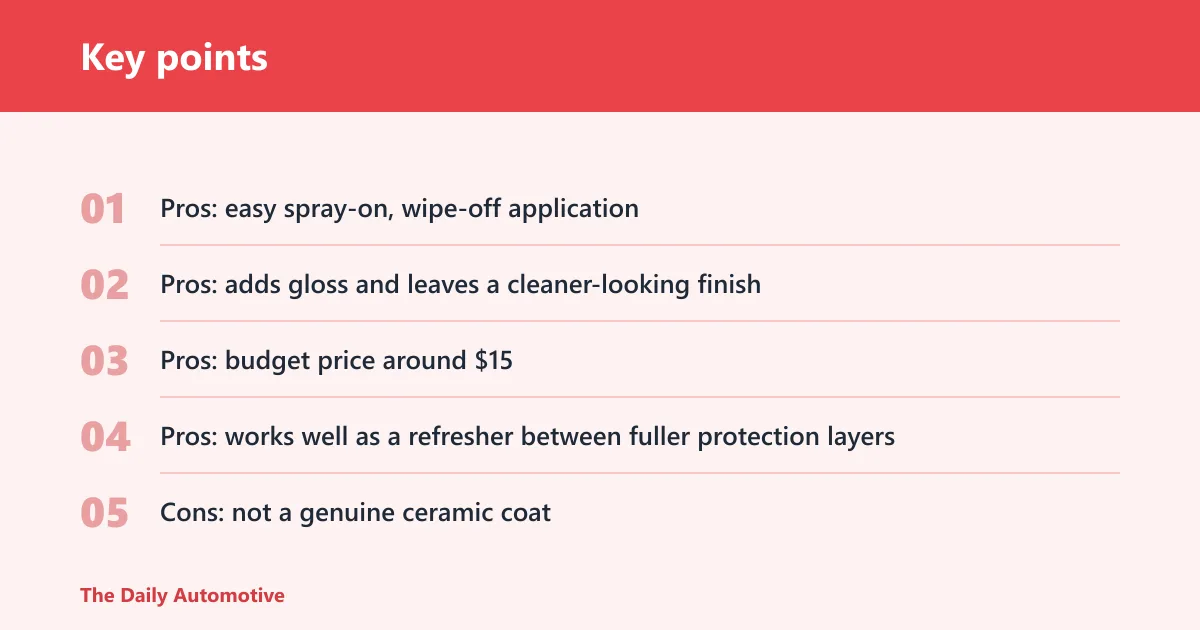
- Pros: easy spray-on, wipe-off application
- Pros: adds gloss and leaves a cleaner-looking finish
- Pros: budget price around $15
- Pros: works well as a refresher between fuller protection layers
- Cons: not a genuine ceramic coat
- Cons: hydrophobic performance is described as lackluster
- Cons: does not last very long
- Cons: synthetic wax polymers can behave more like a topper than a hard protector
Specs at a glance
| Item | What to know |
|---|---|
| Product type | Spray-on exterior protectant |
| Line | Turtle Wax Hybrid Solutions |
| Formula notes | Ceramic technology plus synthetic wax polymers |
| SiO2 | Present, but no percentage is disclosed |
| Price context | About $15 |
| Application | Spray on, wipe off |
| Claimed position | Popular budget product and Amazon #1 best seller in Car Waxes |
| Review take on longevity | 7/10 |
Turtle Wax says the Hybrid Solutions line sits within a broader family of four wax product lines, and Hybrid Solution Pro is the most expensive line. That matters because this spray is not meant to compete with a pro-grade coating. It sits much lower on the ladder: convenient, affordable, and short on staying power.
Who it
This spray makes sense for daily drivers with decent paint who want a fast gloss boost and some water behavior between fuller protection steps. It is also a good fit if you hate complicated application steps and want something that behaves more like a quick topper than a long-term coating.
It is not a fit for someone expecting a coated finish, long durability, or heavy-duty dirt resistance. If the paint is already neglected, swirled, or covered in bonded contamination, a spray like this will not hide that for long.
Picture a sedan that lives outside and gets washed every couple of weeks. A quick spray detailer-style topper can make the finish look cleaner after each wash, but it will not replace correction or a stronger protection layer.
Suppose a hatchback spends most nights in a garage and is already in good shape. In that case, this kind of product can be a practical maintenance step because the paint does not need deep correction every time, only a clean, glossy refresh.
Is it a real ceramic coating?
No. Turtle Wax Hybrid Solutions Ceramic Spray is marketed as a ceramic technology product, but the reviewer says it is not a genuine ceramic coat. Think of it as a ceramic-leaning maintenance spray with wax-like behavior, not a bonded coating system that can stand in for true ceramic protection.
A key clue is the formula. It contains SiO2, or silicon dioxide, plus synthetic wax polymers, but the bottle does not disclose an SiO2 percentage. That usually means you should judge it as a hybrid topper, not as a hard ceramic layer with coating-level durability.
Where the wax-like behavior shows up
The synthetic wax polymers help explain why the product feels closer to a spray wax than a true coating. That helps the application feel simple and the gloss look good, but it also brings the limits you expect from wax-leaning products: shorter life and less confidence that the finish will hold up for long.
That is why the safest way to read the ceramic claim is “ceramic-style maintenance aid,” not “replacement for a ceramic system.”
What works
The strongest part of this Turtle Wax spray is convenience. It sprays on quickly, wipes off easily, and does not ask much from the user. For DIY owners who want a fast step after washing, that matters more than lab-grade claims.
Gloss is the other clear win. The finish looks cleaner and slicker, which can improve the overall appearance of well-kept paint. In the right setting, that visual upgrade is enough reason to keep a bottle on the shelf.
That makes it most useful as a refresher between full wax applications. It can add a temporary boost after a wash, then get renewed when the car gets its next proper protection step.
Easy use in one pass
There is not much ceremony here: apply a light mist, spread it, and wipe it off. That simple routine is the main reason it ends up in so many shopping carts, and why Turtle Wax can sell it as a popular everyday product.
For owners who want a fast maintenance step after a rinse, that low-effort routine is the point.
What does not?
The weakness is durability. The reviewer says it does not last very long, gives longevity a 7/10, and describes the hydrophobic properties as lackluster. That combination means you should not expect coating-level water behavior or long protection between washes.
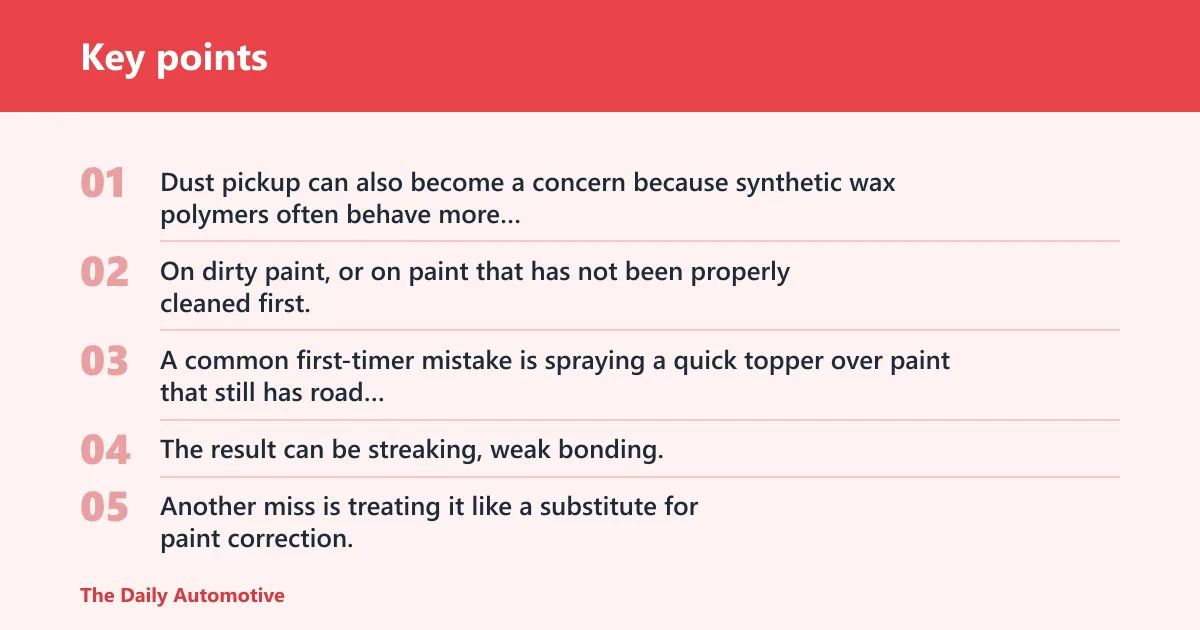
Dust pickup can also become a concern because synthetic wax polymers often behave more like a wax topper than a hard shell. On dirty paint, or on paint that has not been properly cleaned first, the product can disappoint by sitting on top of defects instead of correcting or hiding them.
Failure cases to watch
A common first-timer mistake is spraying a quick topper over paint that still has road film or bonded grime. The result can be streaking, weak bonding, or a finish that looks good for a day and then fades back quickly.
Another miss is treating it like a substitute for paint correction. If the paint is rough, dull, or contaminated, this spray will not fix the surface. It can only temporarily improve the look of the finish that is already there.
Ceramic spray decision table
| Paint condition | Storage type | Expected durability needs | Ease-of-use priority | Recommended verdict |
|---|---|---|---|---|
| Clean, well-kept paint | Garage-kept | Short-to-medium upkeep | High | Buy |
| Decent paint, light defects | Street-parked | Frequent refreshes acceptable | High | Buy |
| Rough, contaminated, or swirled paint | Either | Long-lasting protection expected | Medium | Skip |
| Recently corrected paint | Garage-kept | Maintenance between stronger layers | High | Buy |
| Daily driver, washed often | Street-parked | Coating-level durability expected | Low | Skip |
This table matters because the product is good at one job and weak at another. If you want a simple maintenance spray for decent paint, it is a buy. If you want long-term protection from a spray bottle, skip it and move up a level.
How does it compare with wax?
Compared with traditional wax, Turtle Wax Hybrid Solutions Ceramic Spray is easier to apply and usually looks a bit slicker right after use. It also fits the same broad job: a temporary protective layer that helps keep the car looking cleaner between full details. The difference is that the ceramic-style branding raises durability expectations that the product does not fully meet.
Compared with a true ceramic coating, it falls short on staying power, water behavior, and long-term protection. Compared with other Turtle Wax Hybrid Solutions products, it sits in the value end of the lineup, not the premium end. Hybrid Solution Pro is the most expensive line, while this spray stays in the affordable, easy-use lane.
Where wax still wins
Traditional wax can still make sense if your goal is simple gloss with familiar behavior and you do not care about ceramic branding. In that case, you are choosing based on feel and budget, not on the promise of ceramic-style ingredients.
If the car is already protected by a better layer, this Turtle Wax spray is more useful as maintenance than as the main defense.
What are the pros and cons of turtle wax hybrid solutions ceramic spray?
Its pros are easy to state: it is budget-friendly, simple to apply, adds gloss, and can act as a refresher between stronger protection layers. Its cons are just as clear: it is not a genuine ceramic coating, the SiO2 amount is undisclosed, and the longevity and beading do not reach true coating standards.
That balance makes it a solid maintenance buy, not a final answer for protection.
Cost and value
At around $15, the value case is not hard to understand. You are paying for convenience and a visual boost, not for a permanent layer. For many DIY owners, that is enough.
If the goal is maximum durability per application, the better spend is a product with a stronger protection system, even if it costs more up front.
Alternatives

Chemical Guys HydroSlick sits much higher on the price ladder at $39.99 and leans harder into ceramic-style gloss and hydrophobic behavior. Based on the product details, it is the better pick if you want a more expensive hyperwax with stronger water-beading claims, but it asks for more money and still lives in the sprayable maintenance category rather than the professional coating category.

Gtechniq Crystal Serum Light is the serious option here. At $74.65, it is a professional ceramic coating that bonds to paint, which puts it in a different class from Turtle Wax’s spray. The drawback is obvious: higher cost, more commitment, and a product that is aimed at buyers ready for true coating behavior rather than quick upkeep.
The Turtle Wax spray itself remains the value choice if you want a cheap, easy-to-use maintenance layer with decent gloss. It loses to the other two on long-term protection, but it wins on simplicity and cost, which is the point for a lot of DIY owners.
Should you buy it?
Buy it if you want a budget-friendly Turtle Wax maintenance spray that is easy to use, adds gloss, and can sit between wash cycles and fuller protection layers. Skip it if your main goal is strong hydrophobic performance, long durability, or anything that behaves like a true ceramic coating.
It is best judged as a short-to-medium-term upkeep product. On that score, the reviewer’s overall strength rating of 8 makes sense: useful, convenient, and easy to recommend for the right owner, but not a substitute for proper ceramic protection.
Frequently asked questions
How long does Turtle Wax Hybrid Solutions Ceramic Spray last?
The reviewer says it does not last very long and gives longevity a 7/10, so it should be treated as a short-to-medium-term maintenance product. It is best used between fuller protection layers rather than as your main defense. For owners who reapply often, that limitation may be acceptable.
Is turtle wax hybrid solutions ceramic spray easy to apply?
Yes. The main appeal is the spray-on, wipe-off routine, which makes it one of the easier exterior protectants to use. That convenience is a major reason it sells well. The tradeoff is that easy application does not equal long-term performance, so the process is simple even if the protection is modest.
Does turtle wax hybrid solutions ceramic spray attract dust?
It can be a concern, especially because the formula includes synthetic wax polymers that behave more like a wax topper than a hard ceramic layer. The review does not claim extreme dust attraction, but it also does not present this as a dust-resistant finish. Clean paint and proper prep matter more than the spray alone.
What is the SiO2 content in turtle wax hybrid solutions ceramic spray?
The bottle does not disclose an SiO2 percentage. That is important, because the product is marketed with ceramic technology language, but the exact ceramic loading is not stated. Without a percentage, the safer read is that it contains some ceramic-style ingredient, not that it behaves like a measured ceramic system.
Is Turtle Wax Hybrid Solutions Ceramic Spray worth buying for maintenance?
Yes, if your goal is quick upkeep, added gloss, and a convenient refresh between stronger protection layers. It is a good value at around $15 for that job. It is not worth it if you want coating-level durability or strong hydrophobic behavior that can stand in for a proper ceramic product.
Products related to this article
Sponsored / affiliate links. As an Amazon Associate I earn from qualifying purchases. I may earn additional commission from eligible campaigns.