Windshield Washer Fluid Cost
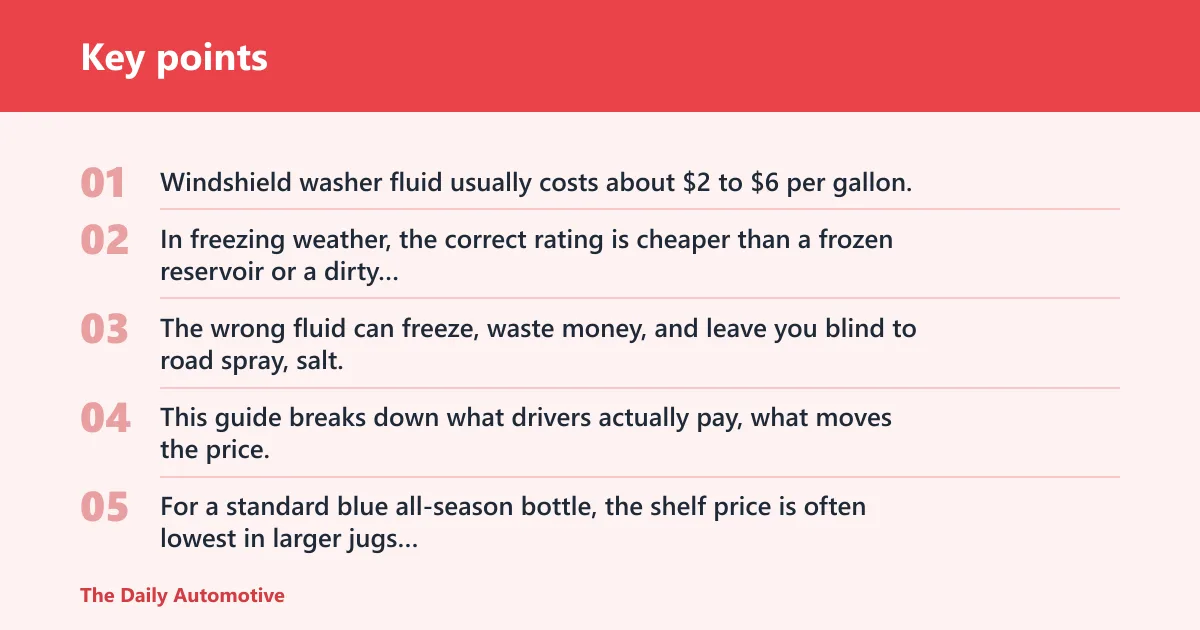
Windshield washer fluid usually costs about $2 to $6 per gallon, while winter formulas can run about $4 to $10. In freezing weather, the correct rating is cheaper than a frozen reservoir or a dirty windshield. The wrong fluid can freeze, waste money, and leave you blind to road spray, salt, and slush. This guide breaks down what drivers actually pay, what moves the price, and when the cheapest bottle becomes the pricier choice.
Typical retail prices and price factors


Typical retail price ranges
For a standard blue all-season bottle, the shelf price is often lowest in larger jugs and multipacks. A single one-gallon refill bottle commonly lands in the low single digits at mass-market stores or auto parts chains, while smaller ready-to-use bottles can cost more per ounce. Winter de-icer blends usually add a few dollars per gallon because of the freeze-protection spec.
Cost per quart matters more than the sticker on the jug. A $2 to $6 gallon works out to about $0.50 to $1.50 per quart. A $4 to $10 winter gallon works out to about $1.00 to $2.50 per quart. That math helps compare a big store jug with a roadside emergency bottle or a premium de-icer formula.
What pushes the price above the floor
Price climbs when you pay for a lower freeze point, a concentrated or specialty formula, a branded bottle, or convenience at the point of need. Labels that mention bug remover, de-icer, or subzero protection often cost more than plain washer fluid. The same fluid can also jump in price when it is sold in a small bottle or at a convenience stop.
Washer fluid price framework
Use the purchase scenario, not just the sticker, to judge value. A cheap bottle is only cheap if it fits the weather, fits the car, and lasts long enough to avoid repeated top-offs. The bands below are practical shopping ranges, not promises from one store.
| Purchase scenario | Expected cost band | Best fit | What to verify before buying |
|---|---|---|---|
| Single bottle refill | $2 to $6 per gallon | Routine top-off in mild weather | Container size, ready-to-use vs concentrate, vehicle washer-system compatibility |
| Winter de-icer upgrade | $4 to $10 per gallon | Cold climates and freeze risk | Freeze rating, temperature spec, methanol or ethanol blend, label direction for pre-mix or straight use |
| Bulk or club-pack buy | Lower per quart than single bottles, often around $6 to $16 for multi-bottle packs depending on size and brand | Drivers who refill often or keep a spare | Total ounces, per-quart math, storage space, seasonal need |
| Emergency roadside purchase | About $8 to $15 for a small bottle, sometimes more near highways | When you need fluid now | Smaller size, overpay risk, whether the bottle is winter-rated |
That table is the shortest route to smart buying. If you only need a top-off in warm weather, a basic gallon usually wins. If the forecast includes freezing rain or slush, the winter band is often the better value because a frozen system costs far more than the price gap.
What makes winter washer fluid cost more?
Winter washer fluid costs more because it is built to stay usable in lower temperatures. You are paying for freeze protection, often a different alcohol blend, and a rating that matters when road spray turns to slush. In cold weather, that extra spend buys visibility when plain fluid can turn into a block of ice.
Freeze protection and temperature rating
Winter fluid is sold around a freeze-point claim, and that number is the spec to read first. A lower temperature rating generally means a more expensive formula, especially if the blend is designed for severe cold. The useful question is not whether it is “winter” fluid, but how low it is rated for your climate.
Standard formula vs seasonal formula
Standard fluid is enough in mild temperatures and usually costs less. Seasonal fluid adds cold-weather protection and can include de-icing ingredients. The right choice depends on where the car is parked overnight and how often the washer system will be used in subfreezing weather.
Methanol-based blends and ethanol-based blends can price differently because the chemical package is different, and higher freeze protection often raises cost. The label matters more than the brand name. If the bottle does not state a freeze rating that fits your area, it is the wrong bargain.
What kind of windshield washer fluid do you need?
You need a fluid that matches the climate, the reservoir use pattern, and the vehicle’s washer-system needs. For warm or mixed weather, a standard all-season fluid is usually enough. For freezing nights, snow, or salted roads, a winter formula with the right temperature rating is the better buy.
Match the climate to the freeze point
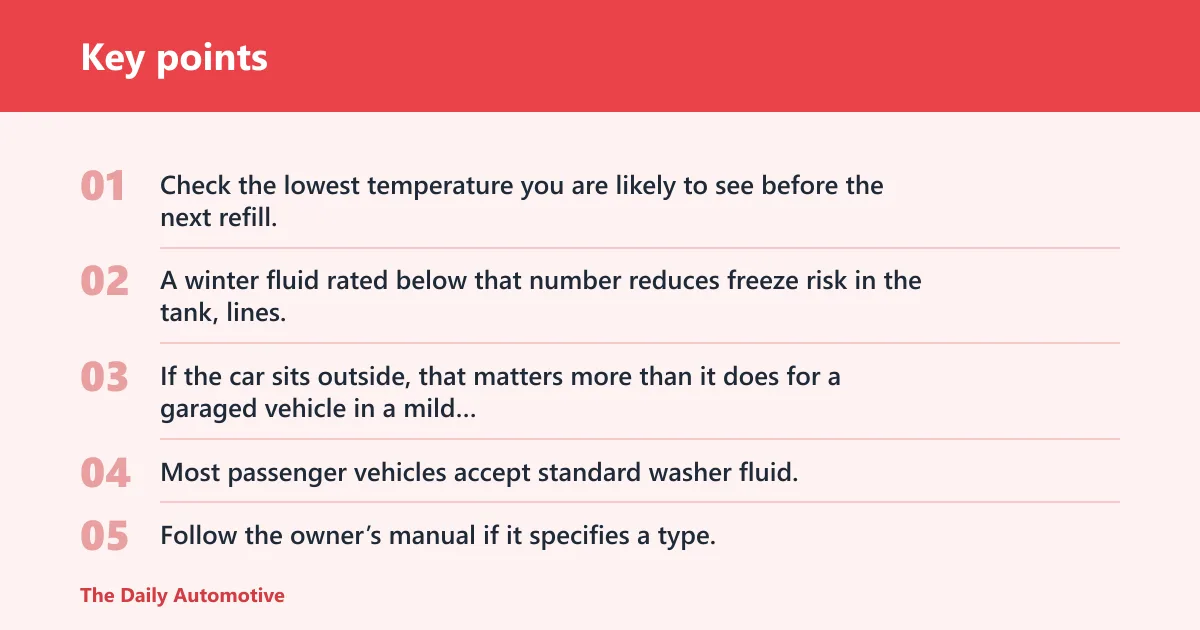
Check the lowest temperature you are likely to see before the next refill. A winter fluid rated below that number reduces freeze risk in the tank, lines, and nozzles. If the car sits outside, that matters more than it does for a garaged vehicle in a mild area.
Check vehicle washer-system compatibility
Most passenger vehicles accept standard washer fluid, but some systems are more sensitive to thickened or specialty formulas. Follow the owner’s manual if it specifies a type. You should also avoid filling a nearly empty tank with a fluid that is not rated for the weather where the car is parked.
When blue all-season fluid is enough
All-season blue fluid is enough when temperatures stay above freezing and road grime is the main problem. It cleans the windshield, supports visibility, and usually costs less than a de-icer blend. That makes it the best value for many drivers outside winter months.
Say your car has a 1-gallon reservoir and the forecast stays above 40 degrees overnight. A standard gallon at the low end of the range is usually the smart choice, because paying for a deep-freeze rating would not return any benefit.
Suppose the same car is parked outdoors in a week of 18-degree mornings. In that case, the lower-cost bottle can become the expensive choice if the fluid freezes, blocks the pump, or leaves the windshield coated in salt spray you cannot clear.
Where can you buy it, and what do prices look like?
You can buy washer fluid at auto parts stores, mass merchants, warehouse clubs, and many independent retailers. Prices usually track size and weather rating more than store type, but stock and convenience change the final bill. A cheap gallon online can cost less than a small bottle bought on the road.
Advance Auto Parts category signals
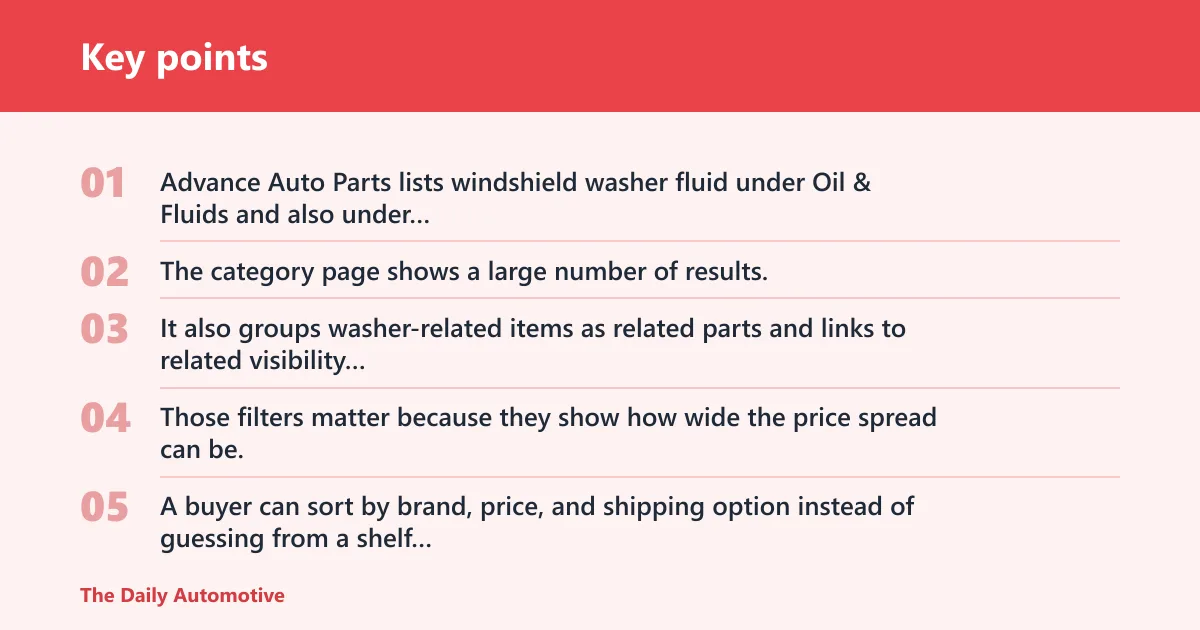
Advance Auto Parts lists windshield washer fluid under Oil & Fluids and also under Additives. The category page shows a large number of results, along with a price filter from $0.01 to $199.99, ship-to-home availability, brand browsing, ratings, and many not-yet-rated items. It also groups washer-related items as related parts and links to related visibility maintenance.
Those filters matter because they show how wide the price spread can be. A buyer can sort by brand, price, and shipping option instead of guessing from a shelf tag. That is useful when comparing a basic refill to a winter-specific bottle or a multi-pack.
Walmart, AutoZone, Costco, and independent retailers
At Walmart, basic washer fluid is often the low-price benchmark, especially for standard all-season bottles and multipacks. At AutoZone, pricing often looks closer to other auto parts chains, with winter formulas and name brands priced above the basic gallon. Costco or club stores can be strong on per-quart value when the bottles are sold in packs.
Independent retailers can be cheaper when they run seasonal sales or closeout pricing, but the shelf may be thinner on winter-specific options. The best move is to compare the per-quart cost, not just the brand sticker. A two-pack at a warehouse club can beat a cheap-looking single bottle at a convenience store.
When ship-to-home beats store pickup
Ship-to-home makes sense when the local shelf is empty, the weather is mild enough to wait, or you want a larger pack at a lower per-quart cost. It is less useful if you need fluid before a snowstorm or before a commute. In that case, paying a bit more in store is the better trade.
When the cheapest bottle gets expensive
The cheapest bottle becomes expensive when it is wrong for the weather, too small for the tank, or bought too late. A fluid that freezes in the reservoir can leave you without spray when you need it most. A bargain bottle that empties fast can also cost more over a winter than one better-rated jug.
Wrong fluid for freezing weather
If a mild-weather formula freezes, the cost is not just the bottle. The washer pump may stop moving fluid, the reservoir can crack in extreme cases, and the windshield may stay coated with road film. Paying a few dollars more for the correct freeze rating is usually cheaper than any of those outcomes.
Low-cost fluid that needs frequent refills
Cheap fluid can still be a bad value if the tank is small or the fluid is poor at clearing salt and grime. Frequent refills raise the real cost per season. That is why per-quart math and refill count matter more than a single shelf tag.
Emergency roadside purchase prices
Emergency bottles sold at gas stations or highway stops often cost the most per ounce. They are worth it only when you need immediate visibility. If you have time, the same money often buys a larger winter-rated bottle at an auto parts store or warehouse club.
Related winter visibility checks
Washer fluid does not work alone. If the pump, reservoir, or wiper blades are failing, a fresh bottle will not fix the visibility problem. Winter maintenance is about the whole system, because the cheapest fluid cannot help if the nozzles are clogged or the blades are streaking.
Washer pump and reservoir symptoms
If you hear the pump but no fluid sprays, or if the reservoir empties much faster than expected, the system needs more than a top-off. Low output can point to a leak, a frozen line, or a failing pump. The refill opening is usually visible under the hood, but the fault may be farther down the line.
Why wiper blades matter at the same time
Wiper blades wear faster in winter because ice, grit, and salt attack the rubber edge. New fluid helps only if the blades can clear the glass. If the blades chatter, streak, or skip, replacing them can do more for visibility than buying a premium bottle.
Signs the system needs more than a refill
- No spray from the nozzles after filling the reservoir
- Pump noise without fluid delivery
- Streaking that remains after a fresh refill
- Visible leaks under the car or inside the engine bay
- Frozen lines or a bottle that was filled with the wrong seasonal fluid
Frequently asked questions
How much windshield washer fluid cost
Washer fluid is often priced at about $2 to $6 per gallon for standard formulas and about $4 to $10 per gallon for winter formulas. Smaller roadside bottles can cost more per ounce. The right number depends on bottle size, temperature rating, and whether you buy at a mass merchant, auto parts store, or convenience stop.
How much windshield wiper fluid cost
People often use “wiper fluid” to mean washer fluid, and the price is usually the same. Expect roughly $2 to $6 per gallon for basic fluid, with winter-rated bottles higher. If you need a quick roadside purchase, the per-ounce cost can be much higher than a gallon at an auto parts store.
How much does windshield washer fluid cost at walmart?
At Walmart, basic washer fluid is commonly priced near the low end of the market, especially for standard all-season gallons and multipacks. A practical shopping band is about $2 to $5 for basic fluid, with winter formulas usually higher. Check the bottle size first, because a small jug can look cheap and still cost more per quart.
How much should windshield washer fluid cost?
It should cost about $2 to $6 per gallon for standard fluid if you are buying in a regular retail setting, and about $4 to $10 per gallon for winter fluid. If the price is far above that, you are probably paying for convenience, a specialty formula, or a small emergency container.
Who has windshield washer fluid on sale?
Sales are common at auto parts chains, mass merchants, warehouse clubs, and independent retailers during seasonal changes. The same source shows a wide category spread with 562 results and price filters from $0.01 to $199.99, which suggests plenty of price competition. Compare per-quart cost and shipping before buying.
Products related to this article
Sponsored / affiliate links. As an Amazon Associate I earn from qualifying purchases. I may earn additional commission from eligible campaigns.