Oxygen Sensor for Car: Enhance Performance and Fuel Efficiency
An oxygen sensor helps the engine computer trim fuel by reading exhaust oxygen; replace it when live data, fuel trims, and trouble codes show the sensor is slow, biased, noisy, or dead. Ignore a bad one and you can lose MPG, trigger a check-engine light, fail an emissions test, or mask another fault. This guide shows how the sensor affects mileage and drivability, how to read the clues, and how to tell cause from symptom.
What an oxygen sensor does
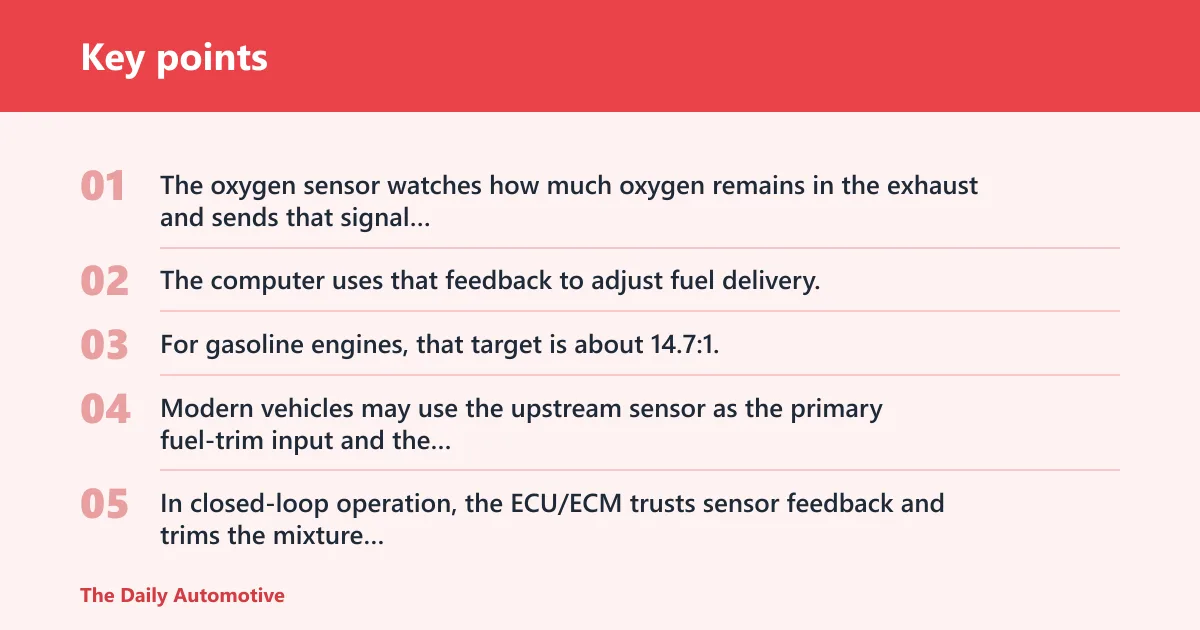

The oxygen sensor watches how much oxygen remains in the exhaust and sends that signal to the ECU or ECM. The computer uses that feedback to adjust fuel delivery, mainly by changing injector pulse width so the engine stays close to the target air-fuel ratio. For gasoline engines, that target is about 14.7:1.
Modern vehicles may use the upstream sensor as the primary fuel-trim input and the downstream sensor to monitor catalytic converter efficiency. In closed-loop operation, the ECU/ECM trusts sensor feedback and trims the mixture continuously. In open-loop operation, such as a cold start or some heavy-load conditions, it relies on preset maps instead of oxygen feedback.
How the signal is used
A conventional zirconia oxygen sensor is the most common type. It produces a voltage-based signal, often near 0.1 volts when lean and around 0.9 volts when rich. Many ECUs aim to cycle around 0.45 volts as the mixture swings either side of stoichiometric control.
Titania sensors work differently. They change resistance rather than voltage. Newer vehicles often use wideband or air-fuel ratio sensors, which read a broader range and give the control system a more precise picture of mixture than a narrowband sensor can provide.
Why sensor feedback affects MPG
Fuel economy depends on the engine staying near the right mixture, not on the sensor alone. When the oxygen sensor reports correctly, the ECU can trim fuel delivery instead of drifting rich or lean. A functioning sensor can improve fuel efficiency by 10-15%, but the real gain depends on whether the sensor was the fault or only reacting to another problem.
Fuel trim and injector pulse width
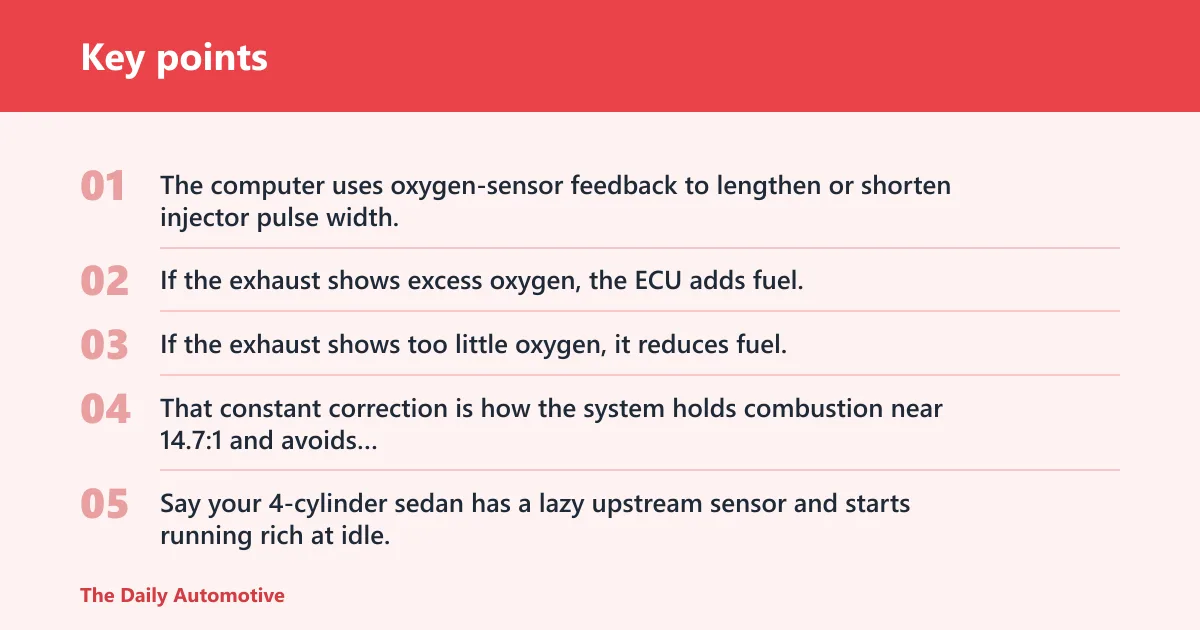
The computer uses oxygen-sensor feedback to lengthen or shorten injector pulse width. If the exhaust shows excess oxygen, the ECU adds fuel. If the exhaust shows too little oxygen, it reduces fuel. That constant correction is how the system holds combustion near 14.7:1 and avoids wasted fuel.
Say your 4-cylinder sedan has a lazy upstream sensor and starts running rich at idle. The fix may restore the trim system, but if a vacuum leak or low fuel pressure caused the bad reading, replacing the sensor alone will not recover the lost MPG.
When a bad sensor hurts efficiency
A bad sensor hurts mileage when it sends slow, biased, or noisy data. The ECM then overcorrects, which can push the engine rich enough to waste fuel or lean enough to cause drivability complaints. A 25 MPG vehicle could gain 2.5-3.75 MPG if the sensor was the true cause and the rest of the system is healthy.
That number is not a promise. A contaminated sensor, a wiring fault, a vacuum leak, a misfire, or a fuel-delivery issue can all create the same fuel-trim pattern. In those cases, replacing the sensor may do nothing.
Upstream vs downstream sensors
The upstream oxygen sensor sits before the catalytic converter and acts as the primary fuel-trim sensor. It tells the ECU how to adjust the air-fuel mixture right now. The downstream sensor sits after the converter and mainly checks catalytic converter efficiency rather than directly controlling fueling.
Upstream sensor job
On many cars, the upstream sensor is the one that matters most for MPG and throttle response. If it is slow or biased, closed-loop control can wander from the correct mixture. That often shows up as rough idle, poor fuel economy, or rich and lean codes that keep returning.
Downstream sensor job
The downstream sensor usually does not command mixture changes the way the upstream unit does. Its job is to compare exhaust oxygen before and after the converter so the ECM can judge catalyst health. A bad downstream sensor can trigger a check-engine light and emissions failures without being the cause of poor fuel trim.
Picture a car that passes a basic drivability test but fails an OBD inspection because the downstream sensor waveform mimics the upstream sensor too closely. That pattern often points to converter efficiency trouble, not a primary fueling fault.
What makes a sensor fail?
Oxygen sensors fail from age, heat, contamination, electrical faults, or slow response. Oxygen sensors can last about 60,000–100,000 miles depending on type and driving, and some service schedules call for replacement around 60,000 to 90,000 miles. Mileage is only part of the story; condition and data matter more than a calendar alone.
Slow response and contamination
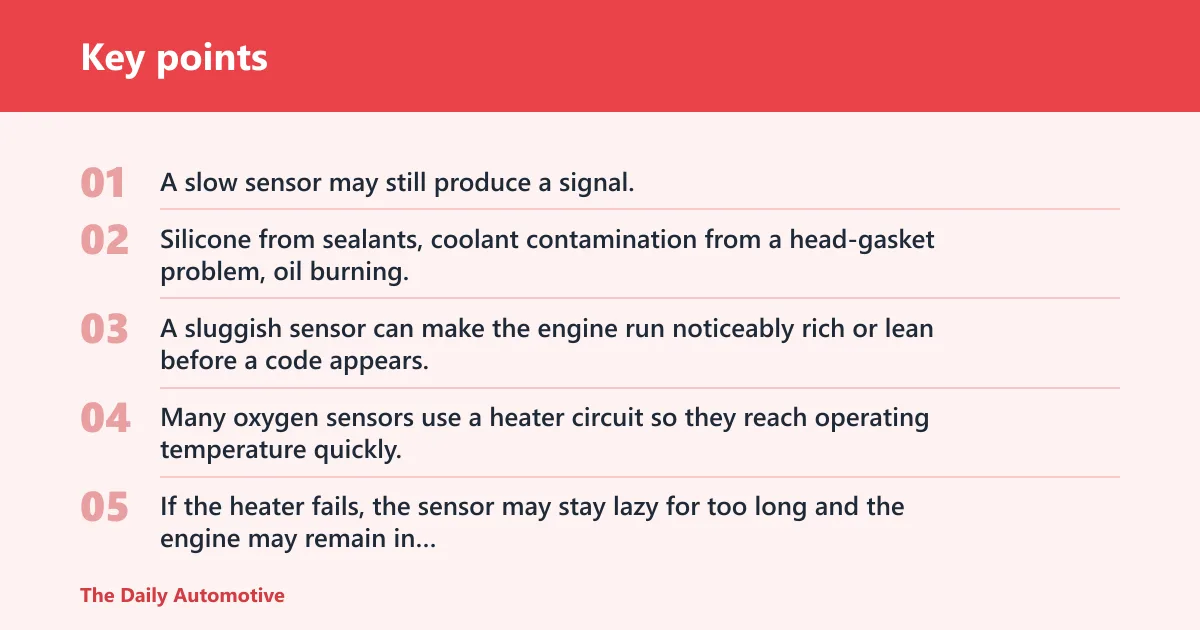
A slow sensor may still produce a signal, but not quickly enough for the ECU to correct mixture accurately. Silicone from sealants, coolant contamination from a head-gasket problem, oil burning, and fuel additives can foul the sensing element. A sluggish sensor can make the engine run noticeably rich or lean before a code appears.
Heater and wiring faults
Many oxygen sensors use a heater circuit so they reach operating temperature quickly. If the heater fails, the sensor may stay lazy for too long and the engine may remain in open loop or use poor-quality feedback. Damaged wiring, corroded connectors, and exhaust heat damage can create the same symptoms without the sensor itself being bad.
Zirconia, titania, and wideband differences
Zirconia sensors are the most common type and are typically diagnosed with voltage behavior. Titania sensors change resistance instead of voltage, so their testing approach differs. Wideband air-fuel ratio sensors are more precise than conventional narrowband units, and they are more common on newer vehicles, so diagnosis usually requires scan data rather than a simple voltage check.
Can a bad oxygen sensor cause poor fuel economy?
Yes, a bad oxygen sensor can cause poor fuel economy, but it is only one possible cause. The usual pattern is an upstream sensor that is slow, biased, or contaminated, causing the ECU to add too much fuel or delay correction. If the signal looks wrong only because of another fault, MPG will not improve until that fault is fixed.
Typical signs of rich or lean correction
Fuel trims are the clue. If short-term and long-term fuel trims sit far positive, the ECM is adding fuel because it sees a lean condition. If they sit far negative, it is pulling fuel because it sees rich operation. Those numbers do not point to the sensor by themselves; vacuum leaks, fuel pressure faults, misfires, and exhaust leaks can create the same pattern.
How the check engine light fits
A faulty oxygen sensor can trigger a check engine light, but the code is only a starting point. Rich and lean codes, heater-circuit codes, and catalyst-efficiency codes may all be related to oxygen-sensor data. The light tells you the system is unhappy; it does not prove the sensor is the root cause.
When MPG loss points elsewhere
If the car runs rough under load, smells of fuel, or idles badly, the problem may be fuel delivery or air leaks rather than the sensor. If the downstream sensor points to catalyst trouble while the upstream sensor looks normal, the converter may be the issue. A bad oxygen sensor can hurt mileage, but it is often a symptom of a broader fault.
Oxygen sensor diagnostic table
This table helps separate sensor failure from the common faults that imitate it. Start with the symptom, then check the likely cause before you buy parts.
| Symptom | Likely cause | Quick check | Action |
|---|---|---|---|
| High fuel trims, lean code, rough idle | Vacuum leak | Inspect intake boots, hoses, PCV lines, and listen for hissing at idle | Repair the leak first, then recheck trims |
| Rich smell, negative fuel trims, poor MPG | Fuel system issue | Check fuel pressure, injector balance, and for leaking injectors or a stuck regulator | Fix fuel delivery fault before replacing the sensor |
| Oxygen-sensor code with unstable readings | Bad O2 sensor | Look for slow switching, flatlined voltage, heater failure, or contaminated sensor face | Replace the sensor if wiring and exhaust sealing are sound |
| Sensor swings oddly near the manifold | Exhaust leak | Inspect manifold gaskets, flex joints, and sensor threads for soot or ticking noise | Seal the leak, then clear codes and retest |
| Downstream code or efficiency failure | Catalytic converter problem | Compare upstream and downstream waveforms; if they look too similar, suspect the converter | Diagnose converter efficiency before replacing downstream parts |
- Read the codes and freeze-frame data.
- Check fuel trims at idle and under light load.
- Inspect for vacuum leaks, exhaust leaks, misfires, and fuel-pressure issues.
- Look at upstream and downstream sensor behavior separately.
- Replace the sensor only after the rest of the system checks out.
When should you replace it?
Replace an oxygen sensor when live data, fuel trims, and trouble codes point to sensor failure, when the heater circuit is dead, or when contamination has slowed the response beyond recovery. A sensor that is electrically failed, contaminated beyond recovery, or slow to respond should not be cleaned and reused as a default fix.
Why quality parts matter
Use a correct application, correct connector, and quality part. A poor match can create the same drivability complaints you are trying to cure, especially on wideband-equipped vehicles that need the right sensor design. Modern systems may be far less forgiving than older zirconia setups.
What to inspect during the job
Inspect the wiring loom, connector pins, exhaust sealing surface, and any sign of oil or coolant contamination. If the old sensor is coated in soot or fuel residue, look upstream for the source. If the converter has been stressed by prolonged rich running, address that too, because a new sensor will not fix a damaged converter.
Frequently asked questions
What does an oxygen sensor do in a car?
It measures oxygen in the exhaust and sends that data to the ECU or ECM so the engine can adjust fuel delivery. In closed loop, the computer uses that signal to trim injector pulse width and keep the mixture near 14.7:1 for gasoline engines. That helps control MPG and emissions.
What are the signs of a failing oxygen sensor?
Common signs include a check engine light, rich or lean codes, slow switching in live data, poor fuel economy, rough idle, and heater-circuit faults. The symptom often appears as bad fuel trims, but the sensor should be tested before replacement because the source may be elsewhere in the system.
How often should oxygen sensors be replaced?
Replacement timing varies by vehicle, sensor type, and condition. Do not replace by mileage alone if the live data, wiring, and fuel trims still look healthy.
What is the difference between upstream and downstream oxygen sensors?
The upstream sensor sits before the catalytic converter and is the primary fuel-trim sensor. The downstream sensor sits after the converter and monitors catalyst efficiency. The upstream unit directly affects air-fuel control, while the downstream unit is mainly for emissions-system diagnostics.
Will replacing an oxygen sensor improve performance?
It can, but only when the old sensor is the cause of the problem. If the sensor is slow or failed, replacing it can restore proper fuel trim, throttle response, and MPG. If another fault is causing the bad reading, performance will not improve until that fault is fixed.
Can a faulty oxygen sensor cause a check engine light?
Yes. A faulty oxygen sensor can sometimes set heater, rich, lean, or catalyst-efficiency codes and illuminate the MIL. The code identifies the system that detected the problem, not always the root cause. That is why live data and a leak or fuel-system check should come before parts replacement.
How does an oxygen sensor affect emissions?
It helps the ECU hold the mixture near stoichiometric, which supports cleaner combustion and better converter performance. A faulty sensor can increase emissions by letting the engine run too rich or too lean. If the converter is stressed by prolonged rich running, emissions can rise even after the sensor is changed.
Products related to this article
Sponsored / affiliate links. As an Amazon Associate I earn from qualifying purchases. I may earn additional commission from eligible campaigns.