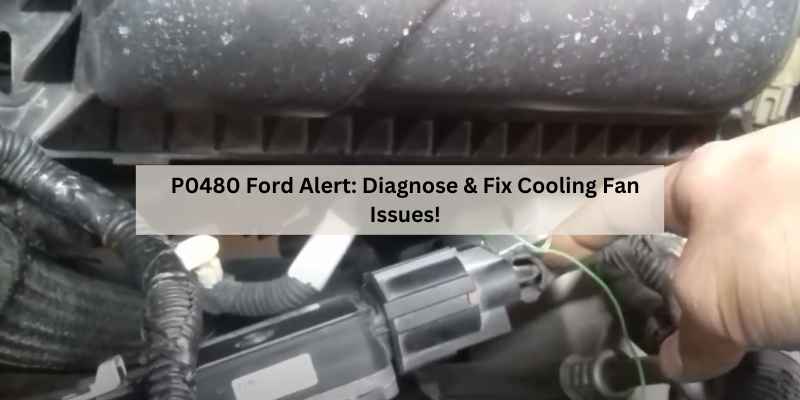
P0480 Ford Cooling Fan: How to Diagnose and Fix It Without Guessing
Your Ford’s cooling fan kicks on when the engine gets warm, pulls air through the radiator, and shuts off. When the P0480 code pops up, that fan either runs constantly, doesn’t run at all, or runs at the wrong speed. The check engine light comes on. The temperature gauge creeps toward the red on a hot day. You’re stuck wondering if it’s a $20 relay or a $400 fan assembly.
This article walks through a diagnose-don’t-guess approach. You’ll learn exactly what P0480 means, how to test each part of the circuit yourself with basic tools, and when to stop diagnosing and start replacing. I’ve fixed enough of these on F-150s, Mustangs, and Edges to tell you the common failure points and the traps that waste people’s money.

Focreedy
Focreedy FD502 Dual Radiator Electric Fan for…
- Fitment: Fit Ford Edge 3.5L 2007-2014, Fit Lincoln MKX 3.5L 2007-2010, Fit Lincoln MKX 3.7L 2011-2015
- Warranty: Two years limited warranty
- Assured: All products are quality inspected & noise detected
If you’re driving a Ford Edge 2026-2026 with the 3.5L or 3.7L engine and need a replacement, the Focreedy FD502 dual radiator fan is a solid drop-in option worth checking. It’s built for the extra heat load of the Max Trailer Tow Package and comes with a two-year warranty. Now let’s get into the diagnosis.
What Does P0480 Mean?
P0480 is a generic powertrain diagnostic trouble code that reads “Cooling Fan 1 Control Circuit Malfunction.” The powertrain control module (PCM) expects to see a certain voltage on the fan control circuit when it commands the fan on. When the actual voltage doesn’t match the expected value, the PCM sets this code.
Fan 1 is the low-speed circuit on most Ford vehicles. It’s a separate circuit from Fan 2, which handles high speed and sets code P0481. The fan control module (sometimes called a fan clutch controller or a variable-speed controller) receives a duty cycle signal from the PCM. That signal tells the module how fast to spin the fan. When the signal is missing, shorted, or the module can’t deliver power to the motor, you get P0480.
This code appears across many Ford models: F-150, Mustang, Focus, Edge, Escape, and Fusion. The wiring colors and connector locations vary, but the circuit logic is the same. If you understand the basics, you can apply them to almost any Ford.
Symptoms of a P0480 Code
The symptoms range from annoying to dangerous:
- Check engine light illuminated
- Engine temperature runs higher than normal, especially at idle or in traffic
- Cooling fan runs constantly at full speed, even when the engine is cold
- Cooling fan doesn’t run at all
- Air conditioning blows warm when the vehicle is stationary
- In severe cases, engine overheating and coolant boiling over
The most dangerous symptom is the fan that never turns on. On a hot day with the AC running, you can overheat an engine in a few minutes of stop-and-go driving. If the gauge climbs past the middle, pull over and shut it down.
Common Causes of Cooling Fan Circuit Failure
Here’s what actually causes P0480, ranked by how often I see it:
- Blown fuse or burnt fuse link. The fan draws a lot of current. A corroded fuse terminal or an old fuse that’s near its limit will fail. Check the fuse box cover for the fan fuse rating (usually 30-60 amps).
- Failed cooling fan relay. The relay is an electromechanical switch. Contacts wear out, the coil opens, or the relay gets stuck. A simple relay test tells you if it’s good.
- Faulty fan control module. This is the brain that varies fan speed. It’s usually bolted to the fan shroud or the radiator support. Water intrusion kills these modules.
- Wiring harness damage. A rubbed wire, a chafed harness, or a broken connector pin. Look near the fan shroud and where the harness passes over the radiator support.
- Bad coolant temperature sensor (or its circuit). The PCM uses this input to decide when to turn the fan on. A sensor reading -40°F or 300°F will make the fan do the wrong thing.
- Mechanical failure of the fan itself. A seized fan motor draws excessive current and pops the fuse. Damaged blades can wobble and bind. This is the one most people miss.
Notice I didn’t list the PCM as a likely cause. It’s rare. Don’t replace an engine computer until you’ve tested every other component.
Tools Needed for Diagnosis
You don’t need a dealer-level scan tool for this. Here’s what you’ll want:
- Digital multimeter (DMM) with a 10-amp current range
- 12V test light or a fused jumper wire
- OBD-II scanner that can read live data and clear codes
- Basic hand tools: socket set, screwdrivers, pliers
- Wiring diagram for your specific Ford model (print it or have it on your phone)
That last one matters. A wiring diagram shows you which pin on the fan connector is power, which is ground, and which is the signal from the PCM. You can find diagrams in a factory service manual or on sites like Mitchell1 or ALLDATA. A generic diagram won’t cut it because Ford changed pinouts between years.
How to Diagnose P0480 (Step-by-Step)
Follow this order. It goes from cheapest and easiest to most involved. You’ll likely find the problem before you get to the last step.
Visual Inspection of Connectors and Fuses
Start with the obvious. Open the under-hood fuse box (the power distribution box) and find the cooling fan fuse. Pull it and look at the metal element inside. A blown fuse shows a visible break. Replace it with the correct amperage fuse—never a higher one.
Next, inspect the fan connector. Unplug it and look at the pins. Are they green or corroded? Are any pushed back into the housing? Spray them with electrical contact cleaner and re-seat the connector. Do the same for the fan control module connector.
Check the ground strap from the engine block to the chassis. A corroded ground can cause weird electrical issues. Clean it with a wire brush and re-tighten.
Testing the Fan Relay
Locate the cooling fan relay in the power distribution box. The fuse box cover usually has a diagram. On an F-150, it’s often labeled “Fan Clutch” or “Cooling Fan.” On a Mustang, it’s in the battery junction box.
With the relay out, test it with your multimeter set to ohms. You should see resistance between the coil terminals (usually 85 and 86) of about 50-100 ohms. If you see infinite resistance, the coil is open. Then apply 12V from a battery to the coil terminals and listen for a click. No click means the relay is dead.
You can also swap the fan relay with an identical relay from another circuit (like the horn relay) and see if the code changes. If the fan works with the swapped relay, you found the problem.
Testing the Fan Motor Directly
This is the step most guides skip, and it’s the one that saves you from buying parts you don’t need. You’re going to bypass the relay and apply battery power straight to the fan motor.
Unplug the fan connector. Use a fused jumper wire (a wire with an inline 20-amp fuse) to connect the battery positive terminal to the power pin on the fan connector. Connect the ground pin to a clean chassis ground. The fan should spin.
If the fan doesn’t spin, the motor is bad. Replace the fan assembly. If the fan spins but sounds rough or draws more than 15-20 amps (use a clamp meter), the motor is wearing out. It will fail soon even if it works right now.
Checking the Wiring Harness for Continuity
If the relay tests good and the motor spins when powered directly, the problem is in the wiring between the relay, the connector, and the PCM. Set your multimeter to ohms and check continuity between the relay socket pin and the fan connector pin. You want near-zero resistance. Any reading above 1 ohm indicates a corroded connection or a broken wire.
Check the signal wire from the PCM to the fan control module. This is the wire that carries the duty cycle signal. With the engine running and the AC on, you should see a square wave on this wire with your multimeter set to AC voltage or frequency. No signal means the PCM isn’t commanding the fan, or the wire is broken.
P0480 vs. P0481: What’s the Difference?
Here’s where people get confused. P0480 is Fan 1 (low speed). P0481 is Fan 2 (high speed). On a two-speed fan system, the PCM energizes one relay for low speed and both relays for high speed. On a variable-speed system, the PCM sends a different duty cycle signal.
| Code | Circuit | Typical Ford Models | Common Failure |
|---|---|---|---|
| P0480 | Fan 1 (low speed) | F-150, Mustang, Focus, Edge | Relay, fuse, fan control module |
| P0481 | Fan 2 (high speed) | F-150, Mustang, Explorer | Second relay, high-speed resistor, wiring |
If you have both codes, check the common components first: the main fan fuse, the ground circuit, and the fan control module. A single failed ground can take out both circuits.
Step-by-Step Repair Guide
Once you’ve found the bad part, the repair is usually straightforward. Here’s a typical sequence:
- Disconnect the negative battery cable. Wait 10 minutes for the PCM to lose power.
- Remove the air intake tube if it blocks access to the fan shroud.
- Unplug the fan connector and any wiring clips holding the harness.
- Remove the fan shroud bolts (usually 8mm or 10mm). On some models, you need to remove the radiator upper support.
- Lift the fan assembly out. Be careful not to damage the radiator fins.
- Install the new fan assembly or the repaired component. Torque the bolts to spec.
- Reconnect the battery and start the engine. Turn on the AC to force the fan on.
- Clear the code with your OBD-II scanner.
If you’re replacing just the fan motor, it’s often cheaper to buy the whole assembly. The motor is usually riveted to the shroud, and drilling out rivets is a pain. A complete assembly with dual fans, like the Focreedy FD502 for the Edge, saves you time and comes with a warranty.
Cost of Repair (Parts & Labor)
Here’s what you’ll pay depending on the failed part:
- Relay: $10-$25 part, 30 minutes labor if you DIY
- Fuse: $5-$10, five minutes labor
- Fan control module: $80-$150 part, 1 hour labor
- Complete fan assembly: $150-$400 part, 1-2 hours labor
- Wiring harness repair: $50-$150 depending on the damage
- Dealer labor rates: $120-$180 per hour
You can save a lot by doing the diagnosis and repair yourself. The fan assembly is the most expensive item, and it’s also the most common failure on higher-mileage vehicles.
Check the current price on Amazon for the Focreedy FD502 if you need a replacement for an Edge. It’s often cheaper than a dealer part and includes a two-year warranty.
Can You Drive with a P0480 Code?
Short answer: it depends. If the fan runs constantly at high speed, you can drive it, but you’ll waste fuel and the fan will wear out faster. If the fan doesn’t run at all, you’re risking severe engine damage.
Here’s the rule: if the temperature gauge stays in the normal range during highway driving, you can make it to a shop. Stop-and-go traffic is the killer. The fan is what pulls air through the radiator when the car isn’t moving fast enough to do it naturally. If you’re stuck in traffic and the gauge climbs, turn off the AC (that reduces heat load) and turn on the heater (it acts as a secondary radiator). It’s uncomfortable, but it can save your engine.
Don’t drive long distances with a non-functioning fan. Overheating can warp the cylinder head, blow the head gasket, or crack the block. Those repairs cost thousands.
Preventing Future Failures
Cooling fan circuits fail for predictable reasons. Here’s how to extend the life of yours:
- Keep the front of the radiator clean. Bugs, leaves, and dirt reduce airflow and make the fan work harder.
- Flush the coolant every 2-3 years. Old coolant loses its corrosion inhibitors, which can damage the fan motor and the radiator.
- Inspect the wiring harness for chafing every time you change the oil. Look where the harness rubs against metal brackets.
- Use dielectric grease on the connector pins when you reconnect the fan. It prevents corrosion.
- Don’t ignore a noisy fan. A grinding sound means the bearing is failing, and it will draw more current until it seizes.
One thing I’ve learned: the fan on a Ford is a wear item, not a lifetime part. Expect 8-10 years out of it in normal conditions. If you live in a hot climate or tow heavy loads, it will fail sooner. Budget for it.
Frequently Asked Questions
Can I just replace the fan relay and clear the code?
If the relay is the actual problem, yes. But test it first. A relay with burned contacts can still click when you apply power, but it won’t pass current. Use your multimeter to check resistance across the switch terminals with the relay energized. If it’s above 0.5 ohms, replace it.
Will a P0480 code cause my car to fail an emissions test?
Yes. In most states, an illuminated check engine light is an automatic failure. The code also prevents the engine monitor from running its readiness checks, so the OBD-II plug won’t show “ready.” You’ll need to fix the issue and complete a drive cycle before you can pass.
What is a proper drive cycle for a Ford after clearing P0480?
Start with a cold engine. Drive at steady speeds between 30 and 50 mph for about 10 minutes, then idle for 5 minutes with the AC on. This lets the PCM run the cooling fan monitor. If the code doesn’t come back, the monitor is ready. If it does, you still have a problem.
Can a stuck thermostat cause a P0480 code?
Not directly. A stuck thermostat can cause overheating, which makes the PCM command the fan on. But it won’t set a circuit malfunction code unless the fan actually fails to respond. If you have both a P0480 and a P0128 (coolant temperature below thermostat regulating temperature), fix the thermostat first and see if the fan code clears.
Is it worth fixing a P0480 code on an older Ford with high mileage?
Depends on the car. If the body and transmission are solid, a $200 fan assembly is a cheap repair. If the car has 250,000 miles and other major issues, it might be time to move on. But a cooling fan failure that causes an overheating event can total a car that was otherwise fine, so don’t put it off.
What to Remember When the Code Is Gone
- Diagnose before you replace. Test the relay, fuse, motor, and wiring in that order. You’ll save money and time.
- Know the difference between P0480 (low speed) and P0481 (high speed). They share components but fail differently.
- Test the fan motor directly with a fused jumper wire. This one step tells you if the motor is good or bad in 5 minutes.
- Don’t drive with a dead fan in traffic. The risk of engine damage isn’t worth it.
- Use the correct fuse amperage. A larger fuse won’t protect the circuit and can cause a fire.
- Consider a complete fan assembly over a bare motor. It’s easier to install and comes with a warranty.
- Clear the code and complete a drive cycle before you assume the repair worked. A code that comes back immediately means you missed something.
If you need more background on how cooling fans work in general, read our cooling fan guide that covers the basics of airflow and fan types. And if you’re dealing with a fan that stays on after you shut the engine off, that’s a different problem—check our article on fan running after car is off for the likely causes. Remember, a methodical approach beats throwing parts at the problem every time.
Products related to this article
Sponsored / affiliate links. As an Amazon Associate I earn from qualifying purchases. I may earn additional commission from eligible campaigns.