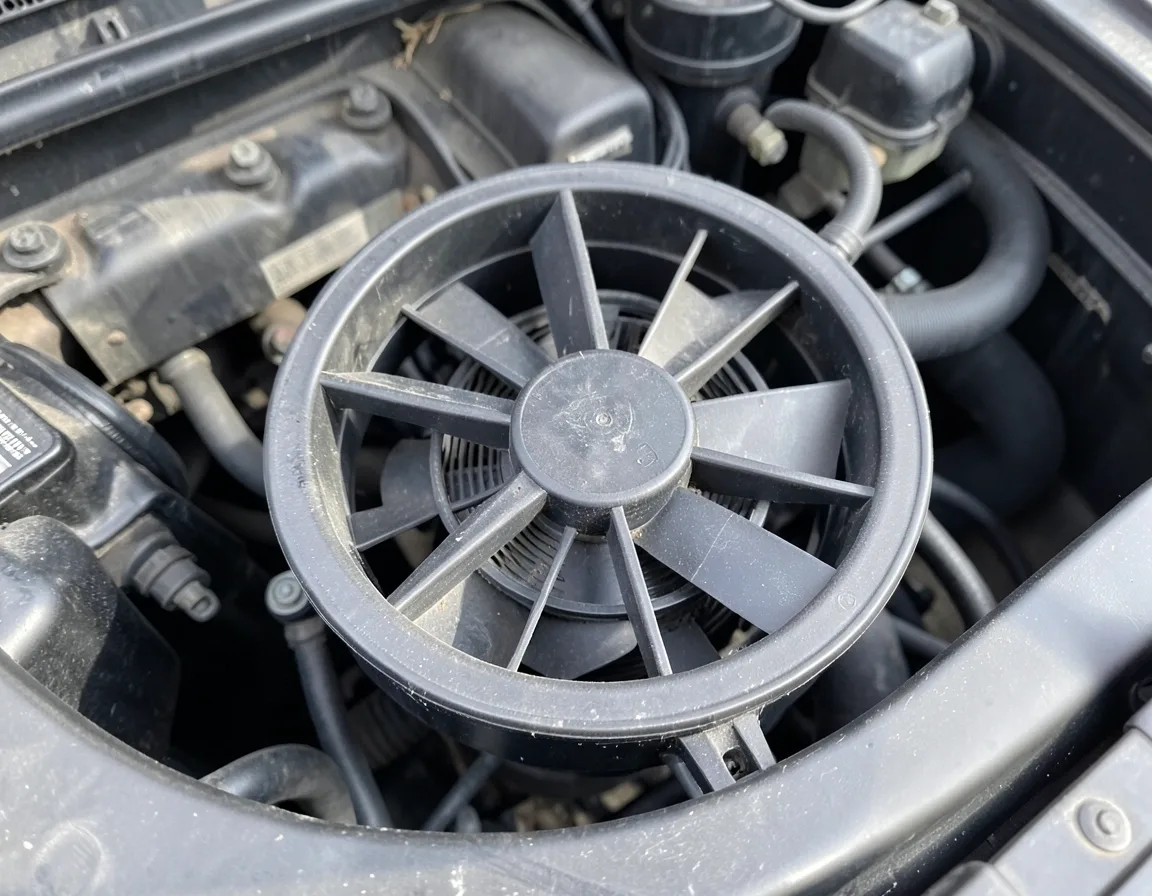
Car Engine Cooling Fan Replacement: Signs, Costs & Top Picks
A bad cooling fan usually shows up as overheating at idle, an inoperative A/C fan, or a fan that never starts; if the fan works with A/C on but not as coolant temperature rises, check the relay, fuse, sensor, or thermostat before buying a motor. If it is left alone, the engine can overheat, a head can warp, or the repair can become more costly than necessary. This guide compares symptoms, common causes, replacement costs, and fitment checks before you book service.
How the cooling fan fits the system


The cooling fan pulls air through the radiator when road speed is too low for ram air to do the job. In many cars, the fan assembly works with the radiator, thermostat, coolant sensor, and ECU, so a fan complaint can start in the electrical side rather than the motor itself.
Halfords groups cooling parts under “Cooling & Heating,” lists “Radiators,” “Thermostats,” “Expansion Tanks,” “Oil Cooler & Oil Pipe,” and “Switch & Sensors” in that section, and says you may need a “replacement car cooling fan.” It also notes that cooling system failure is “not much fun” in extreme seasons.
What the fan assembly includes
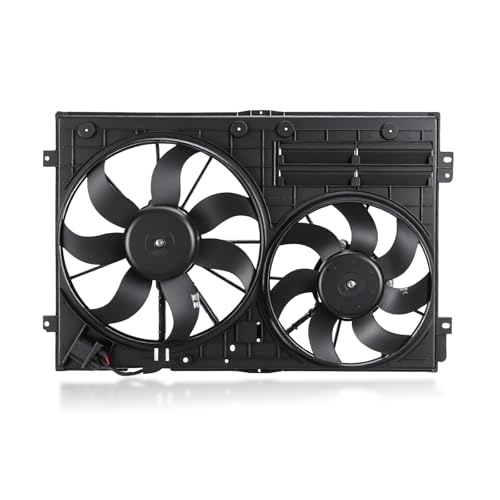
A radiator cooling fan assembly usually includes the fan motor, fan blade, and shroud. On many vehicles, the whole unit mounts as a matched assembly with OE fitment by make and model, and it runs on the car’s 12V electrical system. That is why a generic-looking part can still be wrong.
Some assemblies are sold as a single fan, while others use dual fans. Dual-fan layouts are common where one fan supports radiator cooling and another helps with A/C load, but the exact layout depends on the vehicle. A direct-fit listing should match connector shape, mounting tabs, blade depth, and shroud size.
Single-fan vs dual-fan layouts
Single-fan setups are simpler, but they do not mean the car has a simple diagnosis. A failed relay, sensor, or module can leave a healthy fan idle. Dual-fan systems add more wiring and more failure points, yet they also give you more clues, because one fan may still work while the other does not.
Why 12V supply and fitment matter
Many passenger vehicles use a 12V system, so the fan motor, relay, fuse, and module need to match the vehicle’s electrical design. Fitment matters just as much as voltage. A fan assembly from the wrong trim, engine, or cooling package may bolt in poorly, draw the wrong current, or move too little air.
Is your cooling fan failing?
The quickest clue is when overheating happens at idle, in traffic, or with the A/C on, but normal highway driving seems fine. That pattern points toward weak fan operation, poor relay control, or a fan that never comes on at the commanded temperature. A fan that runs constantly after shutdown points to a different fault path.
Idle overheating vs highway overheating
If the temperature climbs while idling and drops once the car is moving, the fan circuit deserves attention first. If the car overheats at highway speed too, the fan may not be the main cause. Thermostat, radiator flow, water pump output, or low coolant can matter more when airflow from road speed is already high.
Picture a compact car that sits at 210°F on the road but creeps upward in a driveway queue with the A/C on. That pattern fits fan-control trouble better than a simple radiator blockage. By contrast, highway overheating with a cold fan can point to coolant circulation or thermostat problems instead.
Fan runs constantly after shutdown
Some cars keep the cooling fan running briefly after engine-off to drop underhood heat. Halfords says the fan can run “for a few minutes after you turn the engine off” and that this can happen when “the car was hot.” That is normal on many models, not a sign of failure by itself.
If the fan stays on far longer than expected, the coolant-temperature sensor, relay, or control module may be reporting a false high temperature. A scan tool can help confirm whether the ECU is commanding fan operation or whether the circuit is stuck on.
No fan operation at all
If the fan never starts, check the fuse, relay, and control signal before you buy a motor. A cooling fan fuse protects the circuit and typically must match the correct amperage. A cooling fan relay controls high-current switching and can fail intermittently, which makes the fault harder to catch without testing.
A common first-timer mistake is replacing the whole assembly because the fan did not run during one driveway check. If the relay or fuse is open, a new motor will not solve the problem. If the vehicle uses a resistor or module for low and high speed, that part can fail while the motor still spins freely on direct power.
Cooling fan replacement decision table
Use this table to sort the likely fault, not to close the diagnosis. It separates the most common fan complaints from relay, fuse, sensor, thermostat, radiator, and water-pump faults so you can decide what to test first.
| Symptom | Likely failed part | Quick test | Replacement complexity | Typical cost band |
|---|---|---|---|---|
| Overheats at idle, cools at speed | Fan assembly, relay, resistor or module | Command the fan with a scan tool; check for battery voltage at the connector | Moderate; access varies by shroud and bumper clearance | Parts: $80-$450; labor: $120-$350 |
| Fan runs constantly after shutdown | Coolant-temperature sensor, relay, module | Read live temperature data and compare it with engine temperature | Low to moderate; sensor access may be tight | Parts: $25-$220; labor: $90-$250 |
| No fan operation at all | Fuse, relay, wiring, motor | Check fuse amperage, swap relay if identical, then test motor power and ground | Moderate; simple on some cars, time-consuming on others | Parts: $15-$400; labor: $100-$400 |
| Highway overheating too | Thermostat, radiator, water pump | Feel for hose temperature change, check coolant flow, inspect for leaks | Variable; engine-specific and sometimes labor-heavy | Parts: $30-$500+; labor: $150-$900 |
| Only one fan in a dual-fan system works | Fan motor, module, wiring | Swap connectors if the design allows, or power-test each fan separately | Moderate; diagnosis takes more time than a single-fan system | Parts: $60-$500; labor: $120-$450 |
What else can cause the same symptoms?
A failed fan is only one cause of overheating or fan run-on. Relay, fuse, sensor, thermostat, radiator, and water-pump faults can create the same complaint, so a repair quote should start with diagnosis. That matters even more on multi-speed systems where a resistor or module controls low and high fan speed.
Relay, fuse, and resistor or module checks
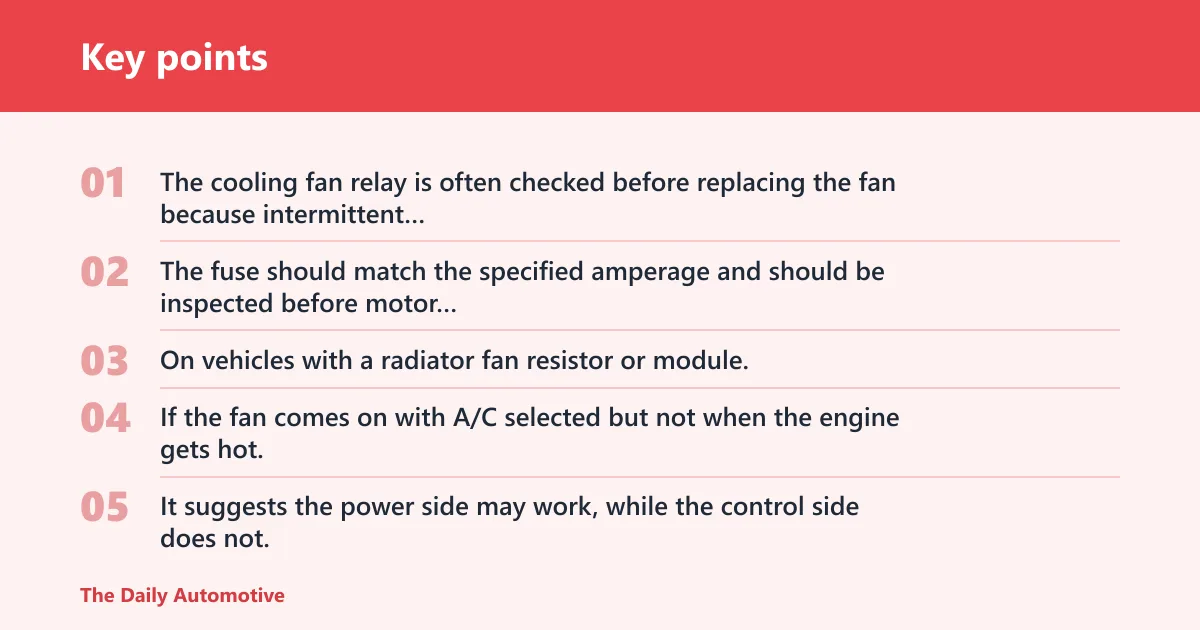
The cooling fan relay is often checked before replacing the fan because intermittent relay failure can mimic a dead motor. The fuse should match the specified amperage and should be inspected before motor replacement. On vehicles with a radiator fan resistor or module, a bad control unit can stop low-speed operation first, which is why the fan may still work only at high speed.
If the fan comes on with A/C selected but not when the engine gets hot, that is a useful clue. It suggests the power side may work, while the control side does not. In that case, relay, sensor, or module testing belongs ahead of a full assembly purchase.
Coolant-temperature sensor and thermostat overlap
The engine coolant temperature sensor signals the ECU, and a faulty reading can trigger late fan engagement or no fan command at all. The thermostat also sits in the diagnosis tree because it regulates coolant flow. If it sticks closed, the engine can overheat even while the fan is healthy.
Thermostat opening temperature is engine-specific, so do not use a universal guess. A hot upper radiator hose and a cold lower hose can point to thermostat or flow issues, while a fan complaint with normal coolant flow can still come back to the sensor.
Radiator and water-pump problems that look similar
The radiator rejects heat with help from the fan, so a clogged or leaking radiator can overload the cooling system. Fitment depends on the vehicle, and a damaged core can make a good fan look weak. A water pump circulates coolant; bearing noise, leakage, or an impeller problem can produce the same overheating complaint.
Suppose a midsize SUV overheats at highway speed and at idle, and the fan still responds to a scan-tool command. That pushes the diagnosis toward thermostat, radiator, or water-pump issues rather than a failed fan assembly. Replacing the fan first would be money spent in the wrong place.
How much does replacement cost?
Replacement cost depends on whether you need a motor, a relay, a module, or the entire assembly, and it changes with vehicle layout. Parts-only pricing often starts low for a fuse or relay and rises sharply for OE-style dual-fan assemblies. Labor varies just as much because some fans sit behind the radiator support.
Parts-only ranges by fan type
For simple repairs, a relay or fuse may cost little more than a small parts bill. A standalone fan motor is usually more than a fuse but less than a full OE-fit assembly. Dual-fan units, shrouded assemblies, and OE direct-fit parts usually cost more because the motor, blade, and housing come together.
Labor differences for easy and tight-fit installs
A straightforward fan swap on a vehicle with room in front of the engine can be a moderate job. Tight-fit cars may need trim tools, screwdrivers, hose clamp pliers, and a socket set to remove covers, grilles, ducts, or shrouds. Torque specs matter when the listing or service data calls them out.
Shop labor should include diagnosis when the symptom is unclear. If the quote jumps straight to a fan assembly without testing the fuse, relay, and scan data, ask for the failure path in writing. That is the best way to avoid paying for a part that was never the problem.
Which fan part fits your car?
Fitment is the part most buyers get wrong. You need the right OE match by make, model, engine, and cooling package, plus the correct connector and shroud shape. A direct-fit assembly is usually the safest choice when the old fan module, blade, and housing are all worn or damaged.
OE, direct-fit, and aftermarket assemblies
OE assemblies are built to the original vehicle spec. Direct-fit aftermarket parts aim to match the factory layout and connector style, while generic aftermarket parts may require more checking. If the vehicle uses a dual-fan system or a multi-speed module, confirm the part listing for your exact engine and trim.
UI Distribution lists “COOLING FAN” under accessories and says it supplies gear for “cars, trucks, boats, motorcycles, ATVs & UTVs.” That broader catalog approach is useful only if the exact part number still matches your vehicle. Fitment beats category name every time.
What to match on the listing
Match the make, model, year, engine code if listed, connector type, shroud shape, and whether the car uses one fan or two. Check whether the listing includes the motor alone or the full radiator cooling fan assembly. If the system uses a resistor or module, confirm whether it is part of the assembly or sold separately.
When to buy the whole assembly instead of a motor
Buy the whole assembly when the blade, shroud, motor, or mounting points are damaged, or when the seller only supports the complete unit for your car. That is also the safer route on OE-fitment jobs where the old fan is noisy, cracked, or out of balance. If the motor alone is sold, verify that the blade and housing can be reused safely.
What tools do I need to replace a cooling fan?
Most fan replacements call for basic hand tools: a socket set, trim tools, screwdrivers, and hose clamp pliers. Some vehicles also need a torque wrench if the service data gives a tightening spec. A scan tool or OBD-II diagnostic code reader is useful before and after the repair to confirm fan command and temperature data.
- Disconnect the battery if the vehicle procedure calls for it.
- Remove covers, ducts, or trim panels that block access.
- Unplug the fan connector and inspect for heat damage or corrosion.
- Check the fuse and relay before removing the assembly.
- Unbolt the shroud or fan frame and lift the unit out carefully.
- Install the replacement part, reconnect wiring, and restore all fasteners to spec.
- Clear codes if needed and verify fan operation with the engine warm and the A/C on.
Frequently asked questions
How do I know if my car cooling fan needs replacing?
Look for overheating at idle, a fan that never starts, or a fan that only works under one condition, such as with the A/C on. If the fuse, relay, sensor, and thermostat check out, and the motor still does not respond to a proper power test, the fan assembly is likely failing.
What are the signs of a bad radiator fan?
Common signs include rising coolant temperature in traffic, poor cooling with the A/C on, noisy bearings, cracked blades, and a fan that starts late or not at all. A bad radiator fan can also make the engine cool normally on the highway but struggle in stop-and-go traffic.
How much does a car engine cooling fan replacement cost?
Costs vary by vehicle and by whether you are buying a relay, motor, module, or full assembly. A simple electrical part may cost far less than a dual-fan OE-fit unit, and labor can swing widely if the fan sits behind the radiator support or requires trim removal.
Can I drive with a cooling fan not working?
Short trips may be possible, but it is a risk. If the fan fails in traffic or while idling with the A/C on, temperature can climb quickly. That can damage the engine, so the safer move is to stop driving until the cause is diagnosed and corrected.
Why does my cooling fan stay on after I turn the car off?
Some cars keep the fan running for a few minutes after shutdown when the car was hot. If it runs much longer than that, or comes on when the engine is cold, the coolant-temperature sensor, relay, or control module may be sending the wrong signal.
Which cooling fan type fits my car?
Check the make, model, year, engine, connector, and whether your vehicle uses a single-fan or dual-fan layout. OE fitment matters more than the label on the box. When in doubt, match the original part number or confirm the listing against your VIN and engine package.
Products related to this article
Sponsored / affiliate links. As an Amazon Associate I earn from qualifying purchases. I may earn additional commission from eligible campaigns.