Best Plastic Paints for Cars: We Compared
For most DIY plastic paint jobs, choose Rust-Oleum 251574 for factory-like exterior trim, then choose VHT High Temperature Plastic Paint for hotter or more flex-prone parts. If the part flexes, gets hot, or sees abrasion, pick the tougher coating. Skipping proper cleaning or using the wrong coating leads to peeling, blotchy color, and a full redo.
Quick comparison
| Product | Badge | Best for | Price | ||
|---|---|---|---|---|---|
 |
Rust-Oleum 2X Automotive Enamel 5-in-1 Spray Paint, GlossRust-Oleum | Our pick | $9.49
Price as of 24 Oct 2026
|
View | |
 |
Plasti Dip Black Multi-Purpose Rubber Coating Spray, 11 ozPlasti Dip | Also great | 2-pack · Plasti Dip · Black Rubber Coating | $25.49
Price as of 24 Oct 2026
|
View |
 |
Dupli-Color Trim & Bumper Paint, Black, 11 ozDupli-Color | Also great | 11 oz · Dupli-Color · Black Trim Paint | $15.97
Price as of 24 Oct 2026
|
View |
The core trade-off is simple: Rust-Oleum 251574 is often a better fit for exterior trim refreshes, while VHT High Temperature Plastic Paint is generally the safer pick when heat or repeated flex can break a coating down.
If you want a broader black trim option for mixed substrates, Dupli-Color Trim & Bumper Paint fits that middle ground. It is still a trim paint, though, so the part and the prep matter more than the label on the can.
How we chose
We compared the products against the failure modes that matter on cars: flex, heat, UV exposure, chemical exposure, and abrasion. We also looked at substrate fit, prep burden, finish, and usable coverage.
That means a bumper, an engine-bay edge, and a dashboard panel are not treated as the same job. They fail for different reasons, so the best product changes with the part.
- Compatibility with common automotive plastics and mixed substrates
- Prep burden and whether adhesion promoter is needed
- Heat, UV, and chemical resistance
- Finish match: matte, satin, or gloss
- Coverage and can size
Rust-Oleum 251574 Automotive Trim & Bumper Spray Paint: best for factory-like exterior trim
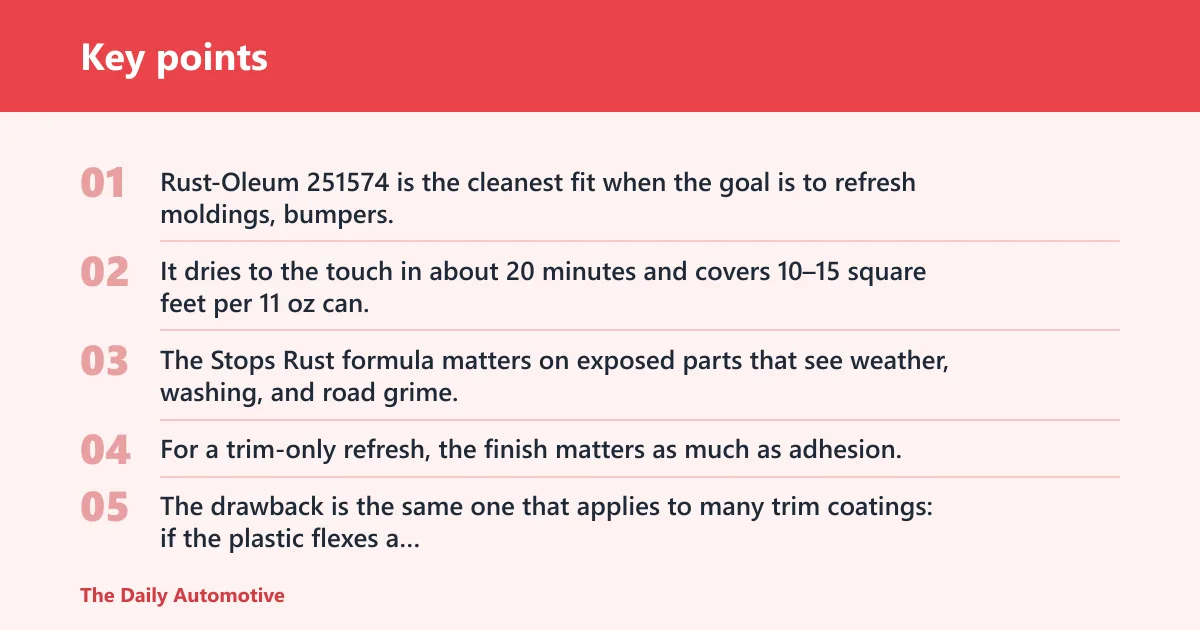
Rust-Oleum 251574 is the cleanest fit when the goal is to refresh moldings, bumpers, rub strips, and metal trim without changing the character of the vehicle. It dries to the touch in about 20 minutes and covers 10–15 square feet per 11 oz can, so it works well for localized exterior trim jobs.
The Stops Rust formula matters on exposed parts that see weather, washing, and road grime. For a trim-only refresh, the finish matters as much as adhesion, and this is aimed at that use case rather than at high-heat or highly flexible parts.
The drawback is the same one that applies to many trim coatings: if the plastic flexes a lot, if the surface is contaminated, or if you lay it on too heavy, the coating can fail early. Heavy coats are especially risky on textured trim and bumper plastic.
On coverage, the math is straightforward. At the listed range, one can goes farther on small trim pieces than on an entire bumper cover. For a budget-minded repair, that makes it easier to control material waste on partial panels.
VHT High Temperature Plastic Paint: best for heat-exposed plastic
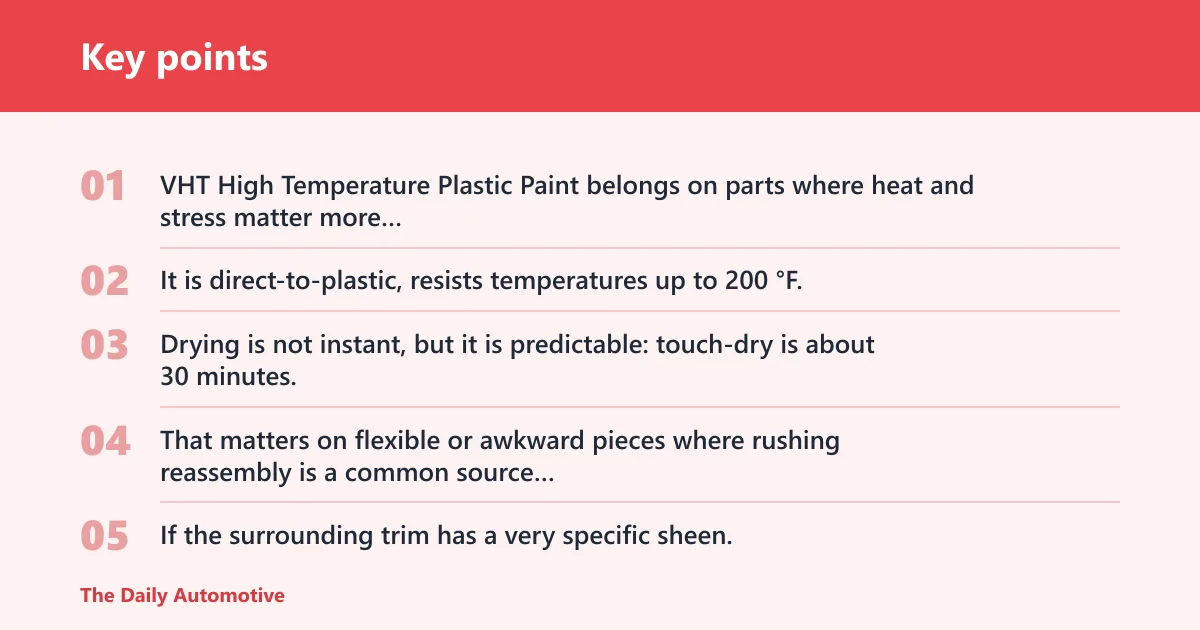
VHT High Temperature Plastic Paint belongs on parts where heat and stress matter more than cosmetic match alone. It is direct-to-plastic, resists temperatures up to 200 °F, and is described as oil- and fluid-resistant, which makes it the better fit for parts that live closer to heat sources or get handled often.
Drying is not instant, but it is predictable: touch-dry is about 30 minutes, and the part can be handled after about an hour. That matters on flexible or awkward pieces where rushing reassembly is a common source of fingerprints, scuffs, and edge lift.
The drawback is finish matching. If the surrounding trim has a very specific sheen, a heat-focused coating may not blend as closely as a trim-specific paint. Surface contamination is another common failure point, especially on parts exposed to wax, silicone dressings, or oily residue.
For a common example, suppose a plastic engine-bay cover sits near warm hardware and a nearby trim panel flexes when clipped back in place. A coating built for heat and direct-to-plastic bonding is the safer bet than a general black spray meant mainly for cosmetic trim.
Which one should you buy?
Buy Rust-Oleum 251574 if you want a trim color refresh with a factory-like look and the part is mostly exterior trim, not a heat-soaked piece. Buy VHT High Temperature Plastic Paint if the part sees more heat or flex and you want a coating chosen for that stress, not just for color.
Choose by failure mode. If the likely problem is dull, faded, or mismatched trim, go with the trim spray. If the likely problem is heat, repeated flex, or fluid exposure, go with the high-temperature plastic paint.
There is a separate lane for interior plastics. A product like SEM Color Coat is often the better style match for flexible interior plastics and trim, but it usually asks for more prep and often an adhesion promoter. That makes it a different job from an exterior bumper repaint.
When the goal is surface color retention rather than coating thickness, a restorer or dye-infused product can make more sense than a paint. That is especially true for interior pieces where you want low sheen and less build-up.
Choose the right plastic coating in 60 seconds
| Part type | Plastic flexibility | Heat exposure | Desired sheen | Required prep | Best product class | If it peels, streaks, or fades |
|---|---|---|---|---|---|---|
| Exterior bumper cover | Moderate to high | Low to moderate | Satin or trim-matched black | Clean, degrease, scuff; adhesion promoter if the substrate calls for it | Trim and bumper spray | Peeling points to poor cleaning or too much flex; streaking points to uneven coats; fading points to weak UV resistance |
| Molding, rub strip, mirror cap | Low to moderate | Low | Factory-like satin or semi-gloss | Careful cleaning and light scuffing | Trim coating | Peeling usually means contamination; streaks usually mean heavy passes; fading usually means the wrong exterior-grade product |
| Warm engine-bay plastic | Moderate | Higher | Usually satin or low gloss | Thorough degrease and full dry-down before spraying | Heat-resistant plastic coating | Peeling points to heat or residue; streaking points to rushed coverage; fading points to the wrong product class |
| Interior dash trim or door panel | High | Low | Matte to OEM-style | Better prep and often adhesion promoter | Flexible interior coating or vinyl/fabric coating | Peeling usually means skipped prep; streaks usually mean incompatible texture; fading usually means the finish is too glossy or the product is not for interiors |
| Vinyl seat panel or soft interior piece | High | Low | Flat or low sheen | Clean and prep carefully; thin coats only | Vinyl and fabric coating | Peeling usually means the surface was not cleaned well; streaking usually means overapplication; fading usually means UV exposure without the right product |
Why flexible plastic changes the answer
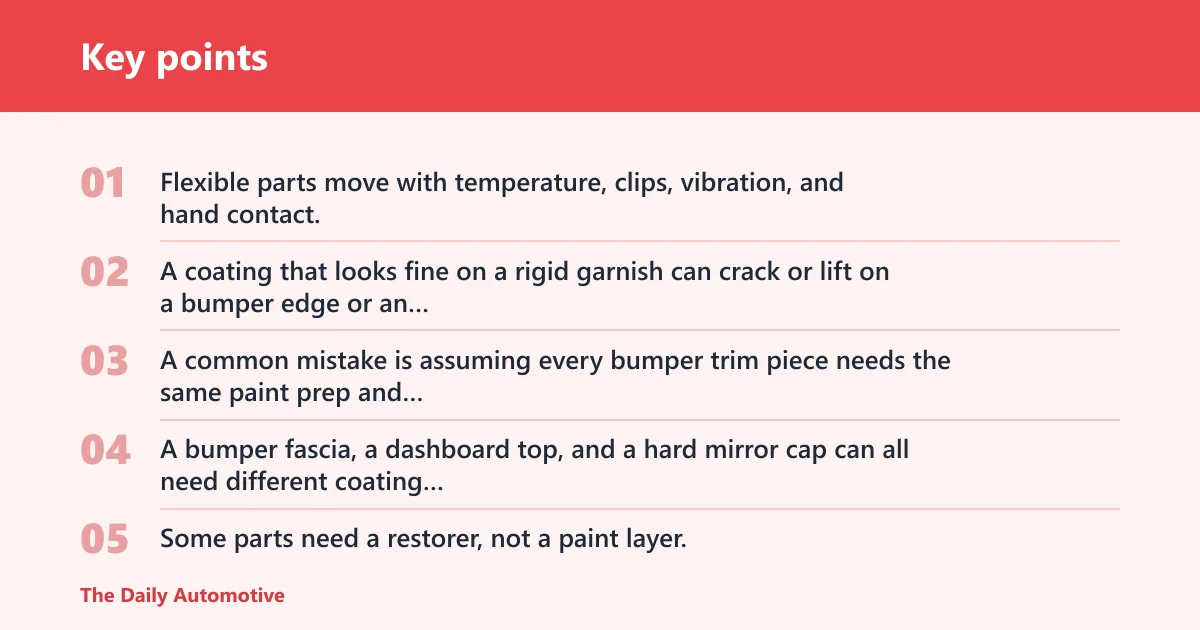
Flexible parts move with temperature, clips, vibration, and hand contact. A coating that looks fine on a rigid garnish can crack or lift on a bumper edge or an interior panel that flexes every time it is removed and reinstalled.
A common mistake is assuming every bumper trim piece needs the same paint prep and adhesion promoter. A bumper fascia, a dashboard top, and a hard mirror cap can all need different coating behavior even when they start from the same faded color.
When paint is the wrong tool
Some parts need a restorer, not a paint layer. If the part is already black and only looks chalky from UV exposure, a restorer can be the cleaner answer because it deals with appearance without building a new film that can chip later.
That is why the part’s job matters. A coating is for color and film build. A restorer is for surface refresh. A dye-infused product is better when you need the color to sink in on interior materials instead of sitting on top.
Do you need primer before painting car plastic trim?
Not always, but you do need the right prep. For some plastics and some coatings, primer is optional; for others, an adhesion promoter is the safer choice because paint failure usually starts with bond failure, not color choice. Clean, scuff, and degrease first.
The key is to avoid assuming that primer solves every substrate problem. If the plastic is slick, flexible, or has old dressing residue on it, paint can still peel even after a primer layer. Surface prep and product compatibility matter more than a generic extra coat.
Use primer or adhesion promoter when the label or substrate calls for it, especially on flexible interior plastics and bumper covers. If you are repainting a trim piece that already has a stable coating, a light prep may be enough.
Can you use regular spray paint on car plastic?
Sometimes, but it is a poor default choice. Regular spray paint can fail on trim and bumper plastics because many automotive plastics flex, shed contamination poorly, and need a coating designed to bond to that substrate. Generic enamel is not the same as plastic trim paint.
The riskiest pieces are soft or flexible bumpers, textured exterior trim, and interior panels that see repeated touch. Those parts can expose weakness in a coating quickly, especially if the can is not intended for automotive plastics.
If a product is labeled for plastic, that is better than a generic can, but it is still not a guarantee. Match the product to the part: trim paint for trim, flexible coating for flexible panels, and heat-resistant paint for warm components.
Which paint works best on flexible plastic car parts?
Flexible plastic calls for a coating that can move with the part. For exterior trim, a trim-focused coating can work if the plastic is only moderately flexible. For hotter or more stressed pieces, VHT High Temperature Plastic Paint is the better fit because it is made for direct-to-plastic use and resists heat.
For interior flexible plastics, a product like SEM Color Coat is often a stronger match, and vinyl-specific coatings can be better for softer surfaces such as dash panels or door cards. The finish should match the factory look, which is often flatter than an exterior gloss.
Look at the failure mode first. If the part bends and gets touched often, choose a flexible coating category. If it also runs warm, choose heat resistance over convenience.
How long does plastic paint take to dry on cars?
Dry time varies by product and coat thickness, but the listed numbers give a useful baseline. Rust-Oleum 251574 dries to the touch in about 20 minutes, Rust-Oleum 271903 dries to the touch in about 20 minutes, VHT High Temperature Plastic Paint is touch-dry in about 30 minutes, and can be handled after about an hour.
Dupli-Color ETB101000 dries to the touch in about 30 minutes and is handleable in an hour. Faster dry does not mean faster cure, though, so the part should still be handled carefully until the coating has had time to set.
Thin coats matter. Heavy coats can stay tacky longer, streak more easily, and print fingerprints into the finish. If the surface still feels soft, stop and let it set before reassembly.
What finish should I choose for car plastic paint: matte, satin, or gloss?
Choose the finish to match the surrounding trim, not the can marketing. Satin is the safest choice for most exterior trim because it looks close to factory plastic without looking dull. Matte works better on many interior parts. Gloss is best when the surrounding panel already has that shine.
Glossier products can make scuffs and texture stand out more. On textured bumpers or dash panels, that can look wrong even if the color match is good. A lower-sheen finish usually hides repair edges better.
If you are unsure, start by matching the factory sheen of the untouched adjacent panel. That gives you the best chance of a consistent result across the car.
Rust-Oleum 2X Automotive Enamel 5-in-1: best for mixed-substrate gloss jobs
Rust-Oleum 2X Automotive Enamel Custom Spray is the broadest utility pick in this group when the job includes metal, wood, or plastic and you want a gloss finish. The 5-in-1 dial helps you adjust the spray pattern, and the product is built with primer and adhesive properties in the can.
That makes it useful for mixed-substrate projects where one product has to cover more than a trim-only repair. It also has 2X coverage, which is helpful when you are trying to keep the coat even over larger areas.
The drawback is fit. A gloss enamel is not always the best visual match for factory exterior trim, and a general-purpose product can be the wrong choice for highly flexible automotive plastics. It is versatile, but versatility is not the same as perfect trim matching.
Dupli-Color Trim & Bumper Paint: best for a black trim refresh
Dupli-Color Trim & Bumper Paint is aimed squarely at black exterior trim work, and the manufacturer describes superior adhesion to plastic surfaces. That makes it a straightforward candidate for faded bumpers, trim strips, and other exterior black pieces that need a cleaner look.
Its strength is the purpose-built trim focus. It is not trying to be a general metal-and-wood spray, and that narrower brief is part of the appeal for car owners who want a black trim result rather than a multipurpose coating.
The drawback is that a trim-specific can still needs careful prep, and you should not treat it as a cure for soft, contaminated, or heavily flexing plastic. If the part moves a lot or carries heat, a more specialized product is the safer choice.
Frequently asked questions
What is the best plastic paint for cars that actually sticks to trim?
For exterior trim, Rust-Oleum 251574 is the clearest fit because it is made for moldings, bumpers, and rub strips and dries quickly enough for a trim refresh. For flexible interior plastics, a product like SEM Color Coat is often a better match, but it usually wants more prep and an adhesion promoter.
What’s the difference between trim paint and plastic restorer for cars?
Trim paint builds a new colored film on the surface. A restorer is better when the part is still black but looks faded or chalky from UV exposure. If the trim is only dull, a restorer may be the cleaner solution. If the coating is failing or color is gone, paint is the right tool.
Which plastic paint is best for bumpers and exterior trim?
Rust-Oleum 251574 is the best first choice for factory-like bumper and exterior trim work because it is made for those parts and covers 10–15 square feet per can. Dupli-Color Trim & Bumper Paint is another black trim option, but the better choice depends on sheen match and prep quality.
Products related to this article
Sponsored / affiliate links. As an Amazon Associate I earn from qualifying purchases. I may earn additional commission from eligible campaigns.