Root Auto Insurance Review: Is It Worth It?
Root auto insurance can fit safe drivers in states Root supports, but it is not the right pick for everyone because pricing, coverage limits, and eligibility change by driver and location. Miss those limits, and you can pay more than expected or find Root unavailable when you need it. This review covers what Root insures, where it operates, how its app-based pricing works, and which drivers are most likely to save.
Root auto insurance basics
Root is an app-based auto insurer that leans hard on driving behavior when it prices a policy. Root says drivers can get a quote, bind a policy, and get on the road in minutes, and it says policy management and claims handling happen through the mobile app.
How Root’s pricing model works
Root’s core pitch is simple: safer driving can mean a lower price. The same source says it uses a driving evaluation process and a 30-day test drive to set pricing, and it says safe drivers can save more when they share driving data. That means the first quote may not be the final number.
That matters because Root is not a plug-and-play choice for every shopper. If you drive gently, keep your phone habits simple, and live in one of Root’s supported states, the model may work in your favor. If your driving pattern looks risky, the app data can push pricing the other way.
What the mobile app handles after you buy
The same source says you can do just about anything from the app, including policy management and filing a claim. It also says filing a claim takes about 3 minutes. That convenience is a real draw for drivers who want a phone-first setup and fewer calls.
For drivers who dislike app-based insurance, that same design can be a drawback. If you want a phone call, a local agent, or a more traditional service flow, Root’s model may feel limiting rather than easy.
Is Root a good insurance company?

Root can be a good insurance company for a narrow group of shoppers: safe drivers in supported states who are comfortable with app-based service and want pricing tied to their driving data. It is a weaker fit for people who need broad discounts, want a large agent network, or may need more hands-on help after a claim.
Who may benefit from Root’s pricing model?
Root’s model may work best if you are a careful driver, spend less time on the road, and want pricing that reflects actual driving behavior rather than broad demographic assumptions. The same source says more than 3 million drivers have switched, which suggests the app-first model has appeal for at least some shoppers.
Say your commute is short, your braking is smooth, and you rarely drive at night. A telematics-based policy can sometimes reward that pattern more directly than a standard quote that relies mostly on age, vehicle, and ZIP code.
Where Root’s model can backfire
Root’s model can backfire if your driving data looks inconsistent, if you want the broadest possible discount menu, or if you need coverage in a state Root does not serve. NerdWallet says Root is more likely to decline coverage than other companies, so some shoppers may not even get to a final quote.
A common first-timer mistake is assuming a fast quote means a guaranteed policy. With Root, the app-based evaluation can still rule you out or change the price after it sees your driving pattern.
How complaint signals should shape your expectations
Complaint data matters because it hints at the service experience after the sale. The same source says Root’s complaint level is far more than expected. That does not mean every claim will be a problem, but it does mean you should be realistic about service speed, claims friction, and how much support you may need from an app instead of a person.
If you want insurer support that feels low-touch and self-directed, Root may still fit. If you expect frequent human guidance, those complaint signals should slow you down.
What does Root auto insurance cover?
Root generally covers the same broad auto insurance categories most shoppers expect, but the exact mix depends on your state and policy choices. At minimum, think in terms of liability coverage, possible medical coverage tied to state rules, and optional protections if you want more than bare-bones coverage.
Liability insurance and state minimums
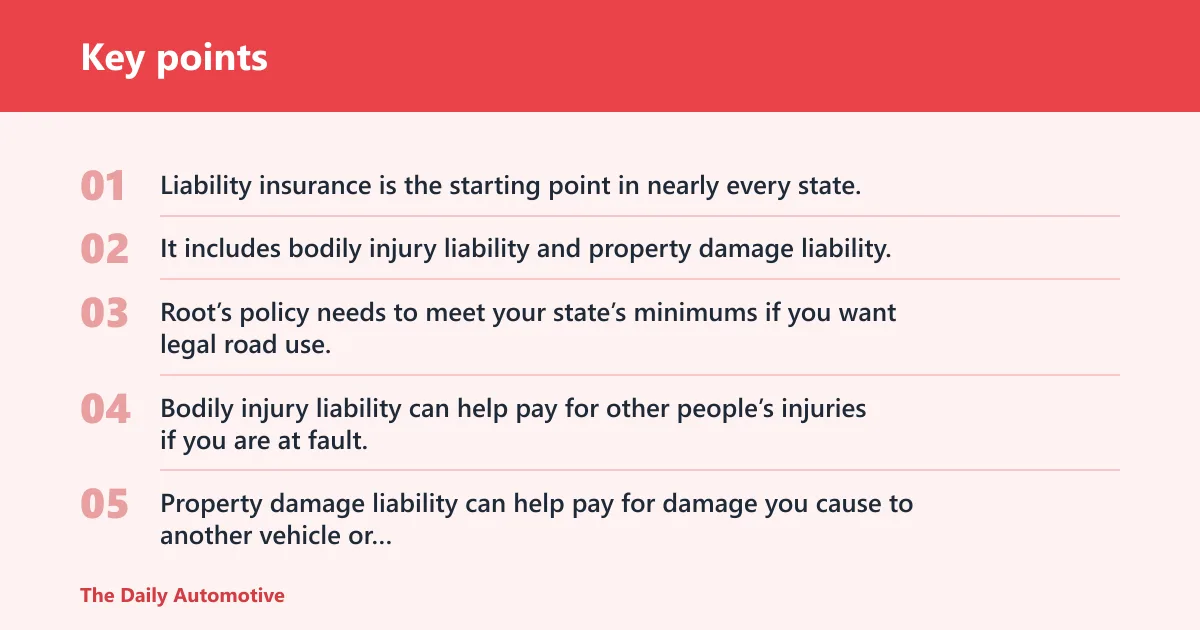
Liability insurance is the starting point in nearly every state. It includes bodily injury liability and property damage liability, and state minimum coverage rules set the floor that must be carried. Root’s policy needs to meet your state’s minimums if you want legal road use.
Bodily injury liability can help pay for other people’s injuries if you are at fault. Property damage liability can help pay for damage you cause to another vehicle or property. Neither one pays for your own car.
PIP and other state-specific coverage needs
Personal injury protection, or PIP, is a coverage type tied to state rules. It can help pay your own injuries and medical expenses, and in some states it may also help with lost wages, certain services, and funeral costs. It is required only in certain states, and it is not the same thing as a full no-fault legal system.
If you are shopping for minimum coverage only, Root may still work if it can meet your state’s floor. If you want full coverage, you need to check for collision and comprehensive options and confirm the policy fits the value of your vehicle.
Root driving score matrix
This matrix helps you judge fit, not hype. Root’s app-based pricing can reward safe driving, but the same model can hurt drivers who dislike phone-based management or need broader flexibility. The right answer depends on your profile, your state, and your coverage needs.
| Driver type | Root fit | Reason |
|---|---|---|
| Safe low-mileage driver | Strong fit | Low miles and calm driving behavior can line up well with Root’s data-based pricing. |
| Teen driver | Mixed fit | Teens can be expensive to insure, and app-based scoring may not offset that enough. |
| Driver with a lapse in coverage | Poor fit | Root may be more selective, and a lapse can make pricing and eligibility less favorable. |
| SR-22 need | Possible fit | Root is reported to offer SR-22 filing, but state rules and eligibility still control the outcome. |
| Phone-averse driver | Poor fit | Root is built around app management, so drivers who want mostly phone-based service may dislike it. |
| Full-coverage shopper | Mixed fit | Coverage may be available, but you still need to confirm limits, deductibles, and optional protections. |
| High-mileage commuter | Mixed to poor fit | More time on the road can work against a usage-based model, depending on the driving pattern. |
| Minimum-coverage buyer | Good fit if eligible | If Root can meet your state minimum and you want a lean policy, the setup can work. |
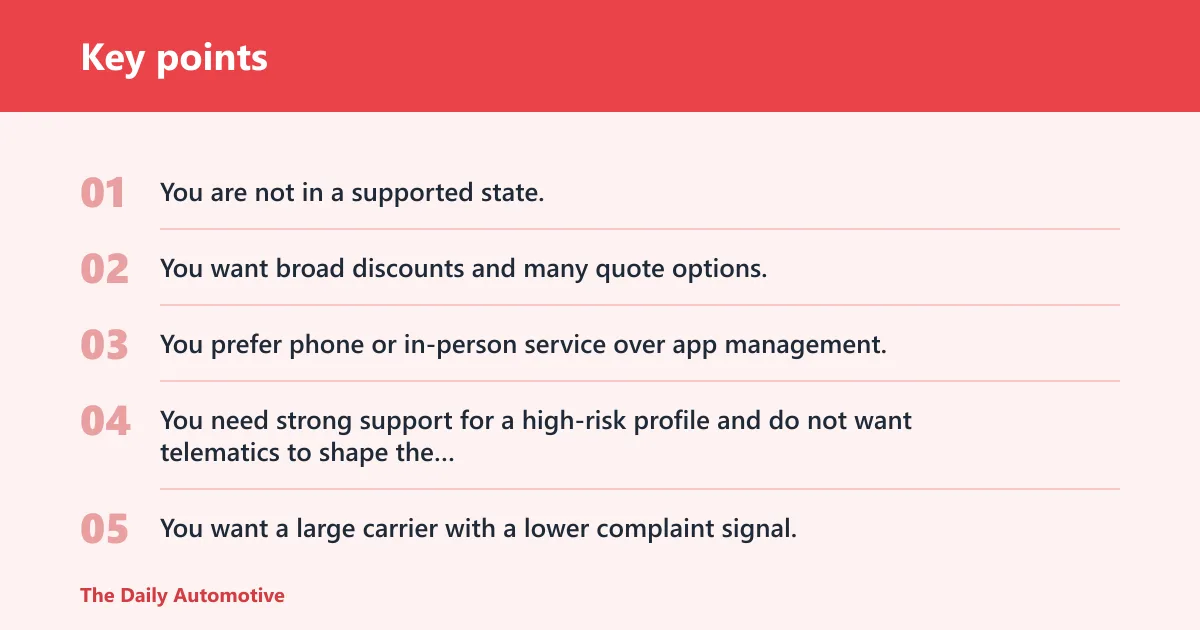
Red flags that point to a bad fit
- You are not in a supported state.
- You want broad discounts and many quote options.
- You prefer phone or in-person service over app management.
- You need strong support for a high-risk profile and do not want telematics to shape the price.
- You want a large carrier with a lower complaint signal.
Does Root have discounts?
Root has fewer discounts than many traditional insurers. The same source says Root has very few discounts, though it may offer an upfront payment discount depending on the state and a home or renters bundling discount. The discount menu is thinner than what many shoppers expect from older carriers.
Why the discount list is thinner than with many traditional insurers
Root’s pricing model is built around driving behavior more than a long list of separate discounts. That means the company leans on the app score and evaluation period rather than on dozens of small price breaks for education, occupation, loyalty, or similar factors.
That can be fine if you are a strong driver and want the price to reflect that. It can be frustrating if you usually save by stacking multiple traditional discounts.
When a smaller discount menu still works
A smaller discount menu can still work if your driving data is strong enough to produce a fair quote on its own. If you are mainly shopping for price and do not need much hand-holding, Root’s model may still be worth checking.
It is less appealing when your savings depend on several discounts coming together. In that case, a more traditional insurer may have more ways to lower the bill.
What states does Root auto insurance offer coverage in?
Root is not available everywhere. The same source says Root is available in multiple states, including AL, CA, FL, GA, IL, OH, TX, VA, and WI.
If your state is not on that list, Root is off the table before price, coverage, or discounts even matter. That makes availability a first-step filter, not a footnote.
Exact state availability list
- AL
- AR
- AZ
- CA
- CO
- CT
- DE
- FL
- GA
- IA
- IL
- IN
- KS
- KY
- LA
- MD
- MN
- MO
- MS
- MT
- ND
- NE
- NJ
- NM
- NV
- OH
- OK
- OR
- PA
- SC
- TN
- TX
- UT
- VA
- WA
- WI
- WV
Why availability matters before you compare price
Some shoppers waste time comparing quotes from insurers that cannot write the policy where they live. With Root, the state list comes first because the app and pricing model are only useful if you can actually buy the policy.
That is especially important for drivers moving across state lines. A policy that works in one place may not be available in the next.
Can you file a claim in the Root app?
Yes. The same source says claims can be filed in the app, and it says filing a claim takes about 3 minutes. That is a major convenience point for drivers who want to handle the basics without calling in.
The practical question is not whether you can file in the app. It is whether app-only service is enough if the claim becomes messy, contested, or time-sensitive.
Frequently asked questions
Is root insurance a good insurance company?
Root can be a good insurance company for drivers who fit its model: safe, comfortable with app-based service, and located in a supported state. It is a weaker match for shoppers who need a wide discount menu, want more human support, or may not pass Root’s eligibility screen.
Is root car insurance good?
Root car insurance is good for some shoppers and a poor fit for others. Its value depends on how your driving data looks, whether your state is on the list, and whether you want a phone-first setup. Safe drivers and low-mileage users may get more out of it than others.
Why is root insurance so cheap?
Root’s lower prices can come from its app-based pricing model, which ties cost more closely to driving behavior. The same source says safe drivers can save more when they share driving data. That can produce a lower quote for some shoppers, but the tradeoff is stricter eligibility and less flexibility.
How does Root’s driving test work?
The same source says it uses a 30-day test drive to determine pricing. In practical terms, the app tracks driving behavior and uses that data to shape the rate. Because program details can vary by state and change over time, you should confirm the current evaluation rules during the quote process.
Products related to this article
Sponsored / affiliate links. As an Amazon Associate I earn from qualifying purchases. I may earn additional commission from eligible campaigns.