
Is Root Auto Insurance Worth It?
Root auto insurance is worth it only if you have a clean driving record, accept app-based pricing, and can live with fewer policy choices; otherwise a traditional insurer usually gives you steadier coverage and more discounts. Picking the wrong fit can raise your renewal price or leave you short on flexibility. This guide compares Root with mainstream insurers on price, eligibility, coverage, and savings tradeoffs.
Root auto insurance at a glance
Root is a usage-based auto insurer, so the quote depends on driving behavior collected through a smartphone app rather than a simple snapshot of age, ZIP code, and record alone. Root bases rates primarily on driving history, and its coverage availability varies by state, so the first step is checking whether you can even qualify before you compare price.
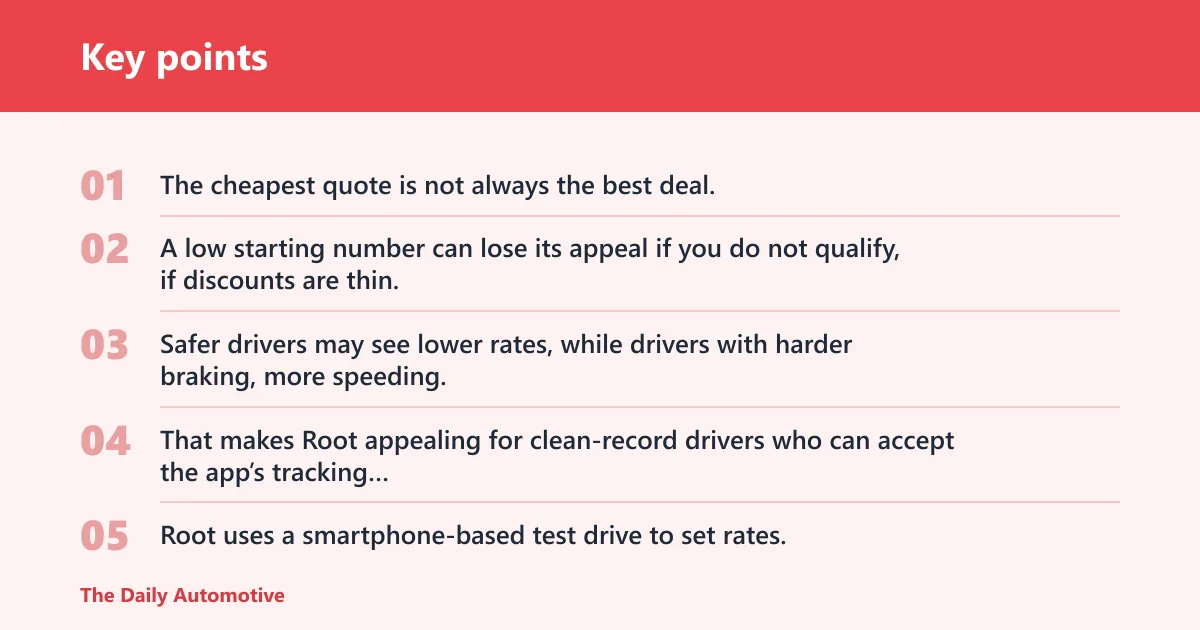
The cheapest quote is not always the best deal. A low starting number can lose its appeal if you do not qualify, if discounts are thin, if your household needs several policy tweaks, or if your state limits the coverages you want.
What Root is and how usage-based pricing works
Root’s model rewards safer driving habits. Safer drivers may see lower rates, while drivers with harder braking, more speeding, more mileage, or less predictable trip patterns can end up priced higher. That makes Root appealing for clean-record drivers who can accept the app’s tracking rules.
Where the app-driven quote process fits in the decision
Root uses a smartphone-based test drive to set rates, and it monitors driving behavior for up to four weeks. The average Root test drive takes three weeks. That means your final quote depends on what the app records during that period, not just on a static application form. (Caranddriver)
Why the cheapest quote is not always the best deal
Root can look inexpensive before you account for eligibility friction, state-specific limits, and narrow discounts. If you need several add-ons, want broad price flexibility, or expect to shop around at renewal, a traditional carrier may be more useful even when its starting quote is higher.
How Root prices drivers
Root’s pricing leans on the driving sample collected during the test drive. That matters because a clean record and low-risk habits are the main fit for the company’s model, while more complicated driving patterns can push the quote away from the initial estimate or shut the door altogether.
Root auto insurance worth scorecard
Root uses a smartphone-based test drive to set rates, and the app gives feedback through a Driver Scorecard. That in-app score matters because it shows where habits may help or hurt the quote outcome, giving you a chance to see whether the insurer views your driving as low risk.
Driving factors Root watches during quoting
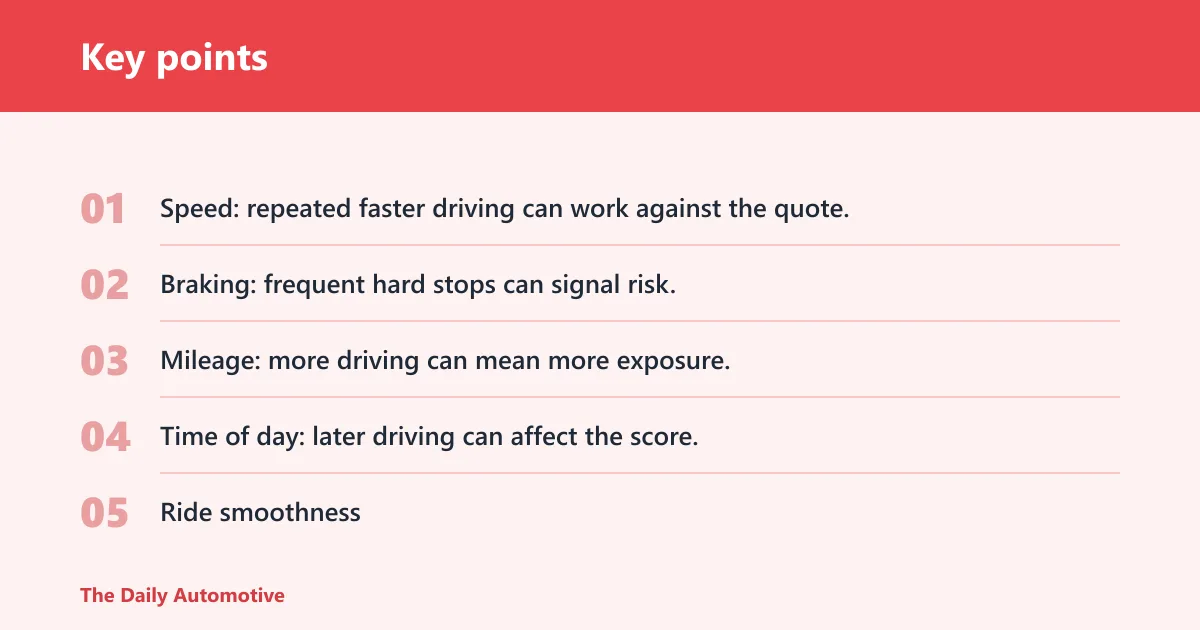
Root’s app may measure factors such as speed, braking, mileage, time of day, ride smoothness, and turn speed during quoting. Those signals can matter more than a driver expects, especially if the car is used for irregular trips or late-night travel.
- Speed: repeated faster driving can work against the quote.
- Braking: frequent hard stops can signal risk.
- Mileage: more driving can mean more exposure.
- Time of day: later driving can affect the score.
- Ride smoothness: jerky inputs may count against you.
- Turn speed: sharp turns can matter in the rating.
Why clean records and lower-risk habits matter most
Drivers with clean records are the best fit because Root bases rates primarily on driving history. That works well for a safe commuter who puts on modest miles, but it can be a poor deal for anyone whose daily routine naturally creates more risk signals, even if the overall record is decent.
Say your 42-mile round-trip commute is mostly steady highway driving, but you also take two late-night errands each week. Root may like the steady miles and clean braking, yet those night trips can still change the app score enough to affect the quote.
What coverage and discounts can you get?
Root offers standard auto coverage types, but the menu is narrower than many large insurers and the discount stack is thinner. That makes coverage selection and payment structure more important, because the savings you see at quote time may not survive once you tailor the policy.
Common policy types
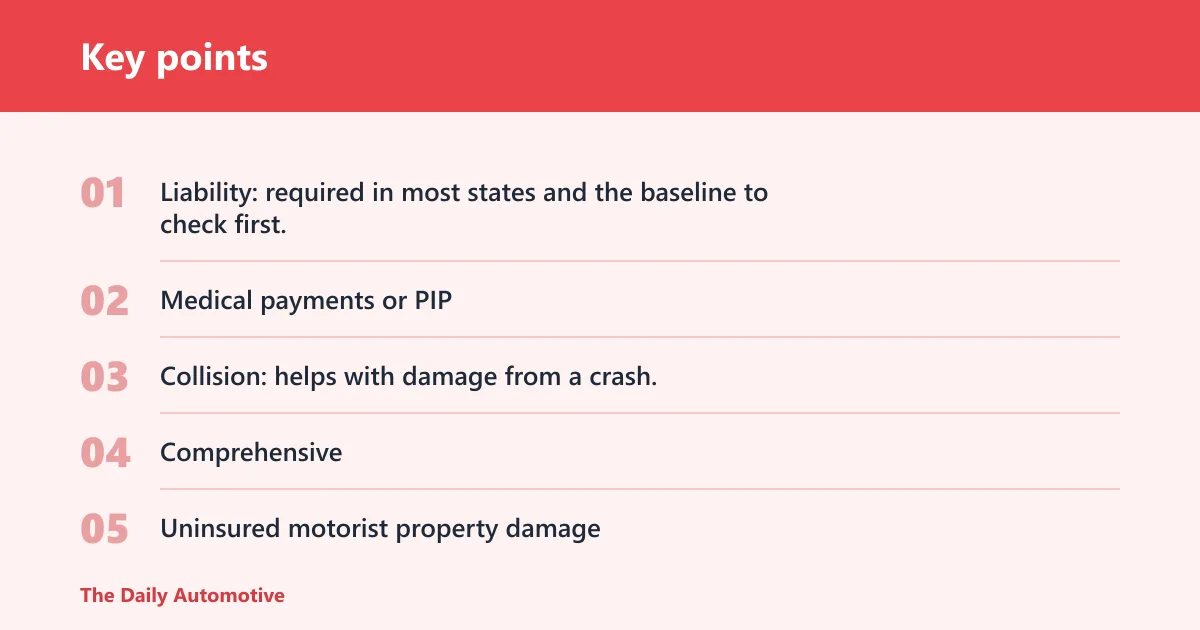
Root’s coverage options may include liability, medical payments or PIP depending on state, collision, comprehensive, uninsured motorist property damage, roadside assistance, and rental coverage. Coverage availability varies by state, so the exact mix can differ from one driver to another.
- Liability: required in most states and the baseline to check first.
- Medical payments or PIP: availability depends on where you live.
- Collision: helps with damage from a crash.
- Comprehensive: covers non-collision losses like theft or weather damage.
- Uninsured motorist property damage: matters if the other driver lacks coverage.
Add-ons such as roadside assistance, rental coverage, and uninsured motorist property damage
Add-ons can be useful, but they also expose a fit issue: if you need a fuller package, Root may be less flexible than a traditional carrier. Rental coverage and roadside assistance are helpful, yet buyers who want more tailored protection should compare those limits carefully against larger insurers.
Discount limits, upfront payment, and bundle options
NerdWallet says Root has very few discounts. An upfront payment may help in some states, and bundling home or renters insurance can help in some cases, but the overall discount picture remains limited compared with competitors. That matters most for families that rely on stacking savings to keep premiums manageable.
Is Root good for your state and situation?
Root can be a good fit in the right state and for the right driver, but it is not a universal buy. The same source says Root is available in a specific set of states, may decline more applicants than other companies, and has far more than expected complaints, so eligibility and service quality both deserve attention before you commit.
State availability and eligibility checks
Root is available only in selected states, not nationwide, so you should verify availability before you quote. That is not a small detail: if the company does not write policies where you live, the rest of the comparison does not matter.
When Root may decline higher-risk drivers
Root may decline drivers it considers higher risk. That is part of the model, not a side issue. If your record includes frequent claims, multiple violations, or other risk factors, the app-driven pricing process may never get to the point where Root looks competitive.
Why household setup and customization needs can change the answer
Households with teen drivers, multi-car families, or buyers who need many customizations tend to see Root lose appeal. The policy may still be available, but the value proposition weakens when you need broader tailoring, multiple vehicles, or more predictable underwriting. A common first-timer mistake is choosing the lowest quote before checking whether every driver and every car can be added cleanly.
Root insurance decision matrix
This decision matrix is the quickest way to judge whether Root’s lower quote is likely to survive real-life needs. The right answer depends less on the sticker price and more on how much app tracking, state friction, and limited discounting you can tolerate.
| Driver profile | Likely Root fit | Likely downside | Key coverage risk | Compare against |
|---|---|---|---|---|
| Clean low-mileage commuter | Strong | App tracking and a waiting period before the final quote | Coverage details may still vary by state | Low-cost traditional carriers and other usage-based insurers |
| Teen household | Weak | Higher-risk scoring and limited discount flexibility | Pricing can jump if the teen drives at risky times | Large insurers with teen-driver discounts and broader bundling |
| Multi-car family | Mixed | Less room for package savings and policy customization | Multiple-driver administration can be awkward | Traditional carriers with multi-vehicle and home bundle savings |
| High-risk driver | Poor | Root may decline more applicants than other companies | SR-22 needs and prior violations can narrow options | Insurers that specialize in nonstandard or high-risk policies |
| Minimum-coverage buyer | Mixed | Limited discounts can erase the appeal of a bare-bones quote | State-required protections may differ | Budget carriers and local insurers with lower minimum-policy rates |
| Full-coverage shopper | Mixed to weak | Add-ons and coverage limits may be less flexible | Comprehensive, collision, and rental coverage can add up fast | Major carriers with stronger package pricing and more options |
Choose Root if… / Choose a competitor if…
Root may be more likely to save money for drivers with a clean record who drive relatively few miles, can complete the test drive, and live in a state where the company writes policies. It can also make sense if you want a digital quote process and do not need a long list of discounts or add-ons.
Choose a competitor if you have teen drivers, multiple cars, a complicated coverage setup, or a history that could make Root decline you. Also lean away from Root if you want more predictable pricing at renewal, broader bundling, or a policy that does not depend so heavily on app scoring.
- Check whether Root is available in your state.
- Confirm that your driving pattern fits the app model.
- Price the same coverage limits with at least two traditional insurers.
- Compare any discount you can actually keep after bundling and add-ons.
- Choose the policy that still works at renewal, not only at quote time.
Frequently asked questions
Is Root good car insurance?
Root may be a good car insurance option for low-risk drivers who accept app-based pricing and do not need many discounts or policy customizations. It is less compelling for families, high-risk drivers, and shoppers who want the broad savings menu and policy flexibility of a traditional insurer.
Is Root car insurance reliable?
Root’s digital experience is above average, but reliability is not only about the app. The same source says Root’s complaint volume is far higher than expected, which is a warning sign for service quality. If you care about claims and support as much as price, compare alternatives carefully.
Is Root auto insurance legit?
Yes. Root Insurance Company is a real American insurance startup that sells auto insurance in selected states. The practical question is whether it is the right fit for your driving profile, state, and coverage needs, not whether the company is legitimate.
Is Root auto insurance good Reddit?
Reddit can be useful for spotting recurring complaints about app tracking, underwriting friction, or renewal surprises, but it is not a substitute for a quote comparison. Treat those threads as anecdotal service feedback, then verify the policy details, state availability, and final price yourself.
How good is Root insurance?
Root is good when its main strength lines up with your profile: clean driving, relatively low mileage, and comfort with a smartphone test drive. It is weaker when you need many discounts, need to insure a complicated household, or want a more predictable traditional-policy structure.
Is Root a good insurance?
Root can be a good insurance option if the app score works in your favor and your state offers the coverages you need. It is not a one-size-fits-all bargain, though, and the value can fade once you factor in limited discounts, possible declinations, and narrower policy flexibility.
Products related to this article
Sponsored / affiliate links. As an Amazon Associate I earn from qualifying purchases. I may earn additional commission from eligible campaigns.