Do You Pay Sales Tax on a Private Car Sale in Most States?
Usually yes: you pay sales or use tax when you register the private-sale car with the agency that handles vehicle titling and registration in your state, and the tax is based on the taxable purchase price or fair market value if the price is too low. Missing the right paperwork can trigger a higher tax bill, delayed registration, or a reassessment. This guide explains when the tax is due, what amount the state uses, and which documents change the calculation.
Taxes are collected at registration
In many states, yes. State sales tax often applies to used cars bought from private sellers, and the state usually collects it at registration instead of at the cash handoff. Some states also add local tax, so the amount due can be higher than the headline state rate.
The key point is that a private-party sale is still a taxable vehicle transfer in many places. The seller usually does not collect tax at the sale itself. Instead, the state agency that handles title and registration uses your paperwork to decide what you owe.
When the DMV collects tax instead of the seller
The registration step is where the tax bill often appears. If you try to title the car without paying the required tax, the agency may hold the registration, limit your temporary tags, or ask for more proof of the sale price.
A state may also treat the transfer as a use-tax event if the car was bought elsewhere or if local rules require tax at the time of registration. That is why the final amount often depends less on the moment you hand over money and more on the papers you file afterward.
When tax is due at registration
In many states, the tax is collected when you register the car rather than on the day you buy it. The sale date, title transfer date, and registration date may not be the same, and that timing can matter if your temporary tags expire before you finish the registration step.
Sale date vs. title transfer date
The sale date on the bill of sale starts the paper trail, but the title transfer is what usually lets the state process the ownership change. If those dates do not line up, the clerk may ask for an explanation or additional documents before accepting the declared price.
A common first-timer mistake is waiting too long to register after buying the car. Suppose you buy a sedan on the 3rd, but wait three weeks to visit the registration office. If your temporary permit ends first, you can end up with a tax bill and a driving problem at the same time.
Temporary tags and timing problems
Temporary transit permits can let you drive the car home before paying tax and finishing registration, but they do not erase the tax. They only bridge the gap between the private sale and the registration visit, and the permit rules vary by state.
If you miss the registration deadline, the state may treat the paperwork as late and charge penalties or require extra forms. The longer the delay, the harder it can be to prove the original sale terms, especially if the bill of sale is thin or incomplete.
What the DMV taxes
The taxable amount is often the bill of sale price, but some states use market value or can challenge a sale price that looks too low. Local taxes can be added on top of state tax, and a low number on paper does not always control the final bill.
Purchase price versus market value
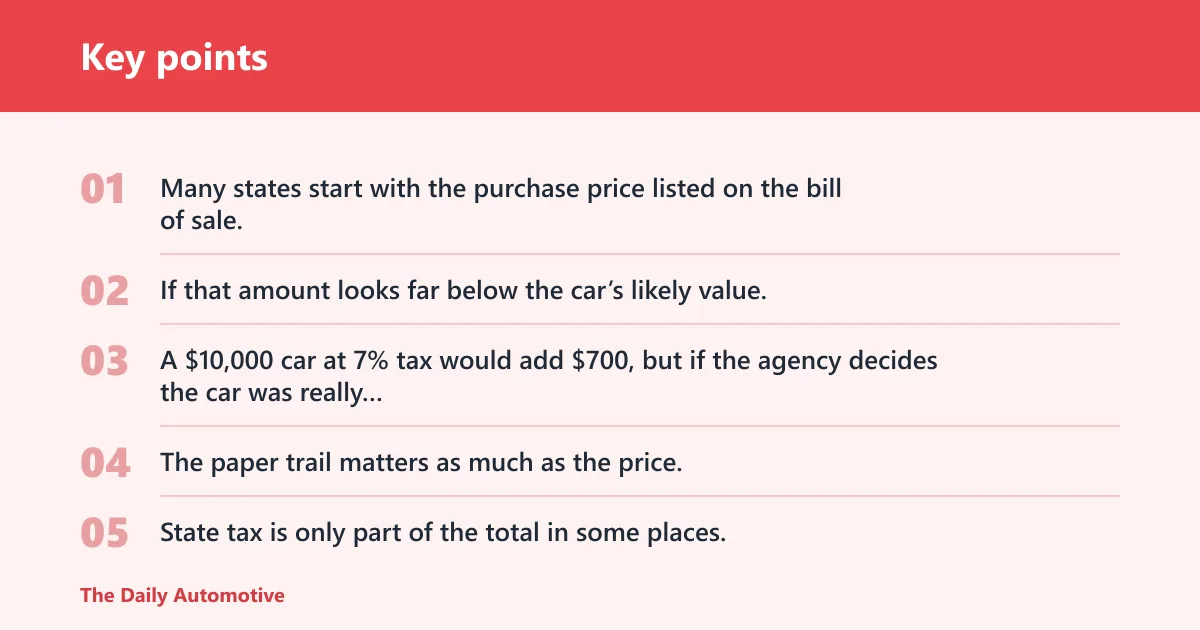
Many states start with the purchase price listed on the bill of sale. If that amount looks far below the car’s likely value, the agency may compare it with market data or its own valuation tables and tax the higher amount.
That is why a low bill of sale can be risky. A $10,000 car at 7% tax would add $700, but if the agency decides the car was really worth more, the tax can rise with the adjusted base. The paper trail matters as much as the price.
How county and local add-ons change the bill
State tax is only part of the total in some places. Local tax may also apply in addition to state tax, and those add-ons may depend on where you live or where the car is registered.
A sales tax calculator can help you estimate the bill before you buy, but it cannot replace the state-specific rules. Use it as a planning tool, then confirm the local surtax and registration requirements with your home state.
When a low bill of sale gets flagged
The agency may question a very low sale price if it does not fit the car’s age, condition, or market level. That review is more likely when the bill of sale lacks clear details, the title transfer does not match the price, or the buyer cannot explain why the number is so low.
Say your neighbor sells you a compact car for $500 and the title says the odometer shows 82,000 miles. If the car appears to be worth far more, the agency can ask for extra proof before accepting that taxable amount.
Pay sales tax checklist
Use this checklist before you go to the registration office. The right filing path depends on whether your state taxes at sale, at registration, or through a credit or adjustment later. The documents listed here are the ones that usually shape the taxable base and help the state accept your paperwork.
| State rule bucket | Tax due at sale vs. registration | Taxable base | Required documents | Common exemption | One red-flag scenario |
|---|---|---|---|---|---|
| Standard private-sale tax | Usually due at registration | Purchase price on the bill of sale | Title, bill of sale, odometer disclosure, ID, proof of residence | None unless state law says otherwise | Bill of sale says $1,000 for a car that usually sells for far more |
| Market-value review state | Due at registration | Higher of bill of sale price or DMV market value | Title, bill of sale, inspection or condition proof if requested | Low-value transfer with strong documentation | Sale price is far below book value and no reason is written down |
| Trade-in credit state | Often due at registration, with credit applied later in the process | Purchase price minus allowed trade-in credit | Title, bill of sale, trade-in records, dealer or state forms if required | Trade-in credit | Trying to claim a trade-in credit in a private sale with no qualifying dealer paperwork |
| Gift transfer state | Often due at registration unless exempt | Nominal consideration or state-assigned value | Title, gift affidavit, relationship proof, ID, residency documents | Family gift exemption | Unrelated friends call the deal a gift without relationship proof |
| Inherited vehicle state | Usually due at registration if no separate exemption applies | May be exempt or handled under estate rules | Title, death certificate, probate or estate documents, ID | Inheritance rule | Heir files only a bill of sale and skips estate paperwork |
| Out-of-state purchase state | Usually due when registering at home | Purchase price, minus any state-approved credit | Title, bill of sale, transit permit, proof of prior tax if any, residency documents | Credit for tax already paid elsewhere | Buyer assumes the other state’s tax means no home-state tax is due |
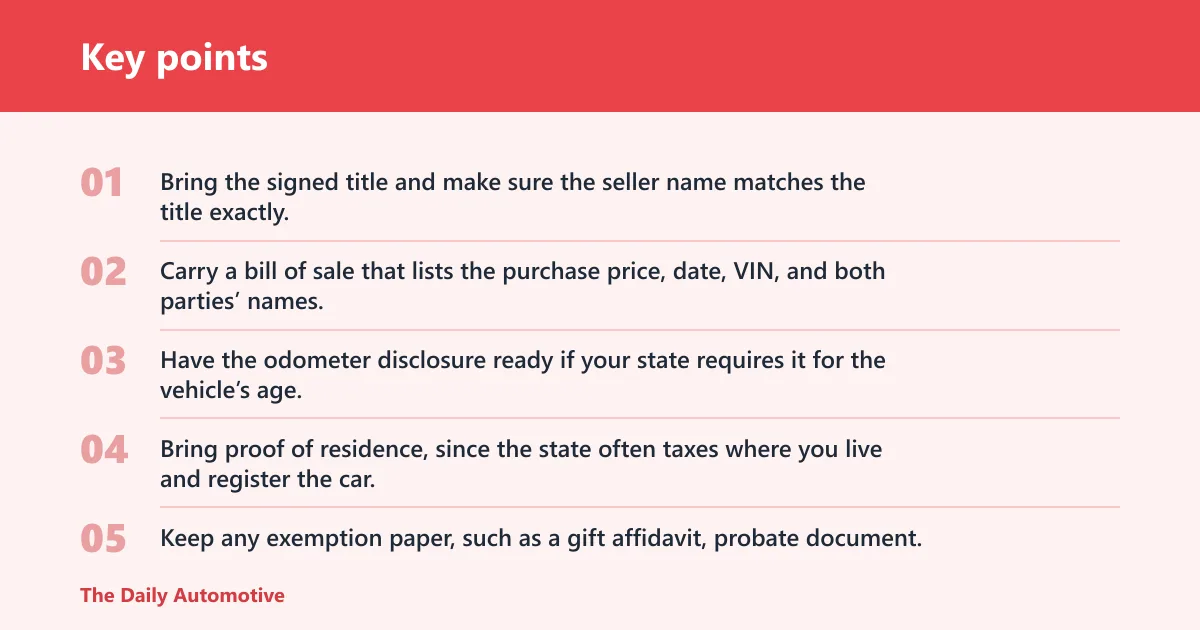
- Bring the signed title and make sure the seller name matches the title exactly.
- Carry a bill of sale that lists the purchase price, date, VIN, and both parties’ names.
- Have the odometer disclosure ready if your state requires it for the vehicle’s age.
- Bring proof of residence, since the state often taxes where you live and register the car.
- Keep any exemption paper, such as a gift affidavit, probate document, or tax receipt from another state.
Can a trade-in lower your tax?
Sometimes, but only if your state allows it. Some states permit a trade-in to reduce the taxable amount, but that rule is usually tied to dealer paperwork rather than a private-party sale.
In a private sale, there often is no dealer paperwork to support a trade-in credit. If the transaction is only between two individuals, the state may tax the full purchase price unless your state has a specific private-sale credit or offset rule.
Why private-party sales often lack trade-in treatment
Trade-in credits usually depend on a structured transaction and records that show both the purchase and the offsetting vehicle transfer. A private seller generally is not set up to document that credit the way a dealer would.
That means you should not assume a trade-in reduces the tax just because you swapped cars with another person. Check whether your state requires dealer involvement, separate forms, or a specific title transfer sequence before you count on the credit.
Are gifts and inherited cars taxed?
Gifted vehicles and inherited cars may qualify for exemptions or separate treatment, but the rules are different. A true family gift can be exempt in some states if you file the right affidavit, while an inherited car may be handled under estate rules instead of a standard sale.
Family transfer rules and affidavit requirements
Gift exemptions often depend on family relationship, not just the fact that no money changed hands. Some states want an affidavit or relationship proof, and some still tax nominal consideration even when the transfer is labeled a gift.
That is where people get tripped up. If two unrelated people call a private sale a gift, the state may reject the exemption and tax the transfer as a sale. The paperwork needs to match the legal category the state recognizes.
How inheritance is treated differently from a sale
Inheritance is usually not treated like a normal private sale because the transfer comes from an estate, not a buyer-seller bargain. The state may want a death certificate, probate records, or other estate documents before changing the title.
Do not treat inheritance and gifts as the same thing. They can follow different filing paths, different proof standards, and different tax outcomes. The state may exempt one and tax the other, depending on the registration rules.
What happens with an out-of-state purchase?
Your home state usually controls the tax when you register the car, even if you bought it from a private seller elsewhere. Buying across state lines does not automatically avoid tax, and any credit for tax paid elsewhere depends on your state’s rules.
Why your home state usually controls the tax
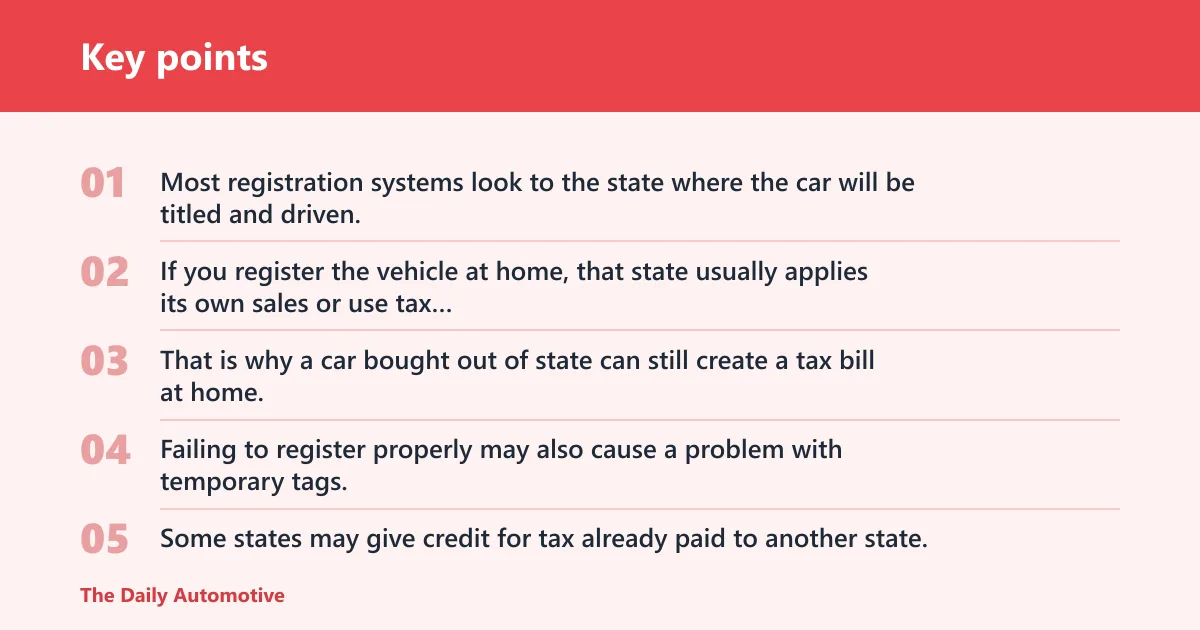
Most registration systems look to the state where the car will be titled and driven. If you register the vehicle at home, that state usually applies its own sales or use tax rate, not the rate from the seller’s state.
That is why a car bought out of state can still create a tax bill at home. Failing to register properly may also cause a problem with temporary tags, because the permit only covers the trip and the paperwork window, not a permanent tax exemption.
How credits for tax paid elsewhere may work
Some states may give credit for tax already paid to another state, but that credit is not automatic. You may need the prior tax receipt, the original bill of sale, and proof that the other state actually collected the tax.
Even then, the credit may be limited to what your home state would have charged. If the out-of-state tax was lower, you may owe the difference when you register.
Picture a buyer who picks up a used SUV in another state and drives it home on a temporary transit permit. The permit gets the vehicle across the border, but the tax question still comes back to the home office when registration starts.
Frequently asked questions
Do you pay sales tax when buying a car from a private seller?
Usually yes. Many states require sales tax on used cars bought from private sellers, and the tax is commonly collected when you register the car. The amount depends on state law, local add-ons, and the paperwork you bring to the registration office.
Do you have to pay sales tax when buying a car from a private seller?
In many states, yes. The timing and taxable base can vary. You may pay at registration, not at the handoff, and the state may use the bill of sale or market value if the stated price looks too low.
Do you pay sales tax when buying a used car from a private seller?
Usually yes. The fact that the car is used does not remove the tax in many states. What changes is the registration process, the supporting documents, and whether the state uses the purchase price, fair market value, or a special exemption.
Which states charge sales tax on private-party car sales?
Many states do, including California, Florida, Illinois, New York, and Texas. A few states do not have a general statewide sales tax, such as Alaska, Delaware, Montana, New Hampshire, and Oregon. Because rules can vary by state and sometimes by locality, you should check the state agency that handles title and registration before you close the sale.
Is sales tax paid at the DMV when I register the car?
Often yes. Many states collect the tax when you register the vehicle rather than at the sale itself. The clerk may ask for the title, bill of sale, odometer disclosure, and proof of residence before setting the final amount.
How do I estimate the tax before I buy the car?
Start with the purchase price, then check your state rate and any local tax. A sales tax calculator can give a quick estimate using the price and ZIP code, but it cannot replace the state’s rules on exemptions, credits, or market-value review.
What paperwork do I need so the state taxes the right amount?
Bring the signed title, a clear bill of sale, an odometer disclosure if required, and proof of residency. If the transfer is a gift, inheritance, or out-of-state purchase, add the specific documents that prove the exemption or prior tax payment.
Products related to this article
Sponsored / affiliate links. As an Amazon Associate I earn from qualifying purchases. I may earn additional commission from eligible campaigns.