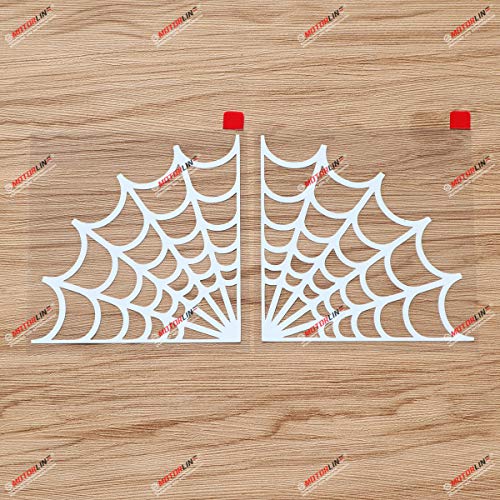
Spider Web Decals for Cars: Corner Window Stickers Compared
Spider web corner-window decals fit best when you match the design size to the glass corner: small triangular windows need compact webs, while larger corner glass can take fuller patterns without blocking sightlines. A poor fit can cover too much glass, wrinkle at the edges, or look out of place against tint. This guide compares how each option fits the glass, how much view it leaves open, and what to order for your window shape and style goal.
Spider web decal comparison table


This comparison focuses on the choices that change fit and day-to-day visibility. The main trade-off is simple: a larger, darker decal draws more attention, while a smaller or outlined web leaves more glass open and usually fits curved corner panes more easily.
| Decal size | Placement | Material/finish | Visibility impact | Left-right symmetry | Curved-glass risk | Install difficulty | Best-use scenario |
|---|---|---|---|---|---|---|---|
| Small, compact web | Quarter window | Die-cut vinyl, matte black | Low to moderate | Often sold in driver or passenger mirror versions | Low if the pane is only slightly curved | Easier | Small triangular corner glass and dark tint |
| Small to medium web | Rear side corner | Printed vinyl, black or white | Moderate | May need a mirrored image | Moderate on tighter curves | Moderate | Drivers who want visible art without filling the whole pane |
| Medium web with outline | Quarter window | Outlined die-cut vinyl, reflective option | Low by day, higher at night if reflective | Check whether the listing is side-specific | Moderate | Moderate | Drivers who want a cleaner look with less visual mass |
| Larger web | Rear side window | Printed or contour-cut vinyl | Moderate to high | Usually needs left-right matching | Higher on curved glass edges | Harder | Larger side glass with enough open area around the pattern |
What corner window decals
Corner window decals are small exterior vinyl stickers placed on the rear side window or quarter window. That placement matters because the available glass area is limited, the shape is often triangular or tapered, and the decal can affect rearward visibility as well as the car’s side profile.
Rear side window and quarter window placement
A rear quarter window usually has less usable surface area than the main side glass. That makes it a better home for compact web graphics than for oversized art. If the decal runs into a molded edge, trim line, or tight curve, the sticker is more likely to wrinkle or lift.
Small-format exterior vinyl
Most corner-window designs are small-format exterior vinyl. Exterior mounting can be useful on tinted or privacy glass because the graphic stays visible from outside without competing with the darker interior view. For temporary use, removable vinyl is usually the safer choice because it comes off later with less work.
Why placement changes visibility
The same spider web pattern can feel subtle on a quarter window and busy on a larger rear side pane. The closer the design sits to the driver’s line of sight, the more carefully you need to judge open glass area. Even a small decal can become distracting if it lands where you check mirrors or blind spots.
Which spider web style fits your glass?
Style choice changes more than appearance. Solid webs cover more of the glass and read louder from outside, while outlined webs leave more open space and usually look lighter on small panes. Finish matters too, especially when the window is already darkened with tint or privacy glass.
Solid versus outlined web art
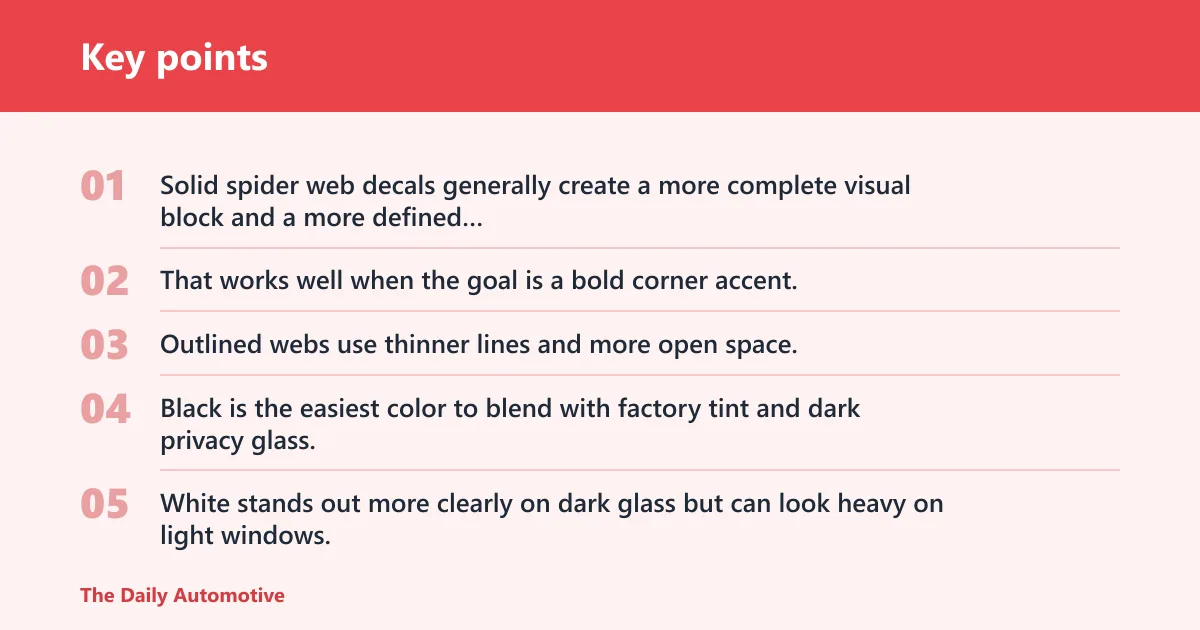
Solid spider web decals generally create a more complete visual block and a more defined graphic shape than outlined web designs. That works well when the goal is a bold corner accent. Outlined webs use thinner lines and more open space, so they can feel less crowded on small glass and are easier to match to curved panes.
Black, white, and reflective finishes
Black is the easiest color to blend with factory tint and dark privacy glass. White stands out more clearly on dark glass but can look heavy on light windows. Reflective vinyl adds nighttime flash, which can help the design stand out after dark, though it may not suit buyers who want the decal to fade into the glass during the day.
Die-cut versus printed vinyl
Die-cut vinyl is cut from a solid sheet, so the web lines and gaps are the actual shape of the material. That usually gives a cleaner edge and less visual clutter. Printed vinyl can carry more detailed art, but it may look denser, which matters when you only have a small corner window to work with.
Suppose your rear quarter window is a narrow triangle and the web graphic covers nearly the entire pane. In that case, the decal may look overfilled and leave little open glass for mirror checks. A smaller outlined version usually solves that without changing the theme.
How do tint and visibility affect your choice?
Tint level changes how much of the decal you can see from outside and how much it stands out from inside. If the car has dark privacy glass, a black web may disappear visually from the side, while a white or reflective option can stay readable without covering every inch of glass.
Inside versus outside mounting
Outside mounting is the safer default for most corner-window decals because it avoids tint-layer issues and keeps the adhesive off the film. Inside mounting can work on some windows, but it is less suitable when the tint is delicate, when the glass is heavily curved, or when the decal needs to sit flush near an edge.
Privacy glass and dark tint
Privacy glass and dark tint reduce how much background detail shows through. That can help a web decal stand out, but it also means a large graphic can seem more opaque than expected. Buyers should think about the percentage of visible open glass they want to keep, especially on the driver side.
Driver-seat sightline tradeoffs
Any corner decal should leave enough clear glass for lane changes, backing, and mirror checks. A small sticker placed high or rearward usually has less impact than one placed low in the corner where the eye naturally sweeps. If the design reaches into your normal sightline, downsize it.
A common first-timer mistake is ordering a bold web sized for a sedan’s large rear side window and then trying to put it on a small hatchback quarter window. The decal may fit physically, but it can crowd the glass, cover too much tint, and look uneven from the outside.
How should you measure the window before ordering?
Measure the exact glass area before you buy. Width, height, and the shape of the corner matter more than the car’s model name alone. A listing that says “fits most cars” is not enough if your window narrows sharply or has a pronounced curve near the edge.
Width and height in inches
Measure the usable glass in inches, not the full door opening. Record the widest safe width, the tallest safe height, and the narrowest point near the corner where the decal will sit. For a corner decal, the usable space is often smaller than it looks from across the car.
Trim allowance around the edges
Leave trim allowance so the design does not press into rubber seals or painted borders. A graphic that touches every edge is more likely to lift as the car flexes and the glass heats and cools. Extra border space also makes the finished decal look less cramped.
Driver-side and passenger-side mirror images
Check whether the seller offers left-right mirrored versions. A web can lean the wrong way if the design is not side-specific, especially on asymmetric corner glass. For best fit, match the listing photos to the actual side of the car and confirm whether the image is mirrored for driver or passenger use.
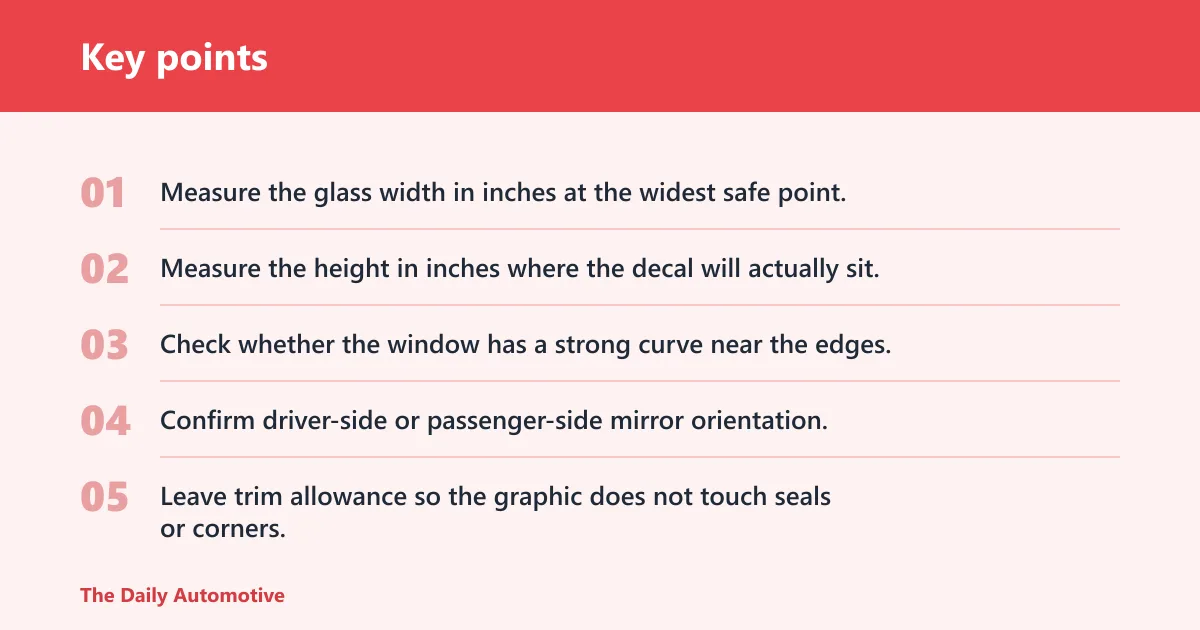
- Measure the glass width in inches at the widest safe point.
- Measure the height in inches where the decal will actually sit.
- Check whether the window has a strong curve near the edges.
- Confirm driver-side or passenger-side mirror orientation.
- Leave trim allowance so the graphic does not touch seals or corners.
- Compare the seller’s photos against your window shape and tint level.
What makes curved glass harder to cover?
Flat glass is the easiest surface for a corner decal. Slightly curved panes can still work well, but the more the glass bends toward the edge, the more likely the decal is to wrinkle, bridge, or lift. Small designs are usually more forgiving than wide graphics on the same window.
Flat versus slightly curved panes
Flat or near-flat quarter windows give the vinyl more even contact from center to edge. On curved glass, the outer edge of the decal has to follow a different shape than the middle. That mismatch is where air pockets and edge lift tend to start.
Edge lift and bubble risk
Edge lift is common when a decal is forced around a curve that is tighter than the material wants to follow. Bubbles can appear when the sticker is positioned too quickly or when the glass is not fully cleaned. Smaller decals reduce the amount of film that must stretch across the curve.
Squeegee fit on small glass
A soft squeegee helps press the vinyl into the window corner without trapping air. On a tiny pane, a full-size tool can be awkward, so a narrow edge is often easier to control. Masking tape can help hold the position before the final press-down.
Solid spider web decals vs outlined spider web decals
The right web style depends on how much glass you want to keep open. Solid designs make the corner look more graphic and can hide more of the pane, while outlined versions keep the window feeling lighter and are usually easier to live with on small or curved glass.
Choose solid spider web decals if…
Choose a solid web if you want the corner window to read as a strong visual accent, the glass is large enough to handle the coverage, and the tint is dark enough that the extra material will not make the window feel closed in. Solid graphics also work when the design is meant to be seen clearly from outside.
Choose outlined spider web decals if…
Choose an outlined web if the window is small, the glass is curved, or you want the style to stay understated. Outlined decals usually leave more clear glass, which can help with visibility and with fit on a quarter window that has limited flat area.
How do I install a corner window sticker without bubbles?
Clean glass, careful alignment, and slow pressure are the keys. Bubbles usually come from dust, oil, or a rushed application. If the decal is small and the corner is curved, a patient install matters even more because there is less room to reposition it after contact.
Basic tools to use
Use a squeegee, isopropyl alcohol, a microfiber cloth, and masking tape. Alcohol removes residue that soap and water may leave behind. Microfiber keeps lint off the surface. Masking tape helps you hinge or temporarily position the decal before committing to the final placement.
Step-by-step install order
- Wash the window and dry it fully.
- Wipe the area with isopropyl alcohol and a microfiber cloth.
- Dry-fit the decal against the glass and check the mirror orientation.
- Use masking tape to hold the top edge or create a hinge.
- Press from the center outward with a squeegee.
- Check the edges for lift and re-press any corner that needs more contact.
Common install mistakes
One common mistake is placing the decal before the glass is fully dry. Another is stretching the vinyl too hard around the corner, which can distort the web pattern. If the web has thin lines, a slight twist during placement becomes visible fast.
Are spider web decals removable without damaging tinted glass?
Most removable vinyl can come off without harming glass when it is removed carefully and with heat. The bigger concern is adhesive residue and the condition of the tint film, especially if the decal was mounted inside over delicate tint. Heat-assisted removal is safer than ripping the sticker away cold.
Heat-assisted removal and residue checks
Warm the decal gently so the adhesive softens, then lift an edge and peel slowly. After removal, check for residue and clear it with a tint-safe cleaner or a method approved for the film. If the window has interior tint, move slowly so you do not pull up the tint edge.
Paint-safe and tint-safe cautions
Outside-mounted decals stay away from tint film, which lowers the risk of damaging the shade layer during removal. On painted surfaces around the window, avoid sharp tools and harsh solvents. If the seller does not clearly describe the adhesive, confirm removability before ordering temporary graphics.
Choose spider web decals for rear side windows if… / Choose spider web decals for quarter windows if…
Rear side windows suit spider web decals when you want more graphic area and a better chance of fitting a medium-sized design without crowding the glass. Quarter windows suit smaller decals, especially when the pane is tight, triangular, or strongly curved. The window shape should decide the decal size, not the other way around.
Choose spider web decals for rear side windows if…
Choose the rear side window when the glass is large enough to show the web without blocking the view, the car has enough open side glass for a medium pattern, and you want a clearer visual statement. This is the better option when left-right symmetry is easy to match and the curve is mild.
Choose spider web decals for quarter windows if…
Choose the quarter window when the decal needs to stay compact, the tint is dark, or the glass has a sharp taper that would crowd a larger graphic. This is also the safer choice when your main goal is style without giving up much visible glass.
Frequently asked questions
What size spider web decal fits a car corner window?
The right size depends on the exact glass shape, but small corner windows usually need compact decals with some border space left around the edges. Measure width and height in inches, then leave trim allowance so the web does not touch the seal or run into the narrowest part of the pane.
Are corner window spider web stickers legal on car windows?
Legality depends on local window rules, tint rules, and how much of the glass the decal covers. A small exterior corner sticker is usually less risky than a full-window graphic, but you should still check local visibility requirements before ordering or installing one.
What material is best for corner window decals on cars?
Removable exterior vinyl is the safest starting point for most buyers because it suits temporary use and is easier to remove later. Die-cut vinyl usually gives a cleaner look, while printed vinyl can carry more detail. For dark tint, black or reflective finishes are common choices.
How do I compare spider web decals for rear side windows vs quarter windows?
Compare them by glass size, curve, and sightline. Rear side windows can usually take larger patterns, while quarter windows often need smaller or more open designs. If the quarter glass is sharply curved or narrow, the better choice is usually the smaller decal with more open space.
Will a spider web decal block my visibility from the driver seat?
A small decal may have little effect if it sits away from the main sightline, but a larger or darker design can reduce usable glass. The safest approach is to keep the sticker out of areas you use for lane changes, mirror checks, and reversing.
Products related to this article
Sponsored / affiliate links. As an Amazon Associate I earn from qualifying purchases. I may earn additional commission from eligible campaigns.