3 Best Stop Lights for Cars (2026): We Compared
The best stop light for a car depends on fitment: choose a direct-fit bulb for the cheapest OEM repair, a third brake light assembly for a cracked housing, or an LED upgrade if you want brighter output and lower power draw. Bad fitment or illegal output can leave your brake lights dim, trigger warning lights, or fail inspection. This guide compares bulb-based stop lights, high-mount assemblies, and LED upgrades by legality, fitment, and failure mode.
Quick comparison
| Product | Badge | Best for | Price | ||
|---|---|---|---|---|---|
 |
iBrightstar 1157 LED Bulb Red, BAY15D 2057 2357 7528 LEDiBrightstar | Our pick | 1157 Red · 2 Pack · Bulbs | $13.99
Price as of 25 Oct 2026
|
View |
 |
LED Third Brake Light for 2010-2014 Ford Mustang | 3rdHTZCMOTO | Also great | Mustang 2010-2014 · LED Strip · DOT | $69.99
Price as of 25 Oct 2026
|
View |
 |
3rd Third Brake Light for 1992 1993 1994 1995 1996 1997Tutor Auto | Also great | Ford F-Series · LED Assembly · Smoked | $25.99
Price as of 25 Oct 2026
|
View |
The right choice usually comes down to the part the car already uses. A socket bulb is the simplest repair path; a high-mount assembly is the right fix when the lens or housing is the problem.
How we chose
We compared only the product details that buyers can verify: socket family, vehicle voltage, weather sealing, function layout, and whether the part is a straight replacement or a more specialized upgrade. We also weighed CANBUS risk, install difficulty, and whether the part is a steady brake signal or a strobe-style attention aid.
Fitment mattered more than raw LED count. A bright part that does not match the socket, model year, or rear housing is the wrong buy.
For durability, we favored parts with explicit weather claims such as IP65 or IP67, since rear lighting lives in spray, salt, and wash water. For electrical compatibility, we looked for clear 12V DC support and noted where 24V support or CANBUS attention is part of the decision.
iBrightstar 1157 LED bulb: best for OE-style replacement
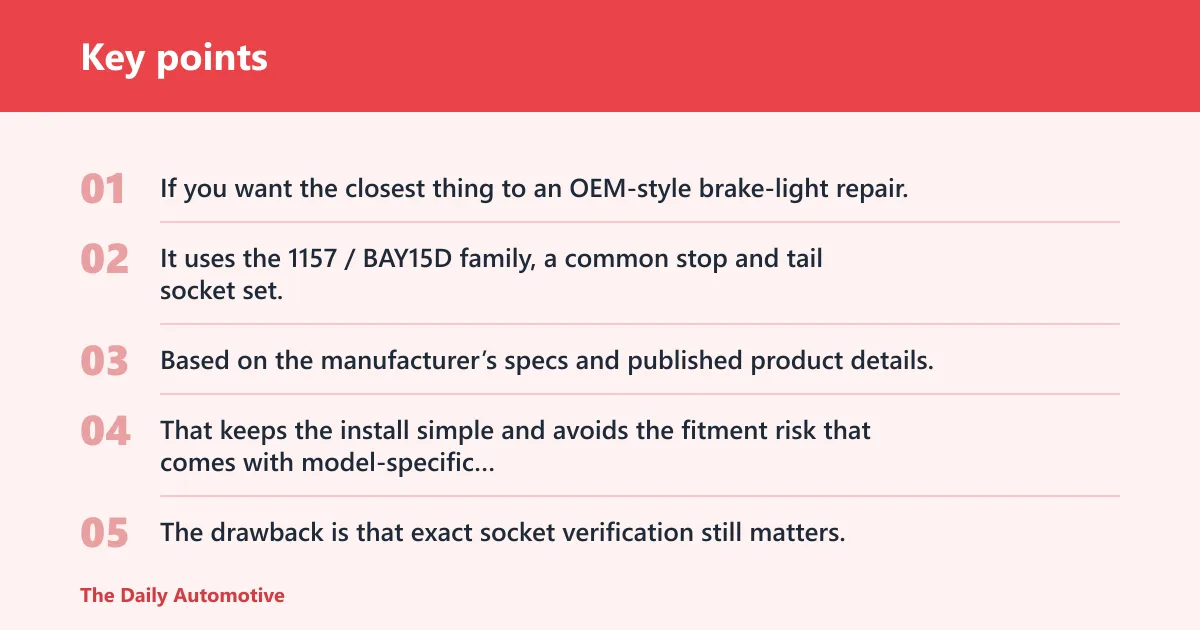
If you want the closest thing to an OEM-style brake-light repair, this is the simplest starting point. It uses the 1157 / BAY15D family, a common stop and tail socket set, and it is marketed as a plug-and-play bulb replacement for rear brake and tail positions.
Based on the manufacturer’s specs and published product details, this is the practical pick when you need to replace a failed bulb without changing the lamp housing. That keeps the install simple and avoids the fitment risk that comes with model-specific third brake light assemblies.
The drawback is that exact socket verification still matters. Some vehicles in this family need load resistors or other CANBUS fixes, and any LED swap can still flicker or trigger a warning if the car is sensitive.
Fitment and socket checks
Many stop and tail light bulbs use 1157 / BAY15D family sockets, but you should verify the exact bulb code before ordering. That matters because socket codes can look similar while the indexing pins and filament layout differ.
For this kind of bulb, the lamp housing stays in the car and the bulb does the work. That is why it is usually the lowest-risk option when the lens is intact and the original assembly is still sealed.
CANBUS and resistor notes
Some LED bulb upgrades may need load resistors on certain systems. Common symptoms include flicker, hyperflash, or a dash warning light after installation.
Load resistors solve compatibility problems, but they create heat. They need to be mounted away from plastic, carpet, and other melt-prone surfaces.
HTZCMOTO third brake light: best for high-mount fitment
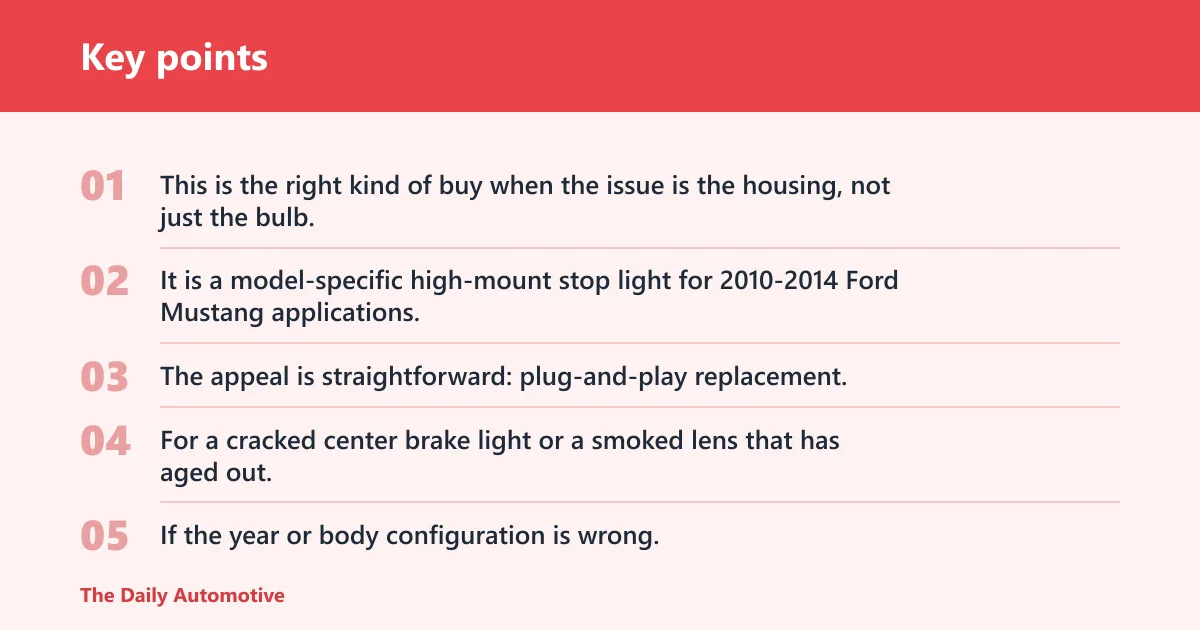
This is the right kind of buy when the issue is the housing, not just the bulb. It is a model-specific high-mount stop light for 2010-2014 Ford Mustang applications, so the fit depends on exact year and cab profile rather than a universal socket code.
The appeal is straightforward: plug-and-play replacement, DOT/SAE road-use approval in the product details, and a water-resistant ABS housing material. For a cracked center brake light or a smoked lens that has aged out, that is the correct repair path.
The drawback is narrow fitment. If the year or body configuration is wrong, the part is the wrong shape even if the wiring looks close.
Model-year and cab-profile checks
High mount stop light fitment depends on exact model year and cab profile. That is different from bulb fitment, where the socket family does most of the work.
Before buying, match the donor vehicle’s year range, body style, and rear roofline or decklid shape. A third brake light can be close in size and still be wrong at the mounting tabs or connector.
Water sealing and gasket notes
Many high-mount stop lights use IP67 or IP65 weather ratings, because the rear of the vehicle sees spray and pressure washing. That matters more here than on a bulb swap because the whole assembly sits in exposed sheet metal or roof trim.
Check the gasket, lens seam, and connector seal. Moisture ingress often starts there, then shows up as fogging, dimming, or a dead LED board.
Alla Lighting 7440/7443 strobe bulb: best for brighter rear signaling
This is the pick for drivers who want an attention-getting LED bulb in a wedge socket, not a full housing replacement. It fits T20 wedge 7440 or 7443 sockets and uses 39 high-power 2835 LEDs per bulb, with a three-flash strobe sequence followed by solid light.
That strobe pattern can stand out more than a plain incandescent replacement, and the socket family is common in rear brake and tail applications. But this is also the most conditional choice in the group, because legality and OEM acceptance vary by location and by vehicle use.
The drawback is that a strobe pattern is not the right answer for every car. Some drivers want the simplest steady brake signal, and some jurisdictions do not allow flashing brake outputs on public roads.
Chip count and beam pattern
LED chip count matters, but only up to a point. A bulb with 39 LEDs can still perform poorly if the beam pattern does not suit the reflector or lens in the lamp housing.
That is why usable output and directionality matter as much as the number printed on the listing. A well-matched bulb in a proper reflector can look more effective than a higher-chip-count bulb in the wrong housing.
Strobe mode caveats
The 3-flash strobe brake pattern is a visibility feature, not a universal recommendation. It may suit a driver who wants a more attention-grabbing rear signal, but it can also conflict with legal rules, local inspection requirements, or an OEM-style look.
Use this style only after checking your area’s brake-light rules. If you want a plain factory signal, choose a steady-output bulb instead.
What socket do you need?
Socket family is the first filter for bulb-based stop lights. If the socket code is wrong, brightness, color, or LED quality will not matter because the bulb will not seat or wire correctly.
High-mount assemblies are different. Those depend on model-year fitment and the shape of the rear lamp opening, not just a bulb number.
1157 / BAY15D basics
The 1157 / BAY15D family is a common brake, tail, and turn socket format. It is a frequent choice for rear lamp repairs, but exact fitment still needs verification because the same car line can use different rear bulb codes by trim or market.
Some LED replacements in this family may need load resistors on certain vehicles.
7440 / 7443 basics
7440 and 7443 are wedge-socket formats used in rear brake and tail applications, and 7443 is often the dual-function version. That makes them common in LED strobe bulb upgrades and other rear-light conversions.
If you are changing one of these, confirm whether the lamp needs a single- or dual-filament equivalent behavior before ordering.
3156 / 3157 basics
The 3156 / 3157 socket family is used for brake and tail light replacements and often needs CANBUS attention on modern vehicles. LED and strobe variants are both common, which makes this family flexible and also more likely to need compatibility checks.
On some cars, the symptom of a mismatch is a dashboard bulb warning, a fast flash, or inconsistent brightness.
921 / 912 / T15 basics
The 921 / 912 / T15 family is used for some third brake light bulbs and appears in CAN-BUS ready upgrades. Universal fitment claims still need verification, because a “fits most” label does not guarantee the connector, depth, or polarity will match your housing.
These bulbs are common in center high-mount stop-light applications where the lamp space is narrow.
Stop light decision matrix
This table maps the common stop-light formats to the things that matter most: fitment, install difficulty, CANBUS risk, weather exposure, and best use. Use it as a filter before you buy anything.
| Stop-light type | Fitment requirement | Install difficulty | CANBUS risk | Weather exposure | Best-use scenario |
|---|---|---|---|---|---|
| Bulb | Exact socket match such as 1157 / BAY15D, 7440 / 7443, or 3156 / 3157 | Low to moderate | Moderate on LED swaps; resistors may be needed | Moderate, depends on housing seal | Cheap OEM repair, failed bulb, intact lens and housing |
| High-mount | Exact model year and cab-profile match | Moderate | Moderate, depending on vehicle electronics | High, because sealing matters at the roof or decklid edge | Cracked center brake light, fogging, dead lens assembly |
| Strobe | Socket match plus legal and polarity checks | Low to moderate | Moderate to high on sensitive vehicles | Depends on bulb or housing design | Attention-focused rear signaling where local rules allow it |
| Strip | Model-specific housing or bar fitment | Moderate to high | Varies by controller and vehicle | High if mounted outside the cabin | Specialty high-mount or custom replacement, not a default bulb swap |
Fitment comes first
Say your sedan uses a 3157 rear brake bulb and the dash shows a bulb-out warning after an LED swap. The problem is not brightness. It is compatibility, and the fix may be a resistor, a CANBUS-ready bulb, or a return to stock-style output.
Picture a pickup with a fogged center brake light lens. A bulb swap will not solve that. A new high-mount assembly with a good gasket and sealed housing is the cleaner repair.
Weather and failure mode matter
Rear lighting sees spray, road salt, and wash water. That is why IP65 or IP67 ratings matter on exposed rear parts, especially high-mount assemblies and external rear bars.
Common failure modes include moisture ingress, melted housings from hot resistors, and dimming from aged incandescent bulbs. A repair that ignores the failure mode often fails again.
Choose bulb if… / Choose a high-mount assembly if…
Choose a bulb if you want the cheapest repair, the lens is intact, and the socket family is confirmed.
Choose a high-mount assembly if the third brake light lens is cracked, the gasket is leaking, or the center lamp is dead and the vehicle uses a model-specific unit. Match the year and cab profile before you buy.
Choose a strobe-capable bulb only if your local rules allow it and you want a more aggressive attention signal than an OEM-style steady brake light. If you want factory behavior, stay with a steady bulb.
Which one should you buy?
If you want the simplest OEM-style fix, start with the iBrightstar 1157 LED bulb. It suits the broadest set of straightforward bulb-replacement jobs and keeps the repair cheap and reversible.
If your center brake light housing is the actual failure, the HTZCMOTO third brake light is the more correct purchase. It fits the vehicle-specific repair path, where shape, sealing, and year match matter more than socket family.
If your goal is brighter rear signaling and your vehicle uses a compatible wedge socket, the Alla Lighting strobe bulb is the most attention-forward option here. It should be the last step after you confirm legality, socket type, and whether your car tolerates LED conversion without warnings.
A common first-timer mistake is choosing a stop light for a lifted SUV based only on lumen count. A 162-LED or 150-LED listing means little if the socket is wrong, the beam pattern does not suit the lens, or the vehicle throws a warning as soon as the lights turn on.
Frequently asked questions
What is the best stop light for a car?
The best stop light depends on the failure you are fixing. For a burned-out bulb, a direct-fit socket replacement is usually the safest choice. If the housing is cracked or leaking, a high-mount assembly is better. LED upgrades help when you want brighter output and the car accepts them cleanly.
Which stop light is brightest for a car?
Brightness depends on the bulb, lens, reflector, and beam pattern, not chip count alone. A higher LED count can help, but only if the light is aimed well in the housing. For rear visibility, a correctly matched bulb usually beats a mismatched “high-count” replacement.
Do LED stop lights need load resistors?
Sometimes. Some LED stop-light upgrades may need load resistors on certain vehicles to prevent flicker, warning lights, or fast flash behavior. Resistors also create heat, so they must be mounted away from plastic and wiring. A CANBUS-ready bulb can reduce the need, but it is not automatic.
What socket type do I need for a stop and tail light bulb?
Check the owner’s manual, the existing bulb code, or the base marking on the old bulb. Common families include 1157 / BAY15D, 7440 / 7443, 3156 / 3157, and 921 / 912 / T15. The socket code must match exactly before you worry about LED color or output.
What is the difference between a stop light and a traffic light?
A stop light on a car is the rear brake lamp that tells drivers behind you that you are slowing or stopping. A traffic light is the roadside signal that controls traffic flow at intersections. They are unrelated parts with different rules, wiring, and legal standards.
Are strobe brake lights legal on cars?
Sometimes, but not everywhere. The three-flash pattern can increase rear attention, yet many areas limit or ban flashing brake signals for road use. Check local rules before buying a strobe bulb, and avoid assuming that a DOT-looking product automatically makes the flash pattern legal.
How do I know if a third brake light will fit my car?
Match the exact model year, body style, and cab profile, then compare the connector and mounting points. Third brake lights are not universal in the way many bulbs are. If the housing shape, gasket layout, or lens size is off, the part will not install correctly.
Products related to this article
Sponsored / affiliate links. As an Amazon Associate I earn from qualifying purchases. I may earn additional commission from eligible campaigns.