Tire Tread Life Calculator
A tire tread life calculator estimates remaining life from tread depth, and 4/32 in. is commonly treated as a wet-weather warning line while 2/32 in. is commonly cited as the U.S. legal minimum for passenger tires. Past that point, wet stopping distance grows and hydroplaning starts at lower speeds. This guide shows how to convert tread depth into mileage left, judge uneven wear, and decide between rotation, alignment, monitoring, or replacement.
How is this calculated?
Press Calculate to see the math with your numbers.
How the calculator estimates remaining tread life
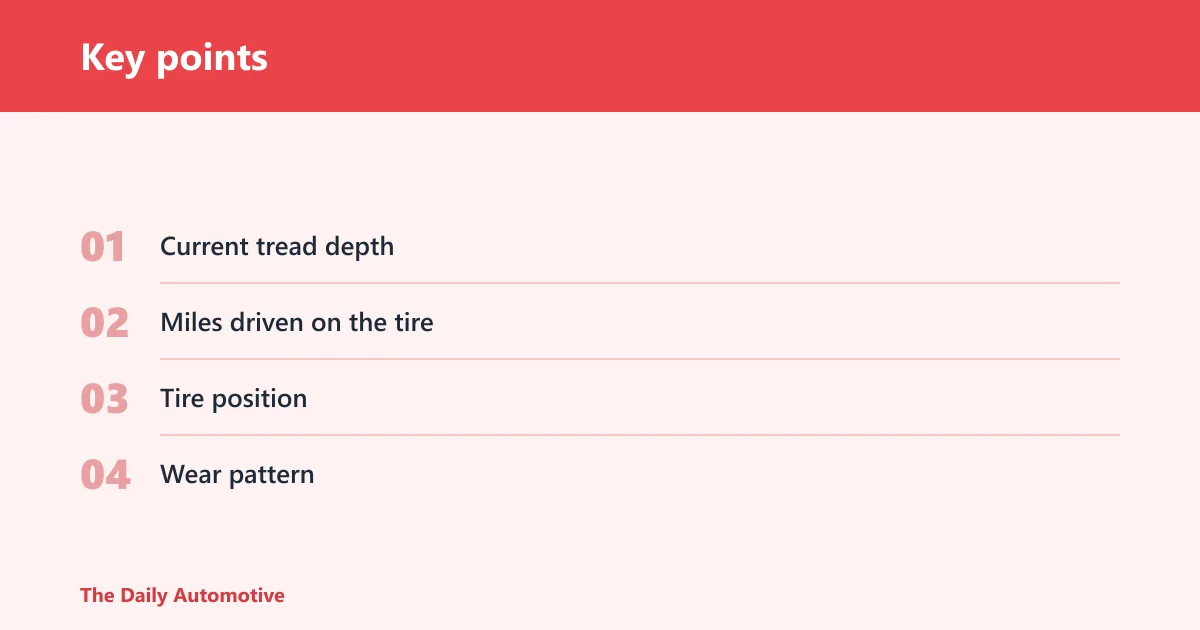

The calculator needs three inputs: current tread depth, miles driven, and where the tire is mounted. It estimates wear rate from tread lost over miles driven, then projects remaining miles from tread above the minimum divided by that wear rate. The shallowest groove controls the result.
That last point matters. If one groove reads deeper and another is shallow near a shoulder, the tire is only as good as the shallowest reading. A single reading from a deep center groove can hide a tire that is already past its useful life on the edge.
Inputs the calculator needs
- Current tread depth. Measure in 32nds of an inch or millimeters.
- Miles driven on the tire. Use the tire’s actual service miles, not the vehicle odometer alone.
- Tire position. Steer, drive, or trailer placement changes the minimum that applies.
- Wear pattern. Even wear and uneven wear do not lead to the same decision.
New passenger or touring tires are typically 10–11/32 in., while all-terrain or mud-terrain tires can start at 15–19/32 in. Commercial drive tires can start at 24–32/32 in. That starting depth affects how long a calculator will project useful life.
Say your front tire measures 6/32 in. in the center groove after 20,000 miles, but one shoulder is down to 4/32 in. The calculator should not treat that tire as a clean 6/32 in. case. The shallow shoulder controls the decision because it reaches the limit first.
How wear rate turns tread loss into a remaining-life estimate
Wear rate is tread lost divided by miles driven. If a tire lost 4/32 in. over 20,000 miles, the average wear rate works out to about 1/32 in. per 5,000 miles. Remaining miles are then based on how much tread is left above the applicable minimum, not on a generic mileage claim.
That estimate shifts with inflation, alignment, load, road surface, and driving style. Underinflation, misalignment, and aggressive driving shorten tire life and make any mileage estimate less reliable. A calculator is useful, but only if the tire is wearing evenly enough for the projection to mean something.
What tread depth means for safety
More tread usually means better wet grip and more room to move water out of the contact patch. As depth falls, the tire clears less water, so braking and cornering on wet pavement become less forgiving. The legal floor is a minimum, not a safe target.
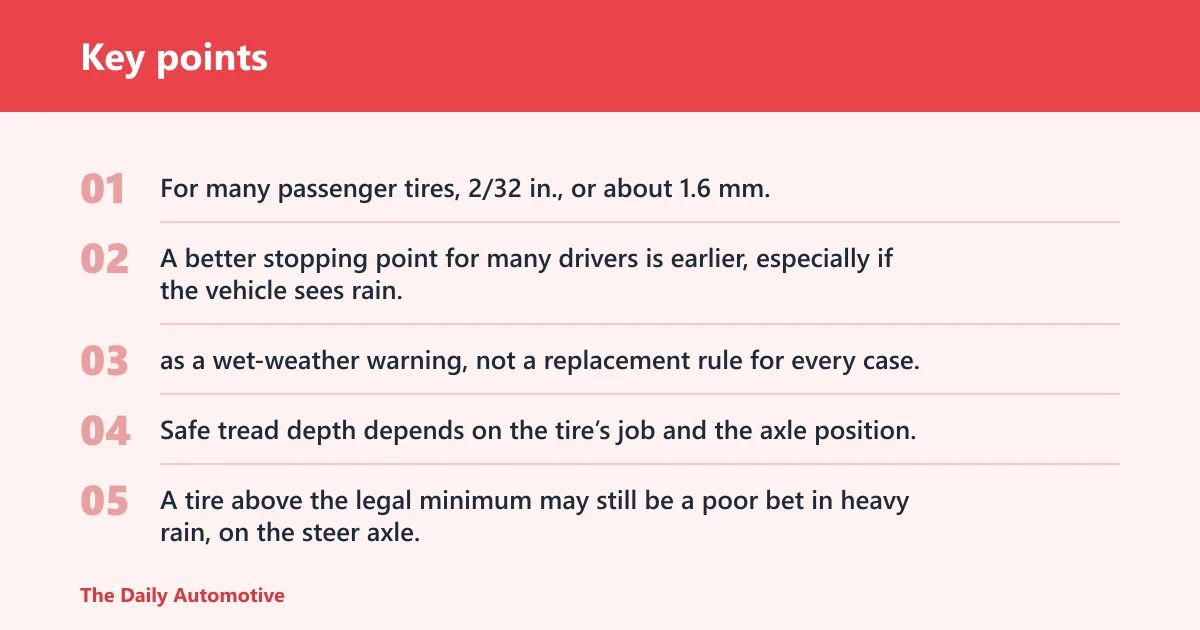
For many passenger tires, 2/32 in., or about 1.6 mm, is commonly cited as the legal minimum. A better stopping point for many drivers is earlier, especially if the vehicle sees rain, slush, or long highway trips. Treat 4/32 in. as a wet-weather warning, not a replacement rule for every case.
How much tire tread is safe?
Safe tread depth depends on the tire’s job and the axle position. A tire above the legal minimum may still be a poor bet in heavy rain, on the steer axle, or when wear is uneven. For everyday driving, 4/32 in. is a practical warning line, while 2/32 in. is the common legal floor for many passenger tires.
On trucks and buses, the legal floor changes by axle. US federal rules require at least 4/32 in. on steering-axle tires and 2/32 in. on all other tires. State rules or carrier rules may be stricter than that federal minimum.
How do I measure tread depth correctly?
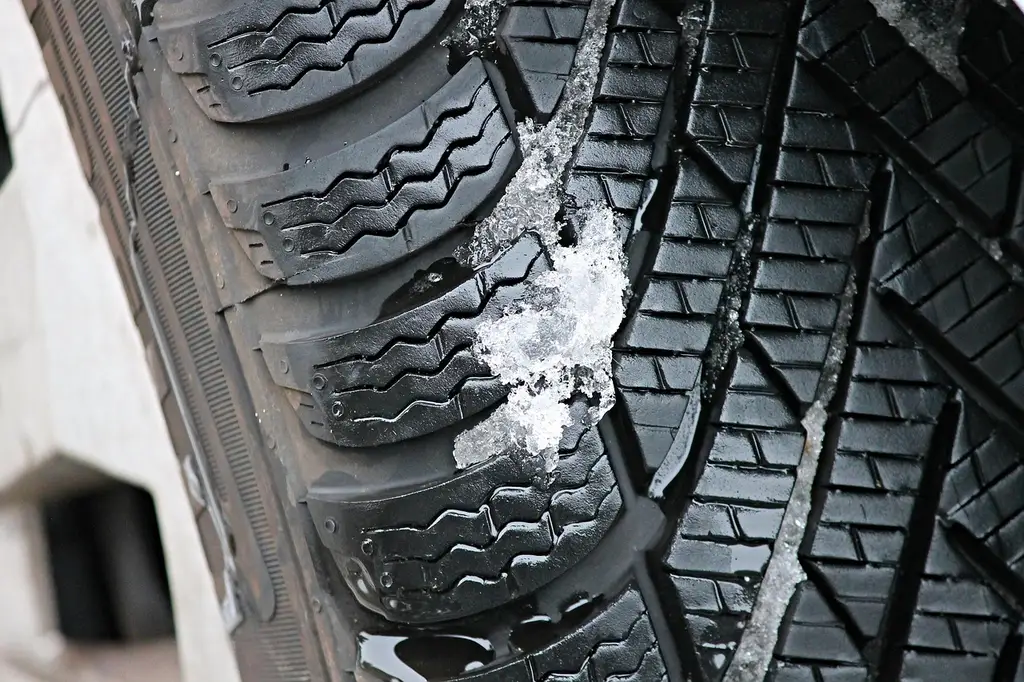
Use a tread depth gauge in a major groove. Read more than one groove, and check both shoulders. The correct measurement point is the shallowest groove that reflects real wear, not a treadwear indicator and not the deepest spot on the tire.
Coin checks can help as a fallback, but they are not precision tools. A US penny can be used to check for tread below about 2/32 in., and a US quarter is often used to gauge the steer-axle threshold near 4/32 in. Both coins must be checked in a major groove. Do not use the wear bars as a measurement point.
Measurement steps
- Park on level ground and set the vehicle safely.
- Measure in at least three locations across the tread.
- Check both shoulders and the center area.
- Record the shallowest reading.
- Repeat on each tire, including the spare if needed.
A common first-timer mistake is measuring only the center rib because it is easiest to reach. That can miss cupping, shoulder wear, or alignment wear that makes the real decision stricter than the center reading suggests.
Units and conversion
Many calculators show tread in 32nds of an inch, but millimeters are useful too. The legal minimum in much of Europe is 1.6 mm. The calculator’s job is to keep the units consistent and compare the reading to the correct floor for the tire’s position and use.
| Depth | Approximate mm | What it usually means |
|---|---|---|
| 10/32 in. | 8.0 mm | Typical new passenger or touring tread |
| 4/32 in. | 3.2 mm | Wet-weather warning level; steer-axle federal minimum for trucks |
| 2/32 in. | 1.6 mm | Common legal minimum for many passenger tires and other axles |
| 15/32 in. | 11.9 mm | Lower end of all-terrain or mud-terrain starting depth |
Tread life decision table
This table turns tread depth into an action. It assumes the tire is measured in a major groove, the shallowest groove governs the decision, and the legal minimum may differ by axle. If wear is uneven, use the shallowest groove and do not average it away.
| Measured tread depth | Wear pattern | Axle position | Legal minimum status | Recommended action |
|---|---|---|---|---|
| 8/32 in. to 12/32 in. 6.4 mm to 9.5 mm |
Even | Any | Above minimum | Monitor monthly |
| 6/32 in. to 7/32 in. 4.8 mm to 5.6 mm |
Even | Any | Above minimum | Rotate now if the service interval is due; inspect for early wear |
| 4/32 in. to 5/32 in. 3.2 mm to 4.0 mm |
Even | Steer axle | At or near steer-axle warning level | Inspect alignment and plan replacement soon |
| 4/32 in. to 5/32 in. 3.2 mm to 4.0 mm |
Even | Drive or trailer axle | Above 2/32 in. floor | Monitor monthly; rotate if serviceable and wear is even |
| At 2/32 in. 1.6 mm |
Even or uneven | Any | At legal minimum | Replace now |
| Above 2/32 in. above 1.6 mm |
Uneven, one shoulder shallow | Any | May still be legal | Inspect alignment and suspension before further use |
| Below 2/32 in. below 1.6 mm |
Any | Passenger tire or non-steer truck axle | Below legal floor | Replace now |
| Below 4/32 in. below 3.2 mm |
Any | Steer axle | Below steer-axle minimum | Replace now |
Picture a pickup tire that reads 5/32 in. in the center but 3/32 in. on the inside shoulder. The center reading alone suggests time left, but the shoulder shows a tire that should be inspected for alignment and likely replaced sooner than the center measurement implies.
How axle position changes the answer
Axle position can change the decision even when the tire is the same. A tire that is acceptable on a drive or trailer axle may be below the stricter steer-axle limit. That is why a calculator should ask where the tire sits, not just how much tread remains.
US federal rules require 4/32 in. on steering-axle tires and 2/32 in. on all other tires. That difference matters because steering tires influence directional control and are often judged more strictly. Fleet rules, state rules, and carrier rules can be tighter than federal minimums.
Steer axle versus drive and trailer axle
On a steer axle, tread depth should be treated more conservatively because the tire affects turning, braking, and straight-line control. On drive and trailer axles, the 2/32 in. floor may still be legal, but that does not make it a good wet-weather target.
For fleets, the calculator should separate compliance from replacement timing. A tire can be legal and still be due for replacement on safety grounds, especially if the shallowest groove is near the warning line or if wear is uneven.
What causes fast or uneven wear
Underinflation, overloading, misalignment, suspension problems, road surface, rotation intervals, and driving style all change tread life. Those factors alter wear rate, so two tires with the same brand and size can age very differently. That is why the calculator should never promise a single mileage number for every case.
Uneven wear is especially important. If one shoulder is lower than the center, or one inside edge is more worn than the rest, the shallowest groove decides the tire’s remaining life. Rotation may help only if the tire still has enough tread and the wear is not too far advanced.
Rotate, inspect, or replace
Rotate when wear is even and the tread is still comfortably above the warning line. Inspect alignment when one edge wears faster than the rest. Replace now when the tire is at the legal floor, below the axle minimum, or so uneven that the shallowest groove leaves little useful life.
Suppose a sedan has 7/32 in. on the left front tire and 6/32 in. on the right front, with both shoulders even. That points toward rotation and continued monitoring. If the inside shoulder of the right front drops to 4/32 in., alignment inspection becomes the better next step.
Frequently asked questions
What is tire lifetime expectancy?
Tire life expectancy is not a fixed mileage number because wear rate changes with inflation, alignment, load, road surface, and driving style. A calculator should use actual tread lost over miles driven and then project remaining miles from the tread above the correct minimum for that tire’s position.
How do I calculate remaining tire life from tread depth?
Measure the shallowest groove, subtract the applicable minimum, then divide the remaining tread by the wear rate. Wear rate is tread lost divided by miles driven. The result is an estimate, not a guarantee, and it becomes less reliable if the tire is wearing unevenly.
What tread depth means I should replace my tires?
Replace at 2/32 in. for many passenger tires, and at 4/32 in. on steer axles that fall under the federal minimum. Replace sooner if the tire wears unevenly, if the shallowest groove is the one that matters, or if wet-weather performance is already compromised.
Does tread life change by axle position or tire type?
Yes. A tire can be legal on a drive or trailer axle and still fail the stricter steer-axle minimum. Tire type also matters because starting depth varies widely: typical passenger tires are 10–11/32 in., all-terrain or mud-terrain tires can start at 15–19/32 in., and commercial drive tires can start at 24–32/32 in.
Products related to this article
Sponsored / affiliate links. As an Amazon Associate I earn from qualifying purchases. I may earn additional commission from eligible campaigns.