Car Loan Payoff Calculator: How to Use It Right
A car loan payoff calculator estimates how much you save by paying extra, but the result only works if you enter the payoff quote, daily interest, fees, and any prepayment penalty correctly. Miss one of those inputs, and you can overpay, skip a final interest charge, or think a refinance is cheaper when it is not. This guide shows how to use a car loan payoff calculator without common mistakes, compare extra payments and lump sums, and verify a lender payoff quote before you send money.
How is this calculated?
Press Calculate to see the math with your numbers.
Car loan payoff checklist

Use this checklist before you trust any payoff estimate. Match the calculator inputs to the lender’s loan rules, then decide whether early payoff beats keeping cash for other needs.
| Item | What to verify | Why it matters |
|---|---|---|
| Current loan balance | Use the remaining principal, not the original amount financed. | The payoff estimate depends on what is still owed, and that can differ slightly from the lender quote because interest keeps accruing. |
| APR or contract rate | Enter the rate the calculator asks for. | Some tools calculate from APR, while others want the loan’s stated interest rate. |
| Regular monthly payment | Use the scheduled principal-and-interest payment only. | Exclude unrelated products, separate charges, or add-ons. |
| Payoff quote date | Check the valid-through date on the lender quote. | Daily interest can change the amount due after that date. |
| Principal-only extra payments | Confirm that extra money is applied to principal. | That is what shortens the term and lowers total interest. |
| Simple interest or precomputed | Ask which method the loan uses. | Loan rules change how extra payments affect savings. |
| Prepayment penalty | Look for any fee or restriction on early payoff. | A penalty can erase some of the interest savings. |
| Emergency fund floor | Set the cash threshold you will not breach. | Do not drain savings just to chase a smaller interest bill. |
Early payoff decision checklist
- Current balance: the remaining principal, not the original amount financed.
- APR: the annual rate the calculator uses to project interest.
- Regular monthly payment: scheduled principal-and-interest amount only.
- Payoff quote valid-through date: the date after which the quote changes.
- Extra payments apply to principal: yes or no.
- Loan type: simple interest or precomputed interest.
- Prepayment penalty: fee, restriction, or none.
- Emergency fund threshold: whether early payoff would breach it.
How a payoff calculator works
A payoff calculator projects the remaining loan path from your balance, rate, and payment. It estimates how much of each payment goes to interest and principal, then shows how extra principal changes the remaining term and the interest total.
What the calculator is doing
One common calculator example uses a $20,000 balance at 5% APR. Monthly interest as remaining principal times APR divided by 12. That is why the current balance matters so much: a smaller balance produces less interest each month, which can move the payoff date sooner.
The calculator also relies on the remaining term, not the original term. If you have 9 months left, the math is very different from a 60-month loan with the same payment and rate. The amortization schedule lets you compare the standard payoff path with an accelerated one.
Where the amortization schedule helps
An amortization schedule shows each payment’s split between principal and interest, plus the remaining balance after each month. That makes it easier to see whether an extra payment trims time, lowers interest, or both. It also helps you check whether a lender quote is close to what the schedule predicts.
What should you enter in the calculator?
Enter the remaining principal, the rate the tool asks for, and the scheduled monthly principal-and-interest payment. If you add a lump sum, include the timing too, because a payment made now saves more interest than the same amount paid months later.
Balance versus amount financed
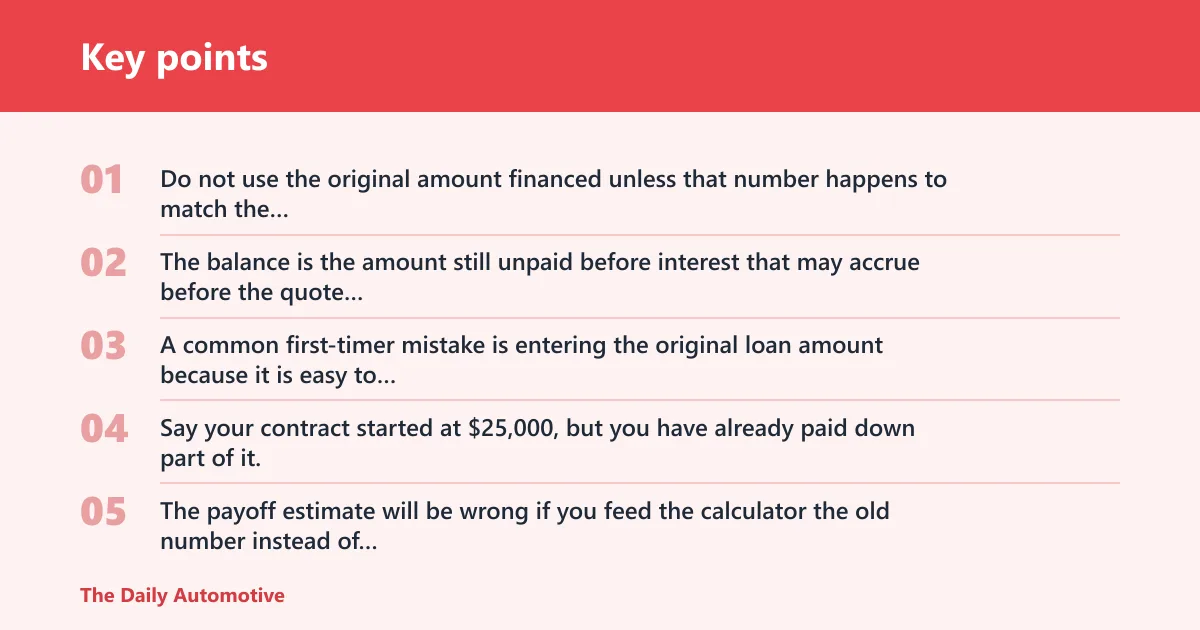
Use the current loan balance. Do not use the original amount financed unless that number happens to match the remaining principal, which it usually will not. The balance is the amount still unpaid before interest that may accrue before the quote date.
A common first-timer mistake is entering the original loan amount because it is easy to find in the paperwork. Say your contract started at $25,000, but you have already paid down part of it. The payoff estimate will be wrong if you feed the calculator the old number instead of the current balance.
Payment amount and excluded charges
Enter the regular monthly payment only if it covers principal and interest. Do not include gap coverage, service contracts, or other unrelated charges. Those items may appear in the total bill, but they do not behave like loan principal in the payoff math.
One example shows a $25,000 loan with a $658.12 monthly payment. With an extra payment, the payment rises to $808.12, the payoff time drops from 42 months to 34 months, total interest falls from $2,349.36 to $1,880.71, and the listed interest savings is $468.66. That kind of result depends on the extra amount going to principal.
Extra payment inputs
Use the recurring extra payment field for money you plan to add each month. A dedicated principal-only extra payment can shorten the term and reduce total interest. If the lender applies the extra amount to next month’s bill instead of principal, the outcome changes.
Suppose a borrower adds $100 each month to principal instead of holding that money for later. The loan balance falls faster immediately, so less interest accrues on each following cycle. That is different from sending the same $100 as a one-time payment several months later.
Lump-sum payment timing
Use the lump-sum field for a one-time payment applied immediately to principal. Timing matters. A lump sum sent early in the loan usually saves more interest than the same dollar amount spread across later extra payments, because more future interest gets avoided.
That does not make a lump sum automatically better in every case. If the cash is needed for repairs, insurance, or a savings target, the interest savings may not justify the liquidity loss.
Why does the lender quote differ?
A lender payoff quote can differ from the calculator because the quote includes the amount needed to close the loan on a specific date. That amount may reflect accrued daily interest, fees, or other charges, and it can change after the quote expires.
Accrued daily interest
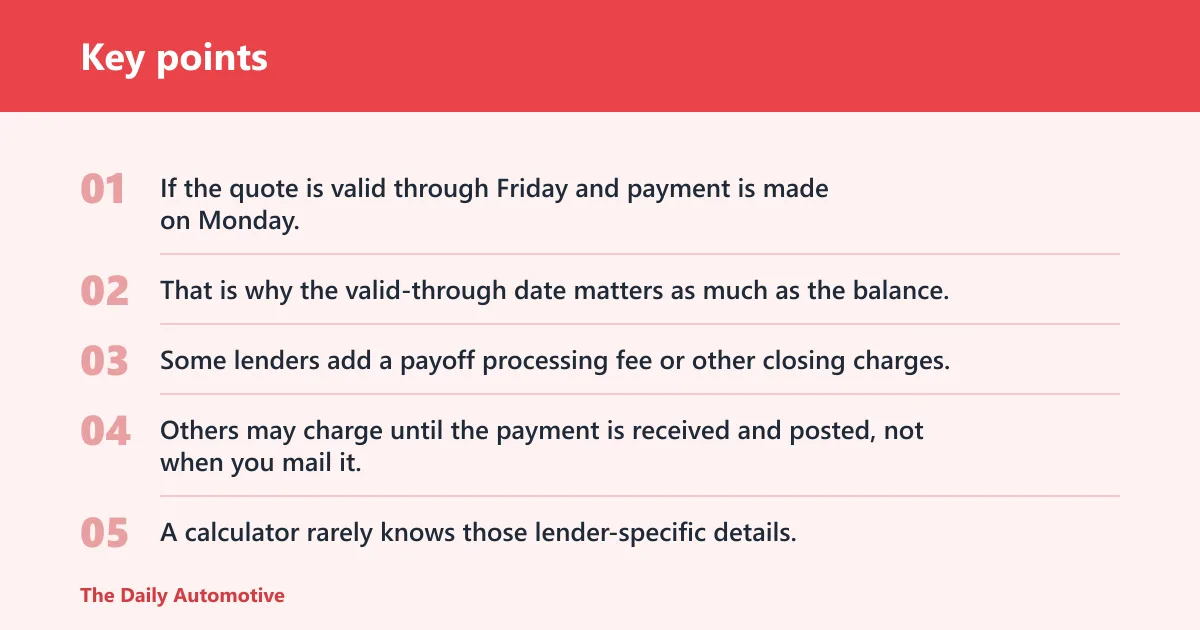
Many auto loans accrue interest daily. If the quote is valid through Friday and payment is made on Monday, the amount due can rise. That is why the valid-through date matters as much as the balance.
Fees and processing details
Some lenders add a payoff processing fee or other closing charges. Others may charge until the payment is received and posted, not when you mail it. A calculator rarely knows those lender-specific details, so it can understate the true closeout amount.
Precomputed loan rules
Precomputed-interest loans create a different mismatch risk. On those loans, the finance charge may already be set by the contract, so extra payments may not save as much as expected. In some cases, the lender advances the due date instead of cutting principal the way a simple-interest loan would.
Monthly extra or lump sum
Both methods can reduce interest, but they do not act the same way. A monthly extra payment spreads the effect across many payments. A lump sum hits principal all at once, so the timing usually creates a larger interest reduction for the same dollars.
| Method | Term impact | Interest impact | Liquidity impact | Lender-risk flags |
|---|---|---|---|---|
| Monthly extra | Usually shortens the loan gradually. | Reduces interest over time. | Lower strain if the extra amount is modest. | Check that the lender applies it to principal each month. |
| Lump sum | Can cut months off sooner if sent early. | Often saves more interest for the same dollars. | Consumes cash in one step. | Confirm quote date and posting timing. |
| Refinance | May extend or shorten the term depending on the new loan. | Depends on the new APR and fees. | Can preserve cash, but closing costs matter. | Watch loan fees, term reset, and whether the new rate truly beats the current one. |
Biweekly payments can help only if the lender posts each half-payment when it is received. If the lender holds the first half until the full monthly payment arrives, the timing benefit may disappear. Ask how the servicer posts biweekly amounts before relying on the shortcut.
When does refinancing make sense?
Refinancing can make sense when the new APR is lower enough to offset fees, and when the new term does not erase the interest benefit. Use the remaining balance and months left on the current loan, then compare the new payment and total cost against what you would pay by staying put.
Current rate versus refinance rate
Start with the current APR, then compare it with the refinance APR. A lower rate helps only if fees, term length, and any lender restrictions still leave you ahead. A refinance that resets the loan term can cost more interest over time even if the monthly bill falls.
Fees and term length
Look for application fees, title fees, and any loan origination costs. If your remaining term is short, those fees can outweigh the savings from a slightly better rate. Refinancing tends to make more sense when the current balance is still large and the payoff horizon is not close.
Picture a driver with only a few months left on the loan. Refinancing may save little because the interest left on the loan is already small. Now picture a long remaining term with a high rate and no prepayment penalty. In that case, comparing refinance savings against extra principal makes more sense.
Can early payoff hurt credit?
Paying off a car loan early can change credit mix and shorten the age of that installment account, so a score may change a little. The effect is usually temporary and case-dependent. What matters more is whether closing the loan helps or hurts your overall debt picture and cash reserve.
What matters more than the dip
If the loan is expensive, the interest savings may matter more than a modest score change. But if the payoff would wipe out your emergency savings, keeping the loan and preserving cash can be the better move. A score dip is not a reason by itself to avoid payoff.
When to keep cash instead
A common rule of thumb is: if an early payoff would breach your emergency fund threshold, stop and keep the cash. That is especially important when the remaining term is short or the interest savings are small. The goal is to reduce cost without creating a new financial problem.
Frequently asked questions
How much can I save by paying off my car loan early?
Your savings depend on the balance, APR, remaining term, and timing of the extra money. The earlier you reduce principal, the more future interest you avoid. A calculator is useful only when it uses the correct balance and a payment plan that matches how your lender posts extra funds.
How do extra monthly payments affect an auto loan payoff?
Extra monthly payments aimed at principal usually shorten the payoff time and reduce total interest. The effect is strongest when the loan still has many months left. If the lender applies the extra amount to something other than principal, the payoff date may not move the way you expect.
Should I use a lump sum or extra monthly payments to pay off my car loan faster?
Use the method that fits your cash flow, but timing matters. A lump sum sent sooner usually saves more interest than the same dollars spread across later monthly extras. Monthly extra payments are easier to budget, while a lump sum can cut the balance faster if the cash is already available.
What balance should I enter in a car loan payoff calculator?
Enter the current remaining principal, not the original amount financed. That number may differ slightly from the lender payoff quote because interest keeps accruing until the payoff date. If the calculator asks for a payoff quote instead, use the lender’s stated amount and its valid-through date.
Why does my lender’s payoff quote differ from the calculator result?
The quote can include accrued daily interest, fees, and posting rules that the calculator does not know. It may also expire on a specific date, after which the amount changes. On some loans, especially precomputed-interest loans, extra payments do not behave the same way a calculator assumes.
Does paying off a car loan early hurt my credit score?
It can cause a small, temporary change because the installment account closes and your credit mix shifts. That is usually less important than the savings from lower interest, unless the payoff drains cash you may need later. Keep the emergency fund rule in mind before sending the final payment.
Can biweekly payments help pay off a car loan faster?
They can, but only if the lender posts each half-payment as principal reduction when received. If the servicer simply holds the money until a full monthly payment is due, the timing benefit disappears. Ask the lender how biweekly payments are handled before counting on any payoff speedup.
Is there a penalty for paying off a car loan early?
Sometimes. Check the loan contract for a prepayment penalty or any restriction on principal-only extra payments. Even without a penalty, lender fees or precomputed-interest rules can change the savings math. A payoff calculator should be checked against the contract, not used as the only source of truth.
Products related to this article
Sponsored / affiliate links. As an Amazon Associate I earn from qualifying purchases. I may earn additional commission from eligible campaigns.
 Half Car Cover SUV,Top Cover with Red Reflective Strip, Hail Protector Car Cover with Cotton Liner, Sunroof & Windshield Cover for Ice and Snow, All Weather Car Body Cover for Sun, Rain, Dust
 Half Car Cover Top with Red Reflective Strip, Snow Car Cover with Cotton Liner, Sunroof & Windshield Cover for Ice and Snow, All Weather Car Body Cover Fit for Compact Sedan