Car Leather Upholstery Cost Calculator
A car leather upholstery cost calculator should start with about $1,500 to $5,000+ for reupholstering a set of seats, and about $4,000 to $12,000+ for a full interior, with luxury or complex vehicles often costing more. Miss the line items and you can be hit with trim, foam, seat-heater, airbag, and pattern-supplement charges that push the bill far past the quote. This guide shows what shops usually charge for, what they often exclude, and where leather jobs get expensive fast.
How is this calculated?
Press Calculate to see the math with your numbers.
What this calculator prices
This calculator prices a full-car leather refit, not just seat covers. It covers PU, bonded, top-grain, full-grain, and nappa leather options. Use it when you need a planning estimate for a shop quote, not when you only want a small repair number for a torn bolster or cracked panel. It is a general planning tool and may not fully capture make/model-specific layouts, such as unique seat structures or integrated console electronics.
Seats-only repair vs full reupholstery
Repair-only work usually means patching, stitching, rebuilding foam at a damaged spot, or replacing one cover panel. Full reupholstery means removing the old trim and installing new leather pieces across the seat set or the cabin. Those are different jobs, and they price differently.
If a seat has a single tear but the foam, heaters, and shape are intact, repair may be the cleaner path. If the cover is split wide open, the foam has collapsed, or the leather has dried and cracked across several panels, replacement becomes easier to justify.
What the quote should include
A proper estimate should list the seat count, vehicle size, leather grade, refit scope, perforation, stitching style, country or region rate, and any hidden trim work. A proper estimate should also name the number of seats, the vehicle class, and the leather grade used for each line. If the shop does not separate materials from labor, you cannot tell whether the total is high because of hide quality or because the labor hour count is high.
What is usually excluded?
Taxes are not included. Many quotes also leave out foam rebuilding, heating and ventilation transfer, door-card trimming, armrest covers, steering wheel wrapping, airbag handling, and any extra pattern work that appears after disassembly. Ask about those before you approve the job.
Vehicle size and scope
Vehicle size changes the baseline before any upgrade is added. A compact car takes less material and less labor than a minivan, and a classic vehicle can cost more than a newer sedan because of pattern matching, repair complexity, and slower fitment. The calculator uses six inputs: vehicle size, leather grade, refit scope, perforation, stitching, and country.
How size changes pricing
Compact cars use a 0.85 size multiplier, while minivans use 1.40. In plain terms, a smaller shell lowers material use and labor time, while a larger cabin raises both. SUVs and pickups usually land between those ends, with classic vehicles often moving higher when trim shapes are harder to reproduce.
How scope changes labor hours and materials
Scope is the biggest reason two quotes for the same vehicle can differ by thousands. Seats only is the lightest job. Seats plus doors takes more material and more removal time. Console and dash work adds pattern matching around vents, switches, and seams. A full cabin wrap is the most labor-heavy option.
| Scope | Baseline materials | Baseline labor | What usually changes |
|---|---|---|---|
| Seats only | Lower than the sedan add-on baselines | Lowest labor block | Seat count, bolsters, headrests, power functions |
| Seats plus doors | $1,800 on a sedan | 22 labor hours on a sedan | Door-card coverage and extra panel matching |
| Seats plus console plus dash | $2,800 | 36 labor hours | Curved panels, cutouts, and tighter fitment |
| Full cabin wrap | $4,200 | 52 labor hours | Maximum panel count and the most trim removal |
A common first-timer mistake is assuming a quote for just the front bucket seats matches the price of redoing the door panels, armrests, and rear bench too, even though door panels and armrests often require separate pattern matching and labor. A seats-only quote covers front and rear seat trim only. A full-cabin quote includes much more trim, more fitting, and more labor hours. Those are not the same job.
Leather grade choices
Leather grade changes both price and durability. PU synthetic, or polyurethane-coated synthetic leather, is the cheapest path. Bonded leather, a reconstituted leather composite, sits above that, but still below true hides. Top-grain is the baseline in this model. Full-grain and nappa move the total higher because the material cost rises fast once you leave budget-grade trim.
PU synthetic and bonded leather
PU synthetic uses a 0.45 materials multiplier and a 0.95 labor multiplier. Bonded leather uses a 0.70 materials multiplier. These choices keep the quote lower, which makes them common for budget builds, fleet vehicles, or owners who want a leather-like look without paying for premium hide.
Top-grain, full-grain, and nappa
Top-grain leather is the baseline with a 1.00 materials multiplier. Full-grain leather uses a 1.45 materials multiplier. Nappa leather uses a 1.85 materials multiplier. The jump is not subtle. If a quote climbs sharply while the scope stays the same, the grade is often the reason.
Durability matters too. Budget synthetic materials can be easier on the wallet, but they are usually chosen because they cost less, not because they outlast premium leather. Full-grain and nappa bring a higher material bill, but they are also the tiers most buyers expect when they want a premium feel and long-term appearance.
Which add-ons raise the price?
Perforation, stitching style, and hard-part removal are common reasons a calculator estimate and a final upholstery quote diverge. A shop may price the base seat first, then add charge lines for heating channels, vent holes, contrast seams, or extra dismantling. Those additions can move the total quickly.
Perforation and heated or vented panels
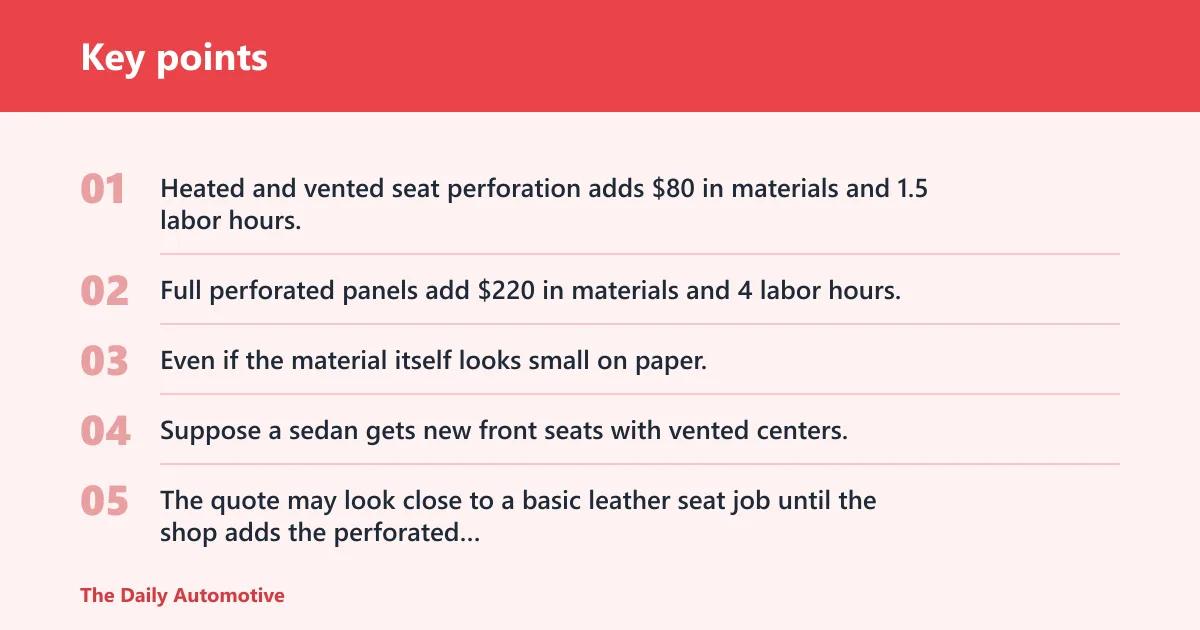
Heated and vented seat perforation adds $80 in materials and 1.5 labor hours. Full perforated panels add $220 in materials and 4 labor hours. Even if the material itself looks small on paper, the real cost often comes from alignment labor, because holes, seams, and trim lines must land where the original design intended.
Suppose a sedan gets new front seats with vented centers. The quote may look close to a basic leather seat job until the shop adds the perforated panel work and the extra time needed to transfer the heater and vent hardware. That is a normal place for a budget to move.
OEM stitching, contrast thread, and diamond quilting
OEM standard stitching is the least expensive path. Contrast thread adds visible detail and more setup. Diamond quilted accents raise labor further because the pattern has to stay even across every panel. The quote may mention “custom trim,” but ask which panels are actually stitched differently, because that determines the labor multiplier effect.
Foam rebuilds, armrests, door cards, and steering wheel trimming
Foam rebuilds are easy to miss and hard to ignore once the seat is open. Armrests and door cards add separate pieces and separate finishing time. Steering wheel trimming is usually priced as its own line because it involves a different shape, different wear pattern, and different handling than a seat cover.
Airbag-related work deserves extra attention. If a seatback, door panel, or wheel has an airbag path, the quote should say how that area will be handled. That step affects both labor and risk, and it should not be buried inside a vague upholstery total.
Leather quote sanity-check table
Use this table to cross-check shop quotes against the cost drivers most likely to move the total.
This table helps you compare calculator output with a shop quote. The point is not to predict every build exactly. The point is to spot whether the job is being driven by material quantity, labor hours, or hidden add-ons that are easy to leave out of a first estimate.
| Scenario | Likely scope | Cost driver that matters most | Hidden add-on to ask about |
|---|---|---|---|
| Compact car, seats only, PU synthetic | Front and rear seat covers only | Low material multiplier | Power seat removal and reinstall |
| Sedan, seats only, top-grain | Full seat set | Labor on removal and fitting | Headrest and bolster pattern match |
| Sedan, seats plus doors, top-grain | Seats plus door cards | More panel coverage | Door-handle and switch cutouts |
| SUV, seats plus doors, full-grain | Larger cabin with premium leather | Material grade plus size | Extra waste from wide panels |
| Pickup, seats only, bonded leather | Seat set in a truck cab | Vehicle shape and bench layout | Split bench or folding seat hardware |
| Minivan, full cabin wrap, top-grain | Seats, trim, and broad panel coverage | Highest labor count | Large-panel nesting constraints |
| Classic vehicle, seats only, nappa | Restoration-oriented seat refit | Pattern recreation | Nonstandard foam repair |
| Sedan, heated front seats, perforated panels | Front seat centers with venting | Alignment labor | Heater and ventilated hardware transfer |
| Sport trim, contrast thread and diamond quilting | Performance-style seat trim | Stitching labor multiplier | Extra pattern approval time |
| Full interior with console and dash | Seats, console, dash, and related trim | Scope expansion | Airbag handling and extra disassembly |
How the estimate is built
The model starts with materials, labor hours, and a planning labor rate of about $65 per hour. Local rates can be higher or lower, so treat that figure as a U.S. planning model, not a universal shop price. This labor rate is a planning input only; it does not separately account for shop overhead, profit margin, or other shop-specific cost structures. The estimate should return low, high, and most-likely totals, plus materials and labor breakdowns.
Labor rate model at $65 per hour
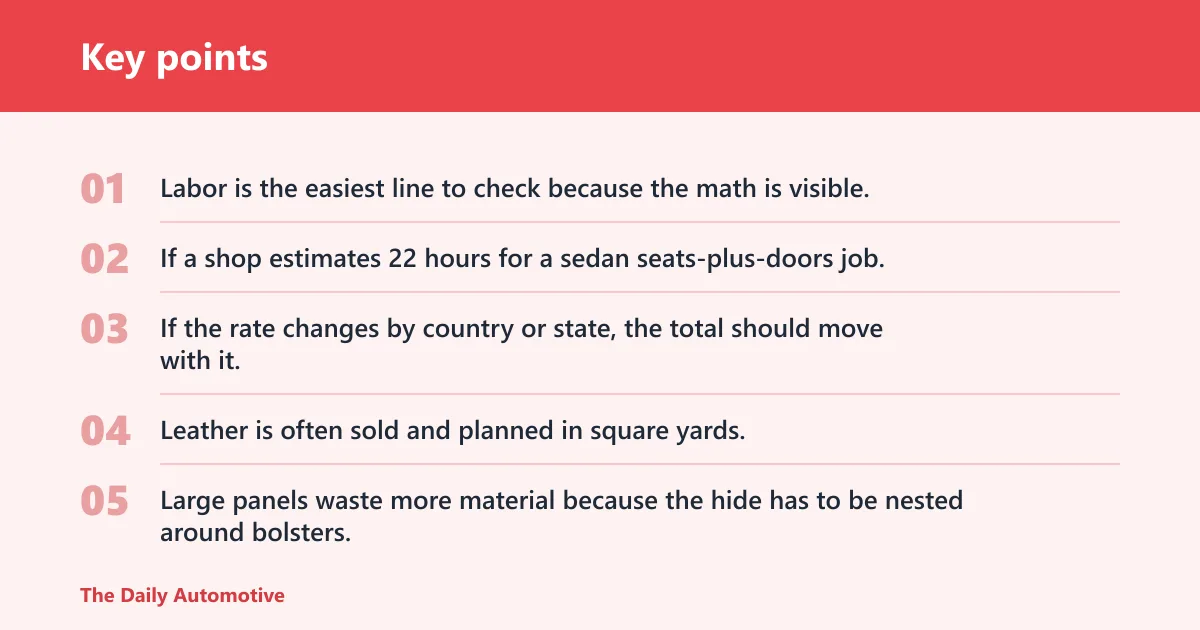
Labor is the easiest line to check because the math is visible. If a shop estimates 22 hours for a sedan seats-plus-doors job, the labor component at $65 per hour is easy to sanity-check before materials are added. If the rate changes by country or state, the total should move with it.
Material yardage and waste allowance
Leather is often sold and planned in square yards, though some trim shops think in square feet for smaller panel jobs. Large panels waste more material because the hide has to be nested around bolsters, seams, and curved shapes. That waste allowance is one reason a full cabin can rise faster than a simple seat swap.
For a quick bridge, ask whether the material line looks reasonable for the scope. If a quote for a full cabin wrap looks almost identical to a seats-only job, the material count may be missing. If the labor line is huge but the material line is tiny, the shop may be pricing pattern work, removal time, or finish detailing more heavily than the hide itself.
Low, high, and most-likely totals
A useful calculator should not give only one number. It should give a low estimate, a high estimate, and a most-likely total. That structure matches real upholstery quoting, where the final number can move after inspection reveals foam damage, extra trim removal, or a more difficult panel pattern than expected.
For example, a sedan with seats plus doors, top-grain leather, and standard stitching can stay near the middle of the range if the seat foam is sound and the door panels are simple. Add perforated centers, contrast thread, and a damaged bolster, and the same job can move much closer to the high end.
Is repair cheaper than replacement?
Repair is cheaper when the damage is small, the foam is intact, and the original cover can still be saved. Replacement is cheaper in time and sometimes in final value when the leather is torn widely, the panel shape is distorted, or the damage extends into the foam, heaters, or stitching lines. Full-cabin work makes sense when several pieces are already being replaced.
When to patch or rebuild a seat bolster
If the wear is isolated to one bolster or one torn seam, a repair can be the most sensible move. The seat keeps its original shape, the material bill stays lower, and the labor stays focused. That path works best when the rest of the cabin still matches the old leather well enough.
When to replace a cover
Replace the cover when cracks, tears, or stitching failure spread across multiple panels. A cover replacement also makes sense when foam damage is visible, because a patch on a collapsed seat often looks wrong and wears unevenly. This is where full reupholstery stops being optional and starts being the cleaner fix.
When a full-cabin job makes more sense
A full-cabin job makes more sense when the owner wants a uniform look across seats, doors, console, and dash, or when the existing trim is already mixed in condition. If only one seat is repaired, the fresh leather can stand out against the rest of the cabin. That can be fine. It can also look unfinished.
Picture a minivan with worn front seats, scuffed door cards, and a sun-faded console. A seat-only fix would leave the cabin mismatched. A broader scope costs more, but it avoids paying twice for a job that should have been coordinated once.
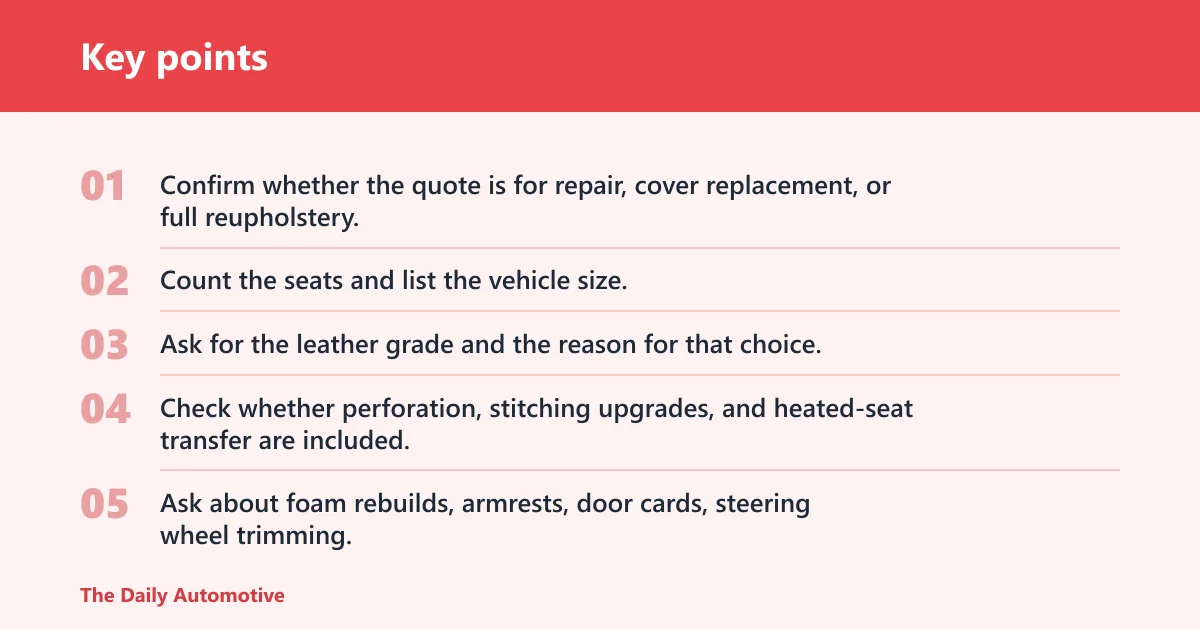
- Confirm whether the quote is for repair, cover replacement, or full reupholstery.
- Count the seats and list the vehicle size.
- Ask for the leather grade and the reason for that choice.
- Check whether perforation, stitching upgrades, and heated-seat transfer are included.
- Ask about foam rebuilds, armrests, door cards, steering wheel trimming, and airbag handling.
- Compare the labor hours against a $65 per hour planning rate.
- Verify that taxes are excluded and that low, high, and most-likely totals are shown.
Frequently asked questions
How much to reupholster leather car seats
Seats-only leather reupholstery usually starts around $1,500 and can climb well past $5,000 when the vehicle is larger, the hide is premium, or the seats need extra trim work.
How much does car upholstery repair cost?
Simple upholstery repair is usually cheaper than replacement because the job targets one damaged area instead of a whole cover or cabin. Small tears, seam restitching, and bolster patches tend to cost less than full reupholstery, but prices rise fast if the foam is damaged or the cover must come off.
How much does reupholstering a car cost?
Full-car reupholstery commonly lands in the $4,000 to $12,000+ range, with the total shaped by vehicle size, scope, and leather grade.
How much to reupholster a car
The short answer is that there is no single number. A compact car with a basic seat-only job will price far below a minivan with a full cabin wrap in top-grain or nappa leather. To compare quotes, ask for scope, material grade, labor hours, and excluded add-ons.
What affects the cost to reupholster leather car seats?
The main drivers are seat count, vehicle size, leather grade, stitching style, and whether the seats have heaters, ventilation, or perforated panels. Foam rebuilds, armrests, door cards, and airbag-related work can add more. If the quote omits those items, the final bill may climb later.
What should I check before getting a leather upholstery quote?
Check the seat count, vehicle size, whether the job is repair or replacement, the leather grade, the scope of coverage, and any add-ons such as perforation or contrast thread. Also ask whether taxes are excluded and whether the shop lists both materials and labor separately.
How much leather material does a full car interior need?
The answer depends on vehicle size and scope, but the material bill rises with larger panel coverage, wider seats, and more complex trim shapes. A full cabin wrap needs more material than seats plus doors, and large-panel nesting constraints increase waste. Ask the shop to state the yardage or square feet used.
How much does perforated or quilted leather add to the price?
Heated and vented seat perforation adds $80 in materials and 1.5 labor hours in this model, while full perforated panels add $220 in materials and 4 labor hours. Diamond quilting raises labor further because the pattern needs careful alignment and more setup time across each panel.
Is it cheaper to repair leather seats or replace them?
Repair is cheaper when damage is localized and the foam is still sound. Replace the cover when tears, cracking, or seam failure spread across several panels. If the seat is badly worn, replacement can be the better value because it avoids repeated repair work that does not solve the underlying damage.
Products related to this article
Sponsored / affiliate links. As an Amazon Associate I earn from qualifying purchases. I may earn additional commission from eligible campaigns.
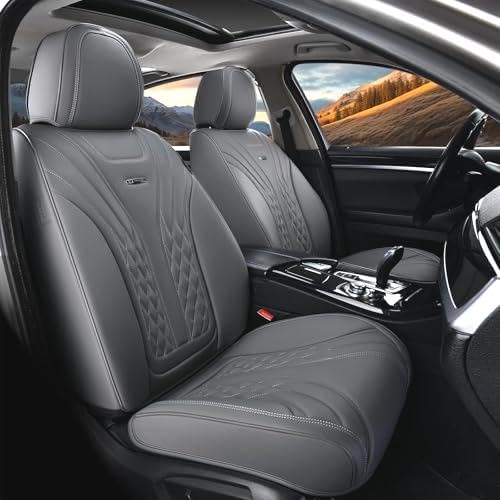 Coverado Car Seat Covers, Car Seat Covers Front Seats, 2-Pack Front Seat Cover, Nappa Leather Waterproof Seat Covers, Car Seat Protectors, Automotive Seat Covers Universal Fit for Most Vehicles
 FLORICH Leather Seat Cover, Car Seat Covers Front Set, Waterproof Car Seat Protectors, Front Seat Covers 2 Pack, Breathable Automotive Seat Covers Protector Fit for Most Cars Trucks SUV