Extended Warranty Review for Used Cars
Buy a used-car extended warranty only when expected covered repairs, after deductible, clearly exceed the contract price; otherwise, self-insure. Ignore exclusions and claim rules, and you can pay for coverage that rejects the repair you needed. This review weighs claim probability, exclusion risk, and repair-cost exposure so you can judge value before you buy.
This guide is part of our Car care and upkeep guide series.
Top used-car warranty pick
The strongest plan type for used buyers is a mid- to long-term exclusionary plan with a modest deductible, a short waiting period, and clear coverage on electronics and climate control. That mix fits used-car failure patterns, where the expensive problems often sit outside the engine and transmission.
What problem it solves best
A good used-car plan limits exposure on high-dollar repairs such as engine electronics, transmission control parts, A/C components, infotainment modules, and suspension items that are not simple wear parts. It matters most when the vehicle has moderate mileage, no remaining factory coverage, and a repair fund would struggle to absorb a $1,500 to $4,000 bill.
Where it can still fall short
Coverage can still fail you if the contract excludes pre-existing faults, seals leaks behind those faults, calls a part “wear and tear,” or requires prior authorization that you skip. A cheap plan with heavy exclusions can cost more than no plan if the likely repair falls outside the contract.
Quick picks
- Older high-mileage cars: choose a plan only if the contract still covers the expensive systems most likely to fail, especially transmission, cooling, electrical, and A/C.
- Newer used cars with factory coverage left: favor a shorter term that starts after the factory warranty ends, so you are not paying twice for overlapping coverage.
- Drivers keeping the car long term: look for longer mileage limits, transferable coverage, and a deductible that fits your repair budget.
Used-car warranty decision table
| Used-car profile | Risk flags | Likely repair categories | Buy, skip, or negotiate | Break-even note |
|---|---|---|---|---|
| Under 60,000 miles, under 4 years old, front-wheel drive, keeping 2 years | Low to moderate if factory coverage remains; watch electronics | Sensors, infotainment, A/C compressor, battery control modules | Negotiate | Buy only if price is low enough that one covered electronics repair could exceed the contract after deductible. |
| 60,000 to 100,000 miles, 4 to 8 years old, front-wheel drive, keeping 3 to 4 years | Moderate to high; repair exposure climbs as factory coverage ends | Wheel bearings, suspension parts, A/C, infotainment, engine electronics | Buy or negotiate | Good value if contract price plus deductible stays below the cost of one transmission or electrical repair. |
| 60,000 to 100,000 miles, 4 to 8 years old, all-wheel drive, keeping 3 to 4 years | Higher due to drivetrain complexity and more covered components to fail | Transfer case, driveshaft parts, sensors, differential-related electronics | Buy | All-wheel drive can justify coverage when the plan includes drivetrain parts and the deductible is not per-visit on each separate complaint. |
| Over 100,000 miles, older than 8 years, any drivetrain, keeping 1 to 2 years | High; eligibility and exclusions matter most here | Cooling system, engine electronics, transmission solenoids, suspension | Skip unless contract is unusually strong | Break-even is hard to reach if the contract excludes pre-existing issues, seepage, or older components with visible wear. |
| Under 60,000 miles, title issues, modified exhaust or tune, keeping 3 years | Very high denial risk if the plan bars salvage titles or modifications | Hard to predict because claims may be denied on eligibility alone | Skip | No break-even works if the vehicle fails eligibility rules before coverage starts. |
Are extended warranties worth it for a used car?
They are generally worth it only when the expected cost of covered repairs, after deductible, is likely to be higher than the contract price. The answer changes with mileage, age, drivetrain, prior maintenance, and how long you plan to keep the car. A low-risk car with a clean inspection often makes more sense with a repair fund.
How repair likelihood changes the answer
A car nearing 100,000 miles has more exposure to expensive failures than one still inside factory powertrain coverage. But the warranty still has to cover the right parts. If the likely problem is a loose trim piece, brake pads, or a routine service item, the plan adds little value.
Say your 7-year-old sedan has 82,000 miles and starts setting intermittent oxygen sensor and throttle body codes. Those parts can be covered on better plans, and the repair can become expensive enough that a mid-priced contract makes sense. If the issue turns out to be a pre-existing wiring fault, the claim can fail.
When self-insuring may be smarter
If the vehicle is simple, still inside factory coverage, or priced low enough that you can reserve money for repairs, self-insuring is often the cleaner move. A dedicated repair fund gives you freedom on shop choice and avoids waiting for authorization.
When a plan can make sense
A plan can make sense when the car has known expensive failure points, the inspection is clean, the contract covers the right systems, and the deductible does not eat most of the savings. That often fits turbocharged engines, all-wheel-drive layouts, and cars with costly electronics.
What does a used-car extended warranty cover?
Coverage depends on contract type. Powertrain plans usually focus on engine, transmission, and drivetrain parts. Bumper-to-bumper plans add more electrical and electronic parts, but they still exclude wear items, maintenance, and many cosmetic or abuse-related repairs. The claim only pays when the part is listed and the failure meets the contract rules.
Powertrain coverage
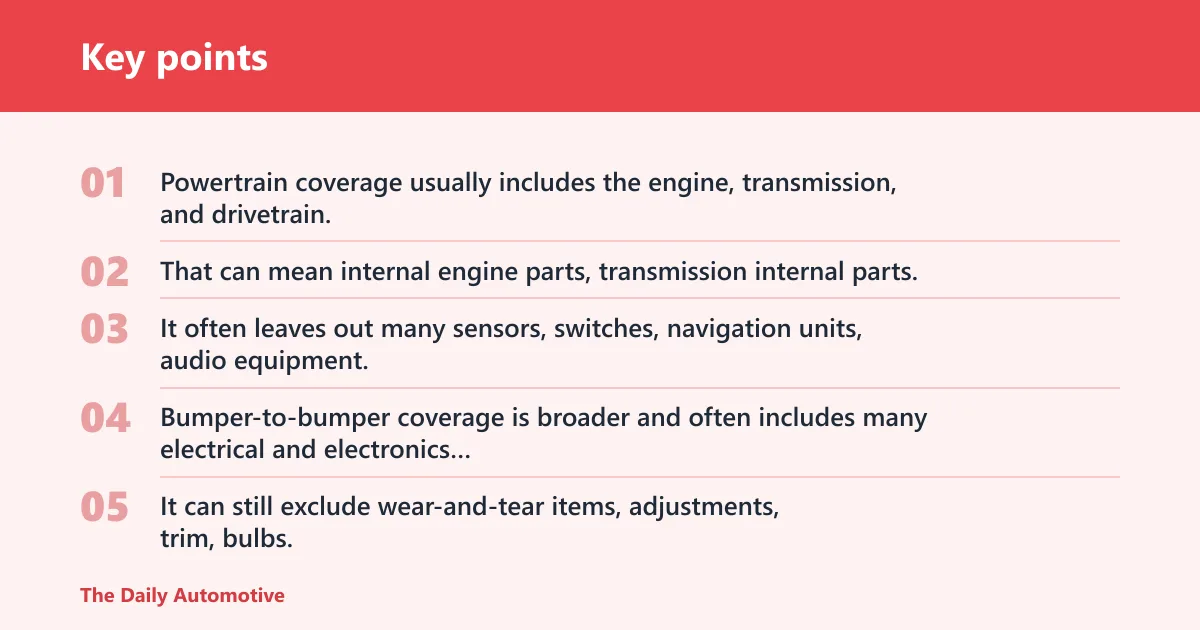
Powertrain coverage usually includes the engine, transmission, and drivetrain. That can mean internal engine parts, transmission internal parts, seals in some contracts, driveshafts, axles, and differential components. It often leaves out many sensors, switches, navigation units, audio equipment, and climate-control electronics.
Bumper-to-bumper coverage
Bumper-to-bumper coverage is broader and often includes many electrical and electronics items, but not every one. It can still exclude wear-and-tear items, adjustments, trim, bulbs, and damage from contamination, improper maintenance, or unauthorized modifications. Approval often depends on the shop diagnosing the failure before work starts.
Deductibles and claim approval
Deductibles change the value fast. A $0 deductible plan can save more on a single large repair, but it often costs more up front. A $100 deductible plan is common and easier to compare. Per-visit billing means you pay once for a visit even if several covered items are found. Per-repair billing can charge you again for each separate claim line, which cuts savings.
What is not covered?
Most denied claims come from exclusions, not from the headline coverage name. Pre-existing problems, maintenance items, cosmetic damage, misuse, neglect, and wear parts are the usual traps. If the contract says a fault started before the effective date or before the waiting period ended, the claim can be rejected.
Pre-existing conditions
If a code, leak, noise, or warning light was present before the contract started, many administrators treat it as pre-existing. That includes faults that were obvious during a pre-purchase inspection or on scan data. A repair shop note showing the issue existed earlier can sink the claim.
Maintenance items and wear items
Oil changes, filters, spark plugs, brake pads, rotors, wiper blades, tires, alignment, and clutch wear are usually excluded. So are items that fail from normal wear unless the contract specifically lists them. If a claim hinges on routine maintenance, approval is unlikely.
Cosmetic damage and misuse
Dents, paint chips, torn upholstery, cracked trim, curb rash, and water stains are generally outside coverage. Misuse and neglect clauses can also void claims tied to overheating, fluid starvation, low-fluid operation, racing, or missed services. That language matters more than a glossy brochure.
Picture a compact SUV with a failed infotainment screen and a dead rear A/C blower. If the screen failure is listed under electronics and the A/C blower is covered, the claim can be valuable. If the diagnosis shows water intrusion from a prior leak or an aftermarket stereo installation, the administrator may deny both repairs.
How do you choose the right plan?
Choose the plan that matches the car’s actual risk profile, not the provider’s marketing. Check mileage, age, remaining factory warranty, inspection status, title status, and modifications first. Then compare covered components, exclusions, deductible structure, and the claim process before you sign.
Match coverage to the car’s risk profile
High-mileage front-wheel-drive sedans often need stronger electronics and A/C coverage. All-wheel-drive vehicles may need drivetrain coverage with attention to transfer case and differential parts. Luxury models can be expensive to repair, but only if the contract includes the modules and sensors that fail most often.
Check eligibility and inspection rules
Most contracts limit vehicle age and mileage at enrollment. Many also exclude salvage titles, branded titles, flood vehicles, lifted suspensions, performance tunes, oversized tires, and other modifications. Some require a pre-purchase inspection or their own inspection before coverage starts. If the car fails that step, price is irrelevant.
Read the claim process before buying
Ask who must authorize the repair shop, whether pre-approval is required, what records you must keep, and how long reimbursement takes. Some plans pay the shop directly after authorization. Others reimburse you later. If the contract demands photos, diagnostic codes, service records, and teardown approval, you need to follow those steps exactly.
- Check the start date and waiting period.
- Confirm the mileage cap and term length.
- List covered parts and excluded parts line by line.
- Note whether deductibles are per visit or per repair.
- Review pre-existing, maintenance, wear, and misuse exclusions.
- Verify title rules, inspection rules, and modification limits.
- Read cancellation and transfer rules before you pay.
How much do extended warranties cost for used cars?
Cost often depends on mileage, age, make and model risk, coverage tier, term length, deductible, and whether the plan starts immediately or after factory coverage ends. A car with common failure points and expensive parts usually costs more to insure through a contract than a simple commuter car with cheap repairs.
Cost factors that move the quote
High-mileage vehicles, luxury models, turbocharged engines, all-wheel drive, longer terms, and broader coverage usually raise the price. A lower deductible can also raise the quote. If a contract includes electronics, climate systems, and more labor time, that broader scope usually costs more than a basic powertrain plan.
How do you know if a used-car warranty is a scam?
It is a bad deal when the sales pitch is vague, the contract is full of exclusions, the claim process is buried, or eligibility rules make payout unlikely. A real contract names covered parts, start date, deductible, mileage cap, exclusions, and claim steps in plain terms.
Use this checklist before you buy:
- Read the exact start date and waiting period.
- Confirm whether coverage begins at sale or after a set mileage or day count.
- Check for salvage title, branded title, and modification exclusions.
- Look for pre-existing condition language.
- Identify wear-item exclusions and maintenance exclusions.
- Verify whether the deductible is per visit or per repair.
- Ask whether repairs need pre-approval before teardown.
- Confirm transfer and cancellation rules in writing.
Frequently asked questions
Are extended warranties good for used cars?
They can be, but only when the contract covers the repairs most likely to happen and the price stays below expected covered repair exposure. A used car with moderate mileage, expensive electronics, or a costly drivetrain can justify coverage. A clean, simple car often does not.
What does an extended warranty cover on a used car?
Coverage depends on the plan. Powertrain plans usually cover engine, transmission, and drivetrain parts. Broader plans can add electrical and electronics coverage, A/C parts, and more labor-intensive systems. The exact parts list matters more than the plan’s marketing label.
What is not covered by a used-car extended warranty?
Common exclusions include pre-existing faults, maintenance items, wear items, cosmetic damage, misuse, neglect, and many modifications. Claims also fail when the repair is outside the contract’s part list or when the shop did not get pre-approval. Read exclusions before you buy.
Is it good to get extended warranty on used car?
It is a good idea when the vehicle has a high repair-risk profile, the coverage matches the likely failure points, and the contract rules are workable. It is a weak buy when the car is still under factory coverage, the exclusions are heavy, or you can self-insure cheaply.
Products related to this article
Sponsored / affiliate links. As an Amazon Associate I earn from qualifying purchases. I may earn additional commission from eligible campaigns.