What Are Running Lights on a Car: Essential Safety
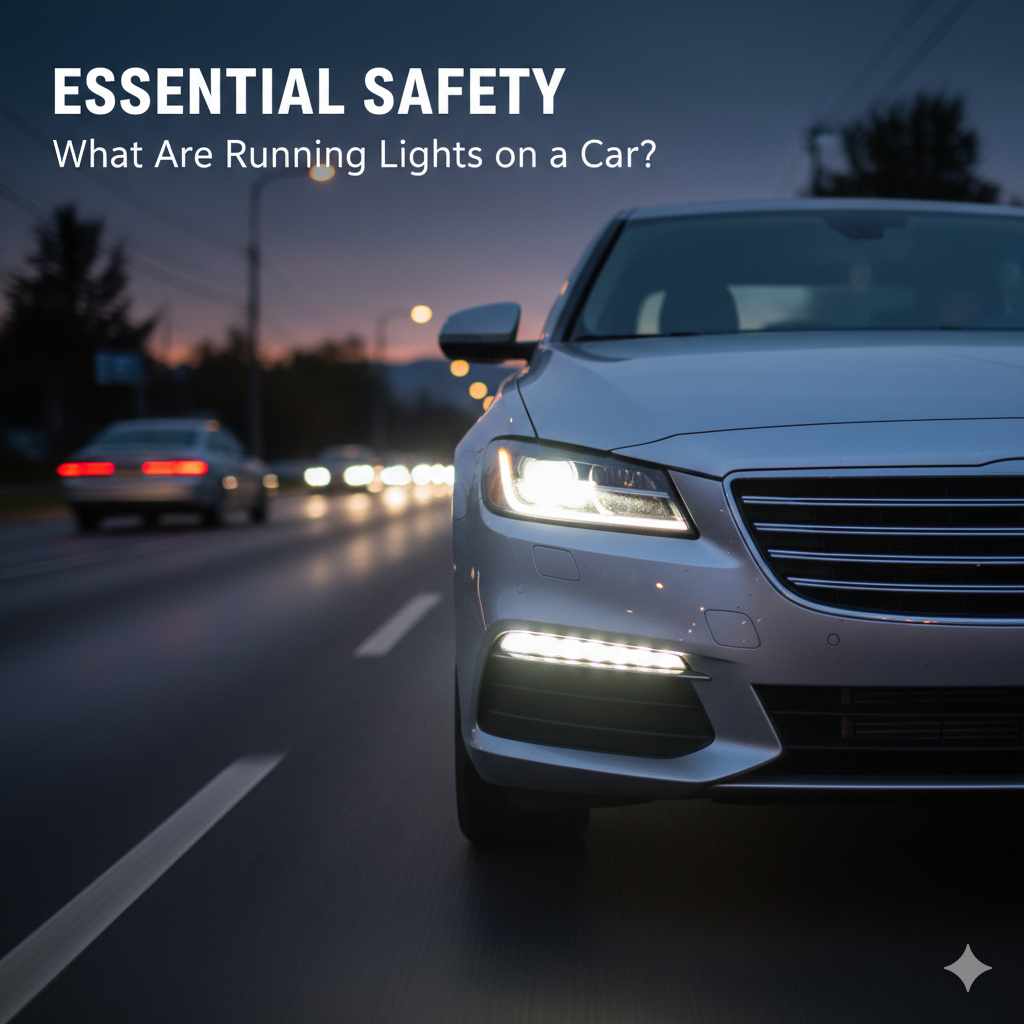
Running lights on a car are essential safety features that increase visibility for other drivers, especially during daylight hours or in low-light conditions. They are typically automatic and help prevent accidents by ensuring your vehicle is seen sooner. Understanding them is key to safer driving.
Ever been driving and noticed those soft, continuous lights glowing on the front of other cars, even when it’s not dark? You might wonder, “What are running lights on a car?” It’s a common question! Many drivers see them but aren’t quite sure what they are or why they’re there. These aren’t your headlights, and they’re not your parking lights either. They have a specific job: to make your car more visible to others, day or night. Thinking about car safety is super important, and these lights play a bigger role than you might think. Don’t worry, though! This guide will break down exactly what running lights are, why they matter so much for safety, and how they work, all in simple terms. Let’s get your car visibility sorted!
What Are Running Lights on a Car?
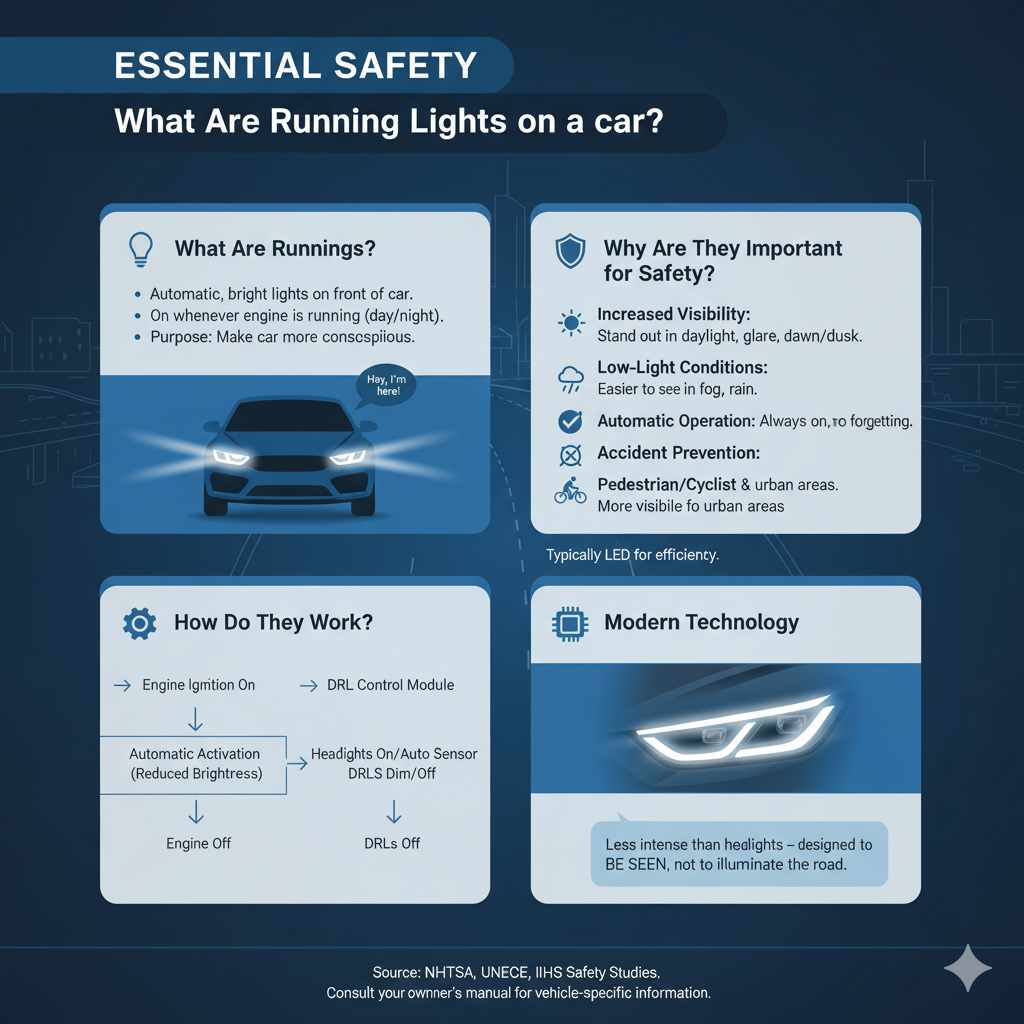
Running lights, often called Daytime Running Lights (DRLs), are a set of small, bright lights that automatically turn on when your car is running. They are usually located on the front of your vehicle, and they stay on whenever the engine is on, whether it’s day or night. Their primary purpose is to make your vehicle more conspicuous to oncoming traffic and pedestrians. Think of them as your car’s way of saying, “Hey, I’m here!”
Unlike headlights, which are designed to illuminate the road ahead and are typically used in darker conditions, running lights are all about making your car seen. They are often less intense than headlights, so they don’t blind other drivers but are bright enough to catch attention. The technology behind them has evolved, with many modern cars featuring LED running lights that are energy-efficient and long-lasting.
Why Are Running Lights Important for Safety?
The main reason running lights are a big deal is safety. In real-world driving, visibility is absolutely crucial for preventing accidents. Most crashes happen because drivers don’t see each other in time. Running lights help solve this problem.
- Increased Visibility During the Day: Even on a sunny day, glare from the sun or other vehicles can make it hard to spot a car. DRLs help your car stand out, especially when it’s approaching you from a distance or at an angle. This gives drivers more time to react.
- Low-Light Conditions: When it’s foggy, raining, or as dusk settles in, visibility drops significantly. Running lights will still be on, making your car easier to see than if you only relied on headlights, which some drivers might not turn on until it’s quite dark.
- Automatic Operation: Since they turn on automatically when the engine is running, you don’t have to remember to switch them on. This means your car is always more visible without you having to do anything, reducing the chance of forgetting to turn on your lights.
- Accident Prevention: Studies have shown that cars equipped with DRLs tend to be involved in fewer accidents, especially those where visibility is a factor. They help prevent sideswipes and head-on collisions.
- Pedestrian and Cyclist Safety: Running lights also make your vehicle more visible to pedestrians and cyclists, which is especially important in urban areas or when turning.
How Do Running Lights Work?
The operation of running lights is generally quite simple and designed for convenience and automatic function. Most modern vehicles have DRLs integrated into the electrical system in a way that makes them turn on and off without driver intervention.
Here’s a general breakdown of how they work:
- Engine Ignition: The system is typically linked to your car’s ignition. When you start the engine, a signal is sent to the DRL control module.
- Automatic Activation: The DRL module then activates the running lights. They are designed to come on at a reduced brightness compared to your main headlights.
- Headlight Integration: In most cars, when you turn on your headlights manually (or when an automatic headlight sensor detects low light), the running lights will often dim or turn off completely to prevent glare. This ensures that your main headlights provide better road illumination when needed most, and the front of your car isn’t excessively bright.
- Automatic Deactivation: When you turn off the engine, the running lights go out, just like your headlights.
The exact implementation can vary slightly from one car manufacturer to another. Some vehicles might use specific bulbs for DRLs, while others integrate them into the headlight assembly using a secondary filament or a separate LED strip. For the most accurate information about your specific vehicle, it’s always best to consult your owner’s manual.
Types of Running Lights
While the purpose of running lights is consistent, the technology and appearance can differ across various car models and manufacturers. Understanding these differences can help you identify them on the road and appreciate the design choices of automakers.
LED Daytime Running Lights (DRLs)
LEDs (Light Emitting Diodes) are the most common technology for modern running lights. They offer several advantages:
- Energy Efficiency: LEDs consume significantly less power than traditional incandescent bulbs. This means they have a minimal impact on your car’s fuel economy.
- Long Lifespan: LEDs are incredibly durable and can last for tens of thousands of hours, often outlasting the car itself. This means you’re unlikely to ever need to replace a DRL bulb.
- Bright and Focused Light: LEDs produce a crisp, bright light that is very effective for increasing visibility. They can also be designed in various shapes and colors, allowing for distinct styling for different car brands.
- Instant Illumination: LEDs turn on and off instantaneously, which is important for safety signaling.
You’ll often see integrated LED strips as part of the headlight assembly or as separate, sculpted light elements on premium vehicles.
Incandescent Bulb DRLs
Older vehicles or some base models might still use traditional incandescent bulbs for their running lights. These work much like the bulbs in your turn signals or brake lights.
- Standard Technology: They use a filament that heats up and glows when electricity passes through it.
- Lower Initial Cost: Incandescent bulbs are generally cheaper to manufacture, which can contribute to a lower vehicle price for base models.
- Shorter Lifespan: Compared to LEDs, incandescent bulbs have a much shorter lifespan and are more prone to burning out.
- Higher Power Consumption: They use more energy than LEDs, leading to a slightly higher draw on the car’s electrical system.
In these systems, the DRL bulb might be a separate bulb from the main headlight, or it might be a dual-filament bulb where one filament is dimmer and used for DRLs, and the brighter filament is used for the main headlight function.
Halogen Bulb DRLs
Some vehicles might utilize smaller halogen bulbs specifically for DRL purposes. Halogen bulbs are an improved version of incandescent bulbs, offering brighter light and longer life, but they are still less efficient and durable than LEDs.
The key takeaway is that regardless of the type of bulb used, the function of being a continuously lit, visible light source during operation remains the same.
Running Lights vs. Other Vehicle Lights
It’s easy to confuse running lights with other lights on your car, but they each serve a distinct purpose. Understanding these differences helps ensure you’re using your lights correctly for maximum safety.
| Light Type | Purpose | When They Turn On | Visibility Impact |
|---|---|---|---|
| Running Lights (DRLs) | Increase vehicle visibility to others. | Automatically when engine is running, day or night. | Makes vehicle more conspicuous in all lighting conditions. |
| Headlights | Illuminate the road ahead for the driver and make the vehicle visible to others. | Manually activated by the driver or by an automatic sensor in low light. | Crucial for driving at night or in poor visibility; provides significant forward illumination. |
| Parking Lights | Indicate vehicle presence when parked or stopped, especially at night, and to signal width. | Manually activated by the driver. Often come on with running lights when headlights are off. | Limited visibility; primarily for static indication, not active driving. |
| Fog Lights | Cut through fog, rain, and snow to improve visibility directly in front of and below the main headlights. | Manually activated by the driver; designed for specific adverse weather conditions. | Low and wide beam to avoid reflecting light back into the driver’s eyes in fog. |
| Brake Lights | Indicate to drivers behind that the vehicle is slowing down or stopping. | Automatically when the brake pedal is pressed. | Red lights, highly visible to the rear. |
| Turn Signals (Indicators) | Signal an intended change in direction. | Manually activated by the driver using the indicator stalk. | Flashing lights (amber at front/rear, sometimes red at rear) visible from front and rear. |
The key distinction is that running lights are passive safety features designed for constant visibility, whereas headlights, fog lights, and turn signals are active safety features that assist the driver or provide explicit signals.
Regulations and Requirements for Running Lights
The use and requirements for running lights vary significantly across different countries and jurisdictions. Many regions have mandated their use to improve road safety due to the proven benefits.
Mandatory DRLs in Other Countries
In many parts of the world, running lights are not just a nice-to-have feature; they are legally required. For example:
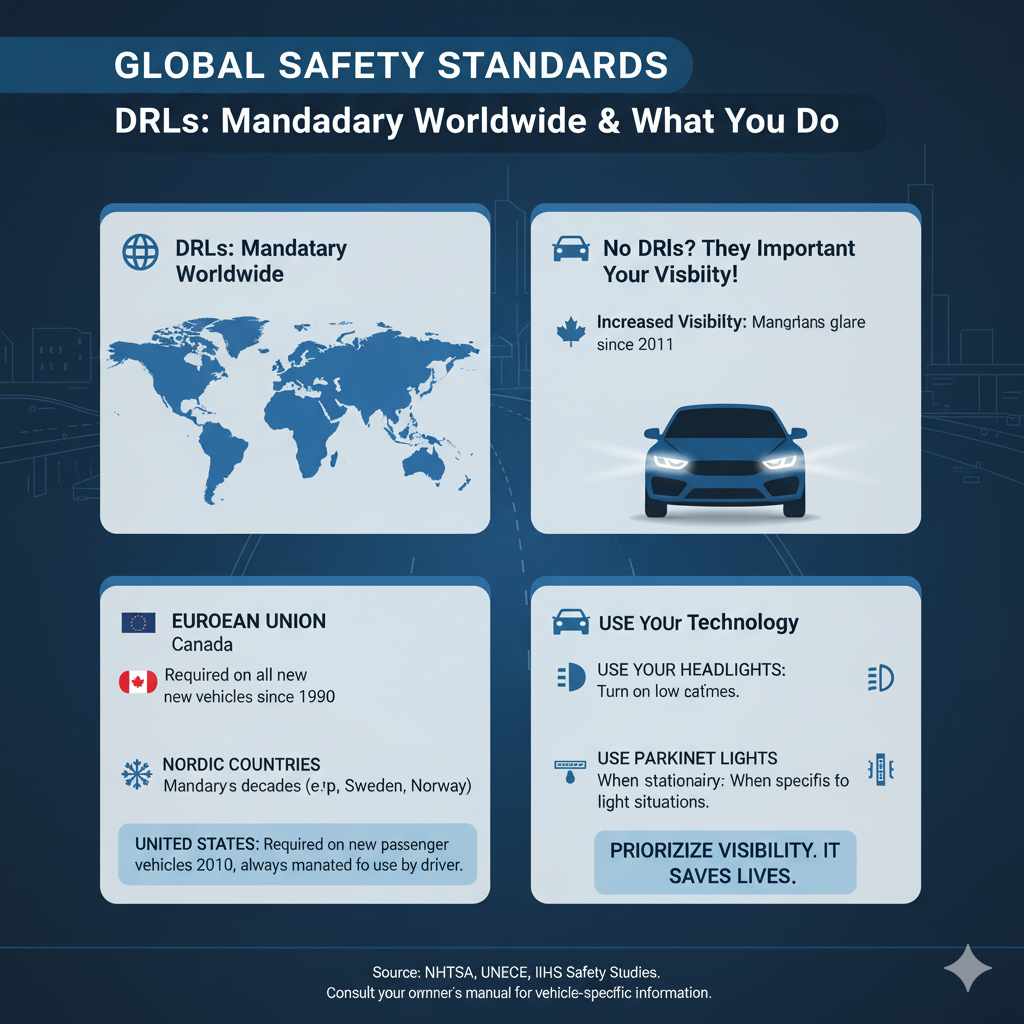
- European Union: Since 2011, all new cars sold in the EU must be equipped with automatic daytime running lights. This is to enhance visibility and reduce accidents. You can find more information on vehicle safety standards from the United Nations Economic Commission for Europe (UNECE), which sets global standards.
- Canada: All vehicles manufactured for sale in Canada since January 1, 1990, are required to have automatic daytime running lights.
- Nordic Countries: Due to long periods of winter darkness and frequent fog, DRLs have been mandatory in countries like Sweden and Norway for decades.
United States Regulations
In the United States, the situation is a bit more varied. While the National Highway Traffic Safety Administration (NHTSA) requires DRLs to be installed on all new passenger vehicles manufactured for sale in the U.S. since September 1, 2010, they do not mandate that drivers must use them if their vehicle is equipped with an automatic on/off switch. However, many vehicles still have them equipped and operational.
It’s important to note that the definition of DRLs can be specific. In the U.S., they are often defined as lights that are on automatically whenever the engine is running and are not considered “headlights” or “parking lights.” They are designed to be less bright than headlights and typically operate at 50-70% of their output. The Federal Motor Vehicle Safety Standards (FMVSS) outline the technical requirements for DRLs in the U.S. For detailed technical specifications, you can refer to the NHTSA’s Federal Motor Vehicle Safety Standards.
What If My Car Doesn’t Have DRLs?
If your car is older and wasn’t equipped with factory-installed running lights, you have a few options to increase your visibility:
- Use Your Headlights: The simplest and most effective way is to turn on your headlights whenever you are driving, especially in low-light conditions, overcast weather, or in busy traffic. It might seem obvious, but many drivers still forget.
- Use Your Parking Lights: If your car has parking lights (which are usually less bright than headlights and are sometimes mistaken for DRLs), you can use them when stationary or in very specific low-light situations where headlights might be too much, though this is rare. It’s generally better to use headlights if you are driving.
- Aftermarket DRL Kits: You can have aftermarket daytime running light kits installed on your vehicle. These can range from simple LED strips to more elaborate integrated systems. It’s advisable to have these installed by a reputable professional to ensure they are wired correctly and comply with local regulations.
Prioritizing visibility is key, no matter what features your car comes with.
Troubleshooting Common Running Light Issues
While running lights are generally reliable, like any automotive component, they can sometimes encounter problems. Most issues are relatively straightforward to diagnose and fix.
One Running Light Not Working
This is one of the most common problems. If only one side is out, it usually points to a specific issue with that light.
- Blown Bulb: For cars with incandescent or halogen running lights, the most likely culprit is a burnt-out bulb. Replacing it is usually a simple DIY task.
- Loose Connection: The bulb or the wiring connector might be loose. Check the connection, ensure it’s clean, and try re-seating it.
- Corrosion: If the connector is corroded, it can prevent the bulb from getting power. Cleaning the contacts might solve the problem.
- Wiring Issue: Less commonly, there could be a break or short in the wiring harness leading to that specific light.
- LED Failure: If your car uses LED DRLs, a failure on one side could indicate a faulty LED module, which might be more complex to replace than a simple bulb.
Running Lights Not Turning On Automatically
If neither of your running lights is coming on automatically, it suggests a system-wide issue.
- Fuse: Check the vehicle’s fuse box for a blown fuse related to the running lights or DRL system. Your owner’s manual will show you which fuse to look for.
- DRL Relay: Many vehicles have a relay that controls the DRLs. This electrical component could have failed.
- DRL Control Module: Modern cars have a computer module (ECU) that manages DRLs. If this module fails, the lights won’t work. This is typically a more expensive repair.
- Ignition Switch or Sensor Issue: In some cases, a problem with the ignition switch or a sensor that tells the car the engine is running could prevent the DRLs from activating.
Running Lights Not Dimming When Headlights Turn On
This is usually a sign that the integrated system isn’t functioning as it should.
- Automatic Headlight Sensor: If your car has an automatic headlight sensor (usually on the windshield near the rearview mirror), it might not be detecting low light conditions correctly, or it might be dirty.
- Headlight Switch/Module: The system that tells the DRLs to dim or turn off when the headlights are on might be malfunctioning. This could be related to the headlight switch itself or a central body control module.
Tips for Basic Troubleshooting
Before taking your car to a mechanic, you can perform a few simple checks:
- Consult Your Owner’s Manual: This is your best resource for understanding your car’s specific lighting system, fuse locations, and Bulb-replacement procedures.
- Check Fuses: Locating and inspecting fuses is a common first step for any electrical issue. They are inexpensive to replace if blown.
- Inspect Bulbs and Connectors: When safe to do so, look for any obvious signs of damage, corrosion, or looseness around the light bulbs and their sockets.
If you’re uncomfortable performing these checks or if the problem persists, it’s always best to seek professional assistance from a qualified mechanic.
FAQs About Car Running Lights
Here are answers to some frequently asked questions about running lights on cars.
Q1: Are my running lights the same as my headlights?
A: No, running lights (DRLs) are different from headlights. Running lights are designed to make your car visible to others during the day and in low-light conditions, while headlights are designed to illuminate the road ahead for you to see. DRLs are typically less bright than headlights and turn on automatically with the engine.