Wheelchair Rack for Car: Top 4 Heavy-Duty Hitch Carriers Reviewed
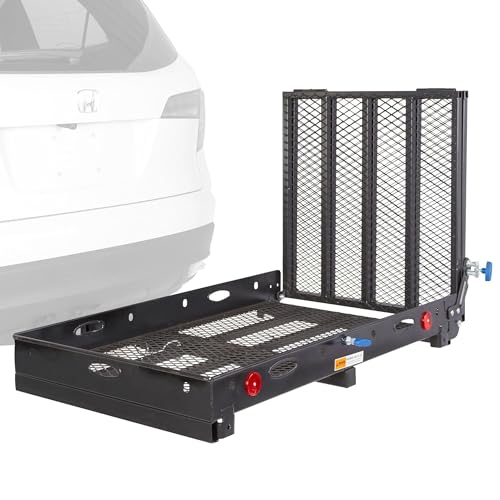
The best wheelchair rack for a car is a Class III or IV hitch carrier with a fold-up ramp, at least 500 pounds of capacity, and enough tray length for your chair. Pick the wrong hitch height or ramp angle, and loading can turn unsafe, scrape the bumper, or push the rack past its real-world stability. This guide compares four heavy-duty carriers by fit, loading ease, stability, and rear-clearance tradeoffs.
Top wheelchair carriers at a glance



The strongest all-around fit here is the MaxxHaul 80779 for a 2-inch receiver, because it pairs a 500-pound max load capacity with a compact 50 x 29.5 x 7.5-inch footprint. That makes it an easy place to start if you need a platform-style carrier for a manual chair or a lighter mobility chair and want a straightforward hitch match.
| Best for | Hitch fit | Ramp style | Tie-down points | One honest drawback |
|---|---|---|---|---|
| MaxxHaul 80779 | 2-inch receiver | Platform-style carrier; check the listing for your exact ramp setup | Check the manufacturer’s listing for your model | Its 53-pound build is not the lightest to move by hand |
| ECOTRIC | Check the manufacturer’s listing for your model | Basket-style carrier | Check the manufacturer’s listing for your model | Steel adds weight, so rear handling can be harder |
| Titan Ramps carrier | Check the manufacturer’s listing for your model | 60-inch ramp, folds flat and vertically against the vehicle’s rear | Check the manufacturer’s listing for your model | Folding hardware can matter for rear-door clearance |
| Silver Spring SC500-V3 | Check the manufacturer’s listing for your model | Built-in 59-inch long ramp | 10 integrated tie-down points | Longer ramp hardware takes up more rear space |
Quick picks by need
- Best 2-inch receiver match: MaxxHaul 80779.
- Best for rear access when stowed: Titan Ramps carrier, because it folds flat and vertically against the vehicle’s rear.
- Best tie-down setup on paper: Silver Spring SC500-V3, with 10 integrated tie-down points.
- Best rust-resistant build: Goplus, because it uses a heavy-duty aluminum structure and is rust and corrosion-resistant.
Which wheelchair rack fits your setup?
The right carrier depends on chair weight, how much lifting you can do, and how much room sits behind the bumper. Manual chairs are easier to manage on a shorter ramp or even with partial lifting help, while heavier mobility chairs usually need a longer ramp, more tie-down points, and more rear clearance for loading.
Manual chair versus heavier mobility chair
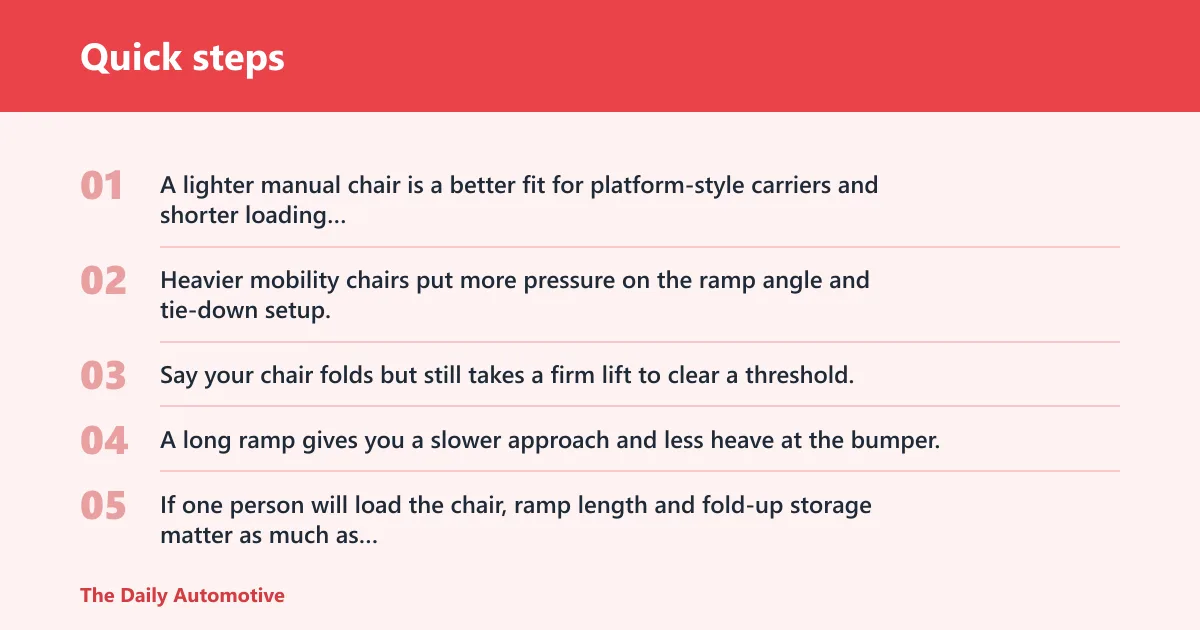
A lighter manual chair is a better fit for platform-style carriers and shorter loading distances. Heavier mobility chairs put more pressure on the ramp angle and tie-down setup, so a 60-inch ramp or a built-in long ramp is the safer starting point when the chair does not move easily by hand.
Say your chair folds but still takes a firm lift to clear a threshold. A long ramp gives you a slower approach and less heave at the bumper, which matters more than a simple load rating when the rear opening sits low.
Solo loading versus assisted loading
If one person will load the chair, ramp length and fold-up storage matter as much as capacity. A foldable ramp can help you keep the rear of the vehicle usable after loading, while a fixed setup may be faster to deploy but more awkward in tight parking spaces.
Suppose a caregiver is loading a chair in a driveway with a noticeable slope. A longer ramp can cut the loading angle, but only if the carrier does not sit so low that the ramp scrapes as you approach the hitch.
SUV, van, and RV clearance checks
SUVs and vans often leave more room for a ramp to move, but RVs can create a different problem: the rear can sit farther from the ground, yet the departure angle may still be poor. Always check your vehicle manual and the carrier listing for receiver height, rear-door swing, and ground-clearance limits before you buy.
MaxxHaul 80779 platform carrier
The MaxxHaul 80779 is the clearest 2-inch receiver choice in this group because it is built for that hitch size, carries a 500-pound max load capacity, and weighs 53 pounds. Its 50 x 29.5 x 7.5-inch size gives you a compact platform footprint that can suit a manual chair without wasting rear space.
Aluminum or steel details are not the point here; fit and dimensions are. This carrier suits buyers who want a simple platform-style setup and who already know their vehicle rear can handle the loaded length without blocking doors or lights.
Why lightweight construction matters
On any hitch carrier, less weight makes installation and removal easier. That matters when the carrier gets folded up after use, or when you need to move it between vehicles with 2-inch receivers.
Rust resistance also matters if the carrier lives outside. A lighter structure can be easier to manage, while a steel build may feel steadier but adds more mass at the hitch.
Ramp and bed layout
A platform layout gives the chair a flatter base and can leave more open floor space than a basket-style design. That matters if the wheelchair has a wide footprint or if you need room to route straps cleanly around the frame.
For a compact manual chair, a platform layout can be easier to align than a deep basket. For a larger mobility chair, check the manufacturer’s listing for tray width and loading length, because those details decide whether the chair sits centered or hangs over the edge.
Who this style suits best
This style fits drivers who want a direct 2-inch receiver match and a capacity in the 500-pound class. It is a practical pick if your chair is lighter, your rear hatch opens high enough, and you prefer a carrier that does not add extra basket walls around the load.
ECOTRIC basket carrier
The ECOTRIC is a heavy-duty steel, basket-style wheelchair carrier, and that basket design can feel steadier when the chair needs more side support. Steel construction usually brings more weight, but it also tends to pair well with powder-coated finishes and corrosion resistance when the carrier stays on the vehicle through rough weather.
Basket-style carriers can be useful when you want more containment around the chair. That extra structure can help the load feel more planted, but it can also add bulk behind the vehicle.
Why basket construction can feel steadier
A basket-style carrier surrounds the chair more than a flat platform does. That can reduce the chance of side drift during loading and may give straps a clearer path around the load.
Steadier does not mean lighter. Steel builds usually ask for more effort during install, and that extra mass matters if you remove the carrier between trips.
Powder-coated finish and corrosion resistance
A powder-coated steel carrier can hold up well against weather and road splash. That is useful for year-round travel, especially if the carrier stays on the vehicle instead of being stored inside after each trip.
Check the listing for whether the finish extends to all exposed edges and hardware. Paint quality matters when the carrier sees repeated rain, salt, or winter grime.
Clearance and storage tradeoffs
Basket carriers can use more rear space than a flatter tray. That means you should check rear-door swing, license plate visibility, and departure angle before you commit.
A common first-timer mistake is choosing a strong steel carrier and then finding out the basket blocks the hatch before the chair is even strapped down. The rack may fit the hitch, yet still fail the clearance check.
Titan Ramps folding carrier
The Titan Ramps carrier stands out for its 60-inch ramp and the fact that it can be folded flat and vertically against the vehicle’s rear. That folding motion matters when you need to park, back up, or open rear doors without pulling the whole setup off the hitch.
This is the most obvious answer for buyers who want a long ramp and a stowable design in one carrier. The ramp length also helps reduce loading angle, which is often more useful than a higher load number alone.
When a folding ramp helps rear access
A folding ramp can make the carrier easier to live with between trips. Instead of sticking straight out, it can fold into a narrower profile that leaves more space behind the vehicle.
That matters on SUVs, vans, and RVs where every inch behind the bumper can affect how doors open or how tight a parking spot feels.
Ramp length and loading angle
A 60-inch ramp usually gives a gentler slope than a shorter one, especially when the receiver sits low. That can reduce the effort needed to roll a chair up the carrier and may lower scraping risk in driveways with abrupt transitions.
Longer is not automatically better. If the carrier sits too close to the ground, even a 60-inch ramp can still drag at the driveway edge or at a curb cut.
Tie-down point layout
Check the manufacturer’s listing for anchor locations and strap routing before you buy. A good ramp carrier should give you multiple places to secure the chair without forcing straps across moving parts or sharp edges.
Ratchet straps should pull the chair down and inward, not just backward. If the layout makes that hard, loading gets slower and the setup becomes harder to trust on rough roads.
Silver Spring SC500-V3 fixed-ramp carrier
The Silver Spring SC500-V3 is the clearest tie-down-focused option here because it includes 10 integrated tie-down points and comes with a built-in 59-inch long ramp. That combination helps when you want more strap choices and a long loading path without searching for accessory anchor points.
It is a strong fit for buyers who care more about secure transport details than about the lightest possible carrier body. The long ramp also helps if solo loading is part of the plan.
What fixed hardware does well
A fixed-ramp carrier gives you a predictable loading path every time. There is less folding hardware to manage, which can simplify setup when the chair goes on and off often.
That predictability helps when the same chair is used regularly and the loading spot stays consistent.
When fixed hardware can get in the way
Fixed hardware can reduce rear access if the vehicle hatch needs room behind the carrier. It can also make the rear profile harder to manage in tight garages or narrow parking spots.
If your vehicle already has short rear clearance, a non-folding setup may be the first thing that turns a usable hitch carrier into a nuisance.
Wheelchair carrier decision table
This table turns the main choice into a simple fit check. Match the chair, the person loading it, the rear clearance, and the hitch class before you compare finishes or extra hardware.
| Wheelchair type | User lifting ability | Vehicle rear clearance | Hitch class | Most suitable carrier style |
|---|---|---|---|---|
| Manual chair | Can lift part of the chair or guide it onto a ramp | Moderate rear space | 2-inch receiver, Class III or IV | Platform carrier like MaxxHaul 80779 |
| Heavier mobility chair | Limited lifting ability | More rear space needed for ramp approach | 2-inch receiver, Class III or IV | Long-ramp carrier like Titan Ramps or Silver Spring SC500-V3 |
| Manual chair with tight rear access | Can manage a slower, guided load | Low clearance or short bumper overhang | 2-inch receiver only if the manual allows it | Fold-up ramp carrier with a compact stowed profile |
| Heavier chair and frequent rain exposure | Assisted loading | Enough room for straps and ramp movement | 2-inch receiver, check the vehicle manual | Steel basket carrier or aluminum carrier with rust resistance |
Wheelchair rack checklist
- Rear-door interference: the carrier or folded ramp blocks the hatch before loading starts.
- Wobble: the rack moves in the receiver because the hitch is not tightened or stabilized enough.
- Ramp too steep: the chair loads at an angle that feels unstable or scrapes at the bumper.
- Strap routing mistakes: straps cross moving parts, sit too loose, or fail to pull the chair down and inward.
How to choose the right carrier
Start with the hitch. Most of these carriers are built around a 2-inch receiver, and a Class III or IV setup is the right place to look for a heavy-duty wheelchair carrier. From there, compare the carrier’s length, ramp design, and how far it projects behind the bumper.
2-inch receiver fit and load class
If your vehicle has a 2-inch receiver, stay within the vehicle manual’s hitch and payload limits. A 500-pound carrier rating does not replace the vehicle rating, and the lower number is the one that matters.
That is why a carrier such as the KAIRAY, rated for 500 pounds and intended for 2-inch receivers, fits the same basic buyer profile as the other heavy-duty options here.
Ramp length, fold-up storage, and tie-down points
Longer ramps help with loading angle. Folding ramps help with rear access. Tie-down points help with security and strap routing. If a carrier does only one of those well, it may still be the wrong pick for your setup.
Use a carrier with enough anchor points to keep the chair from shifting under braking and turns. If the listing does not explain the anchor layout, check the manufacturer’s listing for your model before buying.
Anti-wobble hardware, reflectors, and ground clearance
An anti-wobble or hitch tightener reduces rack movement and helps a 2-inch hitch feel more controlled on rough roads. That matters because even a good carrier can rattle if the receiver fit is loose.
Reflectors improve rear-road visibility after dark. They are a small feature, but on a carrier that sits low and wide, they help other drivers see the back of the vehicle sooner.
Ground clearance is the last check. If the carrier sits too low, steep driveways can scrape the ramp before the chair reaches the tray.
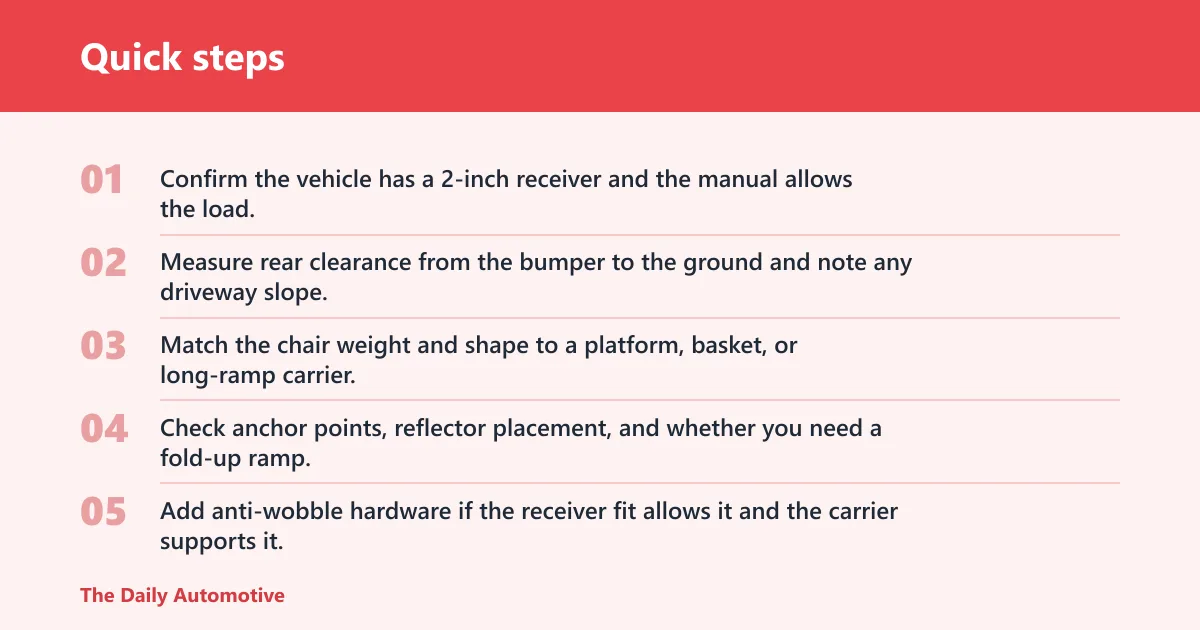
- Confirm the vehicle has a 2-inch receiver and the manual allows the load.
- Measure rear clearance from the bumper to the ground and note any driveway slope.
- Match the chair weight and shape to a platform, basket, or long-ramp carrier.
- Check anchor points, reflector placement, and whether you need a fold-up ramp.
- Add anti-wobble hardware if the receiver fit allows it and the carrier supports it.
Frequently asked questions
What is the best wheelchair rack for a car with a 2-inch hitch?
The best fit for a 2-inch hitch is a carrier that matches the vehicle manual, gives you a 500-pound-class load rating, and has enough ramp length for your chair. For a compact platform setup, the MaxxHaul 80779 is the clearest 2-inch receiver match in this group.
How much weight can a wheelchair carrier hold?
Many heavy-duty carriers sit around the 500-pound class, but the exact number depends on the model and the hitch. The MaxxHaul 80779 is listed at 500 pounds, and the vehicle rating still governs the real limit.
Do wheelchair carriers need a ramp, or can you lift the chair on?
You can lift a lighter manual chair onto some carriers, but a ramp is the safer choice when the chair is heavy or the rear opening sits low. A longer ramp also reduces strain and usually gives better control during solo loading.
Which wheelchair rack is easiest to fold up when not in use?
The Titan Ramps carrier is the easiest answer here because it can be folded flat and vertically against the vehicle’s rear. That makes it the clearest pick when you want less rear protrusion after loading.
What size hitch receiver do wheelchair carriers fit?
Most of the heavy-duty carriers in this group are aimed at 2-inch receivers. Always confirm the listing for your exact model, because a carrier’s fit, pin size, and stability hardware can vary even when the receiver size looks standard.
How do you stop a hitch carrier from wobbling or rattling?
Use a hitch tightener or anti-wobble device that is made for the same receiver size, then confirm the pin and clamp are seated properly. The AA Products Inc carrier is listed with a hitch tightener, and that kind of hardware helps reduce movement on rough roads.
Can a wheelchair carrier be used on an SUV, van, or RV?
Yes, but only if the vehicle manual allows the hitch load and the rear clearance works with the carrier’s length. SUVs and vans usually give more hatch room than smaller cars, while RVs need extra attention to departure angle and rear overhang.
Products related to this article
Sponsored / affiliate links. As an Amazon Associate I earn from qualifying purchases. I may earn additional commission from eligible campaigns.